


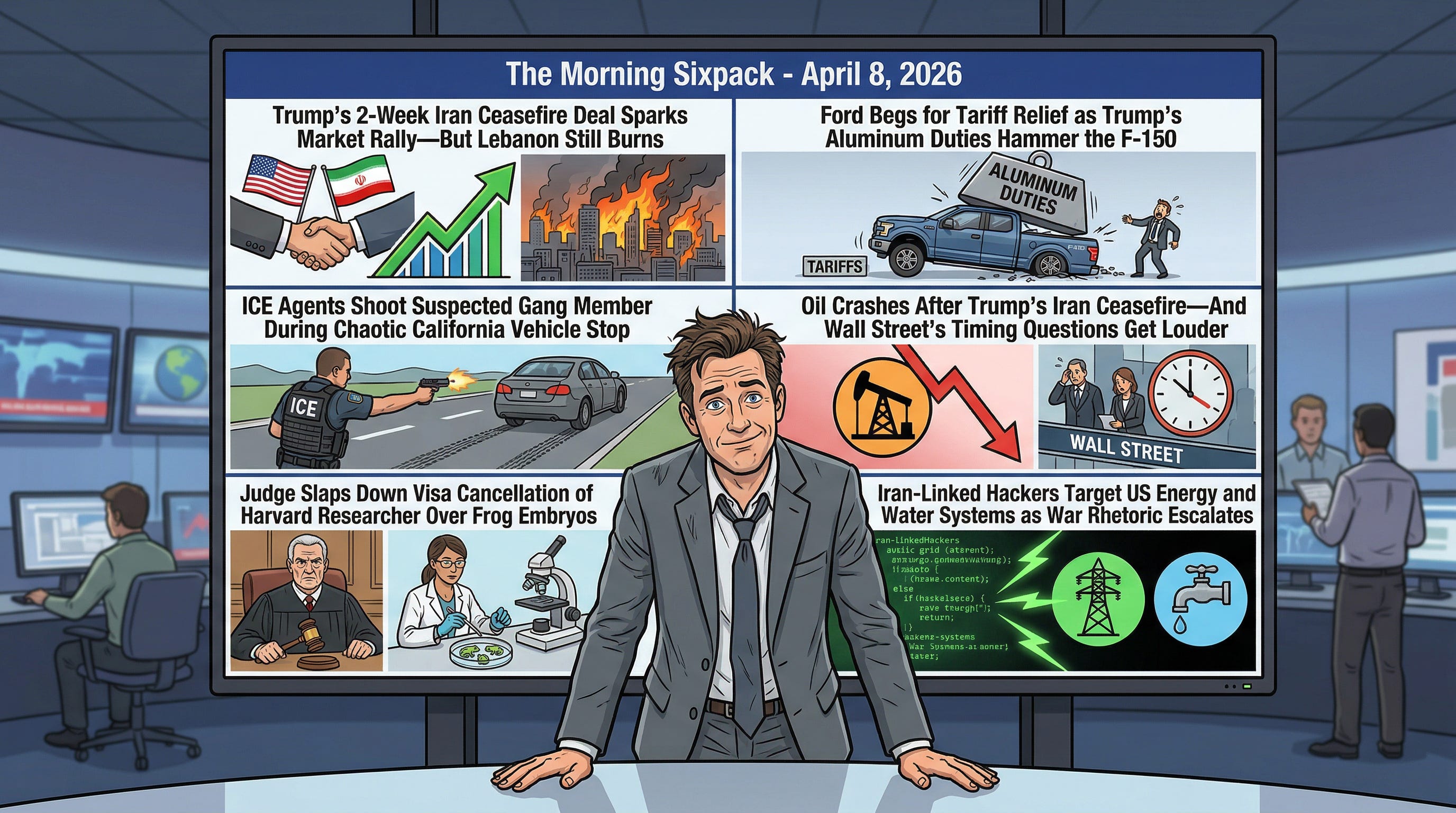
After warning that a “whole civilization will die tonight,” Trump instead declared it “a big day for World Peace!”
Trump’s 2-Week Iran Ceasefire Deal Sparks Market Rally—But Lebanon Still Burns
The U.S. and Iran agreed to a two-week ceasefire just hours before President Trump’s deadline, pausing bombing runs and reopening the Strait of Hormuz (maybe).
The deal, brokered through Pakistan, halts U.S. and Israeli strikes on Iran—for now. In exchange, Iran will allow safe passage through the Strait of Hormuz for $2 million per ship, the chokepoint that carries roughly 20% of the world’s oil. Markets didn’t wait for the fine print. Brent crude plunged more than 13% to $94.74. Stocks surged. Wall Street loves a timeout.
Trump called it a “double sided CEASEFIRE,” (WTF does that mean? Aren’t ALL ceasefires “double-sided?) writing,
“This will be a double sided CEASEFIRE! The reason for doing so is that we have already met and exceeded all Military objectives, and are very far along with a definitive Agreement concerning Longterm PEACE with Iran, and PEACE in the Middle East.”
He also said Iran proposed a “workable” 10-point plan that includes “points of past contention” now agreed to by both sides. Tehran, for its part, is hailing the truce as proof the “criminal U.S.” accepted the “general framework” of its proposal. Victory laps all around.
But here’s the wrinkle. Benjamin Netanyahu says the ceasefire does not apply to Hezbollah in Lebanon. Israeli strikes continued Wednesday. Hezbollah insists the truce covers Lebanon. Translation: the ink is barely dry and the arguments have already started. Meanwhile, displaced civilians in southern Lebanon were told to hold off on heading home because it’s still not safe.
Iran’s leadership is also making it clear this is a conditional breather. “Our hands are on the trigger,” its Supreme National Security Council warned, adding that any deviation will be met “with full force.” Two weeks isn’t peace. It’s a pressure valve.
And in a rare bit of good news, American journalist Shelly Kittleson was freed after being kidnapped in Iraq by Kataib Hezbollah. Secretary of State Marco Rubio said, “Under President Trump, the wrongful detention or kidnapping of U.S. nationals will not be tolerated.” One hostage home. One war on pause. Plenty still unresolved.
Source: NPR
Editor: Two weeks to solve uranium enrichment, sanctions, Hezbollah, and decades of mistrust. What could possibly go sideways?
ICE shoots a suspected gang member during a botched vehicle stop in California’s farm belt, and now the feds are investigating themselves—again.
ICE Agents Shoot Suspected Gang Member During Chaotic California Vehicle Stop
ICE agents shot a man during a vehicle stop in rural Northern California after claiming he tried to run them over.
Another day, another federal shooting—and more questions than answers.
The incident unfolded Tuesday in Patterson, about 80 miles east of San Jose, when agents attempted to arrest Carlos Ivan Mendoza Hernandez. ICE Director Todd Lyons said Hernandez is a member of the Los Angeles 18th Street gang and wanted for questioning in El Salvador in connection with a murder. No evidence of that allegation was provided, and details of the foreign investigation remain murky.
According to Lyons, Hernandez “weaponized his vehicle in an attempt to run an officer over,” prompting agents to “fire defensive shots to protect themselves, their fellow agents and the public.” It’s unclear how many shots were fired. Hernandez was hospitalized, and local authorities declined to comment on his condition.
Dashcam footage obtained by a Sacramento TV station shows a black sedan boxed in by two vehicles with flashing lights. As agents approach, the car reverses with a door open—colliding with the vehicle behind it—before lunging forward in the officers’ direction and swerving across a median into oncoming traffic. There’s no audio in the clip, so what was said—or shouted—is unknown.
The Stanislaus County sheriff’s office said no local deputies were involved. The FBI’s Sacramento office is investigating. Governor Gavin Newsom said he’s been briefed and expects federal authorities to coordinate with state and local law enforcement during the probe.
This shooting lands as ICE faces intense scrutiny under President Donald Trump’s expanded immigration crackdown. ICE arrests in California’s Central Valley surged 58% early last year after Trump returned to office. At least eight people have been shot by ICE agents so far in 2026. Patterson, a farming hub with a large Hispanic and Latino population, now finds itself in the middle of that debate.
Source: The Guardian
Editor: When your enforcement strategy keeps ending in gunfire, maybe it’s time to ask whether this is policy—or a pattern. And make no mistake: If two cars box you in and you’re not sure they’re REAL LAW ENFORCEMENT, maybe the best course of action is to RUN. They’ll try to kill you no matter what…
A federal judge just told Customs they can’t yank a Harvard scientist’s visa over frog embryos they didn’t like.
Judge Slaps Down Visa Cancellation of Harvard Researcher Over Frog Embryos
A federal judge ruled that U.S. customs officials improperly canceled a Harvard researcher’s visa over undeclared frog embryo samples.
Translation: you can’t just void a scientist’s visa because you didn’t like what was in her carry-on.
U.S. District Judge Christina Reiss said Customs and Border Protection overstepped when it revoked the visa of Kseniia Petrova, a Russian-born scientist working at Harvard University. The court found officers have limited authority to cancel visas—and suspected smuggling of biological samples isn’t one of them.
“The undisputed facts reveal that Ms. Petrova’s visa was impermissibly canceled because of the frog embryo samples and for no other reason,” Reiss wrote. In legal terms, the cancellation was “arbitrary and capricious.” In plain English: not how this works.
Petrova had stopped at a lab in France that specializes in slicing superfine sections of frog embryos and brought samples back for research. She was questioned at Boston Logan International Airport last February and told after an interrogation that her visa was canceled. She later said she didn’t realize the samples needed to be declared and wasn’t trying to sneak anything into the country.
She was briefly detained in Vermont before being transferred to a U.S. Immigration and Customs Enforcement facility in Louisiana. After a successful court petition, she returned to her Harvard lab in January. Her attorney called Tuesday’s ruling an important step toward “correcting what should never have happened in the first place.”
The Department of Homeland Security hasn’t commented. But the case is rippling through the scientific community, where concerns are growing that aggressive enforcement tactics could scare off foreign researchers the U.S. relies on.
Source: AP News
Editor: If frog embryos are now a national security threat, somebody better alert every high school biology lab in America.
Ford’s best-selling truck is getting crushed by Trump’s aluminum tariffs and the White House isn’t offering any relief.
Ford Begs for Tariff Relief as Trump’s Aluminum Duties Hammer the F-150
Ford is asking the Trump administration for relief from aluminum tariffs after plant fires disrupted supply for its top-selling F-150 pickup.
The company that builds America’s favorite truck is now paying a premium for metal it can’t easily get—and Washington isn’t blinking.
Two fires last fall knocked out the Novelis aluminum rolling plant in Oswego, New York, the largest U.S. supplier of aluminum sheet for automakers. The facility—owned by a unit of India’s Hindalco—won’t be fully back online until at least June. That’s a problem for Ford Motor Co., which relies on the plant for the aluminum exterior of its F-150, the longtime best-selling vehicle in the country.
To fill the gap, Novelis has been shipping aluminum from Europe and South Korea. But under President Donald Trump’s tariff regime, that imported metal gets hit with a 50% duty. Those costs are passed straight to automakers. Ford said earlier this year it had already absorbed a $2 billion hit from the fires and expects to spend another $1 billion on imported aluminum.
Ford has quietly petitioned the administration for temporary relief from the duties until the New York plant returns to full production. So far, officials haven’t budged. The White House says automakers already received some relief from other national security tariffs and hasn’t indicated it plans to carve out a special break here.
Here’s the kicker: even domestically produced aluminum now carries a delivery premium that reflects the tariff. Buyers are paying roughly $2,500 per metric ton in added costs. As one analyst put it, “Even if this fire had never happened, they’d still be paying the delivery premium, which includes the tariff.” In other words, the pain isn’t just about one plant—it’s baked into the system.
The result? Higher input costs for Detroit at a time when the administration says tariffs are strengthening American industry. The F-150 may be built in the U.S., but the price of the metal wrapped around it is increasingly global—and increasingly expensive.
Source: The Wall Street Journal
Editor: Protectionism works great—right up until it protects you from your own supply chain. It also shows a) Trump doesn’t give a rat’s ass about domestic manufacturers, despite claims he does, and b) Trump’s economic degree was a waste of paper.
Who knew and did they trade on this info? You just KNOW somebody cashed in on this wild oil price swing.
Oil Crashes After Trump’s Iran Ceasefire—And Wall Street’s Timing Questions Get Louder
Oil prices collapsed Wednesday after President Trump agreed to a two-week ceasefire with Iran tied to reopening the Strait of Hormuz.
When crude swings nearly 20% in a morning, somebody always knows something.
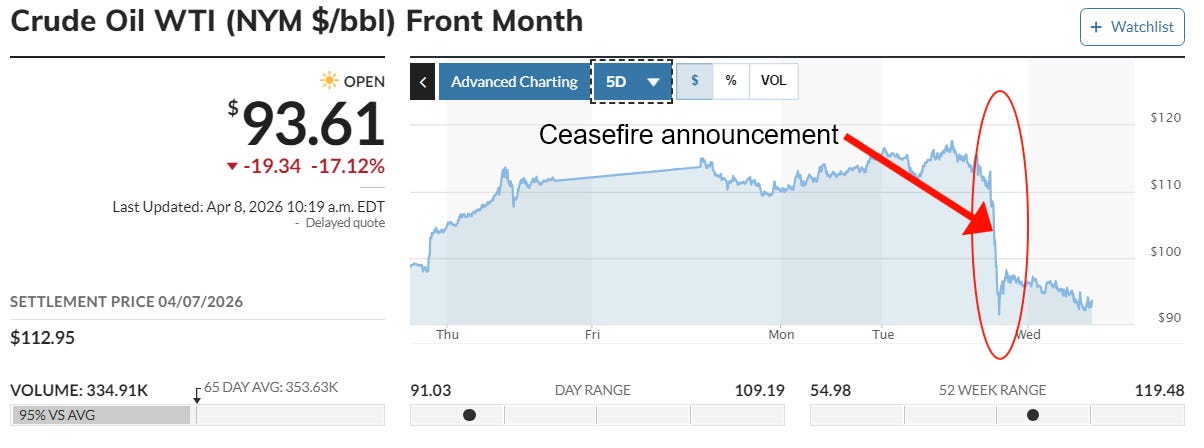
U.S. West Texas Intermediate fell about 18% to $92.50 a barrel. Brent dropped more than 16% to $91.25. If WTI settles down more than 14.52%, it would mark its worst day since April 27, 2020. That’s pandemic-level volatility—triggered not by a virus, but by a social media post.
Trump said the ceasefire hinges on Iran immediately reopening the Strait, the chokepoint that normally carries about 20% of global oil supply. “Almost all of the various points of past contention have been agreed to between the United States and Iran,” he wrote. Iranian Foreign Minister Seyed Abbas Araghchi responded that safe passage would resume during the ceasefire “via coordination with Iran’s Armed Forces.” For a fee, of course. Iran will be getting $2 million for every ship they let through the Strait of Hormuz.
Less than 48 hours earlier, Trump warned that “a whole civilization will die tonight.”
That kind of rhetoric whiplash is catnip for energy traders.
Let’s talk about the elephant in the trading pit. When oil spikes on war threats and then collapses on a sudden diplomatic pivot, the question isn’t whether hedge funds made money. Of course they did. The question is whether anyone with advance knowledge positioned themselves before Trump’s deadline theatrics and ceasefire announcement.
This isn’t the first time timing around Trump’s Iran moves has raised eyebrows. During previous escalations, there were similar suspicions about well-timed trades in oil futures and defense stocks ahead of major announcements. Nothing has resulted in proven wrongdoing tied directly to Trump’s inner circle—but the pattern of dramatic, market-moving declarations followed by reversals creates fertile ground for scrutiny.
Trump’s SEC won’t be doing any serious investigations of trading by Trump regime officials, that’s for damned sure.
Energy markets are thin and highly leveraged. A trader with credible insight that a threatened bombing campaign would be paused—even hours early—could short crude near the highs and cover into a double-digit plunge. On a move like this, that’s generational money. Potentially, trillions.
Now, to be clear: volatility alone is not proof of insider trading. Markets react fast to headlines, and algorithmic trading systems scan presidential posts in milliseconds. But regulators typically examine trading patterns around events like this—looking for abnormal positions, unusual options activity, or accounts that consistently anticipate geopolitical pivots.
The broader issue is structural. When war policy is announced via countdown clocks and social media ultimatums, markets don’t just react—they speculate on access. Who knew about the talks with Pakistan’s prime minister? When did the ceasefire framework solidify? Who was in the room?
If history is any guide, the SEC and CFTC will quietly review trade data. Whether anything comes of it is another matter. Proving insider trading tied to geopolitical decisions is notoriously difficult. You need a clear chain: material nonpublic information, a breach of duty, and trades placed because of that knowledge.
But here’s what’s undeniable: oil exporters were bleeding. Tankers were stalled. Fuel prices were ripping higher. Then—hours before a bombing deadline—everything reversed. Crude posted one of its biggest one-day drops in years.
Markets can handle bad news. What they struggle with is policy by cliffhanger.
Source: CNBC
Editor: When foreign policy starts looking like a day-trading strategy, maybe it’s time to check who’s holding the contracts.
Iran-Linked Hackers Target US Energy and Water Systems as War Rhetoric Escalates
U.S. officials warn that Iran-linked hackers are sabotaging American energy and water infrastructure in retaliation for escalating military threats.
While bombs are debated overseas, keyboards are already crossing the line at home.
According to a new report from WIRED, U.S. agencies say Iranian-linked hackers have launched disruptive cyberattacks on industrial control systems tied to energy and water utilities. The digital intrusions have had “disruptive and costly effects,” hitting the kinds of behind-the-scenes systems that keep electricity flowing and water treated.
The attacks come as President Donald Trump has publicly threatened wholesale destruction of Iranian infrastructure amid the widening conflict. Tehran appears to be responding asymmetrically—not with missiles, but with malware. Industrial control systems—the operational technology that runs pumps, turbines, and treatment facilities—are notoriously fragile and often lag behind corporate IT networks in cybersecurity protections.
This isn’t theoretical cyber snooping. The campaign is described as sabotage. That means tampering with real-world machinery. Energy grids. Water plants. The stuff that affects hospitals, refineries, and homes. One security professional quoted in the piece admitted the hackers are “really quite proficient.” That’s not exactly comforting.
The broader warning from U.S. agencies is clear: geopolitical escalation doesn’t stay overseas anymore. Cyberwar is reciprocal and deniable. And critical infrastructure is a tempting target precisely because it creates fear without the spectacle of traditional warfare.
For years, Washington has warned that adversaries like Iran, Russia, and China have prepositioned access inside U.S. infrastructure. What’s different now is the timing. The digital retaliation appears to be unfolding in lockstep with public threats about bombing campaigns and “civilization” countdowns.
When leaders talk about destroying infrastructure abroad, they shouldn’t be surprised when someone tries to flip a switch here.
Source: WIRED
Editor: You can rebuild a bridge. Rebooting a water grid after a cyberattack? That’s trickier. Maybe cool the rhetoric before someone turns off the lights.