

The Morning Sixpack stays free because the news that shapes your life should not be hidden behind a paywall. Paid subscribers are not paying for access. They are helping fund the research, writing, and independent voice that goes into every issue. Become a paid subscriber and help keep smart, honest news analysis free for everyone.
Trump blamed Biden for inflation, then acknowledged his Iran strikes sent gas prices soaring—a tidy bit of accountability by detour.
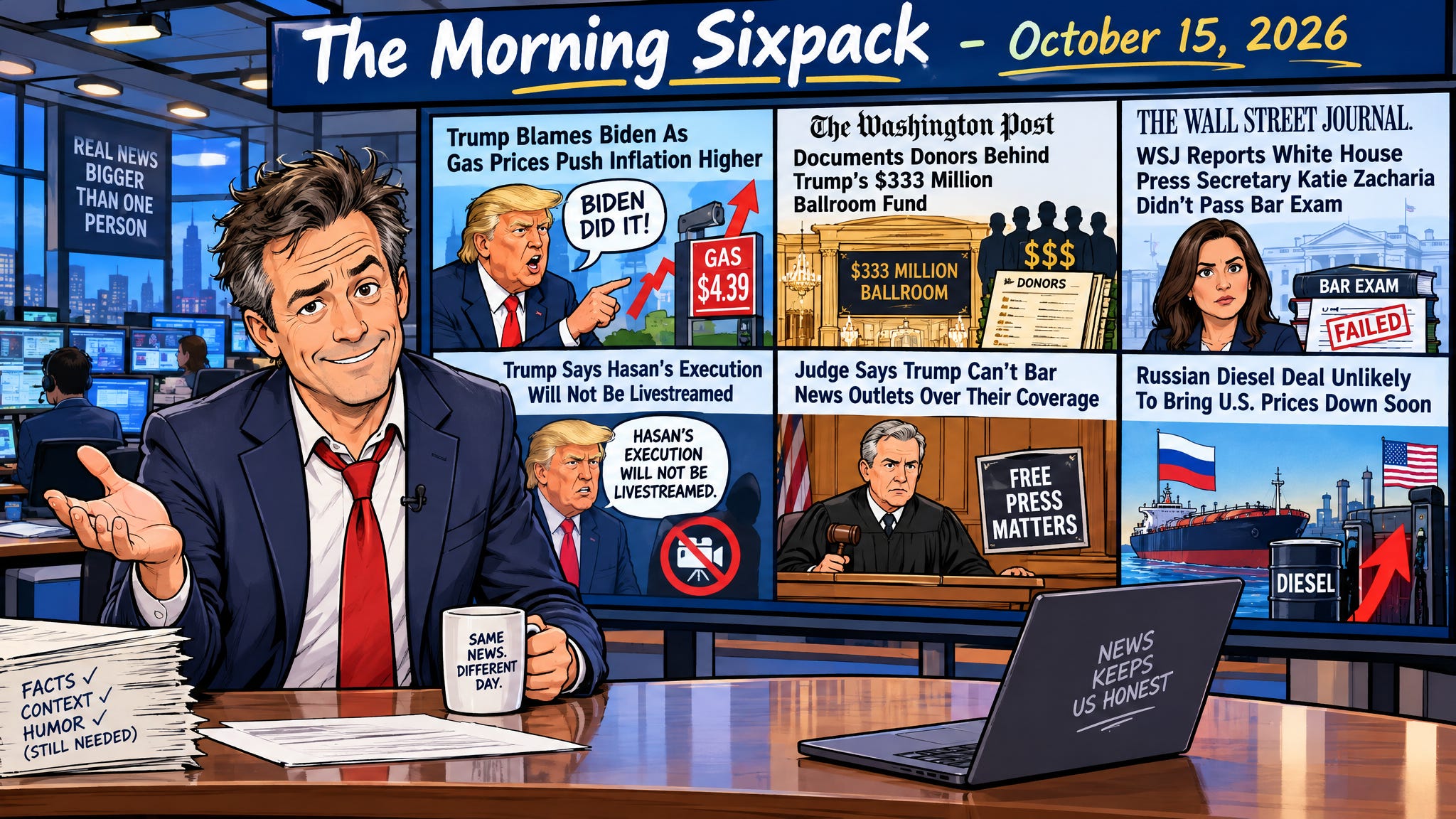
Trump Blames Biden As Gas Prices Push Inflation Higher
President Donald Trump blamed former President Joe Biden for high prices at a Wednesday rally in Bullhead City, Arizona, hours after new government data showed inflation rising again. “I said, ‘Yeah, that was caused by Biden, who gave us the highest inflation in history,’” Trump said, describing how he responds when asked about affordability. He also insisted that prices are coming down. The rally was held for Rep. Andy Biggs, the Republican nominee for Arizona governor.
The September Consumer Price Index rose 3.7% from a year earlier and 0.6% from August, the largest monthly increase since April, according to the Labor Department. Gasoline prices climbed 9.1% in September, accounting for more than half of the monthly increase. Gas now averages more than $1 per gallon above its price a year ago, with the article attributing the surge to the Iran war.
Affordability has become a defining issue in this year’s elections. A Pew Research Center survey conducted Sept. 28 through Oct. 4 found that 84% of registered voters ranked the economy as a top voting issue, including 82% of voters supporting Republicans.
Trump acknowledged that launching strikes on Iran contributed to rising gasoline prices. “I hated to do it, and I knew gasoline would go high, but I had no idea,” he said, adding that he thought prices would go “much higher.” He also pointed to the stock market reaching an all-time high and said elevated oil prices were bringing money to states including Texas, Oklahoma, and North Dakota.
Trump has repeatedly promised that gas prices will fall once the war ends, saying they would drop below where they were before it began. The article offers no timeline for when the war might end or when drivers might see that relief. For now, the latest inflation figures show gasoline pushing prices upward.
Editor: Biden may be Trump’s favorite inflation scapegoat, but the president did name the Iran war as a reason gas prices are up.
Source: Washington Sun
Trump’s ballroom has attracted $333 million in donations, much of it from people and companies with business before the government—and some donors wanted their names kept off the guest list.
Washington Post Documents Donors Behind Trump’s $333 Million Ballroom Fund
An internal donor spreadsheet obtained by The Washington Post shows that private donors had committed $333 million to President Donald Trump’s White House ballroom project by late September. The records list 67 donations above $10,000, including contributions from companies and wealthy individuals with interests before the federal government. At least $77 million came from donors who requested anonymity, according to additional fundraising records. The Post’s reporting does not establish that donations led to favorable government actions.
The fundraising arrangement operates outside ordinary political campaign disclosure rules. Donations pass through the nonprofit Trust for the National Mall and then to the government, into a White House account the president directly controls. An agreement requires the Trust to keep donors anonymous to the extent permitted by law unless White House staff authorize public recognition. Experts and scholars have raised concerns about the arrangement’s potential for influence buying or coerced giving.
Nvidia, Apple, the Adelson family, and Dish Network co-founder Charles Ergen each committed $25 million, the largest listed contributions. More than three-quarters of the funds came in commitments of at least $5 million, with major donors also including Amazon, Caterpillar, Comcast, Microsoft, and T-Mobile. The records show Nvidia asked for its $25 million contribution to remain anonymous; the company said its support was independent of its business interests.
The documents also detail donations by people and companies whose business intersected with federal decisions. Ergen committed $25 million while his company EchoStar faced an FCC investigation; the agency later dropped the investigation, and federal agencies approved a sale of company licenses. A Rocket subsidiary committed $10 million three weeks after the Federal Housing Finance Agency approved Rocket’s acquisition of Mr. Cooper. The Post reported these timelines but did not establish that the donations were connected to the government actions.
Other disclosed examples include $5 million pledged by Small Business Administration head Kelly Loeffler and her husband, and donations from Salesforce and ServiceNow as their federal contracting businesses grew. Isabela Herrera committed $2.5 million to the ballroom after her father, who had faced bribery charges, received a pardon from Trump. The project has raised less than Trump’s stated $400 million goal, while its projected cost reached $600 million; records show taxpayer funds covered some construction costs. Three people or organizations publicly named by the White House as donors do not appear on the spreadsheet.
Editor: The ballroom is being sold as a gift to the public, with a donor list that reads like a directory of people who may need something from the government.
Source: The Washington Post
The White House press secretary has called herself a lawyer, but the WSJ reports she didn’t pass the California bar—legal fine print has entered the briefing room.
WSJ Reports White House Press Secretary Katie Zacharia Didn’t Pass Bar Exam
White House press secretary Katie Zacharia sat for the California bar exam after graduating from Pepperdine University law school in 2011, but did not pass, according to a person familiar with the matter cited by The Wall Street Journal. President Trump introduced her as an attorney when he announced her appointment. Zacharia later moved to Beijing and worked in the international practice of a Chinese law firm.
Zacharia’s credentials drew scrutiny after her name did not appear in attorney license searches for California, Texas, or Washington, D.C. Asked Tuesday where she had passed the bar, she replied, “When I moved to China,” without elaborating. In a statement, she said she had practiced international transaction law “with all the appropriate credentials.” A White House official said she was not hired to handle legal matters.
A person familiar with her work at Zhong Lun Law Firm said Zacharia helped draft multimillion-dollar cross-border agreements and communicated with American and multinational clients. The firm’s international associates did not need to be licensed in China, the person said, because local partners handled legal opinions. The source also said a U.S. bar qualification was not relevant to that work.
The Journal notes that “lawyer” and “attorney” are commonly used interchangeably in the United States, though rules on who may use those titles vary by jurisdiction. Zacharia passed the Multistate Professional Responsibility Examination, an ethics test, before taking the California bar, according to the person familiar with her exam history. California’s bar exam is considered difficult: about 55% passed in July 2025, compared with roughly 31% in February 2026.
Zacharia has repeatedly described herself as a lawyer in public appearances, including on Fox News, where she discussed a criminal trial and was identified onscreen as an attorney. Her LinkedIn profile also lists her as general counsel for Fix California, a nonprofit founded by Trump administration official Richard Grenell. A person familiar with her work there said she directed and served as the contact for the organization’s outside lawyers.
Editor: The distinction between legal training and a license can get technical fast. Calling yourself a lawyer on TV makes the question a lot less theoretical.
Source: The Wall Street Journal
Trump says Nidal Hasan’s scheduled firing-squad execution won’t be livestreamed, after a poll found 80% of Americans opposed turning it into a broadcast.
Trump Says Hasan’s Execution Will Not Be Livestreamed
President Donald Trump said Thursday that the scheduled execution of Nidal Hasan, convicted in the 2009 Fort Hood shooting, will not be streamed online. Hasan is set to be executed by firing squad at 1 p.m. local time on Dec. 3 at Fort Hood in Killeen, Texas. Trump said the execution may be viewed in person by immediate family members of the victims.
The announcement followed widespread public opposition to broadcasting the execution. A Washington Post-ABC News-Ipsos poll released Thursday found that 80% of Americans opposed livestreaming it, while 18% supported the idea. The survey included 2,545 U.S. adults and had a margin of error of two percentage points.
Trump wrote that a livestream might have served as a deterrent by showing how the United States deals with terrorists, but said many people did not want to watch Hasan die. Defense Secretary Pete Hegseth had said the execution would be public so people could see the consequences of such attacks. The Pentagon later said it would be livestreamed.
Hasan, a former Army major, was convicted and sentenced to death by court-martial in 2013 for killing 13 people and injuring 32 at Fort Hood in November 2009. He would be the first person executed following a U.S. armed forces court-martial since 1961, when Army Pvt. John Bennett was hanged at Fort Leavenworth. Before Trump’s announcement, it was unclear which major streaming platforms, if any, would have carried the execution.
The Verge reported that YouTube, Twitch, Meta, and X did not respond when asked whether they would allow the footage, while TikTok pointed to its policy barring shocking and graphic content. Trump described Hasan in his post as a “very bad and evil man.” The Pentagon had not commented on Trump’s decision at the time of CNBC’s report.
Editor: Even a planned public execution has an audience question—and apparently most Americans would rather justice not come with play/pause buttons.
Source: CNBC
A judge says the White House can’t punish news outlets for coverage it dislikes, and the Justice Department is appealing.
Judge Says Trump Can’t Bar News Outlets Over Their Coverage
A federal judge ruled that President Trump cannot block CNN, MS NOW, and Politico from covering the White House because he dislikes their reporting, at least while the case proceeds to trial. U.S. District Judge Timothy J. Kelly found that the administration violated the outlets’ free-speech and due-process rights when it revoked credentials for more than 70 journalists. The outlets sued after reporters were denied access last month. The Justice Department said Wednesday it would appeal.
Kelly concluded that Trump’s own public statements suggested the credential ban was intended to pressure news organizations into more favorable coverage. In his opinion, he wrote that the president’s comments supported the view that the ban could deter journalists from reporting as they had before. The judge also said it restricted the outlets’ ability to observe White House activity firsthand and compete with organizations that retained access.
The administration had argued that national security and concerns about accuracy justified its actions. Kelly said the Justice Department raised national security only after the ban and did not provide the outlets fair warning or a meaningful chance to appeal beforehand. He wrote that the court’s decision did not mean concerns about accuracy or classified disclosures were unfounded, but found the government’s case inadequate to justify the restrictions.
The ruling follows an earlier temporary order requiring the administration to restore the journalists’ access, which NPR reported was observed unevenly. The decision does not address CNN’s complaints that it has still been blocked at times from smaller settings, including Air Force One, where a rotating pool of networks shares coverage duties. CNN said the restrictions have prevented it from serving as the designated video-pool representative.
The White House said it would appeal, calling the decision misguided and arguing that the outlets could report from outside the grounds. The dispute is part of a broader clash between the administration and news organizations, including the Pentagon’s new reporting restrictions and investigations into major television networks. Kelly, a Trump appointee, had also ruled against the administration in the first Trump term in a dispute over CNN reporter Jim Acosta’s access.
Editor: The court’s message is straightforward: a press pass can’t become a performance review where the president docks points for coverage he doesn’t like.
Source: NPR
Trump’s promised Russian diesel is a thin trickle beside the supply lost from the Middle East—so don’t expect a quick price break at the pump.
Russian Diesel Deal Unlikely To Bring U.S. Prices Down Soon
A deal announced by President Trump to increase Russian diesel exports is unlikely to significantly ease high U.S. prices anytime soon. Diesel prices are hovering near record levels and have climbed about 77% this year, as supplies from Russia and the Middle East have fallen. Energy analysts say Russia’s promised shipments are small compared with the fuel the market has lost.
Russia’s proposed October exports are far below what it shipped last year. From July through September 2025, Russia exported about 693,000 barrels of diesel per day, according to S&P Global Energy. In the same period this year, exports averaged about 140,000 barrels daily. Trump and Russian Deputy Prime Minister Alexander Novak say Russia will export 300,000 metric tons in October, equivalent to roughly 75,000 barrels a day spread across the month.
The promised volume is also small compared with the shortfall from the Middle East since the United States and Israel began attacking Iran on Feb. 28. Saudi Arabia and other countries in the region exported 809,000 fewer barrels of diesel per day from July through September than during the same months in 2025, according to S&P Global data. Analysts also say it is unclear whether Russia can deliver all the fuel it has promised.
“The main issue is still the Strait of Hormuz, that there is not enough diesel coming out of the Strait of Hormuz,” said Sarah Raffoul, an oil-products analyst at Argus. The waterway between Iran and Oman had carried a significant share of the world’s fuel shipments. The reduced flow through the strait remains a central constraint on diesel supply.
Even if Russia follows through, its planned shipments would be only a small offset to the Middle Eastern supply loss. The article says the shortage from those two sources is the main reason diesel prices have surged this year. For now, the Russian deal offers little reason to expect a rapid drop.
Editor: A promised 75,000 barrels a day doesn’t do much to fill an 809,000-barrel hole. The math is not exactly on the president’s side.
Source: The New York Times
The Morning Sixpack Archives: