


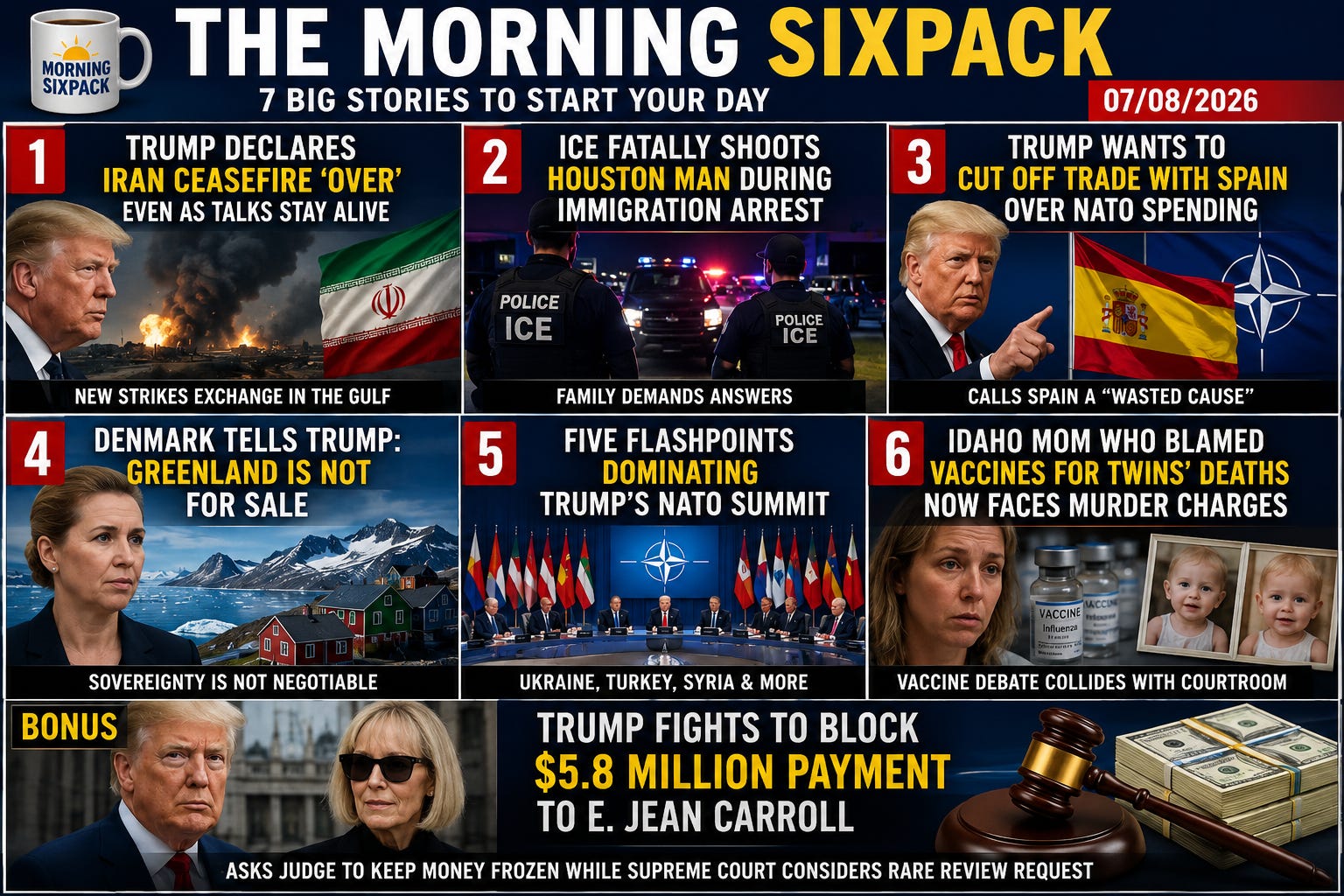
Trump just declared the Iran ceasefire “over” even as U.S. negotiators are still being told to keep talking—a contradiction only Washington could deliver with a straight face.
Trump Declares Iran Ceasefire ‘Over’ Even as Talks Stay Alive
President Donald Trump says the ceasefire with Iran is finished after the U.S. and Iran exchanged new military strikes in the Gulf, raising fresh doubts about whether last month’s agreement can survive.
Trump didn’t just question the truce—he blasted Iran’s leadership as “scum” and “sick people,” while still leaving the door cracked open for diplomacy.
Speaking at the NATO summit in Ankara, Trump insisted, “I think it’s over. I don’t want to deal with them any more, they’re scum.” He added, “They’re scum, they’re sick people, they’re led by sick people, and they’re vicious, violent people. And if they had a nuclear weapon, they’d use it.”
The comments followed a rapid military escalation. U.S. Central Command said it struck more than 80 targets after Iranian attacks on commercial ships in the Strait of Hormuz. Iran’s Islamic Revolutionary Guard Corps responded by claiming strikes on 85 U.S. military sites in Bahrain and Kuwait. The fighting threatens the memorandum of understanding that extended the April ceasefire just weeks ago.
Despite declaring the ceasefire finished, Trump also said American negotiators could continue meeting with Iranian officials. Regional governments, including the Gulf Cooperation Council, are urging both sides back to the table, warning that another full-scale conflict would further destabilize an already volatile region.
Source: Al Jazeera
Editor: Calling a ceasefire “over” while keeping negotiators on the payroll is a bit like announcing the divorce before you’ve canceled the marriage counseling. The next few days will reveal whether this is negotiating leverage—or the beginning of another dangerous spiral. Why have they not called the hotline? LOL.
ICE says the shooting was self-defense. The victim’s family and witnesses want the video—and the investigation—to tell the full story.
ICE Fatally Shoots Houston Man During Immigration Arrest
A Mexican immigrant was fatally shot by an ICE officer during an attempted arrest in Houston after agents say he used his vehicle to threaten officers, while witnesses and the man’s family are demanding a transparent investigation.
The facts are still being sorted out, but this case is already becoming another flashpoint in the national fight over immigration enforcement.
Immigration and Customs Enforcement identified the man as Lorenzo Salgado Araujo, saying he was in the country illegally and refused to comply during a traffic stop. According to ICE, Salgado Araujo rammed a federal vehicle and attempted to run over an officer, prompting the officer to open fire in self-defense. He later died at a Houston hospital.
Family members and immigrant advocacy groups are challenging ICE’s version of events.
His son, Ronaldo Salgado, said, “My father has been in this country for nearly 35 years, working in construction to provide for myself, my two brothers, and my mother. ... My father did not deserve this.”
Witnesses reported hearing the wounded man cry out in Spanish, “They’re killing me!” as he lay on the ground.
The Department of Homeland Security’s Office of Inspector General and the FBI are investigating the shooting. Local elected officials, including Rep. Sylvia Garcia, are calling for all body camera footage and other evidence to be preserved and reviewed. The shooting has reignited debate over ICE enforcement tactics in Houston, where protests and vigils formed within hours of the incident.
Source: The Washington Post
Editor: Every high-profile use of deadly force comes down to the same thing: Evidence beats press releases. Until investigators sort out exactly what happened, everyone is arguing over two very different versions of the same morning.
Trump didn’t just blast Spain over NATO spending—he floated cutting off trade entirely, turning a defense dispute into an economic one.
Trump Wants to Cut Off Trade with Spain Over NATO Spending
President Donald Trump escalated his feud with Spain at the NATO summit by calling the country a “wasted cause” and urging an end to all trade over its defense spending.
The dispute is no longer just about NATO budgets—Trump is now threatening economic consequences for an ally he says isn’t pulling its weight.
Speaking alongside NATO Secretary-General Mark Rutte in Ankara, Trump unloaded on Spain, saying, “Spain is a wasted cause. We don’t want to do any trade business with Spain anymore. Spain is a terrible partner in NATO. They don’t participate. They don’t pay. I don’t want anything to do with Spain. Cut off all trade with Spain, please, including visits.”
The latest clash stems from Spain’s refusal to commit to NATO’s goal of spending 5% of GDP on defense by 2035. Rutte noted that Spain had increased defense spending to 2.1% of GDP in 2025, up from 1.4% in 2021, and credited Trump with pushing allies to spend more. Even so, Trump made clear he believes Spain is still falling well short of its obligations.
Trump has long argued that NATO members rely too heavily on American taxpayers for their security. His latest comments suggest he’s willing to use trade as leverage against allies he believes aren’t paying their fair share.
Source: UPI
Editor: Nothing says “alliance meeting” quite like threatening to stop doing business with one of your allies. Whether it’s negotiating strategy or policy, the message was unmistakable: Pay more—or expect pressure from Washington.
What Trump doesn’t understand is NOBODY is paying NATO. Member countries have made a commitment to spend a certain percentage of their own GDP on defense. From 2014 to 2025, that commitment was 2 percent. In 2025, members agreed to up it to 5 percent. Spain is spending 2.1 percent. So, yes, they are falling short of their commitment. BUT they aren’t “taking money from US taxpayers.” That’s ludicrous.
The US only spends 3.17 percent of its GDP on defense, so it’s falling short of its commitment, too. This is news you won’t hear or read about except right here on The Morning Sixpack.1
Denmark isn’t budging on Greenland, no matter how many times President Trump brings it up.
Denmark Tells Trump: Greenland Is Not for Sale
Danish Prime Minister Mette Frederiksen says Denmark will not compromise on Greenland’s sovereignty despite President Donald Trump’s continued interest in the Arctic territory.
Frederiksen made it clear that cooperation with Washington is welcome—but ownership of Greenland is not up for negotiation.
Speaking during the NATO summit, Frederiksen said she had not spoken directly with Trump but wasn’t surprised by his latest comments. “From the beginning, when this started, I said that he is serious, the Americans are serious, and so are we.”
She added, “Greenland has clearly said that they do not want to be part of the United States. We have sovereignty as a kingdom. We will not compromise on that. We want to work with the Americans on security and defense.”
Frederiksen said Denmark, Greenland, and the United States will continue working together on Arctic security through an existing joint working group. She also noted that NATO has increased its focus on the Arctic, an effort backed by Secretary-General Mark Rutte, as strategic competition in the region continues to grow.
The Danish leader emphasized that media headlines won’t change Copenhagen’s position. While Denmark remains committed to defense cooperation with the United States, she said Greenland’s future belongs to the Kingdom of Denmark and, most importantly, to the people of Greenland.
Source: DR News
Editor: Geography hasn’t changed, and neither has Denmark’s answer. The Arctic may be growing in strategic importance, but Copenhagen keeps sending the same message: Partnership is on the table, ownership isn’t.
NATO’s annual summit is serving up plenty of drama—and Trump is making sure nearly every major issue runs through Washington.
Five Flashpoints Dominating Trump’s NATO Summit
From Ukraine to Greenland, President Donald Trump arrived at NATO’s summit with allies facing major decisions on defense spending, military commitments and global security.
The biggest question hanging over the alliance isn’t whether NATO will change—it’s how much of that change will be driven by Trump.
At the top of the agenda is Trump’s push for NATO members to spend more on defense. While every member has now reached the alliance’s longtime 2% spending target, Trump continues pressing countries to reach 5% of GDP (Editor: The US isn’t spending 5 percent of GDP on defense). NATO leaders have agreed to boost overall security-related investments, but several countries remain well below Trump’s preferred level. Trump also reignited tensions by criticizing allies such as Spain and warning Denmark over Greenland.
Another major issue is Ukraine, where President Volodymyr Zelensky is seeking additional Patriot missile systems after another wave of Russian attacks. Trump is expected to meet with Zelensky while continuing to insist he believes a negotiated settlement with Russian President Vladimir Putin remains possible (Editor: Remember during the 2024 campaign Trump promised he’d negotiate a settlement “on Day One.” LOL).
Meanwhile, Congress is pushing back against Trump’s openness to restoring Turkey’s access to the F-35 fighter jet program, citing Ankara’s continued ties to Russia. The summit is also expected to address Syria, with the Trump administration reviewing remaining sanctions as Damascus seeks closer ties with the West.
For NATO leaders, the gathering isn’t just about budgets and weapons. It’s also a test of alliance unity as members weigh how to respond to Russian aggression, growing instability in the Middle East, and Trump’s willingness to use America’s military and economic leverage to reshape relationships with longtime allies.
Source: The Hill
Editor: NATO summits used to end with carefully worded communiqués and polite photo ops. Now they come with debates over fighter jets, troop deployments, trade threats, and who’s paying the bill. Quiet diplomacy doesn’t generate many headlines these days.
A grieving mother’s vaccine claims are colliding with murder charges—and now the courtroom will become the battleground.
Idaho Mom Who Blamed Vaccines for Twins’ Deaths Now Faces Murder Charges
An Idaho mother who publicly blamed routine childhood vaccines for the deaths of her 18-month-old twins has now been indicted on two counts of first-degree murder, setting up a legal fight over what caused the children to die.
Prosecutors say she deliberately suffocated her twins. Her defense says she’s innocent—and argues the vaccines they received days earlier will be central to the case.
Andrea Shaw was indicted by a Payette County grand jury on charges that she acted “willfully, unlawfully, deliberately, with premeditation and with malice aforethought” in the deaths of her daughter, Dallas, and son, Tyson. Days after the children died in 2025, Shaw appeared on an online program produced by Children’s Health Defense, the organization founded by Health and Human Services Secretary Robert F. Kennedy Jr., saying, “I wish I was anti-vaccine now.” Her attorney says she “absolutely and unconditionally denies having anything to do with the death of her children.”
The defense has been in contact with Children’s Health Defense about potential expert witnesses as prosecutors prepare their case. Public health officials continue to maintain that routine childhood vaccines are safe, effective, and subject to extensive monitoring, while Children’s Health Defense insists vaccines can cause serious injury or death. A judge will ultimately decide what expert testimony can be presented to a jury.
Shaw remains jailed on a $2 million bond while awaiting trial. The case is expected to draw national attention as it combines a high-profile homicide prosecution with one of the country’s most politically charged public health debates.
Source: The Washington Post
Editor: Courtrooms deal in evidence, not internet debates. Whatever people believe about vaccines, the prosecution will have to prove a homicide—and the defense will have to convince a jury the facts point somewhere else.
BONUS
Trump isn’t saying he won—he’s arguing it’s too soon to pay while one last Hail Mary is still pending at the Supreme Court.
Trump Fights to Block $5.8 Million Payment to E. Jean Carroll
President Donald Trump’s attorneys are asking a federal judge to keep nearly $5.8 million out of E. Jean Carroll’s hands while the Supreme Court considers a last-ditch request to revisit his appeal.
The legal battle has shifted from whether Trump lost the case to whether Carroll can collect the money before every possible appeal is exhausted.
Trump’s lawyers argue that the funds deposited with the court after the 2023 civil verdict should remain frozen until the Supreme Court rules on a petition asking it to reconsider its decision not to hear his appeal.
“Collection cannot begin while proceedings remain pending before the Supreme Court,” Trump’s attorneys wrote.
Carroll’s legal team disagrees, arguing the high court already rejected Trump’s appeal and that “it is time for him to pay Carroll.”
The dispute centers on nearly $5.8 million, including interest, tied to the 2023 jury verdict that found Trump liable for sexually abusing and defaming Carroll. Trump’s attorneys also argue the money should remain in escrow because Carroll has publicly said she intends to donate any funds she receives, making repayment difficult if the verdict were somehow overturned later.
The Supreme Court rarely grants rehearing requests after declining to hear an appeal, making Trump’s latest filing a long shot. Editor: But we know at least 4 SCOTUS Justices are in Trump’s back pocket. The trial judge will now decide whether the money stays in court while that process plays out or is released to Carroll.
Source: CNBC
Editor: Appeals are part of the legal process, but so are final judgments. The question now isn’t who won the case—it’s whether one more procedural move is enough to keep the check from being cashed.
Using NATO’s own accounting method for defense spending, the United States currently spends about 3.2% of its GDP on defense.
For context:
NATO benchmarkU.S.Old NATO target (2014–2025): 2%✅ Exceeds it (3.2%)New core defense target (by 2035): 3.5%Slightly below it (3.17%)New total defense + security target (by 2035): 5% (3.5% core + 1.5% related spending)Below that overall target (NATO)
It’s also worth distinguishing two different conversations that often get mixed together:
Defense spending as a percentage of GDP (the NATO benchmark)
The U.S. spends roughly 3.2% of GDP.
Paying for NATO itself
The U.S. does not pay 3.2% of GDP to NATO.
NATO’s common civilian, military, and infrastructure budgets are relatively small, and the U.S. contributes about 16% of those common budgets, roughly the same share as Germany. Most U.S. defense spending goes toward the U.S. military and its global missions, not NATO’s central budget. (Reuters)
So if someone says, “The U.S. spends 3.2% on NATO,” that’s inaccurate. The correct statement is that the U.S. spends about 3.2% of its GDP on defense, as measured by NATO’s methodology, while only a small fraction of that is a direct contribution to NATO’s shared operating budget. Source: ChatGPT and many other sources.