


The Morning Sixpack stays free because the news that shapes your life should not be hidden behind a paywall. Paid subscribers are not paying for access. They are helping fund the research, writing, and independent voice that goes into every issue. Become a paid subscriber and help keep smart, honest news analysis free for everyone.
Republicans took a beating in the midterms, and Donald Trump has already dusted off his favorite explanation: The election must have been rigged.
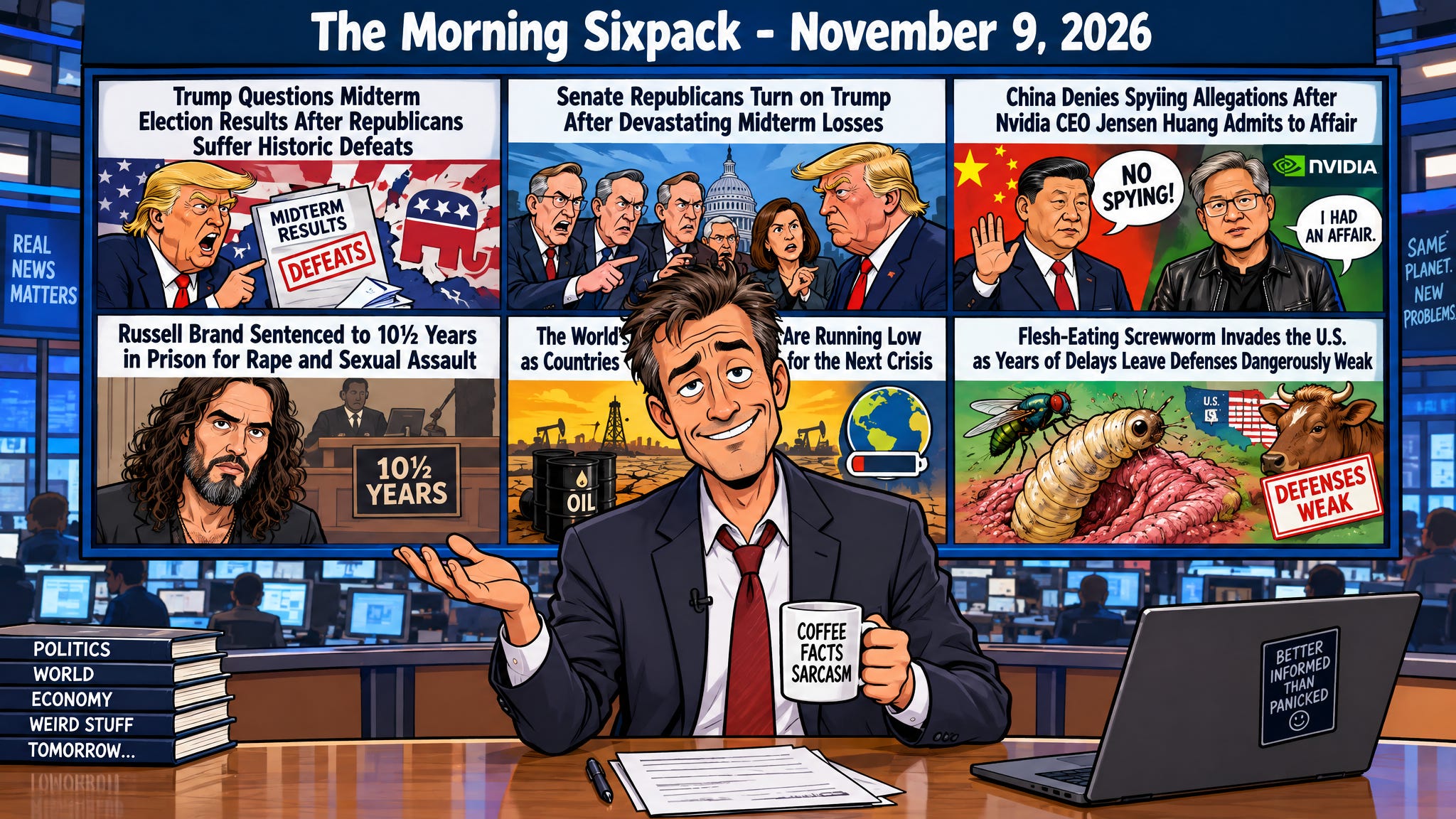
Trump Questions Midterm Election Results After Republicans Suffer Historic Defeats
President Donald Trump is once again casting doubt on American election results, this time after Republicans suffered major defeats in the 2026 midterms. On Monday, November 9, Trump took to Truth Social to question whether the elections were legitimate, just six days after voters handed his party significant losses across the country. The Republican setbacks extended into traditionally conservative territory, including Texas and South Carolina.
Trump offered no evidence of widespread election fraud but suggested that voting machines and early ballot counts were responsible for the Republican losses. “Does anybody really believe that this ‘Election’ was honest,” he wrote on Truth Social. He also questioned why pre-election polling had been so inaccurate, suggesting that large batches of early votes made Republican victories impossible regardless of Election Day turnout.
The president’s complaints focused heavily on voting technology. “It’s all about the machines, which are far more important than the voter!” Trump declared. He also claimed that some early voting “dumps” were so large that Republicans had no chance of winning. His statements echoed the allegations he made following his own defeat in the 2020 presidential election.
After losing to Joe Biden in 2020, Trump repeatedly insisted that widespread voter fraud had cost him the presidency, despite producing no evidence to substantiate those accusations. His campaign and allies pursued dozens of legal challenges to election procedures, none of which succeeded in overturning the outcome. Those claims became a central feature of Trump’s efforts to challenge the legitimacy of Biden’s victory.
The dispute over the 2020 election ultimately culminated in the January 6, 2021, attack on the U.S. Capitol. Following a rally at which Trump addressed his supporters outside the White House, a mob stormed the Capitol and interrupted the congressional certification of Biden’s Electoral College victory for several hours. Congress eventually reconvened and confirmed the results later that day. Nearly six years later, Trump is again questioning an election that delivered an unfavorable outcome for his party.
Editor: And there it is. Republicans lose, the voting machines become suspects, and the ballots are suddenly suspicious. Six years after the last round of election conspiracy theories, Trump is running the same playbook. Accepting defeat still doesn’t seem to be in the repertoire.
Source: CNBC
Republicans spent years following Trump’s lead. Now that he’s helped steer them into an electoral ditch, some are finally questioning who’s driving.
Senate Republicans Turn on Trump After Devastating Midterm Losses
Senate Republicans are returning to Washington furious with President Donald Trump, blaming him for the party’s disastrous performance in the 2026 midterm elections. Republicans lost at least seven Senate seats and more than 40 House seats, with some GOP insiders warning that the Senate losses could climb as high as nine. Party strategists and congressional aides say Trump’s unpopular policies, questionable endorsements, and chaotic campaign messaging contributed to the defeat. The backlash is fueling speculation that Republicans may begin distancing themselves from the lame-duck president as they prepare for the 2028 presidential election.
The anger intensified after Trump announced that immigration hard-liner Stephen Miller would replace Susie Wiles as White House chief of staff. The promotion came just days after Hispanic voters shifted decisively toward Democrats, particularly in Texas, where aggressive immigration enforcement had become a major political liability. Republican Rep. Marlin Stutzman argued that Miller should have been fired rather than promoted, while Sen. Thom Tillis called the appointment a “colossal mistake.” Republican pollster Whit Ayres predicted that Trump’s unquestioned authority over Senate Republicans was nearing its end, saying the party’s “knee-jerk obeisance” to his demands was likely over.
Republican frustration extends well beyond the Miller appointment. GOP leaders blame Trump for backing losing Senate candidates Ken Paxton in Texas, Darline Graham in South Carolina, and Michael Whatley in North Carolina, despite warnings that stronger candidates were available. Senate Majority Leader John Thune had repeatedly urged Trump to support incumbent Sen. John Cornyn over Paxton—or at least remain neutral—but the president ignored that advice. Republican aides also complained that Trump’s political operation sat on roughly $400 million in campaign funds until the final weeks, when expensive television advertising diminished the money’s impact. Meanwhile, Trump repeatedly distracted from the party’s economic message with controversies involving the White House ballroom, the Reflecting Pool, and other pet projects, even dismissing bipartisan housing legislation as a “big yawn.”
The political damage went deeper than poor campaign management. Republican strategists say Trump’s tariffs drove up consumer prices, his aggressive immigration policies alienated voters, and his ongoing conflict with Iran undermined his campaign promise to avoid endless wars. Former New Hampshire Senate candidate John Sununu, who lost to Democrat Chris Pappas by double digits, blamed both the Iran conflict and questions surrounding Trump’s family business dealings for his defeat. Cornyn argued in a Wall Street Journal opinion piece that Trump had fundamentally misread his 2024 mandate, delivering sweeping tariffs and aggressive immigration enforcement that went beyond what voters wanted. GOP aides said Democrats successfully connected economic frustration with concerns about corruption, producing devastating losses among independent voters.
The growing rebellion raises questions about Trump’s ability to control congressional Republicans during his final two years in office. Senate Republicans are particularly irritated that Trump repeatedly attacked them for failing to pass the SAVE America Act, despite their inability to secure the 60 votes needed to advance the legislation. Trump even threatened political consequences unless senators eliminated the filibuster to force the bill through. Although GOP insiders acknowledge that Trump remains popular with Republican voters, they expect increasingly vocal resistance from lawmakers who believe his political influence is fading. After insisting on election night that Republicans would have won in a landslide had he been on the ballot, Trump now faces a party increasingly convinced that his presence was precisely the problem.
Editor: Republicans spent years defending Trump’s every impulse, ignoring his distractions, and treating loyalty as a substitute for leadership. Now they’ve lost control of Congress, and suddenly they’re discovering the virtues of independence. Funny how a political ass-kicking can inspire a little soul-searching. The question is whether they’ll actually stand up to Trump—or just complain about him anonymously until the next election.
Source: The Hill
The CEO of the world’s AI chip powerhouse admits to an affair, U.S. intelligence suspects Chinese espionage, and Beijing insists it’s all a smear campaign. Just another quiet Monday in Silicon Valley.
China Denies Spying Allegations After Nvidia CEO Jensen Huang Admits to Affair
China is denying allegations that its intelligence services attempted to compromise Nvidia CEO Jensen Huang through a personal relationship with a business executive suspected of gathering information for Beijing. The controversy erupted after The New York Times reported that U.S. intelligence had identified the woman as part of a foreign intelligence effort. Huang acknowledged having an intimate relationship with a business executive but did not identify her in a public apology to his wife and Nvidia. The company announced Sunday that it had launched an independent investigation into reports that its chief executive had been targeted by foreign intelligence operatives.
Beijing rejected the espionage allegations Monday, calling them an attempt to damage China’s reputation. Chinese Foreign Ministry spokesperson Guo Jiakun declared that the allegations were unsubstantiated and amounted to smears against China. The New York Times identified the woman as Alice Huang, a former executive at Singapore-based Megaspeed International, a data center company that prominently advertises its relationship with Nvidia. Her company had previously faced allegations of illegally shipping advanced Nvidia computer chips into China, raising questions about whether the relationship involved access to sensitive corporate or technological information.
Huang addressed the controversy in an open letter published on Nvidia’s website, apologizing for the affair and pledging his cooperation with the investigation. “I support the investigation and will cooperate fully. I love our country and our company,” he wrote, emphasizing his commitment to American national security. Nvidia’s announcement did not establish whether any confidential information had been compromised or whether Huang knew of any alleged intelligence activities. George Chen, a technology specialist at Washington-based consultancy The Asia Group, cautioned that investigators must determine what information, if any, was exposed rather than jump to conclusions about espionage.
The allegations arrive at a particularly sensitive moment for Nvidia and U.S.-China relations. Nvidia is among the world’s most valuable publicly traded companies, and its advanced artificial intelligence chips are central to Washington’s efforts to prevent China from acquiring critical computing technology. Huang has repeatedly lobbied the Trump administration to loosen restrictions on chip exports, securing approval this year to sell Nvidia’s H200 processors to China after previously advocating for sales of the less powerful H20 chips. Chinese government restrictions have nevertheless limited those sales, and Nvidia disclosed in August that only small quantities had reached the Chinese market. Investors reacted nervously to the unfolding controversy, sending Nvidia shares down roughly 5% in premarket trading Monday.
Chinese state media have largely emphasized Huang’s admission of the affair while dismissing the espionage allegations as politically motivated. The state-owned Global Times suggested that the reporting was intended to disrupt improving relations between Washington and Beijing. Meanwhile, neither Megaspeed International nor Singapore’s Ministry of Home Affairs immediately responded to requests for comment. The investigation now centers on whether Huang’s personal relationship created an intelligence vulnerability involving one of America’s most strategically important technology companies. For now, the allegations remain unresolved, with no publicly established evidence that Huang knowingly participated in espionage or disclosed sensitive information.
Editor: The CEO of America’s most important AI chip company gets romantically involved with a business executive reportedly linked to Chinese intelligence, and suddenly corporate governance takes on a whole new meaning. Whether this was an actual espionage operation remains to be seen. But when your company sits at the center of a technological cold war, your personal life can become a national security issue in a hurry.
Source: Associated Press
Russell Brand spent years cultivating a reputation for outrageous behavior. Now a British judge has sentenced him to more than a decade behind bars for crimes that were anything but funny.
Russell Brand Sentenced to 10½ Years in Prison for Rape and Sexual Assault
British comedian and actor Russell Brand has been sentenced to 10 years and six months in prison after being convicted of raping one woman and sexually assaulting three others. London’s Southwark Crown Court handed down the sentence Monday, November 9, following a jury verdict delivered the previous Thursday. The crimes occurred between 2004 and 2009, during a period when Brand was becoming a prominent figure in British entertainment. The 51-year-old performer maintained his innocence throughout the proceedings, insisting that all his sexual encounters had been consensual.
The sentencing judge delivered a blistering condemnation of Brand, describing him as a sexual predator who believed celebrity status placed him above ordinary rules of conduct. Judge Joel Bennathan said Brand had demonstrated a “casual and arrogant disregard” for women and used his growing fame as a shield for abusive behavior. The judge told Brand that while audiences once considered him clever, funny, and charismatic, he had also become a predator. A jury consisting of eight men and four women convicted Brand of offenses involving four of six accusers, while acquitting him of two rape charges and one count of attempted indecent assault.
The women who survived Brand’s attacks delivered emotional victim impact statements describing the lasting damage caused by his actions. One woman, whom Brand raped in 2009, said the trauma remained a constant presence in her life nearly two decades later. “Something I carry with me every day and it often feels never-ending,” she said in a statement read by prosecutors. Their testimony underscored the enduring consequences of sexual violence, even when criminal accountability comes many years after the offenses.
Brand, who built his career on provocative comedy, celebrity relationships, and public struggles with addiction, showed little emotion as the sentence was announced. During the trial, he presented himself as a changed man who had embraced Christianity and overcome his dependence on drugs and alcohol. His attorney, Ian Winter, argued that Brand “is a fundamentally different person today and has been for a very long time.” The court nevertheless imposed a substantial prison sentence for the crimes the jury determined he had committed.
The legal troubles facing Brand may not be over. London’s Metropolitan Police confirmed that he remains under investigation for two additional alleged rapes, including one involving a girl who was 16 at the time. The head of the police force said Friday that he would not be surprised if more women came forward with allegations. Those investigations remain separate from the convictions that resulted in Monday’s sentence. For Brand, the verdict and prison term mark a dramatic collapse from his former status as one of Britain’s most recognizable entertainers.
Editor: Brand’s defense emphasized his sobriety, religious conversion, and personal transformation. Good for him if those changes are genuine. But becoming a different person doesn’t erase what you did to other people—or the damage they still carry. A judge and jury made that distinction abundantly clear.
Source: Al Jazeera
The Iran war has burned through the world’s emergency oil reserves, and now countries are scrambling to refill the tanks. Turns out the global energy safety net isn’t much use when you’ve already drained it.
The World’s Oil Reserves Are Running Low as Countries Race to Prepare for the Next Crisis
The war with Iran has depleted global oil reserves to their lowest levels in decades, triggering an international scramble to rebuild emergency stockpiles and protect against future supply disruptions. According to the International Energy Agency, observed global oil inventories fell by 509 million barrels between February and September as the conflict disrupted shipments through the Strait of Hormuz. By August, government-held reserves among wealthy industrialized nations had fallen to their lowest levels since 1989, while America’s Strategic Petroleum Reserve was hovering near its lowest level since 1982. Oil prices remain around $100 per barrel despite unprecedented emergency releases and efforts to reroute shipments around the conflict zone.
Governments and major oil producers are responding by investing billions in new storage facilities, often located far from the Persian Gulf and closer to the customers who depend on their supplies. Saudi Aramco has reached a preliminary agreement to store crude oil in Singapore’s massive underground Jurong Rock Caverns, which can hold 9 million barrels. The United Arab Emirates’ state-owned oil company, Adnoc, is exploring storage arrangements in India totaling as much as 30 million barrels. These investments reflect a growing recognition that pipelines and alternative shipping routes cannot guarantee reliable deliveries during prolonged conflicts, particularly after a September drone attack temporarily shut down Saudi Arabia’s East-West pipeline.
Oil-importing countries are also rethinking how much fuel they need to keep in reserve. Indonesia announced plans to build storage sufficient for 60 days of crude demand, while the Philippines is pursuing its first government-owned oil storage facilities. Australia has committed more than $2.1 billion to stockpile diesel and jet fuel, and Japan has established a $10 billion financing program to support oil storage throughout Asia. The International Energy Agency’s member countries have already released approximately 330 million barrels from emergency reserves during the war, the largest coordinated drawdown in history. Although the world still holds roughly 7.8 billion barrels in total inventories, much of that oil is already committed to everyday operations or traveling aboard tankers, making it unavailable for immediate emergencies.
The rush to rebuild reserves could have significant consequences for oil prices and the global economy. Oil trader Vitol estimates that the world consumes approximately 60 million barrels of gasoline, diesel, and jet fuel daily, meaning an additional 10-day emergency cushion would require 600 million barrels of fuel. At current prices, purchasing that much oil would cost roughly $60 billion, not including the expense of building and maintaining storage facilities. Analysts warn that replenishing depleted inventories could sustain demand and support elevated oil prices for years, although governments may spread purchases over time in hopes of securing better prices. The effort also highlights the limitations of stockpiling: Singapore’s entire underground cavern complex holds less than two days’ worth of Saudi Arabia’s crude exports.
The crisis is reshaping how the world’s energy suppliers and consumers think about security. For decades, strategic petroleum reserves served as insurance against temporary supply interruptions, a system developed after the oil shocks of the 1970s. But the Iran conflict has exposed the vulnerability of a global market heavily dependent on a handful of shipping routes and production regions. Oil companies are now considering overseas storage hubs, additional underground facilities, and new arrangements that position supplies closer to customers. Those measures may provide valuable breathing room during the next disruption, but industry analysts caution that even substantially larger reserves cannot compensate indefinitely for a prolonged interruption in global oil shipments.
Editor: We spent decades building an emergency oil safety net, then burned through a sizable chunk of it fighting a war in one of the world’s most important energy-producing regions. Now we’re preparing to spend billions buying more oil at elevated prices to refill what we’ve already used. And here’s the kicker: All that additional demand could help keep prices high. That’s quite an expensive way to learn that energy security requires more than a few giant tanks.
Source: The Wall Street Journal
America defeated the flesh-eating screwworm 60 years ago. Now it’s back, and three years into the outbreak, we’re still scrambling to produce enough sterile flies to stop it.
Flesh-Eating Screwworm Invades the U.S. as Years of Delays Leave Defenses Dangerously Weak
A flesh-eating parasite once eradicated from the United States has returned, exposing years of government delays, inadequate funding, and a critical shortage of the sterile flies needed to stop its spread. A Reuters investigation found that the New World screwworm outbreak, which began breaking through containment barriers in Panama in early 2023, has now spread across most of Mexico and into the United States. Mexico has recorded approximately 51,000 confirmed cases, while American authorities have documented 120 cases. The parasite’s larvae burrow into living tissue and can kill untreated animals, posing a serious threat to North America’s livestock industry.
The most troubling finding is that officials have known for years how to defeat the parasite but have failed to maintain the production capacity necessary to do it. The proven strategy involves releasing enormous numbers of laboratory-bred sterile male flies, which mate with wild females and prevent their eggs from hatching. The technique eradicated screwworm from the United States in 1966, when production reached approximately 500 million sterile flies per week. Today, facilities in Panama and Mexico produce only about 150 million weekly, less than one-third of that benchmark. “We don’t have enough flies,” Texas A&M entomologist Sonja Swiger told Reuters, adding that officials recognized the shortage almost immediately.
The investigation traces the failures across multiple administrations and international agencies. When the outbreak intensified in Panama in 2023, authorities began expanding sterile-fly production, but it took until November 2024 to reach 100 million flies per week. By then, screwworm had already reached southern Mexico, and officials knew the expanded supply was insufficient. Political transitions in Mexico and the United States, bureaucratic obstacles, and funding delays slowed additional production facilities. Mexico’s new sterile-fly plant did not open until June 27, 2026, more than 18 months after the country’s first confirmed cases, by which time the parasite had spread across 27 Mexican states.
The consequences have extended beyond animal health into international trade and agriculture. The Trump administration closed the U.S. border to Mexican cattle imports for more than 15 months beginning in May 2025, disrupting a multibillion-dollar industry. As imports began resuming in 2026, American cattle were already experiencing confirmed infestations. The United States still lacks its own operational sterile-fly production facility, although the administration awarded a $610 million construction contract for a Texas plant in March. Officials have accelerated the project, with production now expected to begin in spring 2027. Until then, the country remains dependent on facilities in Mexico and Panama, whose entire output is being directed toward northern Mexico and the United States.
Even the accelerated response may not be enough to quickly reverse the outbreak. With a single female screwworm fly capable of laying up to 3,000 eggs, the parasite can spread rapidly when sterile-fly releases are interrupted or insufficient. Authorities are concentrating their limited supply along the northern front of the infestation, leaving much of Mexico and Central America dependent on surveillance and treatment rather than eradication. Experts warn that pushing the parasite back to its former containment zone in Panama could take as long as a decade. The U.S. Department of Agriculture insists it has acted urgently, but the Reuters investigation reveals how a once-successful public health and agricultural defense system became dangerously vulnerable through years of insufficient capacity and delayed action.
Editor: We figured out how to beat this parasite in the 1960s, then somehow managed to leave ourselves without a single domestic factory capable of producing the flies needed to keep it away. Now we’re spending hundreds of millions of dollars rebuilding a defense system we already knew worked. Government efficiency at its finest: Save money on prevention, spend a fortune on the emergency.
Source: Reuters
Read The Morning Sixpack here: