


The Morning Sixpack stays free because the news that shapes your life should not be hidden behind a paywall. Paid subscribers are not paying for access. They are helping fund the research, writing, and independent voice that goes into every issue. Become a paid subscriber and help keep smart, honest news analysis free for everyone.
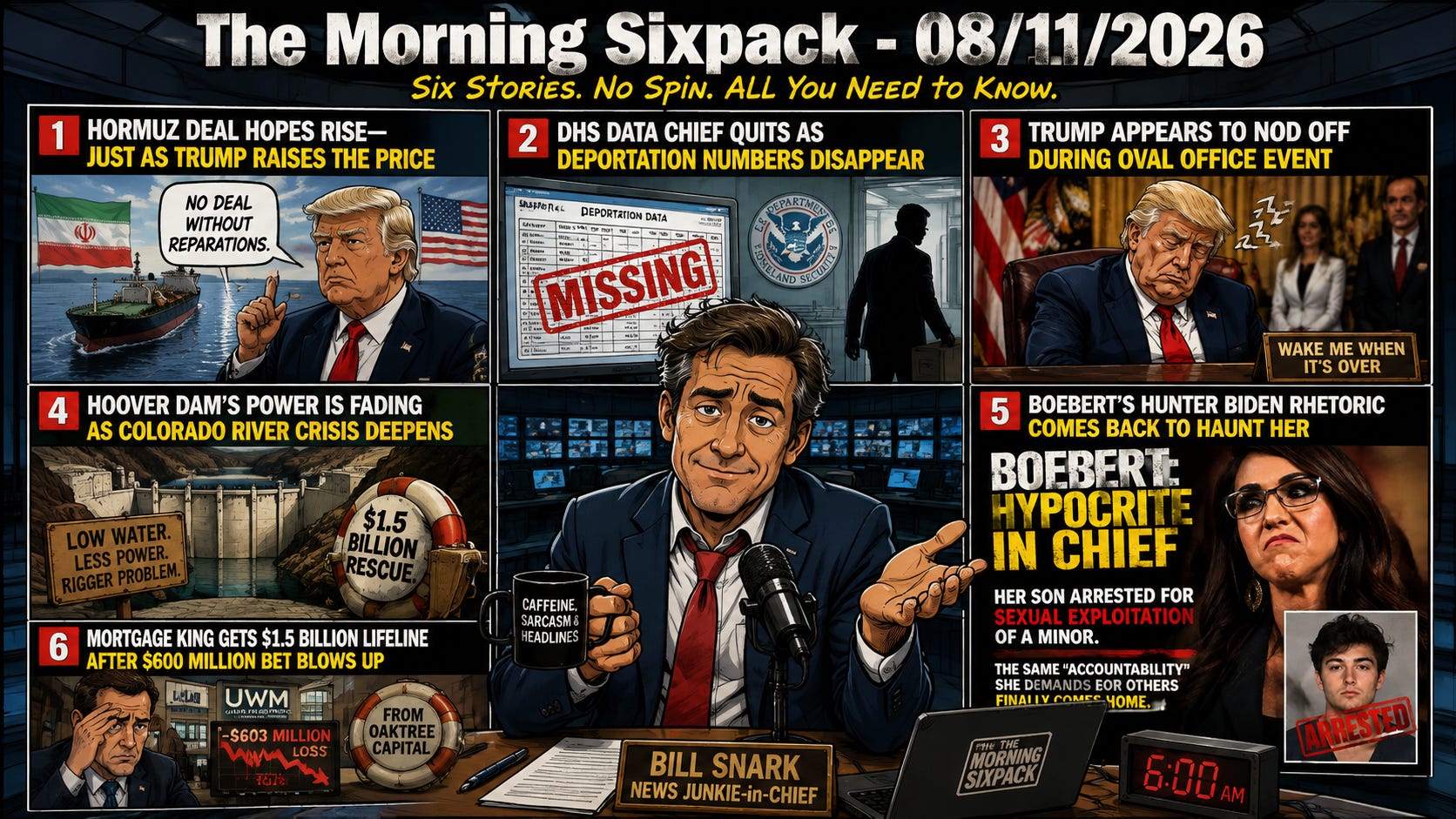
Peace talks are apparently back on the menu, but both Washington and Tehran keep adding new items to the bill.
Hormuz Deal Hopes Rise—Just as Trump Raises the Price
Pakistan says a deal to ease the Strait of Hormuz standoff may be close, even as President Trump adds new demands that could make any agreement harder to reach.
One side is talking about reopening shipping. The other is talking about reparations. That’s not exactly the same negotiation.
Pakistan’s defense minister, Khawaja Asif, says the U.S. and Iran appear to be closing in on “some sort of an arrangement” over the Strait of Hormuz after several days of encouraging signals. A Qatari Foreign Ministry spokesperson also said talks involving Iran and Oman are at a “critical juncture,” fueling hopes that one of the world’s most important oil routes could soon see progress.
Those optimistic comments arrived just as President Trump hardened Washington’s position. Speaking from the Oval Office, Trump said Iran should compensate the United States for decades of attacks and losses, arguing that any future agreement should include payments for wounded or killed American personnel and for victims of the Iranian regime’s crackdown on protesters. “If there’s damages to be paid, I think Iran should pay those damages.”
This sounds a lot like “I know what you are but what am I?” in light of the fact Iran demanded billions in reparations from the US just a few days earlier.
Iran, meanwhile, continues to insist the Strait of Hormuz will not fully reopen until the U.S. lifts sanctions, ends its naval blockade, releases frozen Iranian assets, withdraws forces from the region, and pays reparations of its own. Iranian officials also pushed back against U.S. claims that sanctions are crippling the country, accusing Washington of relying on economic pressure whenever diplomacy stalls.
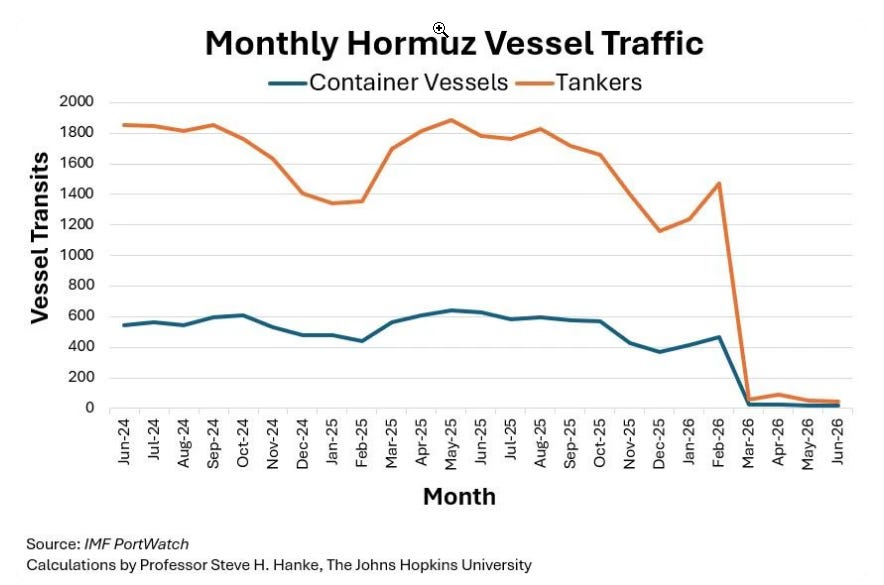
Markets reacted accordingly. Brent crude briefly surged near $90 a barrel before retreating after Pakistan’s comments hinted at possible diplomatic progress. Shipping through the strait remains limited, and a new maritime security incident near the Gulf of Oman serves as another reminder that tensions remain high. Analysts still see a wider regional war as unlikely, but energy markets remain on edge until the standoff is resolved.
Source: CNBC
Editor: Everybody says they want a deal. Then everybody immediately explains why the other side should pay first. That’s one way to keep negotiators employed.
If you stop publishing the scoreboard, people start wondering about the score.
DHS Data Chief Quits as Deportation Numbers Disappear
The Homeland Security official responsible for independent immigration statistics has resigned after the Trump administration blocked his office from publishing key deportation data.
When the government stops releasing the numbers, the numbers usually become the story.
Marc Rosenblum, who spent more than a decade overseeing immigration statistics at the Department of Homeland Security, resigned in late July after his office was effectively sidelined. The Office of Homeland Security Statistics was created with bipartisan support to provide Congress and the public with reliable immigration data free from political interference. Under the Trump administration, monthly enforcement reports stopped, the website went stale, and official data tables froze in 2024.
The information vacuum has fueled questions about the administration’s deportation campaign. While DHS officials continue to tout aggressive enforcement and claim millions of immigrants have “self-deported,” critics across the political spectrum say those estimates aren’t backed by transparent data. Even immigration advocates who support tougher enforcement are demanding regular publication of arrests, detentions, and deportations so the public can judge the administration’s performance.
One line from the story captures the issue perfectly: “I don’t care what the data says. Just give it to me.” That’s what Andrew Arthur, a former immigration judge who supports Trump’s immigration agenda, told The Atlantic. His point wasn’t about politics—it was about having actual numbers instead of competing claims.
The administration insists it is the “most transparent” in history (LOL), but without routine reporting, outsiders are left comparing press releases, social media posts, and unofficial leaks instead of standardized government data. Whether the deportation campaign is meeting its goals or falling short is becoming harder to verify—and that’s exactly why independent statistics matter.
Source: The Atlantic
Editor: Transparency isn’t a slogan—it’s publishing the numbers even when they don’t make your press release look better.
The White House insists everything is fine, but the cameras keep telling their own story.
Trump Nods Off During Oval Office Event—Again
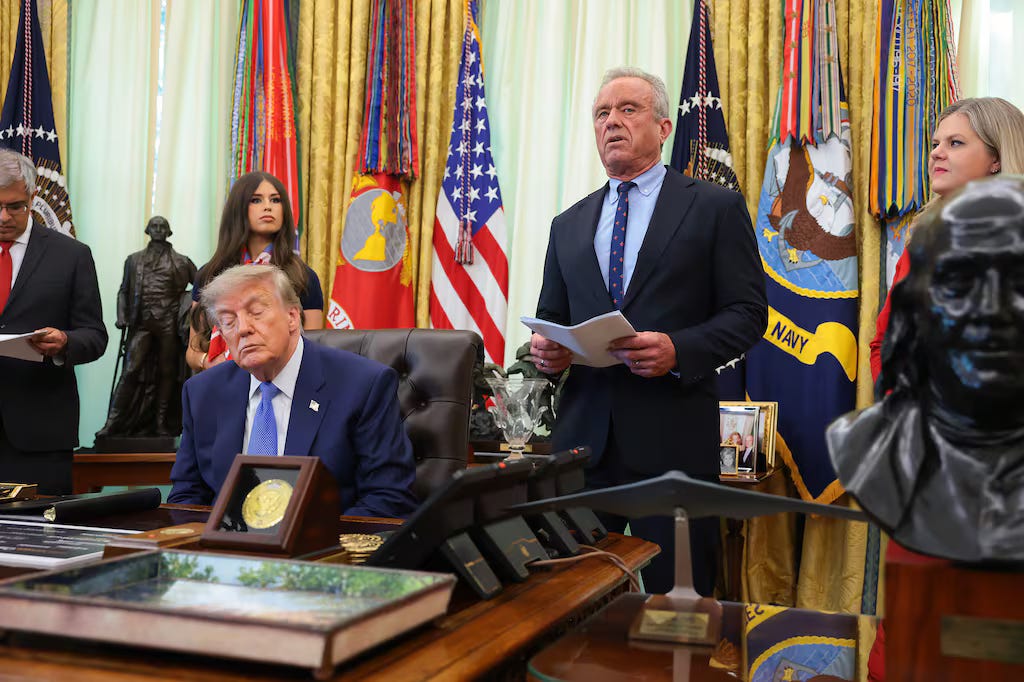
President Trump struggled to stay awake during a White House event Monday, with cameras capturing multiple moments where his eyes closed and he slumped in his chair while others spoke.
Whether it was fatigue, boredom, or something else, the video is doing plenty of the talking.
Trump’s only public appearance Monday was an Oval Office event to sign an executive order on childhood vaccines. After delivering brief remarks, he called on administration officials—including Health and Human Services Secretary Robert F. Kennedy Jr., NIH Director Jay Bhattacharya, and Deputy Chief of Staff Stephen Miller—to speak. During their remarks, cameras repeatedly showed the president with his eyes closed for extended stretches, at times leaning forward or slumping back in his chair.
The appearance lasted a little more than 40 minutes, and Trump remained engaged enough to call on speakers and answer reporters’ questions at the end. But much of the event featured lengthy periods where he had difficulty keeping his eyes open. According to The Daily Beast, it follows several similar public appearances in recent months where Trump has dozed off during meetings and events.
The White House has previously dismissed similar moments, with Trump saying he was merely blinking or closing his eyes because meetings were boring. Monday’s event, however, generated another wave of attention because the footage showed repeated episodes throughout the discussion rather than an isolated moment.
As always, a video clip captures only what is visible on camera and cannot establish why someone closed their eyes or appeared fatigued. But when the same questions keep resurfacing, they tend to become part of the political conversation whether the White House likes it or not.
Source: The Daily Beast
Editor: Every president gets scrutinized on camera. When the footage keeps becoming the headline instead of the policy, that’s a problem no press secretary can spin away. And after years of calling President Biden “Sleepy Joe,” it’s time the tables turn and we start calling Trump “Dozing Donny.” Fair is fair. And speaking of turnabout as being fair play, make sure you read today’s Boebert story below!
Turns out Mother Nature doesn't care how impressive your concrete is.
Hoover Dam’s Power Is Fading As Colorado River Crisis Deepens
America’s most famous dam is generating far less electricity as shrinking Colorado River reservoirs push the Southwest toward a long-feared (and wholly predictable) water and power crisis.
The bigger problem isn’t just losing electricity—it’s running short of the water that makes the entire system work.
The Colorado River system is approaching water levels its dams were never designed to handle. Hoover Dam is expected to produce about 40% less than its maximum hydropower capacity this year, while upstream Lake Powell is edging closer to the critical “minimum power pool” level where Glen Canyon Dam would no longer be able to generate electricity. Experts say decades of drought, extreme heat, and declining snowpack have turned what was once a distant warning into an immediate challenge.
“It’s been the slowest-moving train wreck in history, yet we’re letting it play out in front of us,” said John Berggren of Western Resource Advocates.
Federal officials are already taking emergency steps to keep enough water in Lake Powell to protect power generation, even as states struggle to agree on how to divide an increasingly scarce resource.
The dams were built to supply water, prevent floods, and generate electricity for roughly 40 million people across the Southwest. Now experts say the focus is shifting away from maximizing hydropower and toward simply preserving enough water to keep the system functioning. Utilities are expanding solar generation, cities are investing in water recycling, and farmers are experimenting with more efficient irrigation, but none of those steps creates more water.
Engineers say the system isn’t on the verge of immediate collapse, but another dry winter could dramatically worsen conditions. The Colorado River helped fuel the explosive growth of the modern Southwest. Now the region faces a difficult reality: Future prosperity may depend less on finding new water than on learning to use far less of it.
Source: Popular Mechanics
Editor: You can build bigger dams, dig deeper tunnels, and spend billions on engineering. None of that matters if the river keeps showing up with less water every year. And maybe you turn lush green golf courses into… data centers? LOL.

Funny how "family accountability" suddenly gets a lot more complicated when it's your own family.
Boebert’s Hunter Biden Rhetoric Comes Back to Haunt Her
Rep. Lauren Boebert spent years demanding Americans judge Hunter Biden by his actions. Now her own family is facing allegations that guarantee the same public scrutiny.
Turnabout isn’t always pleasant, but it tends to ignore party affiliation.
Tyler Boebert, the 21-year-old son of Rep. Lauren Boebert, has been arrested in Colorado on felony charges that include sexual exploitation of a child after investigators alleged he recorded and distributed a sexually explicit video involving a 17-year-old girl. Authorities also allege he helped circulate the material and may have been connected to an anonymous Instagram account containing explicit images involving minors. He has been released on bond, and the charges remain allegations that have not been proven in court.
The legal case will play out in court, where Tyler Boebert is entitled to the presumption of innocence. Politically, however, his arrest puts Rep. Boebert in an uncomfortable position. She built much of her national profile attacking Hunter Biden, arguing repeatedly that the president’s son reflected on his father and demanding accountability from the Biden family whenever new allegations surfaced.
Back in 2023, Boebert mocked Hunter Biden during House hearings, called him a “criminal,” blasted Democrats for defending him, and repeatedly argued that Americans shouldn’t ignore misconduct simply because it involved a politician’s family. Those comments are now being replayed across social media as critics argue the same standard should apply to her own household.
Boebert responded with a brief statement: “I love my son. We take these allegations very seriously and pray for everyone affected during this challenging time.” That’s exactly what most parents would say. It also doesn’t erase years of insisting that family scandals involving political opponents were fair game for public debate.
Source: The Gazette
Editor: If Hunter Biden was fair game because of who his father is, then Lauren Boebert doesn’t get to complain when people apply the very same standard she spent years promoting.
It's amazing how quickly the guy writing the biggest checks becomes the guy asking for one.
Mortgage King Gets a $1.5 Billion Lifeline After $600 Million Bet Blows Up
United Wholesale Mortgage CEO Mat Ishbia built the nation’s biggest mortgage lender, bought an NBA team with cash, and then watched one bad bet force his company into an expensive rescue deal.
When you’re the king of mortgages, losing $600 million tends to get everyone’s attention.
Mat Ishbia spent years telling investors his aggressive strategy would pay off when interest rates eventually fell. Instead, a failed $1.3 billion acquisition and a massive interest-rate hedge backfired, leaving United Wholesale Mortgage with a $603 million loss and forcing the company to suspend its dividend while accepting a $1.5 billion capital infusion from investment giant Oaktree Capital Management.
The rescue didn’t come cheap. Oaktree gets preferred stock paying a 10% annual dividend, two board seats, the ability to block major corporate decisions, and the right to eventually force a buyout of its investment. If UWM stumbles further, Oaktree could ultimately seize control of the board. That’s a steep price for a CEO who has long run the company with near-total authority.
Investors weren’t impressed. UWM shares plunged 35% after the announcement and are down roughly 70% this year. The company, once valued at $16 billion after going public in 2021, is now worth about $2 billion. Critics argue Ishbia expanded too aggressively, assumed interest rates would cooperate, and made costly financial bets tied to an acquisition that never happened.
Ishbia insists the partnership strengthens the company and says Oaktree will make “a boatload of money” alongside shareholders. Maybe. But this episode is a reminder that even billionaires can find themselves negotiating from a position of weakness when the market decides it has other plans.
Source: The Wall Street Journal (free)
Editor: Confidence is a great business strategy—right up until it collides with reality. Then you’re no longer making deals from strength. You’re just trying to survive the one you already made.