


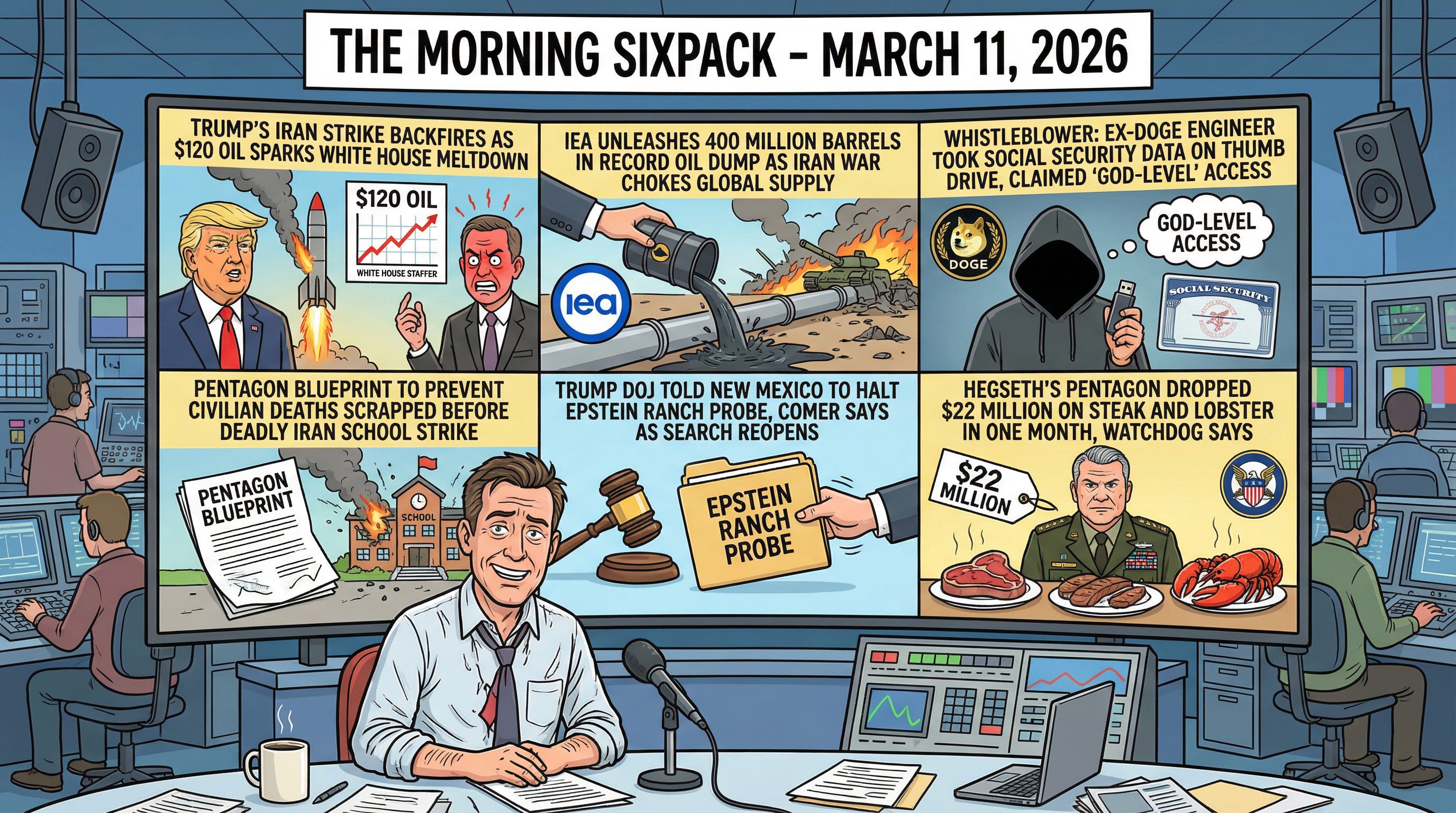
Trump’s DOJ reportedly told New Mexico to stand down on probing Epstein’s ranch in 2019—because apparently some investigations come with a “do not disturb” sign.
Trump DOJ Told New Mexico to Halt Epstein Ranch Probe, Comer Says as Search Reopens
A senior Republican lawmaker says the Trump Justice Department asked New Mexico officials to stop a 2019 investigation into Jeffrey Epstein’s ranch—just as state authorities are now searching the property again.
When a child sex trafficking case meets a federal stand-down order, people are going to ask who hit the brakes—and why.
House Oversight Committee Chair James Comer told Fox News that “the federal government asked New Mexico to stop their investigation” into the ranch once owned by Jeffrey Epstein. Comer said he believes the Department of Justice—possibly the Southern District of New York—took over at the time, but key questions remain unanswered.
“There are so many questions about how the government failed in trying to prosecute Epstein sooner…this whole thing does not make sense,” Comer said. “Everyone has conspiracy theories on how Epstein was able to get away with it. Was it because he had powerful friends? Was it because he was an agent? We do not know. But we are going to find out.”
The sprawling New Mexico estate—formerly known as Zorro Ranch and now called San Rafael Ranch—was never searched during earlier federal probes, even as Epstein’s properties in New York, Florida, and the U.S. Virgin Islands were examined. Victims have alleged trafficking and abuse at the ranch, but no charges were brought in New Mexico tied to activity there.
Now, state authorities have reopened a criminal investigation. The New Mexico Department of Justice, assisted by state police and local law enforcement, conducted a new search of the property this week. State Rep. Andrea Romero, who chairs a nonpartisan Truth Commission examining alleged abuse tied to the ranch, previously said New Mexico had been told to “stand down” in 2019, leaving survivors without a public accounting.
Editor: Officials are searching for—among many things—DEAD BODIES (link).
The ranch’s current owners say they are cooperating fully and welcome the investigation. Meanwhile, Comer says Congress intends to dig deeper into why the earlier probe was halted and whether federal intervention denied victims a path to justice.
One thing is certain: Whenever an Epstein investigation appears to stall, it doesn’t calm suspicion—it supercharges it.
Editor: If you tell a state to “stand down” on a sex trafficking probe, you’d better have a rock-solid explanation—because silence fills itself with theories.
Trump launched military strikes on Iran and then reportedly melted down when oil prices spiked—turns out global markets don’t run on vibes.
Trump’s Iran Strike Backfires as $120 Oil Sparks White House Meltdown
Donald Trump’s decision to launch military operations against Iran sent oil prices soaring toward $120 a barrel—and triggered a reported panic inside his own White House.
When the price spike hit Sunday night, insiders say the West Wing went from confident to chaotic in a matter of hours.
According to Financial Times columnist Ed Luce, Trump “flipped out” as crude climbed, a moment later confirmed by a White House insider speaking to Politico. The bigger issue? Officials apparently never expected Middle East military action to rattle global energy markets this hard. That’s not a minor oversight—that’s Economics 101.
One former administration official tried to downplay the drama, insisting the White House needs a “consistent, multiweek read” of oil prices before reconsidering strategy. “These temporary little gyrations are not what they’re going to be basing their policy on,” the official said. Translation: short-term pain at the pump won’t derail long-term military plans.
Still, even allies admit Sunday night was rough. “At the worst moments [Sunday] night, it was insane,” a person close to the White House said. “That definitely surprised me, and it absolutely surprised them.” Meanwhile, more than 70 percent of voters told Quinnipiac they’re worried the war will push oil and gas prices higher—hardly ideal when your party’s midterm pitch is lowering the cost of living.
White House spokesperson Taylor Rogers brushed off the spike as “short-term disruptions,” signaling no policy shift is coming. But markets don’t care about spin, and neither do drivers staring at gas station signs. The reality for Donald Trump: geopolitical muscle-flexing comes with a receipt.
Source: Raw Story
Editor: Starting a war and being surprised that oil prices jump is like lighting a match in a fireworks factory and blaming the spark.
The world is draining 400 million barrels from emergency reserves because the Strait of Hormuz is effectively choked off—and that’s what happens when global oil arteries get pinched.
IEA Unleashes 400 Million Barrels in Record Oil Dump as Iran War Chokes Global Supply
The International Energy Agency is releasing a record 400 million barrels of oil from emergency reserves to counter price spikes triggered by the Iran war and the near-closure of the Strait of Hormuz.
When one-fifth of the world’s oil moves through a single waterway, shutting it down isn’t a headline—it’s an economic tremor.
The Paris-based International Energy Agency said the coordinated release will more than double its previous high-water mark, eclipsing the 182 million barrels deployed after Russia invaded Ukraine in 2022. The goal is simple: cool crude prices that surged as much as 40% after U.S. and Israeli strikes on Iran.
IEA Executive Director Fatih Birol didn’t mince words: “IEA countries have unanimously decided to launch the largest ever release of emergency oil stocks in our agency’s history. This is a major action aiming to alleviate the immediate impacts of the disruption in markets.” Translation: this is not routine market tinkering—this is break-glass policy.
The crisis stems from Iran’s moves to effectively paralyze the Strait of Hormuz, the narrow corridor connecting the Persian Gulf to global markets. Tanker attacks, mining operations and mounting uncertainty have brought shipments to a crawl. Even with oil dipping below $84 earlier this week, volatility remains fierce as traders weigh how long the conflict will drag on.
History offers mixed reviews. Strategic releases after Russia’s 2022 invasion initially spooked traders before ultimately easing prices. But in 1991, when President George H.W. Bush tapped reserves ahead of Operation Desert Storm, prices plunged more than 20% in a day. The lesson? Markets respond as much to psychology as supply.
Economists warn that sustained oil above $100 risks reigniting inflation, rattling equities and squeezing consumers already fatigued by higher costs. Capital Economics estimates a month-long disruption could erase roughly 350 million barrels of supply—nearly matching this entire release. In other words, this is a powerful move, but it only buys time if the shooting stops.
Source: The Wall Street Journal (free)
Editor: Emptying the emergency tank is a clever trick—just hope the emergency doesn’t last longer than the fuel.
A former DOGE engineer allegedly walked off with Social Security data on a thumb drive and talked about sanitizing it for private use—because apparently “God-level access” wasn’t enough.
Whistleblower: Ex-DOGE Engineer Took Social Security Data on Thumb Drive, Claimed ‘God-Level’ Access
A whistleblower alleges a former DOGE engineer removed highly sensitive Social Security databases and sought to transfer the data to a private employer, triggering an inspector general investigation.
If true, it’s not just a breach—it’s a blueprint for how to torch public trust in one of the government’s most sensitive systems.
According to a complaint now under investigation by the Social Security Administration’s inspector general, the former U.S. DOGE Service employee claimed he had access to two tightly restricted databases—Numident and the Master Death File—containing records on more than 500 million Americans. The data includes Social Security numbers, birth dates, citizenship details and parents’ names.
Editor: I wrote about this yesterday:
BREAKING Whistleblower Says Ex-DOGE Engineer Walked Off with Social Security Data for 500 Million Americans (Living & Dead)
A whistleblower alleges a former DOGE engineer took highly restricted Social Security databases—including records on more than 500 million Americans—on a thumb drive to a private-sector job.
The whistleblower alleges the engineer said he had at least one database stored on a thumb drive and asked for help transferring the data to his personal computer so he could “sanitize” it before using it at a private company. He allegedly told colleagues he expected a presidential pardon if the move proved illegal. The complaint does not claim the data was successfully uploaded to the company’s systems. The engineer’s lawyer denies any wrongdoing.
The investigation comes amid broader scrutiny of the Trump administration’s decision to grant DOGE members sweeping access to agency systems. The Supreme Court had allowed “unfettered” access to Social Security data for DOGE staff last summer, though not for outside contractors. Democrats, including Rep. Robert Garcia, warned the allegations confirm fears that privacy safeguards were treated as optional during DOGE’s cost-cutting push under Donald Trump.
A separate complaint from former SSA chief data officer Charles Borges alleges DOGE members previously uploaded sensitive data to an unsanctioned cloud environment. In January, the Justice Department acknowledged in court filings that DOGE staffers had accessed and shared data without full agency awareness. As Borges put it: “This is absolutely the worst-case scenario. There could be one or a million copies of it, and we will never know now.”
The inspector general has alerted Congress, and the Government Accountability Office is conducting a parallel review. Meanwhile, Americans who count on Social Security are left wondering whether the system guarding their most personal information was treated like a sandbox for experimentation.
Source: The Washington Post (free)
Editor: When your anti-waste crusade allegedly involves walking out with half a billion records on a flash drive, maybe the waste isn’t where you thought it was.
The Pentagon had a working plan to reduce civilian deaths in war, then Trump’s team sidelined it—just in time for a missile to hit a school.
Pentagon Blueprint to Prevent Civilian Deaths Scrapped Before Deadly Iran School Strike
A Defense Department program designed to reduce civilian casualties was gutted under Trump officials before a missile strike in Iran killed more than 150 people, including schoolchildren.
The guardrails were there—and then they weren’t.
According to reporting from ProPublica, the Civilian Harm Mitigation and Response program—known inside the Pentagon as CHMR—had embedded advisers across combatant commands to map civilian environments, update no-strike lists and review targeting decisions before bombs fell. By early 2025, about 90% of the effort had been dismantled as Defense Secretary Pete Hegseth prioritized what he called “lethality.”
The rollback came before a Feb. 28 strike in Minab, Iran, that killed more than 165 people at an elementary school, most of them under 12. Open-source investigators have linked the blast to a U.S.-made Tomahawk missile. President Donald Trump blamed Iran. The Pentagon says the matter is under investigation.
CHMR had been formalized in 2022 after years of controversy over civilian deaths in Afghanistan, Iraq and Syria. It required deeper pre-strike analysis and post-strike investigations to determine what went wrong. Advisers would map civilian infrastructure—schools, hospitals, homes—and update “no-strike lists.” If confirmed, the Minab attack would rank among the deadliest civilian casualty events involving U.S. forces in decades.
Former senior adviser Wes J. Bryant said the dismantling of the program removed layers of scrutiny just as U.S. operations ramped up. “We’re departing from the rules and norms that we’ve tried to establish as a global community since at least World War II,” he said. Of the school strike, he added: “If confirmed, this will go down as one of the most egregious failures in targeting and civilian harm-mitigation in modern U.S. history.”
Global monitors report a sharp rise in U.S. strikes since Trump returned to office, including expanded operations in Somalia and Yemen. Critics warn that higher tolerance for civilian casualties not only erodes moral authority but fuels recruitment for militant groups. As retired Gen. Stanley McChrystal once framed it: for every innocent killed, new enemies are created.
The Civilian Protection Center of Excellence now exists largely on paper, former staff say. And the broader question lingers: when the system designed to prevent tragedy is dismantled, who owns the outcome?
Source: ProPublica
Editor: If you scrap the safety manual before you push the button, don’t act baffled when the explosion hits more than the target.
Reminds one of the time during the first Trump Regime when they destroyed the pandemic playbooks. That turned out SO WELL.
The Pentagon burned through $22 million on steak and lobster in a single month while preaching fiscal discipline—apparently surf and turf is mission-critical. #DOGE
Hegseth’s Pentagon Dropped $22 Million on Steak and Lobster in One Month, Watchdog Says
Defense Secretary Pete Hegseth’s Pentagon spent $22 million on lobster, crab and ribeye steak in September 2025 alone, part of a $93.4 billion end-of-year spending blitz.
Nearly half of that total was pushed out in just the final five business days of the fiscal year.
According to nonprofit watchdog Open the Books, the Defense Department shelled out $6.9 million for lobster tail, $2 million for Alaskan king crab, $15.1 million for ribeye steak and $1 million for salmon in September. Dessert wasn’t skipped either—272 doughnut orders totaling $139,224 and $124,000 for ice cream machines rounded out the menu.
The spending spree comes under the watch of Pete Hegseth, who has publicly pledged to crack down on “wasteful spending.” In February, Hegseth welcomed assistance from Elon Musk’s former Department of Government Efficiency, saying he expected to uncover “hundreds of billions” in waste. “We need to know when we spend dollars, we need to know where they’re going and why,” he said at the time.
Open the Books says nearly 50% of the Pentagon’s $93.4 billion in September grants and contracts was spent during the final workweek of the fiscal year—a classic “use-it-or-lose-it” surge. While agencies aren’t required to exhaust their budgets, leftover funds can shrink future allocations, creating pressure to spend big before the clock runs out.
And this isn’t new. The watchdog notes the Defense Department has averaged $257.6 million on furniture every September since 2008—a 564% jump above non-September months. Even beyond the September splurge, the Pentagon reportedly spent $7.4 million on lobster across four other months in 2025.
Supporters will argue troops deserve good meals and that end-of-year procurement spikes are standard practice. Critics will counter that preaching austerity while approving surf-and-turf shopping sprees sends a message—just not the one about belt-tightening.
Source: Mediaite
Editor: If this is what cutting waste looks like, someone needs to check the pantry—because the leftovers are running the show.