


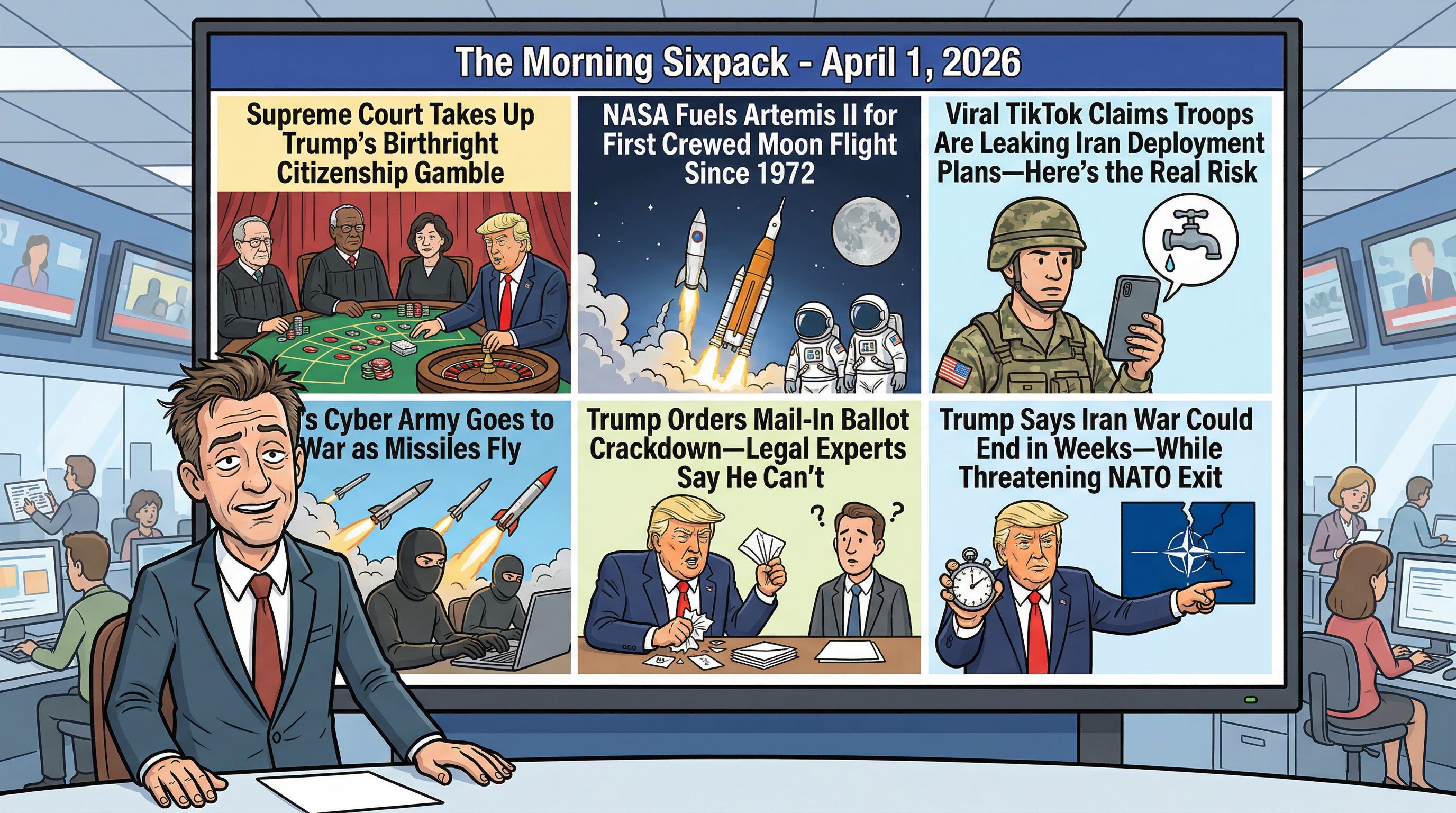
The Supreme Court is weighing Trump’s executive order to end birthright citizenship, a move that would upend 150 years of constitutional law—and he’s betting five votes can rewrite the 14th Amendment.
Supreme Court Takes Up Trump’s Birthright Citizenship Gamble
The U.S. Supreme Court heard arguments Wednesday in a case that could redefine who gets to be an American citizen.
If Trump wins, the 14th Amendment stops meaning what it’s meant since 1868.
At issue is President Donald Trump’s Jan. 20, 2025 executive order, “Protecting the meaning and value of American citizenship,” which seeks to end automatic birthright citizenship. Lower courts have blocked it, calling it unconstitutional. Now the high court will decide whether a president can narrow the Citizenship Clause with the stroke of a pen.
The 14th Amendment is pretty plain: “all persons born or naturalized in the United States, and subject to the jurisdiction thereof, are citizens of the United States.” That language has stood for more than a century, reinforced by the Supreme Court’s 1898 ruling in United States v. Wong Kim Ark, which affirmed citizenship for a U.S.-born man whose Chinese parents were barred from naturalization.
Trump’s team argues the phrase “subject to the jurisdiction thereof” requires allegiance—and that children of undocumented immigrants don’t qualify. An amicus brief from Republican senators leans on early English caselaw and claims “illegal aliens and their children are present in the United States without consent.” Historians aren’t buying it. “There’s certainly never been a president who issued an executive order trying to undermine birthright citizenship in this way,” said Kate Masur of Northwestern University.
Critics warn the fallout could be massive. More than 4 million U.S.-born children have at least one undocumented parent. Author Daisy Hernandez pointed to the Dominican Republic’s retroactive citizenship rollback as a cautionary tale. “Statelessness means that you have no government which you can turn to in any way,” she said. “The philosopher Hannah Arendt said ‘citizenship is the right to have rights.’ You need a government to recognize that you have rights.”
However this lands, it’s not some academic debate. It’s about whether American identity is anchored in birthplace—or in paperwork approved by Washington. The justices now hold the line between precedent and presidential muscle.
Source: UPI
Editor: We’re about to find out if 157 years of constitutional understanding can be undone by executive order—and whether “originalism” suddenly comes with a 2025 expiration date. You KNOW the current MAGA-dominated SCOTUS will say the Court got it wrong in 1868. You just KNOW it.
NASA Fuels Artemis II for First Crewed Moon Flight Since 1972
NASA began pumping 700,000 gallons of fuel into its massive Space Launch System rocket Wednesday, targeting humanity’s first crewed lunar mission in more than 50 years.
If all goes to plan, four astronauts will travel farther from Earth than any humans in history.
At Cape Canaveral, hydrogen fuel started flowing into the 32-story rocket despite nerves still lingering from earlier leak issues that forced delays. This is Artemis II—the opening salvo in NASA’s push to plant a long-term American presence near the moon’s south pole by 2028.
“It is time to fly,” commander Reid Wiseman posted ahead of liftoff. NASA Administrator Jared Isaacman echoed the ambition: “The next era of exploration begins.” The mission will sling three Americans and one Canadian around the moon without landing—no orbit either—before a Pacific splashdown.
The crew includes Christina Koch, set to become the first woman to travel to the moon; Victor Glover, the first Black astronaut assigned to a lunar mission; and Canadian Space Agency astronaut Jeremy Hansen, who will be the first non-U.S. citizen to head into deep lunar space. England’s King Charles III even sent Hansen a note praising his “courage, discipline and vision.”
Editor: Sure sounds like a “DEI mission” to me!
Astronauts last made the trip during Apollo 17 in 1972. This time, Artemis II will push roughly 4,000 miles beyond the moon before looping back—a deeper dive into space than the Apollo era ever attempted.
Source: AP News
Editor: I don’t really have anything to say about this!
Viral TikTok Claims Troops Are Leaking Iran Deployment Plans—Here’s the Real Risk
A San Diego stripper’s viral video claims U.S. troops are casually revealing deployment timelines ahead of a possible Iran escalation.
If true, it’s not intelligence—it’s a textbook OPSEC failure.
Charm Daze, a dancer with a sizable TikTok following, says soldiers have been opening up during visits—dropping hints about deployments to the Middle East and spending heavily before shipping out. In her words: “They’re like, ‘Oh yeah, we’re gonna have fun, we’re getting deployed next week.’”
The backdrop here matters. San Diego is home to major naval operations, and the U.S. is reportedly ramping up troop presence in the region as tensions with Iran rise. But let’s be clear: anecdotes from a strip club aren’t confirmation of strategy—they’re a reminder that loose talk travels fast in the social media era.
Military voices were quick to push back—not on whether troops talk, but on the consequences. “Don’t talk to your barber… don’t talk to your adult entertainer about deploying,” one Marine officer warned, highlighting the basics of operational security that apparently still need repeating.
Meanwhile, the bigger picture hasn’t changed. The U.S. is increasing its regional posture, and President Trump continues to float both diplomacy and escalation in the same breath—promising progress while threatening “obliteration” if talks fail.
In other words, the real story isn’t a TikTok—it’s that even rumors of careless chatter can expose how fragile operational discipline can be when stress, youth, and social media collide.
Source: The Sun
Editor: If your war plan can be pieced together between lap dances and TikTok uploads, the problem isn’t the dancer—it’s the discipline. And remember: Loose lips sink ships. This is exactly the kind of thing Iran is banking on.
Iran’s Cyber Army Goes to War as Missiles Fly
As rockets streak across the Middle East, Iran’s hackers are unleashing a parallel war online—targeting Israel and the United States with phishing scams, wiper malware and psychological ops.
This isn’t just digital graffiti—it’s coordinated cyber warfare aimed at sowing chaos, stealing intel, and rattling civilian nerves.
According to the Financial Times, Israelis recently received fake military text alerts urging them to download a bogus shelter app. Others were told “Netanyahu is dead” in mass panic-inducing messages. Behind much of it: Iranian-linked cyber groups that have spent years sharpening their tools in the shadows.
“The Iranians are throwing everything they have at this,” said former CISA director Chris Krebs. “If their cyber operators are breathing, then they will be on their keyboards.” Iran’s digital bench runs deep—from Revolutionary Guard units to hired proxies and volunteer hacktivists, all working with varying degrees of deniability.
Some attacks are loud and messy. Others are stealthy and strategic. A hacking front known as Handala claimed to have wiped 200,000 devices at U.S. medical tech giant Stryker, disrupting hospital equipment and surgeries. Iranian-linked actors have also targeted Israeli infrastructure, security cameras, and even senior U.S. officials’ personal email accounts. Kash Patel was among them. (Link)
But this is a two-way fight. The U.S. and Israel have flexed serious cyber muscle of their own—think Stuxnet-level sabotage and intelligence operations years in the making. Israeli operatives reportedly hacked Tehran traffic cameras long before striking high-level targets. Washington has launched cyber operations designed to blind Iran’s military systems ahead of air strikes.
Still, analysts warn that America’s cyber defenses aren’t exactly ironclad. Staffing shortages at CISA and the fragmented nature of U.S. infrastructure create openings. “The cat is out of the bag at how weak we are defensively,” said Emily Harding of CSIS.
The bottom line: the modern battlefield isn’t just land, sea, and air. It’s servers, smartphones, and social feeds. And while bombs make headlines, the quiet infiltration of networks may shape the outcome long after the smoke clears.
Source: Financial Times
Editor: We used to worry about air superiority. Now it’s Wi-Fi superiority—and the hackers don’t need runways—or permission.
Trump Orders Mail-In Ballot Crackdown—Legal Experts Say He Can’t
President Trump signed a sweeping executive order attempting to restrict mail-in voting, directing federal agencies to shape who receives ballots despite lacking constitutional authority over elections.
The Constitution gives states—not presidents—the power to run elections.
The order instructs the U.S. Postal Service to send ballots only to voters appearing on a citizenship list compiled by the Department of Homeland Security with help from the Social Security Administration. It also dictates what type of secure envelopes must be used for mail ballots. Translation: a president trying to referee a game he doesn’t legally control.
Elections scholars were blunt. “This executive order is plainly unauthorized and unlawful,” said Wendy Weiser of the Brennan Center for Justice. Richard Hasen, a UCLA law professor, was even more dismissive: “There’s no authority for any of this.” Courts blocked major pieces of a similar Trump election order last year—and legal challenges are already expected.
Trump seemed ready for a courtroom fight, predicting “rogue judges” would intervene. He’s long attacked mail voting without evidence of widespread fraud and continues to push Congress to pass stricter voter ID and proof-of-citizenship requirements. That legislation has stalled in the Senate, so now comes the executive-order workaround.
There’s one more twist: just last week, Trump himself voted by mail in a Florida special election.
“I used a mail-in ballot. You know why? Because I’m president of the United States,” he said. Apparently mail ballots are dangerous—unless they’re convenient.
If history is any guide, this order is headed straight for an injunction. Presidents can campaign against mail voting. They can lobby Congress. But rewriting election rules from behind the Resolute Desk? That’s a different story.
Source: The Washington Post (free)
Editor: Nothing says “faith in democracy” like trying to redesign it by executive order—while dropping your own ballot in the mail.
Trump Says Iran War Could End in Weeks—While Threatening NATO Exit
President Trump said the United States could wrap up its conflict with Iran “within two weeks, maybe two weeks, maybe three,” even as global oil supplies face their sharpest hit yet.
He’s talking peace on one hand—and pulling the NATO pin with the other.
In remarks spanning Washington and an interview with Britain’s Daily Telegraph, Trump suggested the U.S. may soon step back from what it calls “Operation Epic Fury.” “We’ll be leaving (the Iran conflict war) very soon,” he told reporters, adding that a formal deal with Tehran isn’t necessarily required.
At the same time, Trump warned European allies to do more to prevent Iran from blocking the Strait of Hormuz—or risk America reconsidering its commitment to NATO.
“I was never swayed by NATO. I always knew they were a paper tiger,” he said, adding that Russian President Vladimir Putin “knows that too.”
Editor: Trump doesn’t know how NATO works.
The economic clock is ticking. International Energy Agency chief Fatih Birol said oil losses in April could be twice as severe as in March, with jet fuel and diesel shortages already hitting Asia and potentially spreading to Europe within weeks. The Strait of Hormuz remains the pressure point, and markets are reacting accordingly.
Secretary of State Marco Rubio hinted at possible direct talks, saying the U.S. could “see the finish line,” though not immediately. Meanwhile, the White House announced Trump would address the nation with an “important update on Iran.”
So here we are: threats, timelines, and energy shocks all swirling together. The war could end in weeks—or it could escalate just as fast. In this administration, both things can apparently be true at once.
Source: Reuters
Editor: Nothing calms jittery oil markets like a ticking two-week clock and a side order of NATO brinkmanship. Buckle up.
Remember, this is NOT an “energy shock”. NOBODY but Trump and his band of idiots didn’t know that Iran would block the Strait. We all KNEW exactly what they would do. Trump is an idiot.