


The Morning Sixpack stays free because the news that shapes your life should not be hidden behind a paywall. Paid subscribers are not paying for access. They are helping fund the research, writing, and independent voice that goes into every issue. Become a paid subscriber and help keep smart, honest news analysis free for everyone.
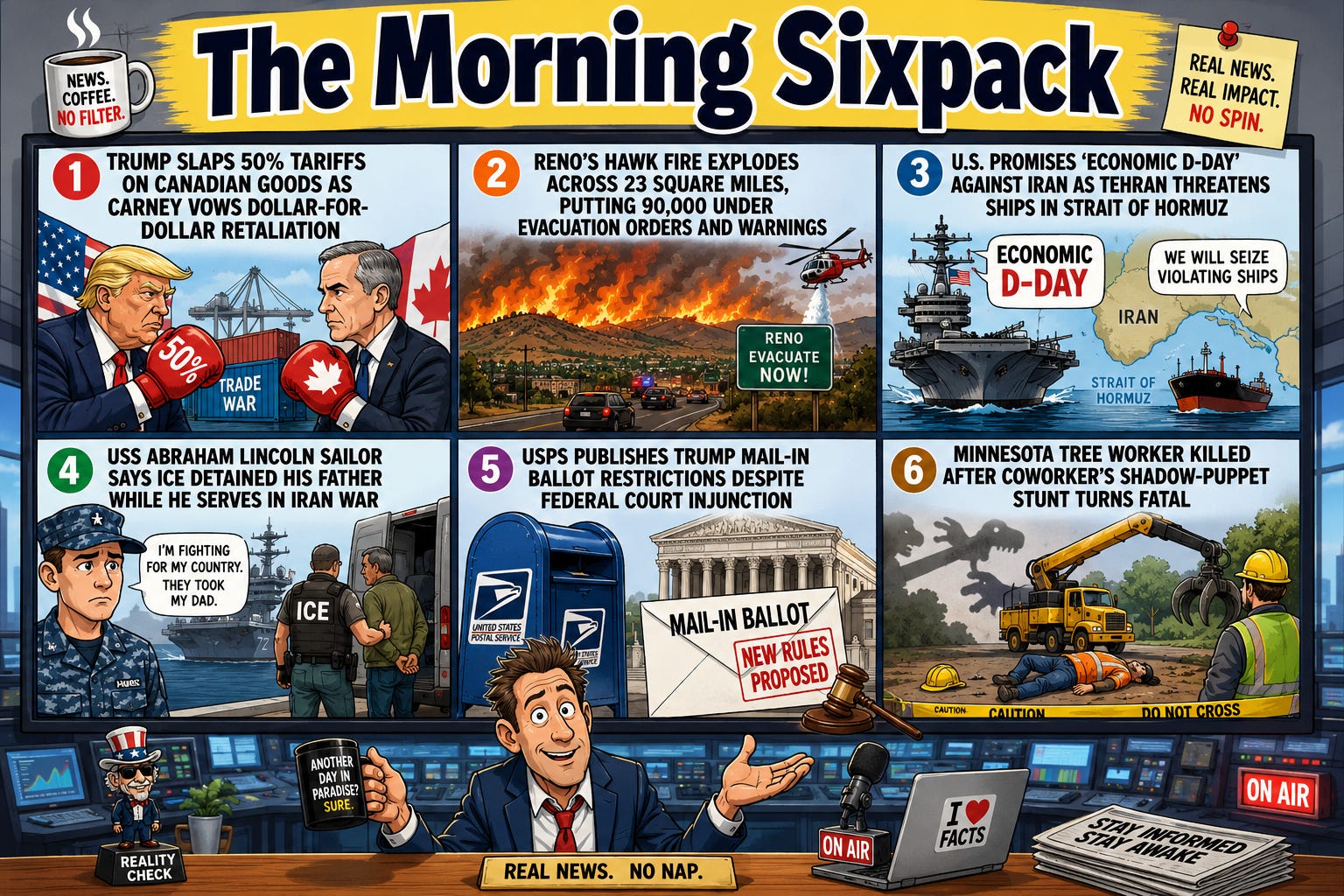
Trump and Carney just turned a failed trade negotiation into a 50% tariff fight, proving once again that nothing says “close trading partners” quite like reaching for the economic brass knuckles.
Trump Slaps 50% Tariffs on Canadian Goods as Carney Vows Dollar-for-Dollar Retaliation
The Trump administration’s new 50% tariffs on billions of dollars of Canadian goods took effect Saturday after last-minute trade negotiations collapsed, prompting Prime Minister Mark Carney to promise Canada will retaliate “dollar for dollar.” The two sides apparently got close to a deal before discovering that “close” doesn’t pay the tariff bill.
A trade dispute between two of the world’s closest economic partners has now escalated into a full-blown tariff war—and businesses (and consumers, of course) on both sides of the border are about to get the invoice.
Carney suspended negotiations and ordered Canada’s team home, blaming late changes to Washington’s proposed terms.
“Last-minute changes in the U.S. proposed terms were unfair, uneconomic, and called into question the reliability of any deal,” Carney said.
U.S. Trade Representative Jamieson Greer offered the opposite account, saying Canada refused to finalize terms previously agreed upon and introduced new demands and reversals that “upended the careful balance reached in the past days.”
The new U.S. duties cover hundreds of Canadian products worth more than $28 billion, including plywood, cement, wine, and hockey sticks. Electronics could take the largest hit, with more than $4 billion US in affected exports, while plastics face roughly $3 billion US in exposure. British Columbia is particularly vulnerable, with affected goods representing more than 13% of its exports to the U.S.; Quebec also faces substantial exposure on top of existing 50% tariffs on steel and aluminum. Even CUSMA-compliant goods that previously escaped some tariffs are no longer universally protected.
The Canadian Chamber of Commerce called the tariffs a “body blow to North American competitiveness,” warning that a 50% levy simply isn’t sustainable for businesses. Washington imposed the duties using Section 338 of the nearly century-old Smoot-Hawley Tariff Act, while Canada is preparing matching retaliation. So here we are: America and Canada are dusting off Depression-era tariff law that didn’t work to settle a 21st-century trade fight, while companies, workers, and consumers get volunteered to find out who blinks first.
Editor: When your economic strategy requires pulling legislation off the Great Depression shelf, perhaps keep the champagne corked until the “winning” part shows up.
Source: CBC News
Reno’s Hawk Fire went from a small Saturday blaze to a 23-square-mile, zero-containment monster that destroyed homes and put roughly 90,000 people under evacuation orders or warnings—because the wind decided firefighters needed the difficulty setting cranked to eleven.
Reno’s Hawk Fire Explodes Across 23 Square Miles, Putting 90,000 Under Evacuation Orders and Warnings
A fast-moving wildfire northwest of Reno destroyed homes, injured at least six people, and forced tens of thousands to flee as shifting winds drove flames through more than 23 square miles of bone-dry terrain. Authorities say the Hawk Fire was human-caused, although they have not said whether it was accidental or intentional.
With zero containment and winds capable of changing the fire’s direction in minutes, nearly 90,000 people were either ordered out or warned they could be next.
The fire began Saturday near Peavine Peak in the Humboldt-Toiyabe National Forest before exploding across rugged foothills surrounding homes and businesses. About 42,000 residents were under “GO NOW” evacuation orders Sunday, while another 45,000 were in warning zones. Six people—three civilians and three first responders—were injured. Washoe County Sheriff Darin Balaam had a straightforward message: “Please get out if you can right now.”
The speed of the fire left some residents virtually no time to save their belongings. Cari Kieffer rushed home with her husband and four children as ash fell and flames raced toward their neighborhood. They grabbed their dogs, clothes, a Bible, wedding photos, and her mother’s ashes before firefighters ordered them out. Their house was later reduced to ruins.
“I woke up this morning and just started crying—all my kids, they lost everything,” Kieffer said. “We lost all our stuff. Everything we own is gone.”
Nevada Gov. Joe Lombardo declared a state of emergency in Washoe County and mobilized the Nevada National Guard, including helicopter crews and troops to help protect evacuated neighborhoods. Roughly 800 firefighters were responding, portions of U.S. Route 395 were closed, and thousands remained without electricity. The University of Nevada sat just outside the evacuation zone Sunday, while two hospitals evacuated patients, and officials monitored whether the county jail might also need to be cleared.
The Hawk Fire is burning after months of dry weather and a record lack of winter snow helped create dangerous fire conditions across the West. What was barely noteworthy Saturday morning became a major disaster within hours, with flames reportedly jumping over fire trucks as residents tried to escape.
That’s the brutal equation here: Dry fuel, high winds, and one human-caused ignition can turn somebody’s ordinary weekend into a race for their life before the evacuation app even catches up.
Editor: The most important number isn’t 23 square miles or 90,000 people. It’s zero containment. When the sheriff says get out now, your furniture doesn’t need consideration—grab the people & pets and go.
Source: Associated Press
Washington is preparing what Treasury Secretary Scott Bessent calls its biggest financial assault ever on Iran while Tehran threatens to seize ships in the Strait of Hormuz—because six months of war apparently needed an economic sequel.
U.S. Promises ‘Economic D-Day’ Against Iran as Tehran Threatens Ships in Strait of Hormuz
The United States is preparing a massive new financial offensive against Iran as Tehran threatens penalties, seizure, or confiscation of vessels that violate its rules in the Strait of Hormuz. The escalation comes after Washington and Tehran blew through a 60-day ceasefire window without reaching an agreement to end a Middle East war now deep in its sixth month.
Now the confrontation is moving deeper into the global financial system—and straight toward one of the world’s most important oil chokepoints.
Treasury Secretary Scott Bessent said the U.S. will unveil “the single greatest financial offensive ever” against Iran on Monday, declaring that “at dawn begins an economic D-Day.”
The measures are expected to pile additional pressure onto sanctions already targeting Iran’s banking, energy, aviation, and cryptocurrency sectors. Bessent also warned countries still doing business with Tehran: “Any nation that serves as a financial artery of a withering regime should expect to share in its isolation.”
Iran isn’t exactly responding with a strongly worded letter. Mohsen Rezaei, the new secretary of Iran’s Supreme National Security Council, warned that countries participating in additional economic restrictions would be considered enemies. Meanwhile, Iran’s state-controlled Persian Gulf Strait Authority said vessels violating its transit rules in the Strait of Hormuz could face “fines, seizure, or confiscation.” Iranian lawmakers are also considering requiring ships traveling through the strait to pay Tehran for services.
Meanwhile, our idiot President proclaimed the Strait of Hormuz a “US Territory.”
That’s where this gets economically dangerous far beyond Washington and Tehran. Roughly one-fifth of the world’s seaborne oil passed through the Strait of Hormuz before the war, meaning any serious disruption could quickly reach energy markets, shipping costs, and consumers around the world. We’ve already seen this once before.
Crude prices actually retreated in Asian trading Monday, with West Texas Intermediate around $85.93 a barrel and Brent near $93.22. Markets may be calm for the moment, but threatening ships in a critical oil artery while Washington promises an “economic D-Day” isn’t exactly a recipe for restful commodity traders.
Not financial advice: This is the buying opportunity. You won’t see oil prices this low for quite some time (months or years) IF the situation doesn’t drastically improve right away.
Editor: Calling sanctions “economic D-Day” certainly gets everyone’s attention. Threatening to seize ships in Hormuz gets the insurance companies’ attention. Put those together and suddenly your morning commute has a geopolitical risk premium.
Source: CNBC
A sailor deployed for nine months aboard the USS Abraham Lincoln says ICE detained his father while he was serving in the Middle East—a family crisis with enough bureaucratic irony to sink a smaller ship.
USS Abraham Lincoln Sailor Says ICE Detained His Father While He Serves in Iran War
Joshua Aviles says that while he has spent roughly nine months deployed aboard the USS Abraham Lincoln supporting the U.S. war effort against Iran, Immigration and Customs Enforcement detained his father back home. His father reportedly had a driver’s license, Social Security card, and work permit and was awaiting approval of his green card application.
Aviles is serving his country thousands of miles from home while that same government is holding his father in immigration detention.
“I’ve been deployed for over nine months, out at sea in the Middle East aboard the USS Abraham Lincoln, fighting for a country that has given me everything,” Aviles wrote on Facebook. He described his father as a hardworking man who came to the United States seeking a better life for his children. NBC News confirmed the detention with the Department of Homeland Security, according to The Hill.
DHS said the father’s work authorization and pending application did not give him legal immigration status. “We are simply enforcing the laws passed by Congress. This Administration does not pick and choose which laws to enforce,” a DHS spokesperson told NBC News.
Aviles described the personal toll differently: “This is heartbreaking for me. I don’t know how I can mentally continue working 12+ hour days knowing that my dad is somewhere, possibly being treated like a criminal.”
The case lands amid a larger dispute over immigration enforcement involving military families. Democratic lawmakers have reported that ICE under President Trump has arrested 125 veterans and attempted to deport at least 282 veterans and family members, while warning that immigration enforcement could discourage service members and their families from seeking military services or remaining in uniform.
Whatever ultimately happens with Aviles’s father, the image is difficult to ignore: A sailor deployed aboard an American aircraft carrier fighting America’s war while worrying whether the American government will deport his dad.
Editor: The government says a work permit and pending green card don’t equal legal status. Fair enough—that’s the government’s legal position. But asking a sailor to grind through 12-hour days in a war zone while his father sits in ICE custody is one hell of a recruiting poster.
Source: The Hill
USPS has published 95 pages of proposed mail-in ballot restrictions even though federal courts have blocked them—nothing says “election clarity” like preparing new voting rules while judges are still saying no.
USPS Publishes Trump Mail-In Ballot Restrictions Despite Federal Court Injunction
The U.S. Postal Service has published its final proposed rules restricting the handling of mail-in ballots, positioning the agency to implement them immediately if federal courts lift injunctions currently blocking the Trump administration’s plan. The rules would require states to provide information about voters requesting mail ballots and redesign ballot envelopes with USPS-readable tracking barcodes.
The rules aren’t in effect—but USPS is making sure they’re ready to go if the courts give Washington the green light.
Under the proposal, USPS would not distribute mail-in ballots for states that refuse to comply with federal requirements for voter information. The Postal Service argues the changes concern mail operations rather than election administration:
“These requirements do not amount to election administration, nor do they usurp state resources.”
Critics and voting-rights groups argue the opposite, saying the requirements could give the federal government an improper role in elections constitutionally administered by the states.
The legal system has so far sided with challengers seeking to stop implementation. U.S. District Judge Indira Talwani blocked the requirements in June and issued another preliminary injunction August 11, noting that the midterm elections were fewer than 90 days away.
“Where [Trump’s executive order] is presently causing confusion and threatening both increasing chaos and an erosion of trust in our democracy, the court finds that enfranchisement heavily outweighs the executive’s attempt to unconstitutionally insert itself into the domain of election regulation,” Talwani wrote.
Trump ordered USPS in March to develop the new requirements as part of his push for tighter controls on mail voting. Postmaster General David Steiner has defended the approach, saying the Postal Service should be able to “match the ballots that a state believes they’re sending out to what actually gets sent out.” With control of Congress on November’s ballot, the fight now combines election administration, presidential power, state authority, and the Postal Service—all with a countdown clock running toward Election Day.
Editor: Whatever you think about mail voting, rewriting the rules months before a national election while federal judges are actively blocking those rules is an impressive way to make an already combustible subject even less boring.
Source: Al Jazeera
A Minnesota tree worker was killed when his coworker allegedly used heavy machinery to play a shadow-puppet joke and accidentally crushed his head—a horrific reminder that industrial equipment is serious business.
Minnesota Tree Worker Killed After Coworker’s Shadow-Puppet Stunt Turns Fatal
A 26-year-old Minnesota tree worker was killed after a coworker allegedly used the grapple on a boom to make it appear as though the machine was grabbing the man’s shadow, then closed the grapple on his head. Police arrested the 34-year-old operator, who now faces a second-degree manslaughter charge.
What apparently began as seconds of screwing around with heavy machinery ended with a young man dead and another facing a felony charge.
Police responded Thursday evening to Apple Valley, Minnesota, where Tyler Anthony Lynch was pronounced dead. According to the criminal complaint, the boom operator told investigators that sunlight was casting shadows of Lynch and the grapple onto the street while the two were “f**king around.” He allegedly maneuvered the grapple to make it appear as though it were grabbing Lynch’s shadow.
The problem was that, according to prosecutors, the operator was moving the grapple without actually looking at Lynch. When he closed it, the machinery crushed Lynch’s head, the complaint alleges. A witness also told investigators they saw the grapple move and either strike or pinch Lynch’s head. The operator, who told police he was responsible for the boom because he was the only worker with a commercial driver’s license, was taken into custody.
The Occupational Safety and Health Administration is also expected to investigate.
Editor: Twenty-six years old. That’s the part worth remembering. There are machines you joke around with and machines you absolutely don’t—and a grapple capable of crushing a human being belongs permanently in category two.
Source: CBS News Minnesota