


The United States didn’t lose its global standing in a war or a recession—it’s lighting the match itself, one reckless decision at a time.
If you were Vladimir Putin or Xi Jinping and somehow seized control of the White House, you couldn’t script a cleaner demolition of American credibility than what’s unfolding right now. In just weeks, Donald Trump has managed to alienate allies, rattle markets, and convince much of the world that the US can no longer be trusted to act like a grown-up superpower.
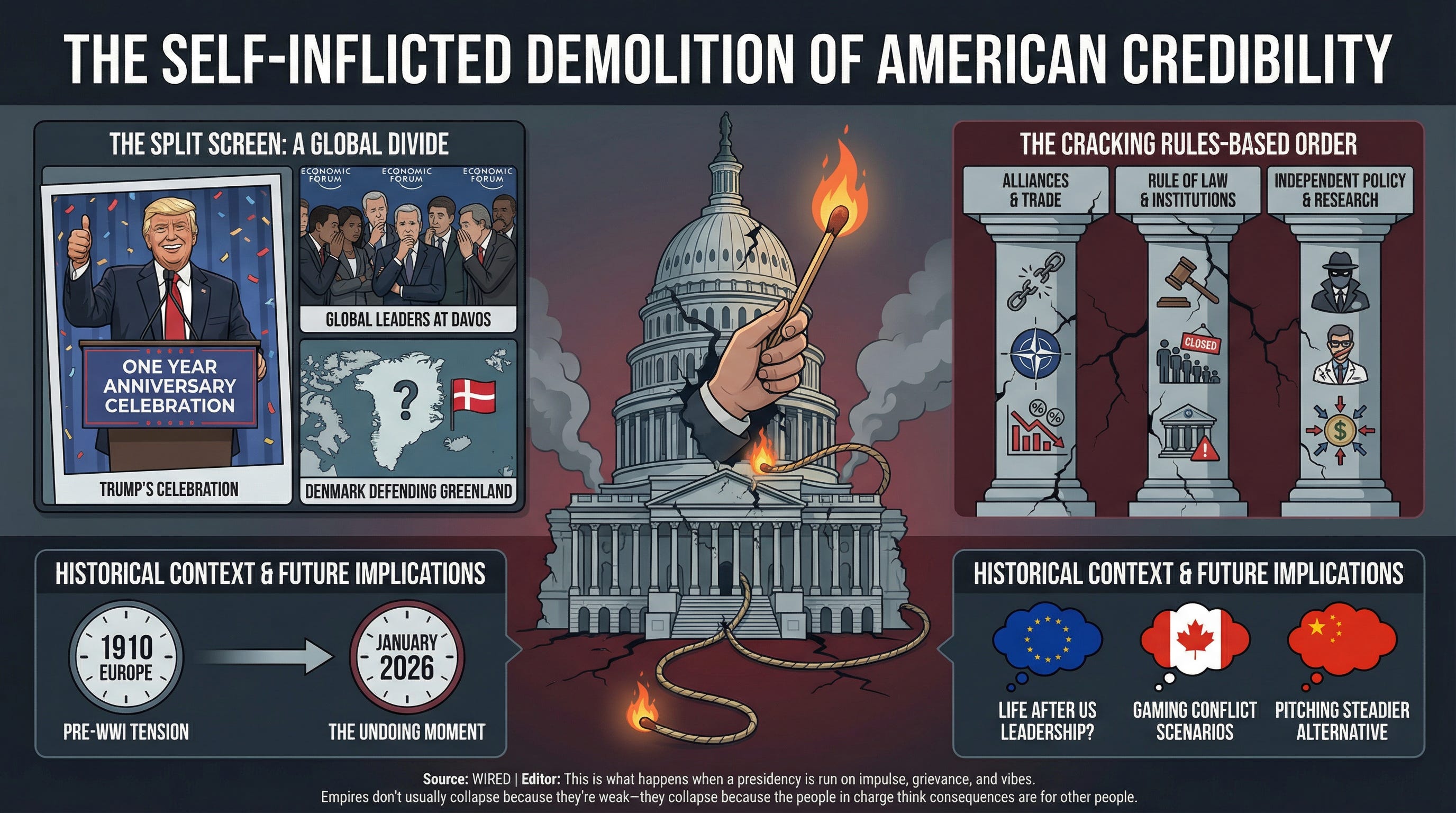
The split screen says it all: Trump celebrating his one-year anniversary, global leaders whispering anxiously in Davos, and Denmark scrambling to defend Greenland from a US president openly flirting with annexation. The rules-based order that held for 80 years is cracking, and the pressure isn’t coming from foreign adversaries—it’s coming from Washington.
Trump’s obsession with Greenland isn’t strategic, ideological, or even popular. Just 17 percent of Americans support it, and only 4 percent back taking it by force—roughly the same number who think Bigfoot is real. Even Trump admits the motive is personal. Asked why Greenland, he said, “Because that’s what I feel is psychologically needed for success.” That’s not foreign policy—it’s id.
The damage runs deeper than one bizarre land grab. The pillars that made America powerful—immigration, research, trade, rule of law, alliances like NATO, and an independent monetary policy—are all under assault at once. Legal immigration is collapsing, allies are prepping tariffs, the Federal Reserve is warning about political pressure, and masked federal agents are roaming American cities like a bad authoritarian cosplay.
The world is responding accordingly. Leaders in Europe are openly discussing life after American leadership, Canada is gaming out conflict scenarios, and China is pitching itself as the steadier alternative. Future historians will look at January 2026 the way we now look at 1910 Europe—the moment before a dominant power finished undoing itself, mostly out of ego.
Source: WIRED
Editor: This is what happens when a presidency is run on impulse, grievance, and vibes. Empires don’t usually collapse because they’re weak—they collapse because the people in charge think consequences are for other people.