


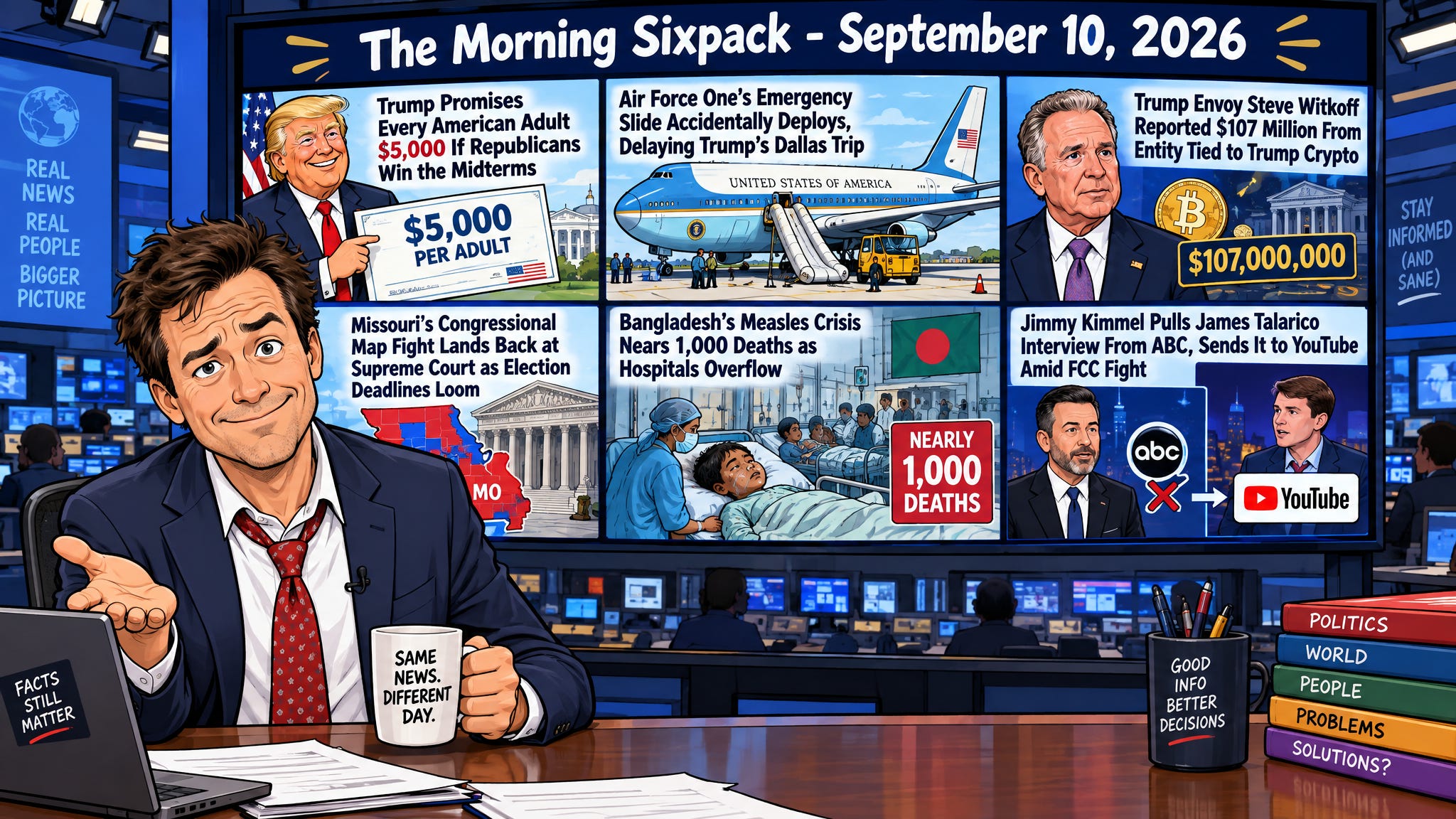
The Morning Sixpack stays free because the news that shapes your life should not be hidden behind a paywall. Paid subscribers are not paying for access. They are helping fund the research, writing, and independent voice that goes into every issue. Become a paid subscriber and help keep smart, honest news analysis free for everyone.
Trump is dangling a $5,000 check for every American adult if Republicans keep Congress, which is one way to turn “get out the vote” into “get out the calculator.” #PresidentialBribes
Trump Floats $5,000 Bribes If Republicans Sweep Midterms—But Who Pays?
President Donald Trump says every adult American will receive a $5,000 “Trump Dividend” (bribe) if Republicans win both the House and Senate in November—a promise that could cost roughly $1.3 trillion. There are nearly 270 million American adults, so even Washington’s calculator may need a minute.
Five grand. Every adult. But only if Republicans win Congress.
Trump unveiled the proposal at the Republican convention in Dallas, telling supporters: “If the Republicans win the House of Representatives and the United States Senate, both of them, I will issue a dividend to every adult citizen in the United States of America for $5,000.”
He added that recipients would have to spend the money in the United States, although he offered no details about how that requirement would be enforced.
The biggest unanswered question is where the $1.3 trillion comes from. HINT: YOU.
Vice President JD Vance has suggested tariff revenue could finance the payments, describing them as a dividend for American workers. But Congress controls federal spending, and Trump did not explain whether he would seek congressional authorization. Democrats called the proposal an “empty promise,” while legal experts are debating whether tying a massive financial benefit to an election outcome creates legal problems. It should. Duh.
Trump has floated tariff-funded checks before, including $2,000 payments, but this version arrives less than two months before the November 3 midterms with control of Congress at stake. Former Republican strategist Robert Moran supplied perhaps the cleanest assessment: “It is an extraordinary promise, and I’m not sure where that money is going to come from—but it is campaign season.” Translation: The checks aren’t in the mail yet, but the campaign pitch certainly is.
Editor: The 2026 GOP/MAGA campaign platform now comes with a $5,000 rebate offer. Somewhere, a congressional budget analyst just spilled coffee on a $1.3 trillion spreadsheet.
Source: BBC News
A military aide accidentally deployed the emergency slide on the new Qatar-gifted Air Force One, briefly delaying President Trump’s Dallas trip and proving that even presidential travel occasionally comes with an unexpected blowup.
Air Force One’s Emergency Slide Accidentally Deploys, Delaying Trump’s Dallas Trip
President Donald Trump’s flight to Dallas was briefly delayed Wednesday after a military aide accidentally triggered an emergency evacuation slide on the new Air Force One at Joint Base Andrews. The president described the episode as officials “checking the slide,” while multiple reports citing people familiar with the incident said the deployment was accidental.
Nothing livens up a presidential departure quite like accidentally turning a Boeing 747 into the world’s largest bounce house.
Trump remained aboard Marine One for roughly 20 minutes while personnel dealt with the deployed slide. When reporters asked what was happening, Trump said, “They want to make sure everything works perfectly.” Asked whether he was confident the aircraft was safe, he replied, “Yeah, I am, or I wouldn’t be on it.” The slide was ultimately removed and Air Force One departed for Dallas.
The aircraft is the Boeing 747-8 donated by Qatar and subsequently refurbished for presidential use. The incident drew extra attention because the jet has already faced questions about its security capabilities compared with the older presidential aircraft. Trump began flying aboard it in July, and Reuters reports that it is expected to undergo additional security upgrades.
The slide itself wasn’t simply something somebody could stuff back behind a panel and call it good. Emergency evacuation systems require specialized handling after deployment, and crews ultimately removed this one before the aircraft departed. The older presidential aircraft was brought nearby as a backup while crews worked on the problem, but Trump ultimately flew to Dallas aboard the new jet.
Editor: Somewhere in the military aide handbook, “Do not accidentally deploy the giant inflatable slide five minutes before the president leaves” is getting moved from the appendix to Chapter One.
Source: The New York Times
Steve Witkoff reported $107 million in 2025 income from a holding company tied to World Liberty Financial, the Trump-linked crypto venture he helped create—and his day job happens to involve negotiating with some of the same international power players orbiting the business.
Trump Envoy Steve Witkoff Reported $107 Million From Entity Tied to Trump Crypto
President Trump’s special envoy Steve Witkoff reported $107 million in 2025 income from a holding company that owned his stake in World Liberty Financial, more than triple the $34 million he reported from the same entity previously. The latest disclosure included nearly $69 million in cash and $38 million in crypto, according to The Wall Street Journal.
The money is eye-catching; the overlap between private business and public diplomacy is what makes the story consequential.
Witkoff co-founded World Liberty Financial with Trump and members of both families in 2024. His son Zach is the company’s CEO, while Trump’s sons are also involved. Witkoff reported more than $400 million in assets and more than $250 million in total 2025 income, including $120 million from selling a stake in his real-estate company. The disclosures use value ranges for some assets, meaning they don’t provide a precise picture of his overall wealth.
The international connections add another layer. The Journal previously reported that UAE national security adviser Sheikh Tahnoon bin Zayed Al Nahyan backed a $500 million investment for a 49% stake in World Liberty, with at least $31 million going to Witkoff-family-affiliated entities. Witkoff, meanwhile, has met with Tahnoon in his official capacity while working on U.S. diplomacy involving conflicts in the Middle East and Ukraine. The disclosure does not specify how much of Witkoff’s $107 million came from World Liberty versus other assets held by the same entity.
The White House says Witkoff’s business dealings and diplomatic work are separate. Sure, they are.
Spokeswoman Anna Kelly said his “prior commercial activities are completely unrelated to his efforts to end global conflicts on the President’s behalf.” ABC News reports that the White House says Witkoff has now fully divested from World Liberty Financial. Sure, he did.
Editor: When a government financial disclosure requires $107 million, crypto, real estate, foreign investors, and international diplomacy to fit on the same page, the footnotes deserve some attention.
Source: The Wall Street Journal (free)
Missouri election officials are caught between conflicting court orders over which congressional map to use in November, which is not an ideal time for the judiciary to introduce a choose-your-own-adventure ballot.
Missouri’s Congressional Map Fight Lands Back at Supreme Court as Election Deadlines Loom
Missouri’s congressional map battle is back before the U.S. Supreme Court after state and federal courts issued conflicting orders over whether voters should use the state’s 2022 districts or a Republican-drawn 2025 map in the November 3 midterms. Election officials now face rapidly approaching ballot deadlines while the fundamental question of which districts exist remains unresolved.
Missouri knows when Election Day is. At the moment, it’s less certain what congressional map Election Day will actually use.
The fight centers on a 2025 map adopted by Missouri’s Republican-controlled legislature that could improve Republicans’ chances of winning seven of the state’s eight House seats, including by reshaping the Kansas City-area district represented by Democrat Emanuel Cleaver. The Missouri Supreme Court unanimously ruled September 3 that the new map could not take effect unless voters approved it in a referendum, after the group People Not Politicians gathered signatures challenging the redistricting plan.
Then things got complicated. Justice Brett Kavanaugh declined Missouri officials’ emergency request to suspend the state Supreme Court ruling. Less than half an hour later, federal Judge Stephen Clark issued an order requiring Missouri to use the new 2025 map because it had already been used in the August primaries. The 8th Circuit subsequently declined to block Clark’s order, sending People Not Politicians racing back to the U.S. Supreme Court.
The practical consequences are no abstraction. Boone County Clerk Brianna Lennon told The Washington Post that about 40 percent of her county’s voters are directly affected by which map wins.
Her office has prepared election systems for both possibilities while awaiting a final answer. “So the question is not, ‘Oh my gosh, what do we do?’ It’s just, ‘Tell us which map to use,’” Lennon said.
Meanwhile, the Missouri Supreme Court has ordered Secretary of State Denny Hoskins to appear in a contempt proceeding over his decision to proceed with the new map despite the state court’s order.
Editor: When election officials have to program two congressional maps and wait for the courts to tell them which reality applies, “administrative complexity” has officially become an understatement.
Source: The Washington Post (free)
Bangladesh is battling the world’s largest measles outbreak, with nearly 1,000 suspected and confirmed deaths after vaccination gaps left children exposed to a disease the country had once come close to eliminating.
Bangladesh’s Measles Crisis Nears 1,000 Deaths as Hospitals Overflow
Bangladesh has recorded 999 suspected and confirmed measles-related deaths since March, along with more than 166,000 suspected cases, as the country confronts its worst measles outbreak on record. More than 146,000 suspected patients have been hospitalized, and the measles surge is colliding with a dengue outbreak that is pushing an already strained healthcare system even harder.
A disease preventable with two vaccine doses is once again filling hospital wards with desperately sick children.
Health experts point to vaccination gaps created during political upheaval in 2024 and 2025, when routine immunization was disrupted, vaccine supplies became unreliable, and a nationwide measles-rubella campaign was canceled. Bangladesh had previously maintained vaccination coverage around or above the 95% level recommended by the World Health Organization for much of the previous decade. Epidemiologist Mahmudur Rahman put it plainly: “Bangladesh missed its measles elimination target because of vaccination gaps in 2024 and 2025.”
The numbers inside hospitals are grim. Dhaka’s Shaheed Suhrawardy Medical College Hospital was designed for 1,350 patients but is caring for more than 2,350, with some measles patients being treated on the floor. At the same time, more than 45,000 people have been hospitalized with dengue this year. Bangladesh launched an emergency measles-rubella campaign targeting roughly 18 million young children and says more than 19.7 million have now been vaccinated, but experts say catch-up campaigns and stronger routine immunization remain essential.
Behind those statistics are parents bouncing between overcrowded hospitals looking for beds and treatment. Nasima Begum said her 13-month-old son missed his vaccination while sick and later couldn’t receive it because the vaccine wasn’t available. Her plea cuts through every bureaucratic explanation for what went wrong: “I don’t want any other mother to see her child suffer or die from this disease.” When a country gets this close to eliminating measles and then watches it roar back, the lesson is painfully uncomplicated: Vaccination gaps don’t stay gaps for long.
Editor: Measles doesn’t care about political turmoil, procurement changes, or bureaucratic explanations. Give it an opening in vaccination coverage and it will happily write the consequences in hospital admissions.
Source: Reuters
Jimmy Kimmel says his interview with Texas Democratic Senate candidate James Talarico will skip ABC and go straight to YouTube because of FCC-related concerns—a sentence that neatly captures how weird broadcast politics has become in 2026.
Jimmy Kimmel Pulls James Talarico Interview From ABC, Sends It to YouTube Amid FCC Fight
Jimmy Kimmel says he will release his interview with Texas Democratic Senate candidate James Talarico on YouTube instead of broadcasting it on ABC, citing concerns about FCC scrutiny and the potential consequences for ABC affiliates. The decision comes as Disney and ABC are already fighting the FCC in federal court over accelerated license reviews for eight ABC-owned stations.
A political interview that once would have been routine television programming is now headed online while lawyers and regulators argue over what broadcasters can safely put on the air.
Kimmel said he has interviewed candidates from Hillary Clinton and Ted Cruz to Donald Trump during more than two decades on television. But he said the regulatory environment has changed and that he was keeping Talarico’s interview off ABC out of “consideration for our local stations, especially our ABC affiliates in Texas.” Talarico has already been at the center of an FCC equal-time dispute after appearing on ABC’s “The View.”
The broader dispute is now in federal court. Disney and ABC sued the FCC in August after Chairman Brendan Carr ordered eight ABC-owned stations to submit license-renewal applications years ahead of schedule. ABC alleges the move amounts to retaliation and violates its First Amendment rights. The FCC disputes that characterization, saying the accelerated reviews relate to an investigation into alleged unlawful employment discrimination and asking a judge to dismiss Disney’s lawsuit.
Kimmel told viewers that anyone wanting to watch the Talarico interview would have to find it on the show’s YouTube channel, calling that “the best that we can do until November.” The FCC maintains broadcasters remain subject to federal requirements that don’t apply in the same way to platforms such as YouTube. Whatever the courts ultimately decide, one practical consequence is already visible: At least one candidate interview that could have aired on broadcast television won’t.
Editor: Nothing says “modern media landscape” quite like a network television host deciding the simpler place to interview a Senate candidate is the internet.
Source: TheWrap