


The Morning Sixpack stays free because the news that shapes your life should not be hidden behind a paywall. Paid subscribers are not paying for access. They are helping fund the research, writing, and independent voice that goes into every issue. Become a paid subscriber and help keep smart, honest news analysis free for everyone.
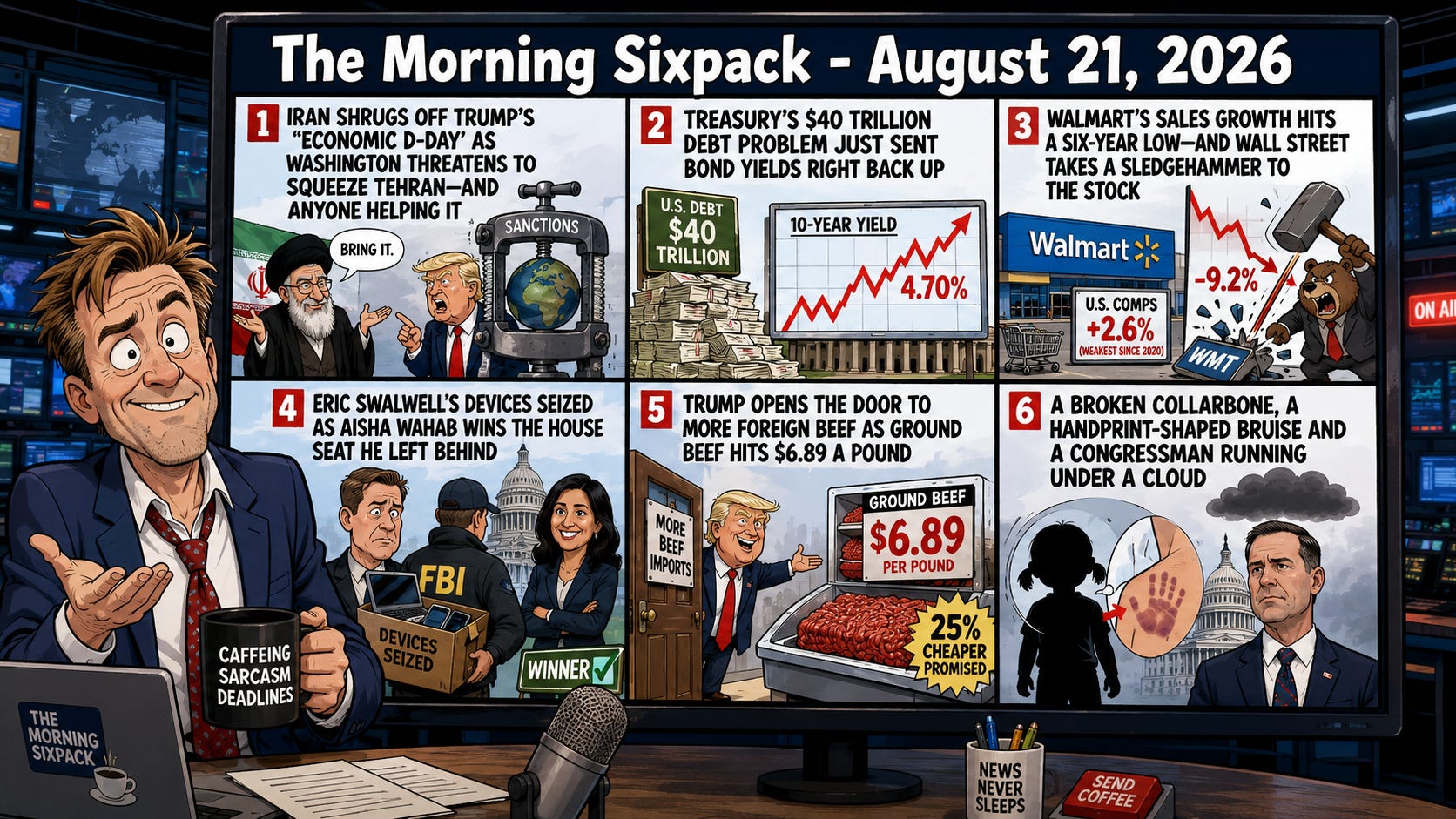
Iran says Trump’s promised “economic D-Day” is proof Washington couldn’t win the war with bombs, so now it’s reaching for the world’s biggest sanctions hammer.
Iran Shrugs Off Trump’s ‘Economic D-Day’ as Washington Threatens to Squeeze Tehran—and Anyone Helping It
Iran is brushing off President Trump’s threat to unleash “the most crushing economic operation ever taken against any country,” arguing that decades of U.S. sanctions haven’t forced Tehran to fold yet. The bigger threat may not be what Washington does directly to Iran, but what it threatens to do to every country still willing to trade with it.
Trump isn’t just threatening Iran anymore—he’s effectively telling the rest of the world to pick a side.
Iranian parliamentary speaker Mohammad Baqer Qalibaf, Tehran’s main negotiator with the U.S., portrayed the new economic offensive as an admission that America and Israel failed to defeat Iran militarily.
“The Americans and the Israelis have realised that they cannot handle Iran…in the field of a hard military war, so they have entered into a cognitive war and an economic war,” he said during a visit to Iraq.
Foreign Minister Abbas Araghchi separately called the strategy “economic terrorism,” while diplomatic efforts remain stalled following the expiration of a 60-day memorandum aimed at negotiating an end to the war.
The U.S. already has extensive sanctions on Iran, has cracked down on businesses and refineries buying Iranian oil, and maintains a blockade as Iran heavily restricts traffic through the Strait of Hormuz. Now Treasury Secretary Scott Bessent is threatening secondary sanctions that could target entire nations doing business with Tehran.
Trump warned Wednesday that “ANY country” providing Iran with a financial or commercial lifeline would face “TREMENDOUS Economic Consequences.”
Bessent went further: “It is going to work in Iran and we are going to collapse this regime. It is time for our allies and the rest of the world to make a decision.”
China is the elephant parked squarely in the sanctions room. Bessent said China had been buying about 90% of Iranian oil but declined to say whether Beijing itself would be targeted. China responded Friday by calling for negotiations and declaring that “sanctions and pressure tactics are not the solution.”
Bessent is expected to detail Trump’s “economic D-Day” on Monday. Meanwhile, Center for International Policy senior fellow Sina Toossi warned that Iranian hardliners may be prepared to absorb enormous economic pain to preserve the regime:
“There’s this existential threat that the Iranians have been faced with. So they’re willing to bear much greater economic costs to kind of secure their survival.”
Editor: Washington wants to turn Iran into an economic island. The interesting part comes when countries like China are handed the bill for refusing to help build the moat.
Source: NPR
Treasury tried to calm the bond market with bigger buybacks and Wall Street’s response lasted roughly long enough for everyone to finish reading the announcement.
Treasury’s $40 Trillion Debt Problem Just Sent Bond Yields Right Back Up
U.S. Treasury yields jumped Thursday, quickly erasing the relief sparked by the government’s decision to ramp up purchases of its own long-term debt. With the national debt now above $40 Trillion, investors appear considerably more interested in America’s underlying fiscal math than Washington’s latest attempt to massage the bond market.
That’s the problem with $40 Trillion in debt—you can buy some bonds back, but you can’t buy back confidence quite so easily.
The benchmark 10-year Treasury yield climbed more than 5 basis points to 4.704%, moving above where it stood before Wednesday’s buyback announcement. The 30-year yield also rose more than 5 basis points to 5.248%, while the more Fed-sensitive 2-year yield barely moved, rising less than one basis point to 4.185%. Treasury had announced it would at least double its longer-term debt buybacks beginning Sept. 9, initially sending the 30-year yield down roughly 10 basis points after it had touched its highest level in about 19 years.
That relief didn’t last. Investors quickly returned their attention to the structural forces pushing borrowing costs higher: A national debt that just crossed $40 Trillion, enormous corporate borrowing connected to the artificial-intelligence build-out, stubborn inflation, and the possibility that the Federal Reserve will need to keep rates elevated. JPMorgan Chase senior research analyst Maia Crook warned that Treasury’s intervention “belie[s] the underlying structural challenges and do[es] nothing to address them,” adding that intervention could ultimately produce “higher risk premia” as Treasury moves away from its traditional “regular and predictable” approach.
Treasury Secretary Scott Bessent has suggested the buyback operation could exceed the initially announced $4 billion, but bigger purchases don’t erase the forces driving yields upward. July Fed minutes indicated officials could need higher interest rates if inflation fails to improve, while Thursday brought another reminder that the economy isn’t exactly begging for rescue: The Philadelphia Fed manufacturing index posted its strongest reading since April 2021. Treasury wanted to put a lid on long-term yields. The bond market politely removed it.
Editor: When Washington announces a bond-market intervention and yields are higher again the next day, the market isn’t being subtle. $40 Trillion has a way of drowning out the press release.
Source: CNBC
Walmart is still selling $186 billion worth of stuff in three months, but its weakest U.S. sales growth since 2020 was enough for Wall Street to send the stock down 9.2%.
Walmart’s Sales Growth Hits a Six-Year Low—and Wall Street Takes a Sledgehammer to the Stock
Walmart posted its smallest U.S. comparable-sales increase in more than six years, as cautious consumers and weaker physical-store traffic overshadowed booming e-commerce growth. Investors didn’t bother waiting around to see how the transformation plays out—the stock plunged 9.2% Thursday, its worst day in more than four years.
When Walmart shoppers start watching every dollar, you can bet the rest of corporate America is watching Walmart.
U.S. comparable sales rose just 2.6%, the weakest quarterly increase since 2020 and below analysts’ expectations. Walmart said new pharmacy-pricing regulations dragged down the number and that comparable sales would have risen 3.4% without them. Physical-store comparable sales declined in the “low single digits,” even as U.S. e-commerce sales surged 24%. That digital growth matters: E-commerce now represents nearly a quarter of Walmart’s overall sales, and roughly 80% of those orders are fulfilled through its stores.
CFO John David Rainey argues the old distinction between stores and digital sales increasingly misses what’s actually happening inside Walmart. “It’s a legacy fixation,” he said. “We are not the Walmart of a decade ago.” The company is increasingly using its giant store network as fulfillment infrastructure for online orders while building businesses around advertising and memberships. Meanwhile, Walmart says it continues gaining market share, particularly among households earning $100,000 or more, while lower-income consumers remain cautious amid higher gas prices. The company has also been cutting prices, helped partly by $2.9 billion in tariff refunds.
And here’s the wrinkle Wall Street’s 9.2% selloff has to digest: Walmart actually raised its full-year outlook. The company now expects net sales to grow 4% to 5% and operating income to rise 7% to 8.5%. Quarterly net sales climbed 5.9% to $186.1 billion, although net income fell 9.4% to $6.37 billion. So Walmart isn’t exactly wheezing in the clearance aisle. But with its shares now 23% below their record close from only three months ago, investors are making it clear that America’s biggest retailer doesn’t get much room for an off quarter.
Editor: Walmart grew sales, raised its outlook, and watched its stock get flattened anyway. Wall Street apparently saw “weakest growth since 2020” and stopped reading before reaching the part where the company still sold $186.1 billion worth of merchandise.
Source: The Wall Street Journal (free)
Eric Swalwell’s political exit now comes with FBI-seized electronics and a successor already taking his old House seat—Washington turnover rarely comes with this much baggage.
Eric Swalwell’s Devices Seized as Aisha Wahab Wins the House Seat He Left Behind
Former Rep. Eric Swalwell had his electronic devices seized by the FBI and his Washington home searched as part of a federal investigation into sexual-misconduct allegations, just as Democrat Aisha Wahab won the special election to finish his House term. One political career is moving into Congress while the other is moving deeper into multiple criminal investigations.
Swalwell went from leading the California governor’s race to losing his devices to federal agents and watching someone else win his congressional seat.
Federal agents stopped the 45-year-old former congressman at an airport and seized his electronic devices while also executing a search warrant at his Washington, D.C., home, according to CBS News as reported by the BBC. Swalwell faces allegations from multiple women, including accusations of rape, sexual assault and sending unsolicited nude photographs.
He is also reportedly under criminal investigation by the Manhattan District Attorney’s Office and Los Angeles Sheriff’s Department. Swalwell has previously denied the allegations, and his attorney Sara Azari called them “false, fabricated, and deeply offensive—a calculated and transparent political hit job.” The allegations remain accusations, and no criminal conviction is described in the reports.
The political consequences, however, are already very real. Swalwell abandoned his campaign for California governor after the allegations surfaced, despite having been leading the race, and resigned his House seat. On Thursday, Democrat Aisha Wahab won the special election to serve the remainder of his term, defeating fellow Democrat and Bay Area Rapid Transit Board President Melissa Hernandez. California’s jungle-primary system means Wahab and Hernandez aren’t finished with each other—they’ll meet again in November for the next full term.
Wahab, a former California state senator and the first Afghan American to serve in Congress, now inherits a seat whose previous occupant is facing investigations on opposite sides of the country and at the federal level. Swalwell maintains that the allegations against him are fabricated, while investigators are apparently interested enough to start collecting hardware. The courts will determine what, if anything, happened. Voters have already determined who gets his desk.
Editor: Politics usually gives defeated candidates a little time to clean out the office. Swalwell’s replacement has already been elected while federal agents are apparently helping with the electronics.
Trump is temporarily loosening tariffs on foreign beef to fight record prices, which means the tariff wall has apparently developed a hamburger-sized door.
Trump Opens the Door to More Foreign Beef as Ground Beef Hits $6.89 a Pound
President Trump says the U.S. will temporarily allow up to 300,000 metric tons of imported ground beef to enter without triggering higher tariffs, as beef prices continue hammering American shoppers. Ground beef averaged $6.89 a pound in July—10% higher than a year earlier—and the administration now says the imported product will be sold 25% below current market prices.
Nothing concentrates Washington’s attention quite like discovering that the backyard hamburger has become a luxury item.
The 90-day plan marks another attempt to tackle one of the most stubborn pieces of food inflation. America entered 2026 with roughly 86.2 million cattle and calves, the smallest herd since the 1950s, after drought and difficult financial conditions pushed ranchers to reduce herds. The shortage has driven livestock costs higher and squeezed meatpackers, with Tyson recently announcing the closure of a major Illinois beef-processing plant—its second shutdown this year.
The administration had considered suspending beef tariff-rate quotas earlier this year but backed away after resistance from cattle groups and some congressional Republicans. Now Trump is trying again on a temporary basis.
“We have a commitment that this beef will be sold at 25 percent below current market prices,” Trump said.
The administration hasn’t yet released the documents implementing the plan, and it wasn’t immediately clear which countries would supply the beef or which retailers would sell it. The proposed imports would equal roughly 2% of the approximately 29 billion pounds of beef Americans are expected to consume this year.
The administration has also launched an antitrust investigation into major meatpackers, proposed funding for smaller processors, and reopened southern ports to Mexican cattle after closures prompted by New World screwworm concerns. But beef-industry officials say rebuilding America’s cattle herd remains the durable solution—and that takes about two years. In other words, Washington can adjust tariffs in 90 days; unfortunately, cows continue stubbornly refusing to operate on the election-cycle production schedule.
Editor: We spent years arguing that tariffs protect American producers, and now we’re suspending tariffs to protect American consumers from $6.89 ground beef. Somewhere, an economist just quietly ordered the chicken.
By the way, ground beef runs around $10 a pound in the PNW and CA.
Source: The Wall Street Journal (free)
Police spent months investigating how Rep. Max Miller’s 2-year-old daughter suffered a broken collarbone and suspicious bruise, only to close the case without identifying who—or what—caused the injury.
A Broken Collarbone, a Handprint-Shaped Bruise and a Congressman Running Under a Cloud
An investigation into a broken collarbone and apparent handprint-shaped bruise on the 2-year-old daughter of Republican Rep. Max Miller ended without charges after authorities said they couldn’t determine who caused the injury. Miller was cleared of the child-abuse allegation by county investigators, but the case has spilled into his bitter custody fight, triggered a House ethics investigation, and turned what should be a safe Republican reelection campaign into something considerably messier.
The criminal case is closed, but politically, this thing is nowhere near the rearview mirror.
The investigation began after Miller’s daughter was diagnosed Feb. 19 with a fractured right collarbone and doctors noticed a bruise that appeared shaped like a handprint, including what looked like a thumbprint on her shoulder. Four adults had access to the child during the relevant period—Miller, his ex-wife Emily Moreno, Miller’s girlfriend, and the child’s nanny—and all denied hurting her or knowing what happened. Police studied the child’s movements on library surveillance footage, reviewed photographs, and interviewed the adults, but couldn’t establish when or how the injury occurred. Investigators ultimately ruled out one theory involving a car-seat strap.
The investigation also exposed an ugly battle between Miller and Moreno, daughter of Republican Sen. Bernie Moreno. Emily Moreno told police she had been afraid of Miller and alleged that he once held a gun to her head while she changed their baby’s diaper and, on another occasion, threw her against a wall. Miller denies those allegations. During questioning, Miller initially considered accidental explanations for his daughter’s injury but later pointed the finger at Moreno, telling investigators: “She did it. She’s guilty.” His spokesman now says Miller won’t speculate about who injured the child.
In April, county Children and Family Services determined the abuse allegation against Miller was unsubstantiated, finding “no evidence” to support it. The agency instead classified abuse as “indicated” against an unidentified alleged perpetrator, meaning there were signs abuse may have occurred but investigators couldn’t determine who was responsible. In May, prosecutors concluded there was “insufficient admissible evidence” to present the case to a grand jury. The police report ended rather definitively: “Case Closed. Prosecution Declined.” Miller, however, remains under a House ethics investigation and faces reelection after the deadline for Republicans to replace him on the November ballot passed Aug. 10. Democrats now see an opening in what ordinarily would be reliably Republican territory.
Editor: Investigators couldn’t establish who hurt this little girl, and that’s the fact that matters most. But “Case Closed” is a phrase that works much better in a police file than on a campaign poster.
Source: The Washington Post (free)