



The Morning Sixpack stays free because the news that shapes your life should not be hidden behind a paywall. Paid subscribers are not paying for access. They are helping fund the research, writing, and independent voice that goes into every issue. Become a paid subscriber and help keep smart, honest news analysis free for everyone.
Trump says he doesn’t want a deal with Iran, but Washington is reportedly considering massive new airstrikes. Apparently, diplomacy is getting in the way of a perfectly good bombing campaign.
Trump Rejects Iran Deal as U.S. Weighs Massive Bombing Campaign Ahead of Midterms
President Donald Trump said Wednesday that he no longer wants a diplomatic agreement with Iran, even as reports indicate his administration is considering a major new military offensive against the country. Speaking at a Republican campaign rally in San Antonio, Trump claimed Iranian officials were willing to make significant concessions to stop the fighting. “I think the deal isn’t really something that I want to do, but they’re willing to offer us anything to stop,” he said. Trump added that Middle East envoy Steve Witkoff had been working on negotiations and was “doing very well,” despite the president’s apparent loss of interest in reaching an agreement.
Behind the scenes, the White House is reportedly discussing a return to large-scale military operations against Iran within weeks. NBC News reported Wednesday that Trump and his national security team have considered resuming major attacks, citing a U.S. official and another person familiar with the discussions. Axios separately reported that the potential offensive could involve “massive bombing” of Iranian energy facilities, infrastructure, and nuclear targets. The strikes could occur before November’s midterm elections, raising questions about how another escalation in the conflict might affect an already volatile political environment.
The military discussions come as Trump faces mounting domestic political pressure over the cost of living, particularly soaring gasoline and diesel prices. His approval ratings have reportedly fallen to record lows as Americans struggle with elevated energy costs. Axios noted that renewed military action could influence the midterm elections, although the political consequences remain uncertain. Another major round of attacks could further complicate an energy market already strained by the conflict.
Diplomatic negotiations have also been undermined by conflicting accounts of who is responsible for the stalled peace process. Earlier this week, Trump claimed Washington’s biggest obstacle was uncertainty over who actually controlled Iran during negotiations. Iranian officials rejected that characterization, arguing that Washington was the source of confusion. Foreign Ministry spokesperson Esmail Baghaei pointed to the “contradictory positions and mixed messaging from U.S. officials.” With Trump simultaneously praising his envoy’s negotiations and dismissing the prospect of a deal, the administration’s next move remains unclear.
Meanwhile, global oil markets continue to feel the effects of the conflict despite signs that regional exports are recovering. According to energy analytics firm Kpler, combined crude shipments from the Gulf, excluding Iran, along with Saudi Arabian and United Arab Emirates volumes, have returned to approximately 18.5 million barrels per day, roughly their prewar levels. Yet crude prices remain elevated, suggesting that recovering supply has not eliminated concerns about regional instability. Kpler freight analyst Matt Wright said normalization could continue without a diplomatic agreement, although he expects the process to be slower and uneven as shipping operators adapt to ongoing hostilities. That leaves consumers facing high fuel prices while Washington weighs military action that could introduce still more uncertainty.
Editor: So Iran is reportedly willing to negotiate, Trump’s envoy is doing a great job, and the president doesn’t want a deal. Meanwhile, Americans are paying through the nose at the pump, and the White House is contemplating bombing energy infrastructure. Somebody explain how this is supposed to make gasoline cheaper.
Source: CNBC
Kimberly Guilfoyle reportedly wanted a Trump donor to pay off her $100,000 Amex bill without leaving a paper trail. Nothing screams financial transparency quite like asking someone to make six figures disappear.
Kimberly Guilfoyle Asked Trump Donor to Pay $100,000 Amex Bill While Offering Access to Top Officials
Kimberly Guilfoyle, now the U.S. ambassador to Greece, allegedly pressured a wealthy Trump supporter to pay $100,000 toward her American Express bill just days before her Senate confirmation hearing. According to a Wall Street Journal investigation based on hundreds of messages, emails, and letters, Guilfoyle urged Kentucky political donor Eric Deters to wire the money directly to American Express, claiming the transaction wouldn’t leave a paper trail. “It won’t show up anywhere if you wire money to American Express,” she reportedly wrote on the encrypted messaging app Signal. On July 3, 2025, six days before her confirmation hearing, she sent Deters payment instructions and pleaded with him to complete the transfer immediately. Deters ultimately refused, saying the payment would jeopardize his marriage.
The reported request was part of a much larger arrangement in which Guilfoyle allegedly offered her political connections to help Deters resolve personal legal and financial disputes. Deters, a former congressional and gubernatorial candidate who had donated to Trump-related causes, wanted assistance with an IRS tax dispute, a Justice Department investigation, and the extradition of a Pakistani doctor accused of performing unnecessary spinal surgeries. Guilfoyle, formerly engaged to Donald Trump Jr., reportedly contacted incoming IRS Commissioner Billy Long and offered to approach other powerful administration figures, including FBI Director Kash Patel and former Attorney General Pam Bondi. Deters had previously paid Guilfoyle $300,000 for speaking engagements and discussed additional payments tied to her assistance, including a potential $1 million arrangement to secure an appearance on Tucker Carlson’s show. Carlson told the Journal he had never heard of Deters and called the proposed million-dollar podcast appearance “completely nuts.”
The messages also reveal Guilfoyle’s apparent concern about creating written records of their financial dealings while she awaited confirmation. In January 2025, she reportedly scolded Deters for discussing their arrangement with a podcast producer, warning that public disclosure could threaten her ambassadorship. She repeatedly instructed him to stop documenting their conversations about money and encouraged him to communicate through Signal instead. In June, after Deters complained in writing that he had paid her hundreds of thousands of dollars without receiving results, she again warned him against creating records. The correspondence raises questions about whether a politically connected nominee was seeking compensation for helping a donor gain access to government officials.
Guilfoyle’s financial circumstances provide additional context for the reported requests. According to the Journal, she complained privately about money problems as her confirmation hearing approached, despite reporting nearly $800,000 in podcast income and business assets valued in the millions. Her financial disclosures also listed a mortgage of between $1 million and $5 million and a boat loan of up to $250,000. She had struggled to sell the Florida mansion she once shared with Trump Jr., initially listed for $30 million, before he eventually bought out her interest for $7.6 million. Guilfoyle had also pursued several business ventures, including cosmetics, a medspa, and an upscale alcohol brand that was later dissolved.
Guilfoyle disputes the authenticity of the messages through her attorney, Jesse Binnall, who declined to identify specific inaccuracies. Binnall maintained that she was owed money for legitimate speaking engagements and defended her efforts to draw attention to allegations involving unnecessary surgeries performed on children. Deters disputed owing her any outstanding balance and complained that her promises had produced little in return. The revelations follow another Journal investigation into Guilfoyle’s promotion of a Greek company, which prompted Democratic lawmakers to request a State Department review of her conduct. Secretary of State Marco Rubio nevertheless praised her performance during a Wednesday appearance in Athens, calling her a strong ambassador. No finding of criminal wrongdoing was reported in the investigation.
Editor: A $100,000 credit card bill, a donor looking for government favors, and repeated warnings not to put anything in writing. That’s quite a collection of red flags for someone representing the United States abroad. And the guy who was supposed to pay the bill says he never got the favors he wanted. Apparently, even influence peddling has customer service complaints.
Source: The Wall Street Journal
Oil prices are soaring, diesel is topping $6 a gallon, and Trump is considering another round of strikes against Iran. Apparently, the road to cheaper energy runs straight through another bombing campaign.
Oil Surges Past $105 as Trump Weighs New Iran Strikes, Sending Stocks Tumbling and Gas Prices Soaring
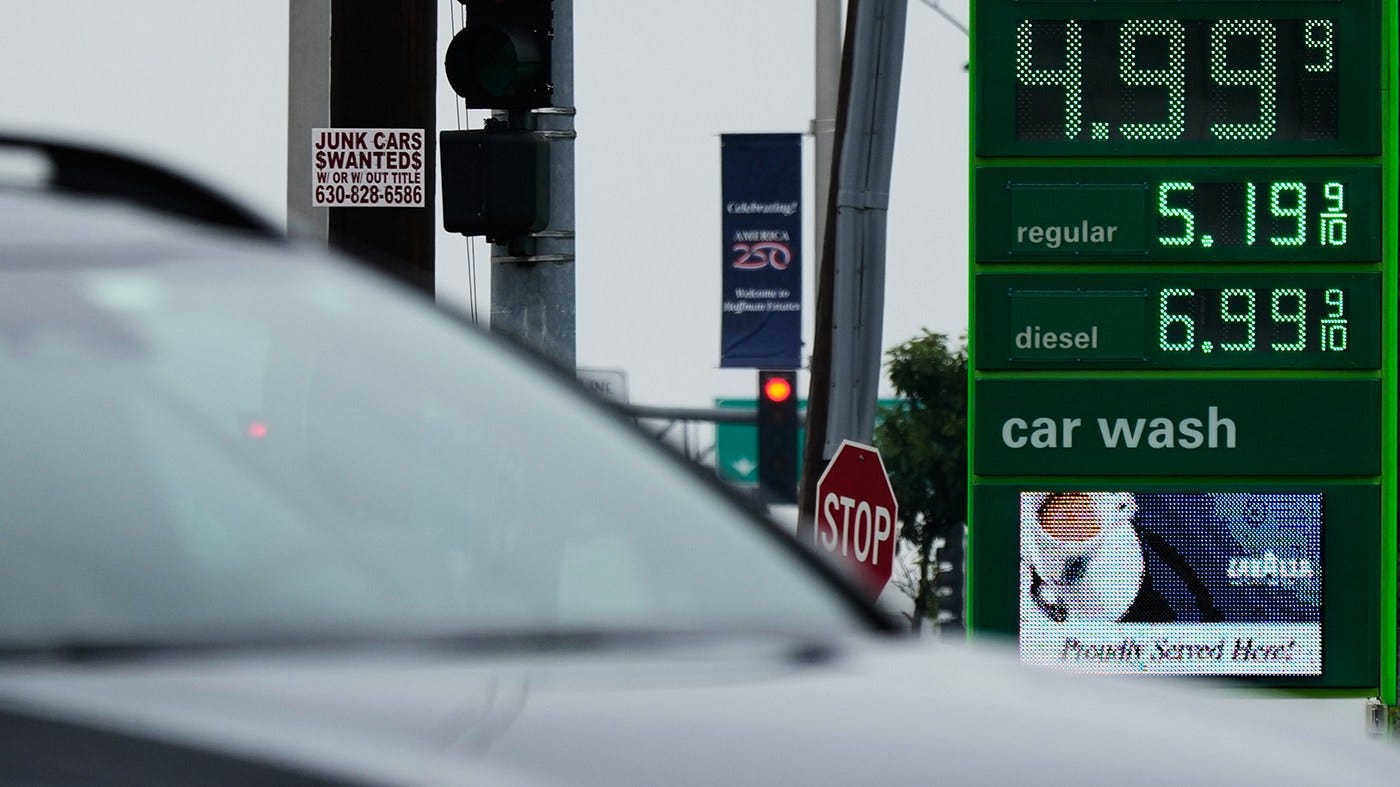
Global oil prices surged Thursday as President Donald Trump considered resuming large-scale U.S. military operations against Iran, rattling financial markets and threatening to drive already painful fuel prices even higher. Brent crude jumped more than 5% to above $105 per barrel, while U.S. crude climbed nearly 5% to almost $93. Diesel futures rose 4.5% in European trading, and heating oil futures, which also serve as a proxy for jet fuel, gained more than 4%. The increases reflect growing fears that renewed military action could further disrupt energy supplies from one of the world’s most important oil-producing regions.
The prospect of another major military offensive sent shock waves through stocks and bonds as investors weighed the economic consequences of an escalating war. The yield on the benchmark 10-year U.S. Treasury jumped to 5.35%, potentially increasing borrowing costs for mortgages, auto loans, and other consumer credit. S&P 500 futures declined 0.6%, Nasdaq 100 futures dropped 0.8%, and Russell 2000 futures fell 1%. NBC News reported that Trump and his national security advisers were discussing military options that could be implemented within weeks, although no final decision had been made. Any substantial operation would come less than a month before the midterm elections, with early voting already underway.
The potential escalation threatens to end a fragile three-month stalemate between Washington and Tehran, while shipping through the strategically vital Strait of Hormuz remains severely restricted. Iranian attacks on commercial vessels have reduced traffic through the waterway, which normally carries enormous volumes of crude oil and petroleum products to international markets. According to MarineTraffic, fewer than 23 ships per day passed through the strait between September 28 and October 4, compared with hundreds daily before the war. The disruption has forced energy producers and shipping companies to find alternative routes and supplies, creating extraordinary transportation costs. Bloomberg reported that moving a tanker of American crude to Asia now costs approximately $77 million, compared with an average of just $9.2 million for the same route in 2025.
Energy analysts warn that another round of fighting could push oil prices substantially higher, particularly if Iranian or regional energy infrastructure suffers significant damage. Francisco Blanch, Bank of America’s head of global commodities, warned in September that continued disruptions could keep Brent crude trading between $95 and $120 per barrel through the end of the year. A broader conflict involving major infrastructure damage could send prices as high as $150 per barrel, he cautioned. Those scenarios would place additional pressure on businesses and consumers already struggling with elevated transportation and energy expenses. With shipping costs at extraordinary levels and traffic through Hormuz severely constrained, even countries outside the immediate conflict are feeling the economic effects.
American motorists are already paying a steep price for the war, which began February 28 with U.S. and Israeli attacks on Iran. The national average for regular gasoline reached $4.36 per gallon Thursday, more than 45% higher than before the conflict began. Diesel prices have climbed even faster, rising nearly 70% to $6.28 per gallon, with additional pressure coming from recent escalations in the Russia-Ukraine war. Higher diesel costs affect far more than truck drivers, increasing expenses throughout the supply chain as goods move from farms, factories, and ports to store shelves. With the midterm elections approaching, the administration faces the prospect of further military escalation while voters confront increasingly expensive fuel and the broader economic consequences of prolonged conflict.
Editor: Gas is $4.36, diesel is $6.28, mortgage-related borrowing costs are climbing, and oil could hit $150 if things get worse. Meanwhile, Washington is considering another bombing campaign in the Middle East. At this rate, Americans may need a second job just to afford the commute to their first one.
Hey, remember when Trump promised $2 gas during his 2024 campaign (and continued that bullshit after he was elected? WHERE ARE THOSE $2 A GALLON GAS PRICES NOW, MANGO?
Source: NBC News
Washington helped take control of Venezuela’s oil industry, and now former Trump officials are lining up for lucrative private-sector opportunities. Apparently, the revolving door between government and business comes with an oil pipeline.
Former Trump Officials Cash In on Venezuela Oil Boom After U.S. Takeover
Former Trump administration officials are moving into lucrative private-sector positions tied to Venezuela’s oil industry following the U.S. military operation that removed President Nicolás Maduro in January. A Washington Post investigation reveals that companies and investors are aggressively recruiting people with recent White House connections, insider knowledge of U.S. policy, and access to influential administration figures. One prominent example is Michael Jensen, formerly the National Security Council’s top official for Latin America, who joined a newly formed energy company just three days after leaving government service. On June 1, Jensen boarded a private jet with cryptocurrency billionaire Fred Ehrsam, co-founder of Coinbase, to explore oil opportunities in Venezuela. The rapid transition highlights growing concerns about the intersection of U.S. foreign policy, political influence, and private financial gain.
The scramble for Venezuela’s vast energy resources has created an extraordinary business opportunity for former government insiders and politically connected investors. Jensen became vice president of operations at Primavera, Ehrsam’s new energy venture, which subsequently signed production agreements with Venezuela’s state-owned oil company, PDVSA. Ehrsam was also appointed to Trump’s Council of Advisors on Science and Technology, further connecting the venture to the administration. Meanwhile, Brittany Kelm, formerly a senior adviser to the White House’s National Energy Dominance Council, joined Houston-based Sable Offshore, which is reportedly negotiating Venezuelan oil development contracts. Democratic lawmakers have demanded information about Kelm’s interactions with Sable while she was still working in the White House. Another former administration official, Micah Ketchel, joined Ballard Partners, a lobbying firm helping clients navigate Venezuela’s rapidly changing political and commercial environment.
The opportunities emerged after U.S. forces captured Maduro on January 3, installed Vice President Delcy Rodríguez as interim president, and assumed substantial control over Venezuela’s energy sector. The Trump administration subsequently moved to attract foreign investment and revive the country’s long-struggling oil industry. In August, Washington took an unusual direct 35% ownership stake in North American Blue Energy Partners, Venezuela’s second-largest private oil company. That arrangement placed the U.S. government in the position of both shaping Venezuelan energy policy and holding a financial interest in the industry. Lobbyists, consultants, investors, and former officials from both political parties have since descended on Caracas, although individuals with current Trump administration connections appear particularly valuable to companies seeking access and contracts.
The expanding business activity is raising familiar questions about Washington’s revolving door, in which public officials leave government service for companies that stand to benefit from policies they previously helped shape. Federal law restricts former officials from lobbying on matters they personally handled and imposes additional limits on certain senior employees. Representatives for Jensen, Kelm, and Ketchel maintain that they consulted ethics officials and complied with applicable rules. The White House similarly defended the arrangements, saying it had no reason to believe former employees were violating federal restrictions. Richard Painter, a former chief White House ethics lawyer under President George W. Bush, said Jensen’s employment would likely be permissible provided he avoided using classified information or improperly lobbying on matters he handled in government. Painter nevertheless expressed concern that former officials could exploit their connections for personal financial advantage.
The rush extends beyond recently departed officials to prominent veterans of previous administrations. Former Secretary of State Mike Pompeo, former Energy Secretary Dan Brouillette, and former State Department official Kimberly Breier have reportedly assembled a deal to export Venezuelan fertilizer to the United States. Carlos Trujillo, a former Trump ambassador, operates a lobbying firm representing at least a dozen clients in Venezuela, while former Biden administration official Juan González has also traveled there for consulting work. Mauricio Claver-Carone, another former senior Trump official, described Venezuela as an exceptionally attractive emerging market, saying, “Everybody is in Venezuela.” For investors, the country’s enormous natural resources and newly reopened business environment represent potentially significant profits. For critics, the situation raises a more uncomfortable question about whether American military power and foreign policy are creating financial opportunities for the very people who helped shape those policies.
Editor: First Washington helps remove Venezuela’s president and takes control of its oil industry. Then former officials start landing jobs and brokering deals with companies eager to profit from the new arrangement. Everyone insists the ethics rules are being followed, of course. But when the people making foreign policy become the people making money from that policy, taxpayers deserve more than a pinky promise that everything’s aboveboard.
The ONLY conclusion one can draw from Trump’s inflationary policies is that he and his cronies are benefitting from higher prices, especially oil and gas.
Source: The Washington Post
Republicans want cheaper gas before Election Day, but their proposed fixes keep getting shot down by other Republicans. Turns out the only thing harder than lowering fuel prices is getting the GOP to agree on who should take the financial hit.
Republicans Turn on Each Other Over Gas Prices as Election Day Looms
Senate Republicans are struggling to agree on how to lower soaring gasoline and diesel prices before the November 3 midterm elections, with internal divisions derailing nearly every proposed solution. Lawmakers from oil-producing states, agricultural regions, and fiscally conservative factions have repeatedly clashed over measures intended to provide relief at the pump. Proposals to temporarily ban diesel exports, suspend federal fuel taxes, and expand access to ethanol-blended gasoline have all encountered resistance from within the Republican Party. With Election Day less than a month away, GOP strategists acknowledge that Washington has few effective tools to bring prices down quickly enough to help vulnerable Republican candidates.
One of the most prominent proposals, a 90-day ban on diesel exports, collapsed after fierce opposition from oil-state Republicans and energy industry officials. Sen. Chuck Grassley of Iowa championed the idea in September, arguing that keeping American-produced diesel at home could ease prices that had climbed above $6 per gallon. President Trump initially embraced the proposal, and the White House explored implementing it despite objections from Energy Secretary Chris Wright. But Republican senators Kevin Cramer of North Dakota and John Cornyn of Texas warned that restricting exports could discourage production, disrupt global markets, and potentially make diesel more expensive. Cornyn dismissed the plan as a “gimmick,” while Wright insisted that banning diesel exports would not work. Trump ultimately abandoned the proposal last week.
Another proposed solution, temporarily suspending federal fuel taxes, ran into opposition from Republicans concerned about government spending and infrastructure funding. Sen. Josh Hawley of Missouri promoted a gas tax holiday as a way to provide immediate relief to American families and workers. The federal government currently collects 18.4 cents per gallon on gasoline and 24.4 cents on diesel, with the revenue supporting the highway trust fund. Fiscal conservatives, including Sen. Rand Paul of Kentucky, objected that suspending those taxes would undermine transportation funding. Supporters argued that a short-term suspension would provide tangible savings without significantly damaging the fund, but the proposal failed to gain sufficient Republican support.
Farm-state Republicans have also pushed to expand year-round availability of E15 gasoline, a blend containing 15% ethanol, as another way to lower fuel costs. Sen. Mike Rounds of South Dakota claimed broader access could reduce prices by as much as 30 cents per gallon, while also supporting American agricultural producers. However, Republicans representing oil-refining interests warned that expanding E15 sales could hurt smaller and midsize refiners. Senate Majority Whip John Barrasso of Wyoming opposed what he characterized as a year-round ethanol mandate, highlighting the competing economic interests dividing the party. Senate Majority Leader John Thune nevertheless expressed confidence that E15 legislation could eventually pass as part of the stalled farm bill, although the precise provisions remain unsettled and action may have to wait until after the election.
The deeper problem is that domestic policy changes may have limited influence over fuel prices while the war with Iran continues disrupting global oil supplies. The Strait of Hormuz, a critical shipping route for international petroleum shipments, remains severely constrained by Iranian threats to commercial tankers. Previous releases from the Strategic Petroleum Reserve have also reduced Washington’s flexibility to intervene in energy markets. Republican strategist Ron Bonjean said the federal government’s available options would have little effect on gasoline prices before Election Day, predicting that prices would likely remain elevated. He suggested that reopening the Strait of Hormuz through a diplomatic or military solution could bring more meaningful relief, although the administration has recently discussed renewed military action against Iran. For Republicans facing voters angry about affordability, the combination of expensive fuel, limited policy options, and internal party divisions presents an increasingly difficult political problem.
Editor: Republicans have three ideas to lower gas prices, and Republicans have three reasons those ideas won’t work. The oil states don’t want export restrictions, the farm states want more ethanol, and the fiscal hawks won’t touch the gas tax. Meanwhile, voters just want to fill their tanks without taking out a second mortgage. Washington’s solution? Keep arguing until after the election.
Source: The Hill
The Trump grift continues... Now the president wants to turn his privately owned golf club into an official presidential retreat. Because apparently having a taxpayer-funded Camp David isn’t enough when there’s a Trump-branded property available.
The Trump Grift Continues: President Wants to Turn His Private Golf Club Into a New Camp David
President Donald Trump wants to transform his privately owned golf club in West Palm Beach, Florida, into an official presidential retreat, potentially creating a lasting connection between the presidency and his family’s business empire. Trump announced the proposal Wednesday, describing the property as an alternative to Camp David where future presidents could relax, play golf, and entertain foreign leaders. He claimed the idea originated with the Secret Service and argued that the golf course already offers many of the security advantages needed for presidential visits. The proposal has been submitted to Palm Beach County officials, whose approval would be necessary because the Trump Organization owns the club but leases the underlying land from the county.
The arrangement would give Trump’s private golf business an official presidential designation while allowing future administrations to use facilities built on the property. According to a letter submitted by attorney Harvey Oyer, who represents the golf club, Trump wants the property recognized as a “U.S. Presidential Golf Course.” The club would finance construction of presidential lodging and coordinate with the Secret Service and other federal agencies to provide the government with free access. A separate entrance would distinguish the presidential facilities from the private club, which generated nearly $37 million in income for Trump during his first year back in office, according to his financial disclosure. Although the proposal promises free government access, the article does not establish who would ultimately bear ongoing security and operating expenses or whether the presidential designation would provide financial benefits to Trump’s business.
Trump promoted the location as particularly suitable for presidential use because of its proximity to an airport and its distance from residential neighborhoods and tall buildings. He did not mention that the same golf course was the scene of an attempted assassination during his 2024 presidential campaign. In that incident, a Secret Service agent spotted an armed man near the club’s perimeter while Trump was golfing. The suspect was arrested following a pursuit, subsequently convicted of attempting to kill Trump, and sentenced to life in prison. Despite that history, Trump maintained that the property would make an excellent retreat for future presidents, predicting that it would receive frequent use.
The proposal is the latest in a growing collection of projects through which Trump has sought to reshape presidential landmarks and Washington’s physical landscape. His administration has pursued plans for a White House ballroom, a triumphal arch, changes to the Kennedy Center, improvements to the Lincoln Memorial Reflecting Pool, and reconstruction of a golf course in East Potomac Park. Trump has also begun planning a presidential library in a Miami skyscraper. Palm Beach County Administrator Joseph Abruzzo welcomed the golf retreat proposal as a potential opportunity to raise the county’s international profile. Oyer compared the proposed facility to famous government retreats and residences, including Camp David, Windsor Castle, and France’s Élysée Palace, while emphasizing that construction would likely finish after Trump leaves office.
The plan also revives a familiar connection between presidential retreats and private Florida real estate. Mar-a-Lago, Trump’s nearby residence, was once envisioned as a winter presidential retreat after its original owner, Marjorie Merriweather Post, left the estate to the federal government in 1973. The National Park Service returned the property to her estate in 1980 because of its high maintenance costs, and Trump purchased it five years later. Unlike Camp David, which is government-owned, the proposed West Palm Beach retreat would remain associated with a privately owned Trump business. Oyer characterized the project as a gift to future presidents and the American people, comparing it to land donations by former presidents Dwight Eisenhower and Franklin D. Roosevelt. Whether the proposal becomes reality will depend on local approvals and the details of the eventual agreement.
Editor: The Trump grift continues... We already have Camp David, but why settle for a government-owned presidential retreat when you can slap an official designation on a private Trump golf course? Sure, they’re promising free access, but the club still belongs to the Trump business empire. And apparently we’re supposed to believe that turning a $37 million-a-year golf operation into a presidential destination is purely an act of generosity. What a guy.
Source: NPR