


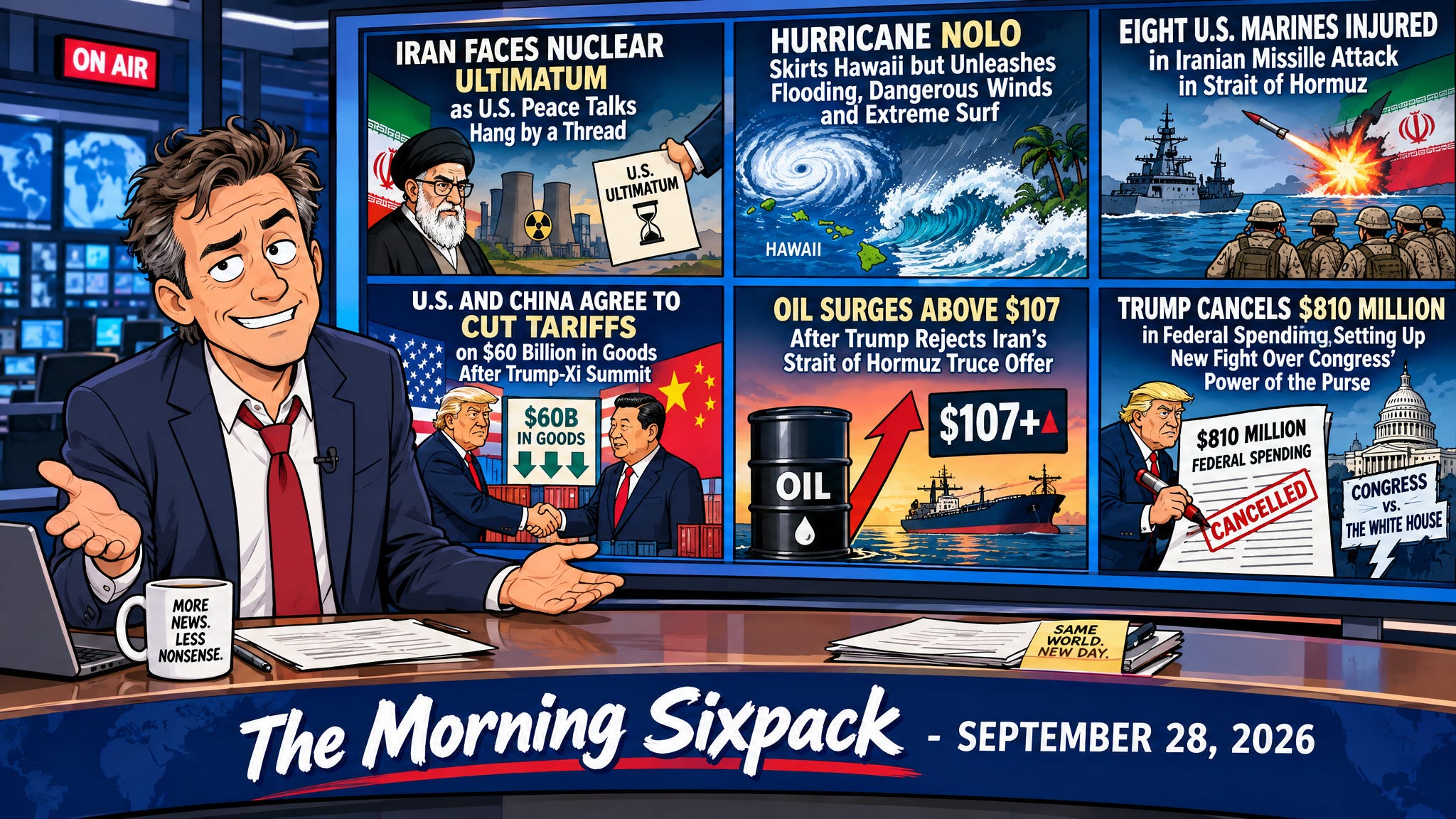
The Morning Sixpack stays free because the news that shapes your life should not be hidden behind a paywall. Paid subscribers are not paying for access. They are helping fund the research, writing, and independent voice that goes into every issue. Become a paid subscriber and help keep smart, honest news analysis free for everyone.
Iran and the U.S. are back at the negotiating table’s edge, where everyone says they want diplomacy while keeping the bombers warmed up.
Iran Faces Nuclear Ultimatum as U.S. Peace Talks Hang by a Thread
Mediators are pressing Iran to make nuclear concessions in hopes of reviving negotiations with the United States after President Trump rejected Tehran’s proposed seven-day truce. The diplomatic scramble is aimed at preventing the conflict from sliding back into full-scale war, but Iran has given negotiators little indication it is ready to budge on the nuclear issue.
The problem is simple: Washington and Tehran are negotiating over two very different things, and neither side seems interested in blinking first.
Trump wants the talks centered on preventing Iran from obtaining a nuclear weapon, while Tehran has focused on reopening the Strait of Hormuz, ending the U.S. naval blockade, and securing sanctions relief. Iran’s rejected proposal would have reopened the strait and restarted nuclear negotiations within seven days if Washington lifted the blockade and eased sanctions.
Iranian Foreign Minister Abbas Araghchi says Tehran remains ready for diplomacy—but also for another round of fighting. “We are fully prepared for the war to resume,” Araghchi said. “We stand firm in the face of any new aggression, even if it comes to a doomsday war. But at the same time we stand ready for diplomacy. It is up to President Trump to choose.” Meanwhile, Trump told Axios he expects more talks with Iran this week, even after rejecting Tehran’s proposal.
The U.S. believes its blockade and growing oil traffic through Hormuz are weakening Iran’s leverage, while Tehran appears convinced it can withstand continued economic and military pressure. That leaves mediators trying to manufacture a compromise between two governments that each think time is working in its favor—a famously relaxing recipe when nuclear weapons, oil supplies, and another bombing campaign are all part of the conversation.
Editor: Nothing screams “peace process” quite like one side discussing nuclear concessions, the other preparing for “doomsday war,” and everybody insisting the negotiations are still alive. Technically, so is a patient when the defibrillator comes out.
Source: The Wall Street Journal (no paywall)
Hurricane Nolo spared Hawaii a direct hit, but apparently decided 20 inches of rain, flooding, high winds, and monster surf would still make a lovely parting gift.
Hurricane Nolo Skirts Hawaii but Unleashes Flooding, Dangerous Winds and Extreme Surf
Hurricane Nolo passed south of Hawaii without making a direct landfall, but its outer bands threatened the Big Island with life-threatening flooding, mudslides, damaging winds and rainfall totals of up to 20 inches. The storm was packing sustained winds of 90 mph as it crawled south of the islands, with forecasters expecting it to strengthen into a major hurricane as it moved westward.
Hawaii dodged Nolo’s center, but it didn’t dodge the storm.
Heavy rain flooded sections of the Big Island, partially closing a major highway between Kailua-Kona and Hilo. More than 120 Hawaii National Guard members were activated on the island, part of roughly 400 statewide, while officials warned residents about flooded roads, falling trees, and downed power lines. “Don’t venture out if you don’t have to into the dangerous flooding environment, but also high winds. We can have trees and power lines down,” National Hurricane Center Director Michael Brennan said.
The timing couldn’t be much worse. Big Island residents are still recovering from August’s Hurricane Lala, which brought heavy rain and winds powerful enough to sweep about 100 homes from their foundations. President Donald Trump approved an emergency declaration authorizing FEMA assistance, while Hawaiian Electric repositioned crews that had been restoring power after yet another storm, Hurricane Lowell.
And because the Pacific apparently misplaced its off switch, Hawaii wasn’t the only place watching the tropics. Category 4 Hurricane Polo was bearing down on Mexico’s Baja California Peninsula with sustained winds of 140 mph, while forecasters described this Pacific hurricane season as unusually active. For Hawaii, Nolo’s direct-hit threat may have eased, but the floods, wind, and surf were more than enough reminder that “missed us” is a highly relative term during hurricane season.
Editor: Hawaii has now reached the stage of hurricane season where utility crews are being moved from one storm cleanup to prepare for the next storm. At some point, Mother Nature needs to discover the concept of PTO.
Source: Associated Press
Eight Marines were reportedly injured by an Iranian missile in the Strait of Hormuz, and Americans apparently needed two weeks and an NBC report to hear about it.
Eight U.S. Marines Injured in Iranian Missile Attack in Strait of Hormuz
Eight U.S. Marines were injured when an Iranian cruise missile struck the vessel they were aboard in the Strait of Hormuz on September 14, according to an NBC News report cited by The Jerusalem Post. None suffered serious injuries, but the Marines reportedly experienced smoke inhalation and concussion symptoms, including headaches, before returning to duty.
The Pentagon did not publicly disclose either the September 14 attack or the Marines’ injuries.
The officials cited in the report said the Marines weren’t aboard a U.S. Navy ship, but they didn’t identify what kind of vessel was hit. That leaves an important piece of the incident unexplained even as U.S. forces enforce a naval blockade against Iran and provide protection for commercial shipping moving through the strategically vital Strait of Hormuz.
The disclosure also lands amid questions about how the Pentagon has publicly reported U.S. casualties during the Iran conflict. The Washington Post previously reported that at least four service members killed in the Middle East since the war began weren’t reflected in the official casualty count, while wounded troops have separately accused the Defense Department of understating the severity of some injuries. The military disputes those accusations and says casualty classifications have precise definitions that can be misunderstood.
“The care and well-being of our soldiers is of the highest priority,” an Army spokesperson said, according to CBS News. “Any assertion that the army seeks to downplay a soldier’s injuries is simply not true.” Fair enough, but when eight Marines are injured in an Iranian missile strike and the incident itself isn’t publicly disclosed, people are going to have questions about more than terminology.
Editor: Eight Marines, an Iranian cruise missile, and a previously undisclosed attack. That’s the sort of footnote that usually deserves to be somewhere other than the footnotes.
Source: The Jerusalem Post
Washington and Beijing found something they can agree on: tariffs can come down, especially when Christmas decorations, toys, peanut butter, and frozen chicken feet are caught in the crossfire.
U.S. and China Agree to Cut Tariffs on $60 Billion in Goods After Trump-Xi Summit
The United States and China are moving to reduce tariffs on roughly $30 billion worth of each other’s goods, covering everything from Chinese toys and household products to American agriculture and food exports. The reciprocal lists were released after President Donald Trump’s Washington summit with Chinese President Xi Jinping, adding a concrete trade measure to the two countries’ continuing tariff truce.
That’s $60 billion worth of trade getting at least some relief from a tariff fight that has made doing business across the Pacific considerably more expensive.
The American list focuses heavily on consumer products imported from China, including toys, Christmas decorations, kitchenware, bedding, microwave ovens, sporting goods, and other household items. China’s much longer list leans heavily toward U.S. agricultural and food products, including livestock, pork, poultry, salmon, dairy products, peanuts, apples, and soy products. The framework reportedly covers 1,619 U.S. export items entering China and 77 categories of Chinese goods entering the United States.
The potentially important catch is that the announcement didn’t immediately spell out exactly when the reductions would begin or how far tariff rates would fall. That’s no small detail considering the steep duties imposed during the trade confrontation. The broader tariff truce has meanwhile prevented another round of increases, giving businesses on both sides something they haven’t enjoyed much of lately: a little predictability.
The two governments also created a U.S.-China “Board of Trade,” with officials expected to meet at least quarterly and senior officials meeting when necessary. For American farmers, Chinese manufacturers, and retailers heading into the holiday season, tariff relief could translate into greater sales and lower import costs. Whether this becomes a durable thaw or merely another timeout in the U.S.-China trade fight remains an open question, and the tariff guns aren’t exactly being melted down.
Editor: After years of using tariffs as economic artillery, Washington and Beijing have discovered the revolutionary diplomatic concept of charging each other less money. Somewhere, a container full of Christmas ornaments is breathing easier.
Source: CNBC
Trump rejected Iran’s seven-day truce proposal and oil immediately remembered that geopolitics is one of its favorite ways to ruin everybody’s Monday.
Oil Surges Above $107 After Trump Rejects Iran’s Strait of Hormuz Truce Offer
Brent crude jumped more than 3% to above $107 a barrel Monday after President Donald Trump rejected Iran’s proposed seven-day truce, reigniting fears that the conflict and restrictions around the Strait of Hormuz will keep squeezing global energy supplies. U.S. benchmark WTI also climbed, trading above $94 a barrel as markets reversed some of Friday’s optimism over a possible agreement.
The peace proposal lasted long enough to knock oil prices down Friday, and its rejection sent them roaring right back up.
Tehran had proposed pausing hostilities and reopening the Strait of Hormuz, but its conditions included releasing frozen Iranian assets, lifting sanctions on Iranian oil, and ending the U.S. naval blockade. Trump rejected those terms while leaving the door open to more negotiations. “They want to make a deal, but it is not the deal that I want to make,” Trump told Axios. “They overplayed their hand.”
The fallout spread well beyond the oil market. U.S. stock futures fell, European markets were mostly lower, and the 10-year Treasury yield briefly climbed above 5.21%, near its highest level since 2007. The yield stood at 3.97% when the Iran war began. Investors are increasingly concerned that expensive energy could feed another inflation cycle and keep the Federal Reserve raising interest rates, with markets putting the probability of another hike at its October meeting above 65%.
That creates an ugly economic feedback loop: conflict threatens energy supplies, higher oil prices feed inflation, inflation pushes interest rates higher, and higher borrowing costs pressure consumers, businesses, and stocks. Add increased shipping risks around both the Strait of Hormuz and the Red Sea, and the world’s energy market is once again depending heavily on what happens in some extremely narrow—and extremely contentious—stretches of water.
Editor: Diplomats can debate ceasefire language all week. Oil traders need about 30 seconds and a rejected proposal before reaching for the “BUY” button.
Source: Euronews
Trump is canceling $810 million Congress already approved, turning the federal budget into another separation-of-powers fight with a fiscal-year deadline doing much of the heavy lifting.
Trump Cancels $810 Million in Federal Spending, Setting Up New Fight Over Congress’ Power of the Purse
President Donald Trump is withholding $810 million that Congress had appropriated for federal programs, including $567 million connected to services for refugees, asylees, and other noncitizens. The administration is using what’s known as a “pocket rescission,” reigniting a dispute over whether a president can effectively cancel congressionally approved spending by acting too late in the fiscal year for Congress to respond.
The constitutional question is bigger than $810 million: who ultimately gets to decide how taxpayer money is spent?
The Constitution gives Congress the power of the purse, while federal law provides a process for presidents to ask Congress to rescind previously approved funds. The Government Accountability Office has concluded that pocket rescissions—in which funds are withheld until they effectively expire before Congress has adequate opportunity to act—are illegal. With the fiscal year ending within days, lawmakers don’t have the usual window to accept or reject these cancellations.
Criticism isn’t limited to Democrats. Republican Sen. Susan Collins of Maine, chair of the Senate Appropriations Committee, said the Office of Management and Budget doesn’t have authority to substitute its judgment for Congress. “OMB is an agency of the executive branch. It does not get to decide which programs are worth funding.” Democrats, including Sen. Patty Murray and Rep. Brendan Boyle, likewise accused the administration and OMB Director Russell Vought of circumventing Congress. The White House, meanwhile, characterizes the action as eliminating spending it considers wasteful or harmful.
The cuts also include $15 million for a Justice Department program dealing with racial and ethnic tensions and civil disorders, $70 million for programs supporting foreign students and faculty studying or teaching language, and additional climate, research, and nonprofit grants. Whatever one thinks of those programs, the institutional fight is straightforward: Congress appropriated the money, the executive branch doesn’t want to spend it, and the dispute over whether it can legally prevent that spending is headed straight back into the long-running battle over presidential and congressional authority.
Editor: Washington has found a wonderfully efficient way to turn an $810 million spending dispute into a constitutional argument. Apparently even the budget has discovered the executive-order lifestyle.
Source: NPR