


The Morning Sixpack stays free because the news that shapes your life should not be hidden behind a paywall. Paid subscribers are not paying for access. They are helping fund the research, writing, and independent voice that goes into every issue. Become a paid subscriber and help keep smart, honest news analysis free for everyone.
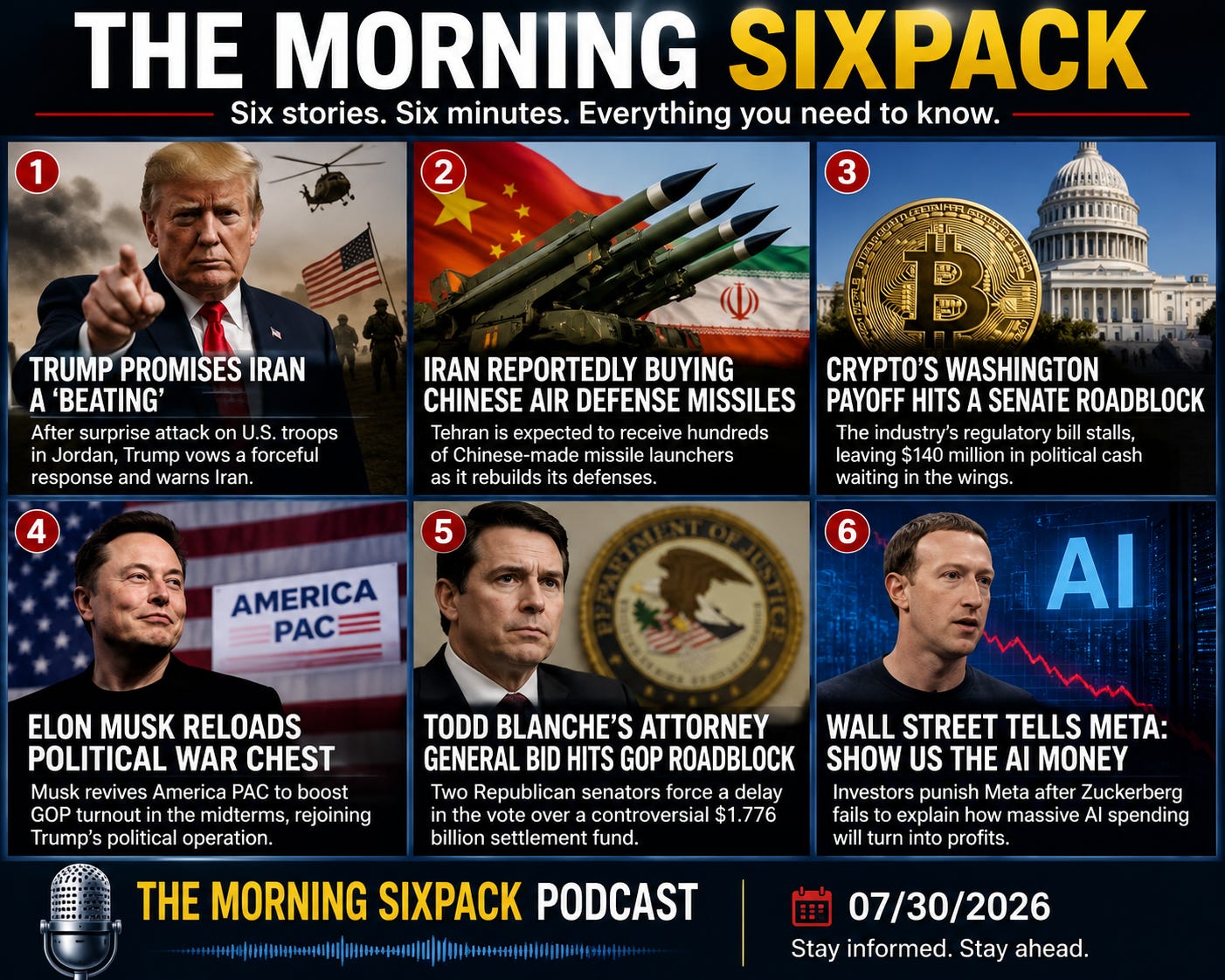
Iran fired first, Trump promised to hit back harder—and diplomacy suddenly looks like it’s running on borrowed time.
Trump Promises Iran a ‘Beating’ After Surprise Attack on U.S. Troops
President Trump says the U.S. will retaliate after Iran launched a surprise ballistic missile attack targeting American forces in Jordan, signaling that any hopes for cooler heads may have just taken a major hit.
“We are going to beat the fucking shit out of them.”
Trump delivered that blunt message to Fox News correspondent Trey Yingst after the overnight attack, adding, “We’ll be hitting them hard. They’re going to get a beating.” According to Yingst, Trump said U.S. forces had only minutes to intercept the incoming missiles and successfully shot them down before they reached their targets.
The president also defended overnight U.S. and Saudi strikes against Iran-backed Iraqi Shia militias, calling the proxy groups “a cancer on the world” and suggesting additional action against Iranian-backed forces remains on the table. Trump said those operations were coordinated with the Iraqi government. Read that again.
Yingst reported that the attack may have strengthened an emerging coalition of Gulf nations willing to confront Tehran after Iran broadened the conflict by targeting countries beyond Israel and the United States. At the same time, Trump indicated back-channel talks with Iran are still continuing despite the latest escalation, saying, “We’re going to let them keep talking.”
Source: Mediaite
Editor: Iran apparently thought expanding the fight would intimidate its neighbors. Instead, it may have convinced more of them to line up against it. That’s one way to build a coalition—just not the one you wanted.
Iran is racing to patch the holes in its air defenses, and China appears ready to cash the check—even if everyone involved is denying it.
Iran Reportedly Buying Hundreds of Chinese Air Defense Missiles
Iran is expected to receive up to 400 Chinese-made shoulder-fired air-defense missile systems within weeks as Tehran rebuilds its battered military following months of war with the United States and Israel.
The reported deal signals that while ceasefire talks may be underway, the arms race certainly isn’t.
According to Reuters, the $60-$70 million agreement includes between 300 and 400 Chinese-made QW-12 and FN-16 man-portable air defense systems, commonly known as MANPADS. The missiles are designed to target low-flying aircraft, helicopters, and drones, giving Iran more mobile defenses after repeated strikes exposed weaknesses around key military and strategic sites.
The report says the contract was signed through a Hong Kong-based intermediary and that initial deliveries could begin within weeks. Sources told Reuters the weapons would likely move from western China through Pakistan before reaching Iran, although both China and Pakistan strongly denied the claims. China’s Foreign Ministry called the report “completely groundless,” while Pakistan dismissed any role in transporting the weapons.
Military analysts say portable missile systems are far harder to target than fixed air-defense batteries because they can be moved quickly by small teams. Reuters also reported Iran has explored additional Chinese weapons purchases, including anti-ship cruise missiles, as it attempts to rebuild capabilities depleted during the war.
Source: Reuters
Editor: “Completely groundless” has become the international version of “nothing to see here.” If the shipment shows up, somebody’s paperwork is going to look awfully awkward.
Washington’s crypto lobby thought it had a victory lap planned. Now it’s discovering that Senate politics has a habit of eating even the best-funded plans.
Crypto’s Washington Payoff Hits a Senate Roadblock
The cryptocurrency industry’s push for sweeping federal regulation is stalling in the Senate, throwing millions of dollars in planned midterm campaign spending into political limbo.
When legislation stalls, lobbyists don’t just lose time—they lose leverage.
Semafor reports that Senate negotiators remain divided over key provisions in the long-awaited crypto regulatory bill, including ethics rules, enforcement authority, and safeguards against illicit finance. With lawmakers preparing to leave Washington for their summer recess, even an initial procedural vote is no longer guaranteed.
That uncertainty matters because Fairshake—the crypto industry’s powerful network of super PACs—has roughly $140 million available for the 2026 elections. Industry leaders reportedly hoped a Senate vote would help determine which lawmakers deserved financial backing and which deserved well-funded opponents. Democrats, meanwhile, argue forcing a premature vote could derail bipartisan negotiations entirely.
One of the biggest sticking points remains how to regulate President Trump’s family’s cryptocurrency interests while establishing new federal oversight of digital assets. Both parties say talks continue, but with only weeks before the election calendar dominates Congress, time is running short for a breakthrough. Even if the bill slips until after August, the crypto money isn’t going away—it may simply become far more unpredictable.
Source: Semafor
Editor: Congress may argue about principles, but everyone suddenly pays attention when $140 million is waiting to decide who gets campaign commercials—and who gets retirement brochures.
Elon Musk is opening his checkbook again, proving that even after political drama, money still talks louder than old grudges.
Elon Musk Reloads Political War Chest for GOP Midterms
Elon Musk is preparing another massive investment to help Republicans keep control of Congress, reviving the super PAC that spent more than $260 million backing Donald Trump’s 2024 campaign.
The breakup with Trump didn’t last nearly as long as the campaign checks.
According to Axios, Musk is reactivating America PAC, which will focus on turning out conservative voters through door-knocking, digital advertising, bribes, and direct mail ahead of the November midterm elections. While aides declined to reveal how much Musk plans to spend this time, sources say the investment is expected to be substantial.
The renewed effort comes as Republicans try to overcome weak polling driven by concerns over the economy and the Iran war. GOP committees already hold a cash advantage of more than $300 million over Democrats, not including the roughly $400 million sitting in Trump’s MAGA Inc. super PAC ($1 million of which was contributed by Taylor Farms to get their asses out of hot water over explosive diarrhea lettuce).
America PAC will coordinate with other Republican organizations, allowing them to focus more heavily on television advertising while Musk’s operation concentrates on voter turnout. Trump’s senior political adviser James Blair praised the partnership, calling America PAC “an essential partner” during the 2024 campaign and predicting another aggressive turnout operation this fall.
The move also marks another chapter in the repaired relationship between Musk and Trump. After publicly clashing over federal spending and briefly floating the idea of creating a third political party, Musk quietly returned to backing Republican candidates and is now fully rejoining the GOP’s midterm strategy.
Source: Axios
Editor: Politics has a funny way of healing old wounds—especially when one side owns X and the other side controls the White House. Turns out billion-dollar friendships are remarkably resilient.
Todd Blanche’s confirmation isn’t being slowed by Democrats—it’s Republicans demanding the Justice Department put its promises in writing.
Todd Blanche’s Attorney General Bid Hits GOP Roadblock
President Trump’s choice to lead the Justice Department was pulled from a key Senate vote after two Republican senators threatened to derail the nomination over a controversial $1.776 billion settlement fund.
Nothing stalls a confirmation faster than members of your own party saying, “Show me the paperwork.”
Senate Judiciary Committee Chairman Chuck Grassley postponed Thursday’s scheduled committee vote after Sens. John Cornyn of Texas and Thom Tillis of North Carolina refused to support Todd Blanche’s nomination without written assurances that the Justice Department has permanently abandoned the proposed $1.776 billion “anti-weaponization” fund.
The fund originated as part of a settlement tied to Trump’s lawsuit over leaked IRS records and was intended to compensate people claiming they had been targeted by the federal government. But it quickly drew criticism from Republicans and Democrats alike, particularly over concerns it could benefit Jan. 6 defendants traitors and others with questionable claims.
Cornyn said the Justice Department had “stonewalled” his requests for months, while Tillis warned he wouldn’t even attend the committee meeting without an agreement, denying Republicans the quorum needed to move the nomination forward. Blanche has publicly insisted the department is “not moving forward with the fund. Period,” but the two senators want that commitment formally documented before voting.
With both Cornyn and Tillis retiring at the end of the year, the dispute underscores that even Trump’s nominees can run into resistance when Republican senators decide promises aren’t enough without signatures.
Source: The Hill
Editor: Washington runs on trust... right up until someone asks for it in writing. Then suddenly everybody discovers the copier is broken.
Wall Street is no longer applauding every AI spending spree—it’s asking where the profits are hiding.
Wall Street Tells Meta: Show Us the AI Money
Meta’s stock tumbled after investors concluded Mark Zuckerberg still hasn’t explained how the company’s massive AI spending will eventually pay off.
Building AI is exciting. Convincing investors it’ll make money is becoming a whole different challenge.
The Wall Street Journal reports Meta shares plunged about 10% after earnings as investors searched for answers on how the company plans to monetize its enormous investments in artificial intelligence. While Microsoft’s shares jumped after posting accelerating Azure cloud growth, Meta offered few new details on generating revenue from AI services or selling excess computing power.
Analysts said Meta’s core advertising business remains strong, but Wall Street is demanding proof that hundreds of billions of dollars flowing into AI infrastructure will eventually produce meaningful returns. Zuckerberg said Meta has received offers to rent excess computing capacity at premium prices but declined to identify customers or provide a timeline for those deals.
The company also raised the lower end of its 2026 capital spending forecast to $130 billion while refusing to provide any outlook for 2027. Investors have grown increasingly sensitive after Google also faced heavy selling following its own massive AI spending projections. The message from Wall Street is becoming clear: Impressive technology alone is no longer enough—profits have to follow.
Source: The Wall Street Journal (free article)
Editor: “Trust us” works great in Silicon Valley pitch meetings. It works a lot less well when shareholders just watched $140 billion disappear before dinner.