


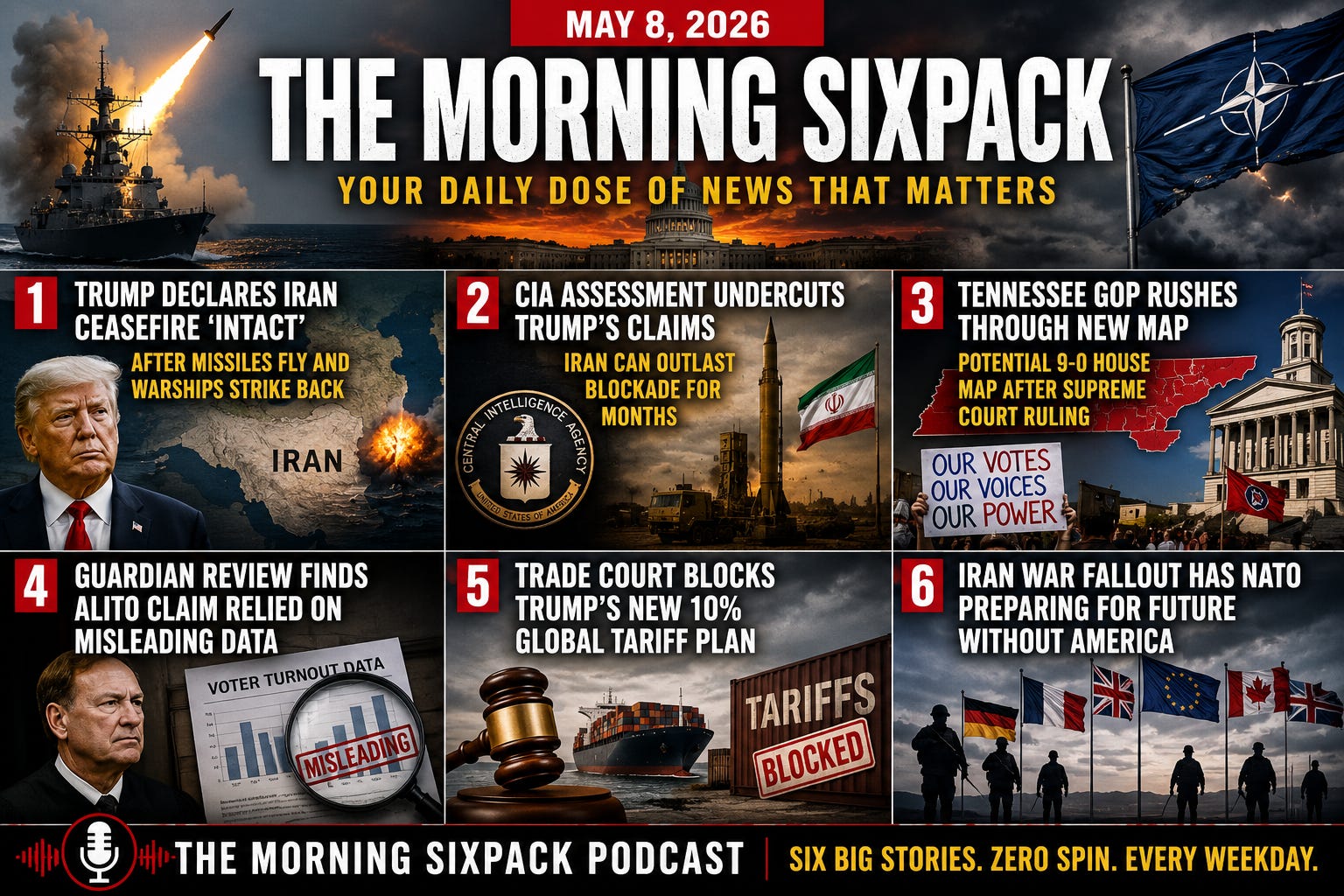
Trump says the ceasefire with Iran is still “intact” after U.S. warships and Iranian missiles traded fire in the Strait of Hormuz—which is kind of like saying the Titanic’s voyage was still “on schedule” after the iceberg.
Trump Declares Iran Ceasefire ‘Intact’ After Missiles Fly and Warships Strike Back
President Trump insists the Iran ceasefire is holding—even after U.S. destroyers exchanged missiles and drone fire with Iranian forces in the Strait of Hormuz.
That’s not exactly what most people call “stable.”
The White House says U.S. destroyers USS Truxton, USS Rafael Peralta and USS Mason came under attack from Iranian missiles, drones and small boats before American forces launched retaliatory strikes on Iranian military sites. Trump brushed off the clash as “a trifle,” saying: “They trifled with us today. We blew them away.”
Iran, naturally, tells a very different story. Tehran claims its Revolutionary Guard launched a “highly extensive and precise combined operation” that inflicted “significant damage” on U.S. ships after American forces allegedly attacked an Iranian oil tanker and pushed too aggressively toward the Strait of Hormuz. The U.S. says none of its vessels were hit.
The bigger problem here is that all this is happening while Washington and Tehran are supposedly negotiating a peace deal. Secretary of State Marco Rubio said the administration is waiting for Iran’s response to a proposed framework agreement, while Trump warned earlier this week he could restart bombing “at a much higher level” if talks collapse. So yes, the ceasefire technically exists—while missiles are flying and naval blockades tighten.
One line from Trump perfectly captured the moment. Describing Iranian missiles intercepted by U.S. defenses, he said: “They dropped ever so beautifully down to the Ocean, very much like a butterfly dropping to its grave!” That’s either wartime rhetoric or the weirdest nature documentary narration ever attempted by a commander in chief.
Source: Washington Post (gift)
Editor: Nothing says “successful diplomacy” quite like both sides firing missiles while simultaneously insisting negotiations are progressing nicely. At this rate, the peace talks may need their own air-defense system.
The CIA says Iran can withstand Trump’s blockade for months—which puts a dent in the White House narrative that Tehran is one bad week away from waving a white flag.
CIA Assessment Undercuts Trump’s Claims That Iran Is Near Collapse
A new CIA assessment reportedly concludes Iran can survive the U.S. naval blockade for at least three to four months despite Trump administration claims the regime is on the brink.
That’s a long time for a White House insisting victory is basically already here.
According to officials familiar with the classified analysis, Iran still retains roughly 70 percent of its missile stockpile and 75 percent of its mobile launchers despite weeks of U.S. and Israeli strikes. The report also says Tehran has reopened underground facilities, repaired damaged missiles and may already be assembling new ones. That sharply contrasts with Trump’s claim Wednesday that Iran’s missile capabilities are “mostly decimated.”
The intelligence report also suggests Iran’s economy, while battered, isn’t collapsing nearly as fast as administration officials claim. Tehran is reportedly storing oil aboard tankers, preserving its oil fields for long-term production and exploring rail routes through Central Asia to bypass maritime pressure. In other words, sanctions are hurting—but not breaking—the regime.
One unnamed U.S. official summed up the problem bluntly: “The leadership has gotten more radical, determined and increasingly confident they can outlast U.S. political will.” That’s the kind of sentence nobody wants to read after being told “Operation Economic Fury” has the enemy cornered. Analysts also warn that Iran’s lower-cost drone arsenal remains a major threat because even a single successful attack on a tanker could send insurance markets into panic mode and choke shipping through the Strait of Hormuz.
Source: DNyuz/Washington Post syndicated report
Editor: Washington keeps talking about Iran like it’s a casino patron down to its last chip. The intelligence community seems to think Tehran still has plenty of cards—and possibly a few hidden under the table.
Tennessee Republicans just redrew the congressional map to go 9-0 GOP—eight days after the Supreme Court weakened Voting Rights Act protections. Funny how fast government can move when power is on the line.
Tennessee Republicans Rush Through New 9-0 Congressional Map After Supreme Court Voting Rights Ruling
Tennessee lawmakers approved a new congressional map designed to hand Republicans all nine U.S. House seats by dismantling the state’s last majority-Black district in Memphis.
The timing wasn’t subtle: the legislature moved just days after the Supreme Court cleared the legal runway.
The new map fractures Memphis across three districts, effectively wiping out Tennessee’s lone Democratic-held congressional seat. Democrats are expected to sue, arguing the redistricting violates constitutional protections and was pushed through dangerously close to the election. Current District 9—which includes Memphis—is about 60 percent Black.
Republicans made little effort to disguise the political strategy. State Sen. John Stevens openly declared: “This is about allowing Tennessee to maximize its partisan advantage.” House Speaker Cameron Sexton insisted “no racial data was used,” a statement that reportedly drew laughter from spectators packed into legislative hearings. State Sen. London Lamar fired back: “Racism doesn’t become less racist just because it’s called partisan.”
The redraw came after the Supreme Court struck down a key Voting Rights Act provision requiring states with histories of racial discrimination to preserve majority-minority districts. Tennessee Republicans also repealed a state law that previously limited congressional redistricting to once per decade after the census. Translation: when the rules became inconvenient, they changed those too.
Republicans argue the map better reflects Tennessee’s conservative electorate and point to Democratic-led states that aggressively gerrymander districts for partisan gain. But critics see this as part of a larger national arms race over congressional maps ahead of what could be a brutal midterm cycle for Trump and the GOP.
Source: Tennessee Lookout
Editor: Nothing screams “healthy democracy” quite like redrawing election maps mid-cycle after the Supreme Court loosens the guardrails. Somewhere Elbridge Gerry is looking down and saying, “Now that’s efficiency.”
Samuel Alito used voter turnout numbers to argue the Voting Rights Act isn’t needed like it once was—but the data behind the claim appears to have been massaged harder than a campaign donor at a steakhouse fundraiser.
Guardian Review Finds Alito Voting Rights Claim Relied on Misleading Data
A Guardian analysis says Justice Samuel Alito relied on a misleading interpretation of voter turnout data when writing last week’s Supreme Court opinion gutting key Voting Rights Act protections.
The court used the numbers to argue racial voting discrimination has largely faded—even though experts say the math doesn’t hold up.
In the ruling involving Louisiana’s congressional map, Alito claimed Black voter turnout had surpassed white turnout in two of the last five presidential elections both nationally and in Louisiana. That argument became a cornerstone of the majority opinion, helping justify the idea that the Voting Rights Act’s protections are no longer as necessary as they once were.
The problem, according to election experts interviewed by The Guardian, is the Justice Department analysis cited by Alito used total adult population figures—not the standard “citizen voting-age population” metric typically used by researchers. That broader calculation includes non-citizens and others legally ineligible to vote, making turnout rates appear artificially favorable. When turnout is calculated using accepted methodology, Black turnout in Louisiana only exceeded white turnout once—not twice—in recent presidential elections.
Michael McDonald, a University of Florida political scientist and voting expert, didn’t mince words: “If I wanted to manipulate the numbers in a way that was favorable to the government’s interest, I would be using voting age population.” Another expert accused the court and DOJ of cherry-picking both the years and the methodology while ignoring the broader trend: Black turnout has lagged white turnout in every presidential election since 2012.
The irony here is hard to miss. The court points to reduced disparities as proof the law is no longer needed, while critics argue the improvements happened precisely because the Voting Rights Act existed in the first place. Since the Supreme Court weakened the law in its 2013 Shelby County decision, researchers say the racial turnout gap has widened again.
Source: The Guardian
Editor: The Supreme Court spent years insisting it simply “calls balls and strikes.” Turns out the strike zone gets pretty flexible when the data starts helping your argument.
Trump’s backup tariff plan just hit another legal wall—which is awkward when the entire economic strategy keeps getting returned to sender by federal courts.
Trade Court Blocks Trump’s New 10% Global Tariff Plan
A federal trade court ruled that President Trump’s new 10% global tariff was illegal, dealing another blow to an administration already struggling to keep its aggressive trade agenda alive in court.
The judges basically told the White House: you can’t just keep changing the legal label on the same policy and hope nobody notices.
The ruling from the U.S. Court of International Trade found that Trump improperly relied on Section 122 of the Trade Act of 1974 to impose the tariff after the Supreme Court had already blocked earlier tariffs enacted under emergency powers law. Section 122 allows temporary import surcharges to stabilize the dollar—not to function as a catch-all presidential tariff machine.
Trump unveiled the new 10% tariff after the Supreme Court ruled in February that his earlier 2025 tariffs exceeded the authority granted under the International Emergency Economic Powers Act. The administration argued the revised tariffs were lawful because they relied on a different statute. The trade court wasn’t buying it.
The tariffs were challenged by Democratic-led states and small businesses, which argued the White House was stretching presidential authority far beyond what Congress intended. For now, the ruling only blocks the tariffs in states involved in the lawsuit, though the administration is expected to appeal quickly.
The larger issue hanging over all of this is whether any president can effectively bypass Congress to reshape global trade policy through emergency declarations and obscure statutory loopholes. Courts increasingly seem skeptical—especially when the “temporary” tariffs start looking permanent.
Source: UPI
Editor: At this point, Trump’s tariff strategy resembles a guy repeatedly trying to sneak back into the same casino using different fake mustaches. Federal judges keep recognizing him anyway.
NATO allies are openly wondering whether America can still be trusted to lead the alliance—which is not exactly the kind of conversation Washington usually likes happening out loud.
Trump’s Iran War Fallout Has NATO Quietly Preparing for a Future Without America
European leaders are increasingly planning for a NATO alliance where the United States no longer serves as the dependable military and political anchor it has been since World War II.
And according to diplomats and defense experts, Trump’s handling of the Iran conflict may have accelerated that shift dramatically.
The latest rupture came after Trump launched strikes related to the Iran war without fully coordinating with NATO allies, then later pressured the alliance to help reopen the Strait of Hormuz. European governments were already rattled by Trump’s threats involving Greenland, Canada and repeated suggestions that the U.S. could leave NATO altogether. Now the trust problem is becoming impossible to ignore.
Former U.S. Ambassador to NATO Ivo Daalder put it bluntly: “Something fundamental has broken.” Germany, Britain, Canada and others are quietly reassessing military planning and defense procurement because they’re no longer certain America would automatically come to their defense in a crisis. Germany is already preparing to assume a much larger military role in Europe, while Canada is openly talking about building closer ties with “reliable partners”—a diplomatic phrase that practically comes with neon lights attached.
The Pentagon’s announcement this week that it plans to withdraw 5,000 U.S. troops from Germany only intensified fears. European officials worry they still depend heavily on America for intelligence, strategic airlift, missile defense and nuclear deterrence, but now face a shrinking timeline to build those capabilities themselves. One analyst estimated Europe could need five to ten years to close the gap. As one NATO expert noted: “You cannot just ‘Amazon next day order’ these things.”
Ironically, Trump’s pressure campaign may ultimately succeed in forcing Europe to spend far more on defense—but at the cost of weakening American influence inside the alliance. NATO probably survives. It just may become a NATO increasingly led by Europe instead of Washington.
Source: NPR
Editor: America spent 75 years building NATO into the centerpiece of Western power. Now allies are quietly drafting contingency plans in case the guy holding the steering wheel decides alliances are for suckers.