


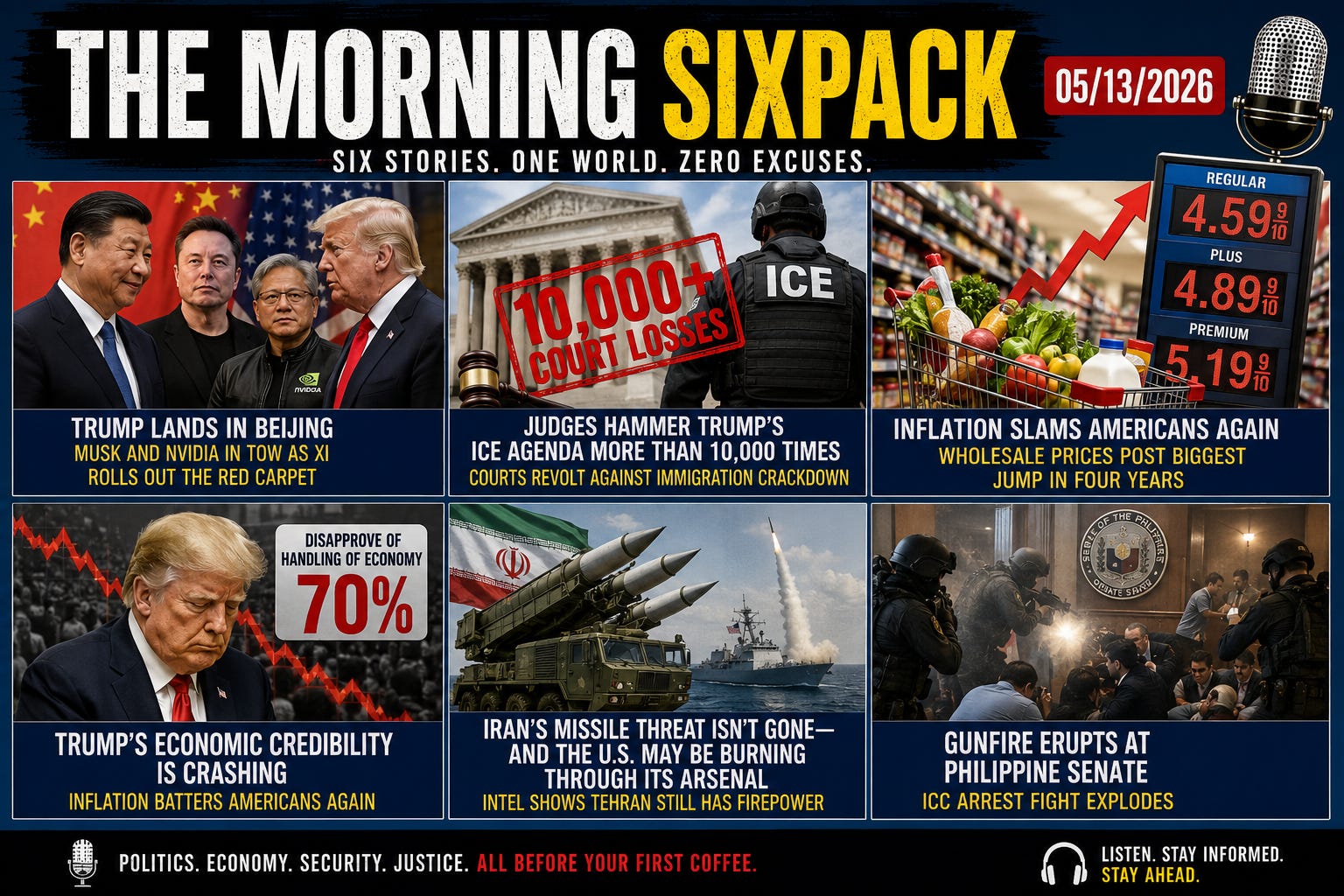
Trump Lands in Beijing with Musk and Nvidia in Tow as Xi Rolls Out the Red Carpet
Donald Trump arrived in Beijing to a full state-style welcome from Xi Jinping’s government as the US and China prepare for tense talks over tariffs, tech dominance, Taiwan and the Iran war.
Trump’s two-day visit comes as the relationship between Washington and Beijing grows more confrontational on nearly every front. Trade fights are back on the table, tensions over Taiwan continue simmering, and both countries are maneuvering for control of the global tech industry. Trump is also walking into Beijing while facing mounting questions over the ongoing US-Israel conflict with Iran and the economic fallout tied to it.
The optics were impossible to miss. Elon Musk and Nvidia CEO Jensen Huang joined Trump’s entourage as Air Force One touched down, reinforcing just how much this summit revolves around technology and global supply chains. Trump leaned into that angle before landing, posting that he would urge Xi to “open up” China so American innovators could “work their magic.”
Trump’s trip was originally supposed to happen in March, but it was pushed back because of the escalating Iran conflict. Now he returns to a China far more confident and aggressive than the one he visited in 2017—and one far less interested in playing junior partner to Washington.
“‘I will be asking President Xi, a Leader of extraordinary distinction, to ‘open up’ China so that these brilliant people can work their magic, and help bring the People’s Republic to an even higher level,’” Trump wrote ahead of arrival.
Source: BBC News
Editor: Xi rolled out the red carpet, Trump brought the billionaires, and somewhere in the middle the American worker is probably wondering when exactly they got outsourced from the guest list.
The ugly number for the White House isn’t just the losses—it’s that many of the judges rebuking ICE were appointed by Trump himself.
Judges Hammer Trump’s ICE Agenda More Than 10,000 Times as Courts Revolt
Federal judges across the country have ruled against Donald Trump’s ICE detention policies more than 10,000 times, exposing massive resistance inside the courts to his immigration crackdown.
According to a Politico analysis cited by The Daily Beast, judges have sided against ICE’s mandatory detention policy in over 10,000 cases versus roughly 1,200 rulings supporting the administration. Judges are increasingly furious over ICE detaining migrants indefinitely without bond hearings, due process, or meaningful court access.
West Virginia Judge Joseph Goodwin unloaded on the administration in a blistering ruling: “Across the interior of the United States, agents of the federal government—masked, anonymous, armed with military weapons, operating from unmarked vehicles, acting without warrants of any kind—are seizing persons for civil immigration violations and imprisoning them without any semblance of due process.” He added: “It is an assault on the constitutional order.”
Judges have also accused ICE of moving detainees across state lines to dodge lawsuits and dumping people far from home after courts ordered their release. New York Judge Gary Brown blasted the practice, writing: “This isn’t how things are supposed to work in America… Unquestionably, the laws of human decency condemn such villainy.”
The administration insists the courts are wrong and expects the Supreme Court to eventually side with Trump. The White House argues federal law requires detention while deportation proceedings continue. But for now, the courts appear deeply skeptical of an immigration operation that many judges see as steamrolling constitutional protections in pursuit of mass deportations.
Source: The Daily Beast
Editor: Ten thousand losses is the kind of legal record usually reserved for Washington Generals games and cable news defamation lawyers.
The timing couldn’t be worse for Donald Trump, who landed in Beijing facing growing anger at home over rising prices tied to the Iran war and battered global supply chains.
Inflation Slams Americans Again as Wholesale Prices Post Biggest Jump in Four Years
U.S. producer prices surged 1.4% in April—the biggest monthly increase since 2022—as inflation pressure spread across energy, transportation, retail and food costs.
The latest Producer Price Index report from the Labor Department came in far hotter than economists expected and followed another sharp rise in consumer inflation earlier this week. Annual wholesale inflation jumped to 6%, its highest level since late 2022, as businesses passed rising costs directly onto consumers.
Energy prices were a major driver, with wholesale gasoline soaring 15.6% in April after an even bigger jump the month before. Freight transportation costs climbed, retailers boosted margins, and supply chain problems linked to the Strait of Hormuz disruptions continued hammering everything from aluminum to fertilizer markets.
Economists are now warning the inflation wave is becoming entrenched. Ben Ayers of Nationwide said the spike in producer prices “portends further increases for consumer prices in May,” while markets increasingly expect the Federal Reserve to keep interest rates elevated well into 2027.
Trump didn’t exactly calm nerves before departing for China. Asked about Americans struggling financially because of inflation, the president said: “I don’t think about Americans’ financial situation” when making decisions tied to ending the Iran conflict and preventing Tehran from obtaining nuclear weapons.
The Federal Reserve now faces a growing dilemma. Inflation is accelerating, consumers are getting squeezed, and the pressure for rate cuts is colliding with fears the economy could overheat even more if borrowing costs come down too quickly.
Source: Reuters
Editor: At this point Americans don’t need an inflation report—they just need five minutes alone with their grocery receipt and a quiet place to cry.
A stunning 70% of Americans now disapprove of Trump’s handling of the economy—a level of backlash he never hit during his first term, even during COVID.
Trump’s Economic Credibility Is Crashing as Inflation Batters Americans Again
Donald Trump is facing some of the worst economic polling of his political career as inflation spikes, wages fall behind prices, and voters sour fast on the economy.
Axios paints a brutal picture for the White House: inflation hit 3.8% in April, gas prices surged past $4.50 a gallon, consumer debt is climbing, and Americans increasingly believe the country is spinning out of control. The affordability crisis that helped return Trump to power is now threatening to swallow his presidency whole.
The numbers are ugly. Seventy-seven percent of Americans say Trump’s policies are directly driving up the cost of living in their communities. Consumer confidence has cratered, small business optimism is fading, and for the first time in three years inflation is outpacing wage growth, wiping out gains in purchasing power.
Trump doesn’t appear eager to soften the message. Before leaving for Beijing, he was asked whether Americans’ financial struggles were influencing his decisions surrounding the Iran war. His response: “Not even a little bit.” He added: “I don’t think about Americans’ financial situation.”
The White House insists the pain is temporary and argues gas prices will eventually fall if tensions in the Strait of Hormuz ease. Trump has also endorsed suspending the federal gas tax and pushed housing legislation in an effort to calm voters furious over rising costs. But politically, warning lights are flashing everywhere. New polling now shows Democrats leading Republicans on virtually every major economic issue heading into the midterms.
Source: Axios
Editor: Turns out “I alone can fix it” sounds a lot less convincing when eggs cost a car payment and gas prices need their own bailout package.
Iran’s Missile Threat Isn’t Gone—and the U.S. May Be Burning Through Its Arsenal
New intelligence reports suggest Iran still retains roughly 70% of its missile arsenal and has restored most launch sites along the Strait of Hormuz despite months of U.S. strikes.
According to reports cited by NDTV and The New York Times, Iran has reopened around 30 of its 33 missile launch sites near the Strait of Hormuz and regained access to most underground weapons facilities. The intelligence sharply undercuts repeated claims from Donald Trump and Defense Secretary Pete Hegseth that Iran’s military had been “decimated” or “obliterated.”
The stakes are enormous because the Strait of Hormuz handles roughly 20% of the world’s crude oil shipments. Continued instability there has already driven oil prices above $100 a barrel for extended stretches, hammering global economies and fueling inflation across the West. Reports also suggest the U.S. is increasingly concerned about dwindling stockpiles of Tomahawk cruise missiles and Patriot interceptors if fighting resumes at full scale.
Trump has repeatedly insisted Iran’s military capability is collapsing. On March 4, he declared: “They have no navy; it’s been knocked out. No air force; it’s been knocked out.” Weeks later he doubled down, claiming Iran had been “literally obliterated.” But intelligence leaks now paint a very different picture, with estimates suggesting Tehran still possesses thousands of drones and a large majority of its missile inventory.
Meanwhile, ceasefire negotiations appear to be deteriorating. Iran reportedly demanded sanctions relief, compensation and recognition of its authority over Hormuz—conditions Washington flatly rejects. That leaves the world stuck between two ugly outcomes: a prolonged economic chokehold on global energy markets or another dangerous military escalation in the Gulf.
Source: NDTV
Editor: “Mission accomplished” has become the geopolitical version of declaring victory in the third quarter while the other team still has all its timeouts.
Nothing says “rule of law” quite like senators barricading themselves inside parliament while gunshots echo through the hallway.
Gunfire Erupts at Philippine Senate as ICC Arrest Fight Explodes
More than a dozen shots rang out inside the Philippine Senate as security forces moved to arrest Senator Ronald “Bato” dela Rosa over alleged crimes against humanity tied to Rodrigo Duterte’s brutal drug war.
The chaos turned the Philippine legislature into a near-war zone as journalists ducked for cover and heavily armed forces stormed the building.
According to Al Jazeera, around 15 shots were fired Wednesday evening after police and marines in tactical gear entered the Senate building where dela Rosa had been holed up under Senate protection. It remains unclear who fired the shots, but the confrontation triggered evacuations and panic inside one of the country’s most powerful institutions.
Dela Rosa, Duterte’s former police chief and chief architect of the notorious anti-drug crackdown, had publicly begged supporters to stop authorities from arresting him and transferring him to the International Criminal Court in The Hague. “Do not allow another Filipino to be brought to The Hague,” he pleaded in a Facebook video before the standoff began.
The ICC unsealed an arrest warrant accusing dela Rosa of crimes against humanity linked to the killings of thousands during Duterte’s “war on drugs.” Human rights groups have long alleged the campaign amounted to systematic extrajudicial executions, while police insist suspects were killed only after resisting arrest.
“I did everything for the country. I did not enrich myself. I worked faithfully,” dela Rosa told reporters while fighting back tears inside the Senate. Meanwhile, Duterte allies continue rejecting the ICC’s authority altogether, framing the arrests as foreign interference rather than accountability.
The entire spectacle underscores how politically radioactive the Duterte legacy remains in the Philippines. Violent scenes are sadly not rare in Manila—but seeing armed confrontations erupt inside the halls of government is a whole different level of instability.
Source: Al Jazeera
Editor: Somewhere in a civics textbook, the chapter titled “peaceful democratic institutions” just burst into flames.