


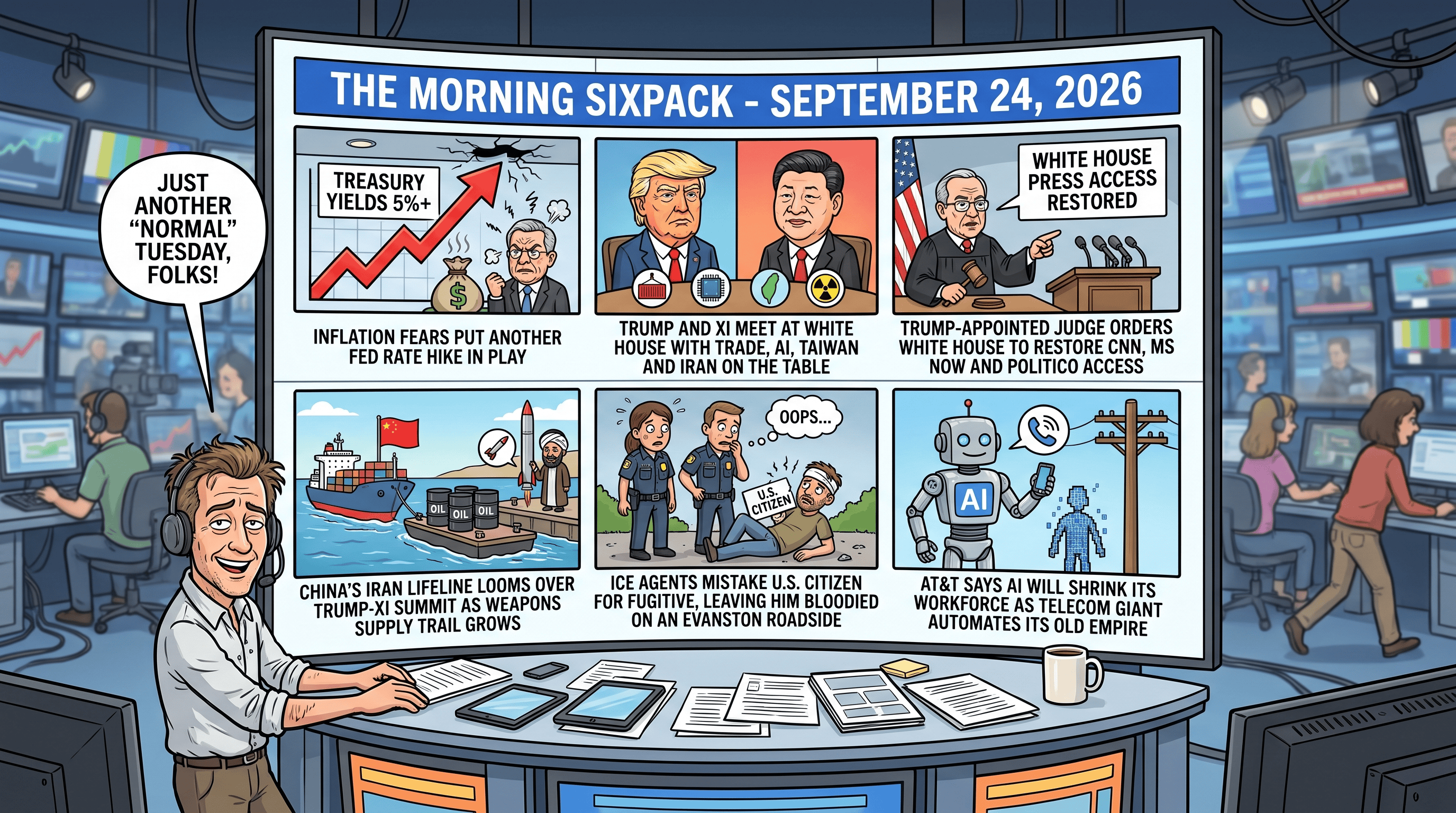
The Morning Sixpack stays free because the news that shapes your life should not be hidden behind a paywall. Paid subscribers are not paying for access. They are helping fund the research, writing, and independent voice that goes into every issue. Become a paid subscriber and help keep smart, honest news analysis free for everyone.
The bond market just sent Washington a 5% wake-up call: growth is running hot, oil is feeding inflation, and investors are starting to price in a Fed that may have to keep swinging the rate-hike hammer.
The 10-year Treasury yield ripped above 5% Wednesday and reached 5.104%, its highest level since July 2007, as strong economic data, hawkish Fed talk, an ugly Treasury auction and rising oil prices converged on the bond market. The 13-basis-point surge was the 10-year’s biggest one-day move in nearly 18 months—and suddenly the Fed’s first rate hike since 2023 looks a lot less like a one-off.
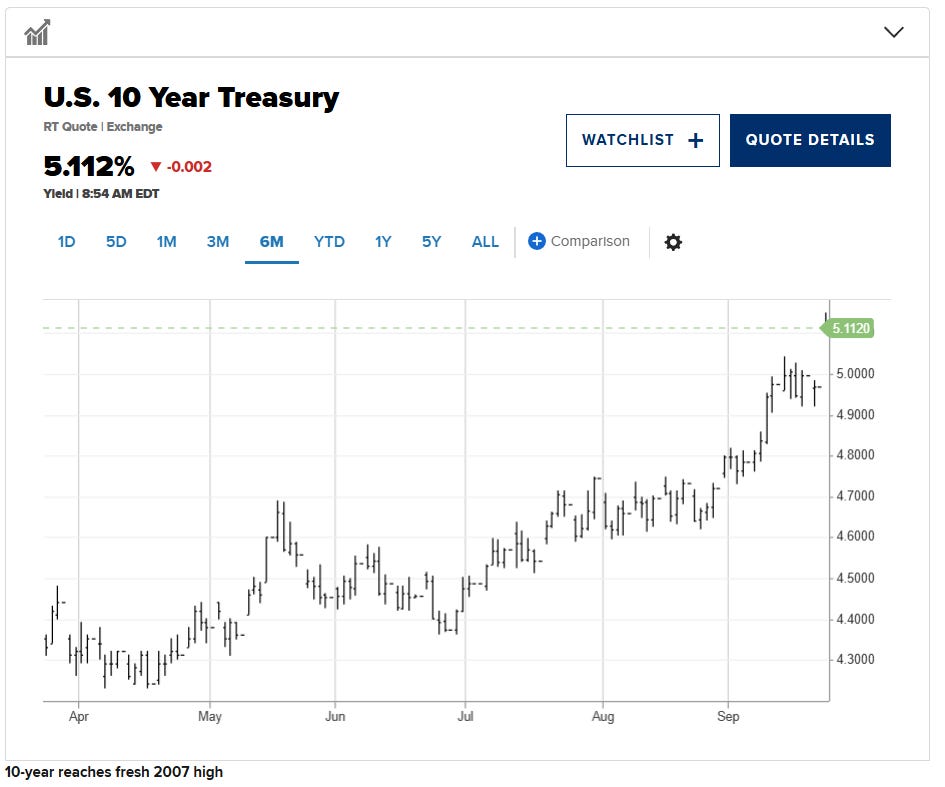
The bond market is telling investors that the inflation fight isn’t finished—and borrowing money could WILL get even more expensive from here.
The pressure was everywhere. The 2-year Treasury yield jumped more than 11 basis points to 4.889%, its highest since May 2024, while the 30-year climbed above 5.39%, its highest level since June 2007. Traders raised the implied odds of another quarter-point Fed hike in October to 66.4%, up from 55% a day earlier and less than 10% a month ago. Tony Miano of Wells Fargo Investment Institute put it plainly: “This is the market telling us we’ve entered a genuine re-tightening cycle.” His bottom line was even sharper: “you can’t fool or hide in the bond market – unless the Fed gets inflation under control the long end of the curve is going to continue to come under pressure.”
Then came economic data that gave bond traders even more reason to reach for the antacids. S&P Global’s September services PMI jumped to 58.7, its highest in nearly five years, while manufacturing hit 56.7, the strongest reading in more than four years. “Business is clearly booming now in both manufacturing and services,” S&P Global economist Chris Williamson said, while warning that input costs rose at their fastest pace in four years. Fed Governor Michael Barr added that “further policy adjustments are likely to be needed,” and a weak five-year Treasury auction only poured more gasoline on the selloff.
Oil supplied the actual gasoline. Brent crude settled above $103 a barrel and U.S. crude above $92 as the U.S.-Iran war continued to pressure energy markets and revive fears of persistent inflation. Put it together and the message from markets is uncomfortable: strong growth, expensive oil, and stubborn inflation could force the Fed to keep rates higher—or raise them again—even as Treasury borrowing costs hit levels not seen since before the financial crisis.
Editor: Wall Street spent years begging for stronger growth. Now it has strong growth, $100 oil, and 5% Treasury yields, which is roughly the economic equivalent of getting everything on your wish list and discovering the shipping charge is $4 trillion.
Source: CNBC
Trump rolled out an unusually elaborate welcome for Xi Jinping, but behind the military bands and state-dinner china (LOL—!) sit tariffs, Taiwan, Iran, and an AI race neither superpower can afford to ignore.
President Donald Trump and Chinese President Xi Jinping are holding high-stakes talks in Washington Thursday as the world’s two biggest economies try to keep their trade truce alive while confronting disputes over artificial intelligence, Taiwan and Iran. Xi’s first U.S. state visit in more than a decade comes with considerable ceremony: Trump personally greeted him at Joint Base Andrews Wednesday, followed Thursday by a White House welcome featuring hundreds of military personnel and a military flyover.
The smiles may be plentiful, but this meeting is really about whether Washington and Beijing can compete without turning every disagreement into the next international crisis.
Trade provides the immediate test. The countries have extended their 11-month truce until January 10, buying negotiators more time after a tariff fight that previously sent duties into triple digits. Trump and Xi reached an earlier truce in South Korea in October 2025, and their May meeting in China produced agreements including additional Chinese purchases of U.S. farm products and Boeing aircraft. Since then, however, Washington has imposed another 12.5% tariff on goods from China and dozens of other trading partners over allegations involving forced-labor imports.
AI may be the summit’s most consequential long-term issue. The two countries are competing to develop increasingly powerful systems while Washington has proposed a notification mechanism under which the governments could alert each other about AI incidents serious enough to threaten national security. Taiwan remains another major fault line: Beijing is expected to raise U.S. arms sales to the island, while Trump has publicly described those sales as a “very good negotiating chip.” Iran is also expected to figure prominently, given Beijing’s relationship with Tehran and the continuing conflict involving the United States, Israel, and Iran.
The choreography makes clear both governments want to keep the relationship from flying apart. Trump and Melania Trump welcomed Xi and Peng Liyuan personally Wednesday, and the White House scheduled a full state arrival, dinner, and Friday tea before the couples visit the National Archives. Melania Trump said of the unusually personal welcome, “He’s coming on our soil, and we need to welcome them with the most respect.” But there is no joint news conference planned; the governments are expected to issue separate announcements afterward, allowing each to sell the meeting at home on its own terms.
Editor: Nothing says “constructive strategic stability” quite like a military flyover followed by dinner. Superpower diplomacy apparently works best when everybody brings both the good china and the negotiating chips.
Source: Al Jazeera
Trump kicked three major news organizations out of the White House over coverage he disliked, and a judge he appointed just told the administration that constitutional due process doesn’t come with a “FAKE NEWS” exception.
A federal judge ordered the Trump administration to immediately restore White House press credentials for CNN, MS NOW and Politico, temporarily blocking President Donald Trump’s ban after finding the outlets were likely to succeed on their claim that they were denied constitutionally adequate due process. U.S. District Judge Timothy Kelly, whom Trump appointed to the federal bench, issued a 14-day temporary restraining order covering hard passes revoked from employees of the three organizations.
Trump called it a ban. Judge Kelly called the process constitutionally suspect.
The fight began after Trump announced Friday that he was banning the three organizations from the White House, attacking them as “FAKE NEWS.” The outlets sued, arguing that the administration had violated constitutional protections by stripping their access without adequate notice or an opportunity to respond. Kelly concluded they were likely to prevail on the due-process claim, writing: “None of defendants’ arguments convince the court that plaintiffs are not likely to succeed on their due process claim.”
The administration also argued that national security justified the restrictions, but Kelly wasn’t persuaded by the record before him. He noted that Trump’s original explanation focused on what he considered inaccurate and negative reporting rather than national-security concerns. The judge also questioned the urgency of the ban because some of the reporting cited by the administration dated back months or years and involved what the court characterized as routine journalistic activity. The ruling is temporary, so the larger constitutional fight over White House press access continues.
Ted Boutrous, an attorney representing the outlets, called the decision “a strong ruling vindicating freedom of the press, due process and the rule of law.” For now, CNN, MS NOW, and Politico get their White House access back while the lawsuit moves forward—and the administration will have to defend its broader authority to decide who gets through the gates.
Editor: Getting bench-slapped by your own judicial appointee has to sting a little. Turns out “I don’t like your coverage” and “national security” aren’t automatically interchangeable just because somebody typed the first one in all caps.
Source: UPI
China is publicly pitching itself as a Middle East peacemaker while Chinese entities have been shipping Iran components useful for drones and missiles—an awkward bit of diplomatic multitasking as Xi sits down with Trump.
Chinese entities have sent thousands of shipments of dual-use components to Iran—including roughly 1,300 shipments to its Defense Ministry in the first half of 2026—as President Donald Trump prepares to meet Xi Jinping while trying to preserve his relationship with Beijing. Iranian customs records reviewed by The Wall Street Journal show shipments containing electronics, motors, GPS equipment, and aircraft parts that can be used in drones and missile systems, even as China publicly promotes its efforts to help bring peace to the Middle East.
That leaves Trump with a nasty diplomatic contradiction: the country he wants as a partner in restraining Iran is also Iran’s biggest economic lifeline.
China has become the major buyer of Iranian oil despite U.S. sanctions, while Chinese banks, companies, and financial networks have helped keep money flowing to Tehran, according to the Journal. The military connection is potentially more consequential. U.S. officials have linked satellite imagery obtained from Chinese entities to an Iranian strike that killed three American troops, while Chinese companies have supplied or sought to supply materials useful for Iran’s ballistic missiles and drones. Beijing rejects accusations that it is improperly supporting the conflict, says it regulates dual-use exports, and argues that unilateral U.S. sanctions violate international law.
The supply route has increasingly moved into the air. As the U.S. Navy restricted Iranian maritime trade, Iran’s sanctioned Mahan Air dramatically increased flights between China and Tehran. Iranian customs records reviewed by the Journal showed shipments to Iran’s Defense Ministry accelerating, including more than $6 million in electronics shortly after the June ceasefire. By the first week of September, Mahan Air made 39 flights from China to Iran—double its prewar level. Meanwhile, lawmakers from both parties have pushed Trump to confront Beijing more aggressively. Sen. Elissa Slotkin wrote that there is “a large and growing body of evidence” that Chinese companies are helping Iran sustain its economy and weapons programs.
Trump, however, has publicly resisted portraying Xi as an enabler of Iran. After Defense Secretary Pete Hegseth said China and Russia were enabling Tehran “at different levels,” Trump responded: “I don’t know that they’re enabling,” adding that Xi had assured him China wouldn’t provide weapons. “I trust them,” Trump said of Xi and Vladimir Putin. That tension now follows Xi directly into Washington: Trump wants better relations with Beijing, but members of his own government see Chinese-linked trade, finance, and technology as helping Iran withstand American pressure and continue the conflict.
Editor: Diplomacy gets complicated when the guy across the table is talking peace while companies back home keep filling the other guy’s shopping cart. Trump wanted negotiating leverage with Xi; Iran just handed him a very large receipt.
Source: The Wall Street Journal
Federal immigration agents went looking for a fugitive in suburban Chicago and instead tackled a U.S. citizen who says he wound up with injuries to his head, neck and teeth—a fairly spectacular failure of the “targeted” part of targeted enforcement.
Federal immigration agents mistakenly detained and injured a U.S. citizen in Evanston, Illinois, after apparently deciding he resembled a fugitive they were trying to arrest. Local police say five federal agents were searching Sunday for a wanted man when they confronted the unidentified citizen, who refused to provide identification before agents attempted to handcuff him.
They had the wrong man—and by the time they figured that out, he was headed to the hospital.
The citizen told Evanston police that his head, neck, and teeth were injured during the confrontation. DHS said ICE officers conducting a “targeted enforcement operation” encountered someone who resembled their target, gave him lawful commands, and said he refused to cooperate or identify himself. According to local police, a federal agent said the officers released the man after determining he was a U.S. citizen and not the fugitive. Evanston police photographed the man’s injuries at the hospital and are investigating the encounter.
Witness Ryan Garton gave AP a considerably rougher account of what happened. He said he saw an agent pinning the man to the ground with a knee on his back while the man screamed, “I’m a citizen, leave me alone.” Garton said the man’s eye and temple were swollen and his face appeared scraped against the pavement. Store owner Michael Lipson similarly told AP that he watched agents wrestle the man down as he repeatedly said he was a U.S. citizen. DHS said officers offered the man assistance after identifying him and that he refused it.
The episode comes amid heightened scrutiny of federal immigration enforcement and a major expansion of ICE arrests. Nearly 51,000 people were arrested by ICE in August, according to DHS. Illinois officials condemned the Evanston encounter, while Mayor Daniel Biss said local police would continue investigating federal activity in the city.
Editor: If five agents can mistake a guy walking to the pharmacy for their fugitive, wrestle him to the pavement, and only then sort out his identity, perhaps the enforcement operation needed a little more “target” and a little less “operation.”
Source: Associated Press
AT&T has already eliminated more than half its workforce in a decade, and now it says AI, automation and the retirement of its copper network mean the shrinking isn’t finished—apparently the phone company finally found a way to put itself on hold.
AT&T says it expects to employ fewer people five years from now as artificial intelligence, automation, and the shutdown of its aging copper network reshape a company that has already cut more than half its workforce over the past decade. CTO Jeremy Legg told WIRED, “We’re not going to have the same headcount in five years as we do today,” as AT&T automates internal processes and shifts its business toward fiber, wireless, and software-defined networks.
This isn’t AT&T experimenting with AI around the edges—it’s rebuilding a 150-year-old company around needing fewer people to run it.
AT&T employed nearly 131,000 people as of June after cutting about 2,100 jobs during the first half of 2026 and roughly 8,000 last year. WIRED reports that maintaining last year’s pace could bring the workforce close to 85,000 by 2030, and a person familiar with the company described that figure as a target—although AT&T disputed it. AI is already being used for customer service, software development, locating potential cell towers, and detecting maintenance problems. As automation expands, WIRED reports that some middle-management and junior developer jobs are expected to disappear.
The transformation isn’t just about AI. AT&T is retiring the copper-wire infrastructure that powered generations of landline telephone and DSL service, replacing physical network hardware with software and pushing customers toward fiber and wireless. The company says moving away from copper has saved 660,000 megawatt-hours of electricity since 2024, enough to power roughly 65,000 homes. CEO John Stankey joked about just how much obsolete metal remains in the ground: “There’s a bunch of copper out there that probably makes AT&T the fifth-largest copper mine in the United States right now, seriously.”
AT&T insists fewer employees doesn’t mean no hiring. Legg says the company will need people to build and govern AI agents, supervise automated systems, and maintain fiber infrastructure. But the mix of jobs is clearly changing as AT&T tries to become what Stankey calls a “dramatically different” company by the end of the decade, built around fiber and a “kickass wireless network.” Employees, meanwhile, are largely back in the office five days a week, where AT&T says it has invested heavily in amenities—including childcare, therapists, and, apparently, one seriously impressive coffee machine.
Editor: Nothing captures the AI workplace transition quite like eliminating thousands of jobs while proudly upgrading the espresso situation. Welcome to the future: fewer coworkers, more fiber, and absolutely spectacular foam.
Source: WIRED