


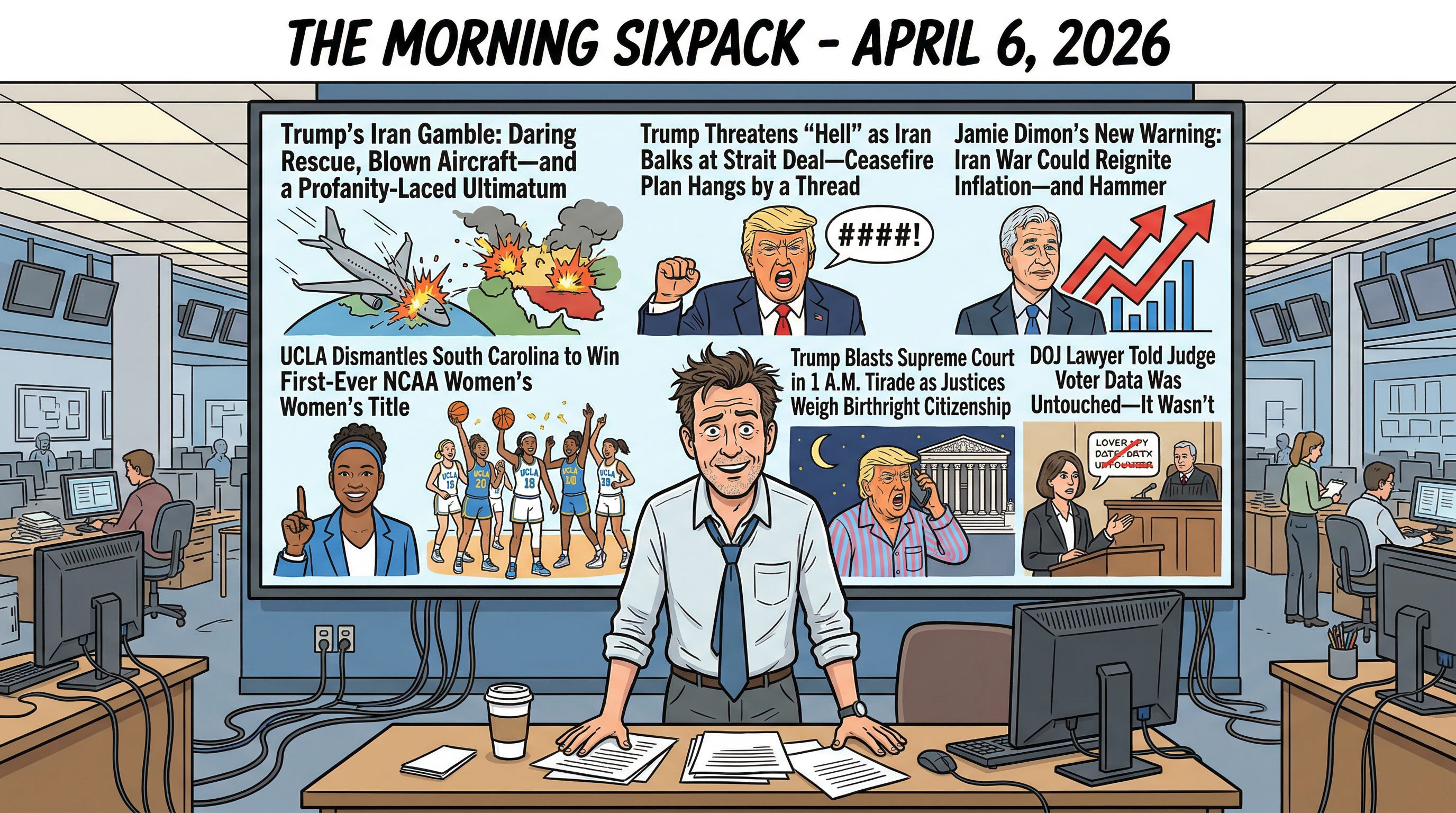
Trump’s Iran Gamble: Daring Rescue, Blown Aircraft—and a Profanity-Laced Ultimatum
Trump is set to celebrate a risky rescue inside Iran even as his threats to bomb power plants and bridges raise the stakes in a war Tehran refuses to end.
And he’s now slapped an 8 p.m. Tuesday deadline on a country that has ignored every previous one.
President Donald Trump plans a White House victory lap after U.S. forces pulled a downed F-15E crewman out of remote Iranian mountains, averting what could have been a politically disastrous POW scenario. “WE GOT HIM!” Trump wrote, calling the mission “miraculous” and “an AMAZING show of bravery and talent by all” as Iranian forces were “looking hard, in big numbers, and getting close.” The rescue came after the fighter jet was shot down and another U.S. aircraft—an A-10—was also lost in the escalating fight.
The operation was no cakewalk. U.S. C-130s and rescue helicopters flew low and slow over mountainous terrain, taking ground fire. Some service members were injured. Two C-130 cargo planes and at least two MH-6 “Little Bird” helicopters had to be blown up after getting stuck on a makeshift airstrip—tens of millions of dollars in equipment torched to avoid leaving it behind. (Editor: Nice self-own, Trump.)
Trump, however, doubled down: “WE WILL NEVER LEAVE AN AMERICAN WARFIGHTER BEHIND!” (until we do) and insisted the missions prove “overwhelming Air Dominance and Superiority over the Iranian skies.” U.S. officials have acknowledged injuries during the rescue effort.
Then came the escalation. In a profanity-laced post, Trump warned: “Tuesday will be Power Plant Day, and Bridge Day, all wrapped up in one, in Iran…Open the Fuckin’ Strait, you crazy bastards, or you’ll be living in Hell — JUST WATCH! Praise be to Allah.” He later added: “Tuesday, 8:00 P.M. Eastern Time!” The demand: reopen the Strait of Hormuz, a chokepoint for roughly 20 percent of the world’s oil supply. Iran’s leadership responded by rejecting U.S. ceasefire terms and promising retaliation, calling the threats tantamount to war crimes.
Meanwhile, Israel—assisting with intelligence—said it killed Maj. Gen. Majid Khademi, Iran’s Revolutionary Guard intelligence chief, and struck major petrochemical facilities that account for a huge share of Iran’s exports. European Council President António Costa warned attacks on energy infrastructure are “illegal and unacceptable,” noting civilians would pay the price if the war widens.
So here we are: a successful rescue that required blowing up our own aircraft, mounting casualties the White House glosses over, and a presidential ultimatum with a ticking clock. Tehran hasn’t blinked yet. And history suggests deadlines from this White House tend to move.
Source: The Washington Post (free)
Editor: If you’re measuring “air dominance” by how much of your own gear you have to detonate in the desert, the bar has officially been lowered.
Trump Threatens “Hell” as Iran Balks at Strait Deal—Ceasefire Plan Hangs by a Thread
President Trump is giving Iran until 8 p.m. Tuesday to reopen the Strait of Hormuz—or face expanded U.S. strikes—even as a fragile, Pakistan-brokered ceasefire framework quietly takes shape. He’s gonna #TACO
The clock is ticking toward a showdown that could jolt global oil markets and drag the region deeper into war.
According to Reuters, Washington and Tehran are weighing a proposal that would trigger an immediate ceasefire followed by negotiations on a broader peace deal within 15 to 20 days. Pakistan’s army chief, Field Marshal Asim Munir, was reportedly in overnight contact with Vice President JD Vance, special envoy Steve Witkoff and Iranian Foreign Minister Abbas Araqchi to float the framework. But a senior Iranian official made clear: Tehran will not reopen the Strait as part of a temporary truce—and it won’t negotiate under deadlines.
Trump, meanwhile, is keeping the pressure on. He has vowed to rain “hell” on Iran if it doesn’t make a deal and restore shipping through Hormuz, through which roughly a fifth of the world’s oil and gas flows. “This is one of many ideas, and (Trump) has not signed off on it. Operation Epic Fury continues,” a White House official said of the ceasefire outline. The president is expected to address the proposal publicly.
Tehran’s response has been blunt. Foreign Ministry spokesperson Esmaeil Baghaei said negotiations are “incompatible with ultimatums and threats to commit war crimes,” rejecting earlier U.S. demands—including a 15-point plan—as excessive. Iran insists its conditions reflect strength, not compromise. And it’s signaling that the Strait of Hormuz remains leverage, not a concession.
The battlefield tells the rest of the story. Israeli strikes reportedly killed Revolutionary Guards intelligence chief Majid Khademi and hit the South Pars petrochemical complex. The International Atomic Energy Agency confirmed military strikes near Iran’s Bushehr nuclear plant, though the facility itself was not damaged. More than 3,500 people have been killed in Iran, according to HRANA, while Israeli and U.S. casualties continue to mount. Oil prices dipped slightly Monday on ceasefire chatter—but no one’s betting the farm on calm just yet.
So here we are: an ultimatum on the table, intermediaries scrambling, and both sides insisting they won’t blink. If this is diplomacy, it’s diplomacy with a fuse burning down.
Source: Reuters
Editor: Nothing steadies global energy markets like a public countdown to “hell.” Investors must be thrilled.
Jamie Dimon’s New Warning: Iran War Could Reignite Inflation—and Hammer Markets
JPMorgan CEO Jamie Dimon says the Iran war could spark fresh inflation, push interest rates higher, and send asset prices tumbling—even as markets hover near record highs. DUH.
“The skunk at the party—and it could happen in 2026—would be inflation slowly going up.”
In his annual letter to shareholders, Dimon warned that rising oil and commodity shocks tied to the conflict could lead to prolonged inflation and ultimately higher rates. “This alone could cause interest rates to rise and asset prices to drop,” he wrote. He pointed to the painful lessons of the 1970s and 1980s, when oil spikes helped trigger deep recessions—while noting the U.S. is less vulnerable today.
Dimon made clear the geopolitical stakes matter more than market swings. “We should not turn a blind eye to the role the current regime in Iran has played in fostering terrorism and killing thousands of people, including Americans and many of its own citizens, over many years,” he said. “That threat must be addressed in an appropriate manner.” In other words: fix the security problem—but don’t pretend the economic fallout won’t sting.
On Wall Street, Dimon flagged brewing trouble in private credit, predicting that high-risk lending could take a bigger-than-expected hit in a downturn as underwriting standards slip. He also warned that pushing private credit products onto retail investors demands “greater transparency” and “higher standards.” Translation: not everyone handing out loans knows what they’re doing.
And he couldn’t resist a jab at private equity. With markets recently at all-time highs, Dimon questioned why firms sitting on nearly 13,000 companies haven’t rushed more of them public. “It’s hard to imagine what will happen if and when we have an extended bear market,” he wrote. Markets may be cruising now—but Dimon’s message is that war, inflation and easy credit are a combustible mix.
Source: The Wall Street Journal (free)
Editor: When the guy running the nation’s biggest bank starts talking about skunks at the party, you might want to check the exits before the music stops.
Also—Dimon is kind of a wish washy dumbass, so there’s that.
UCLA Dismantles South Carolina to Win First-Ever NCAA Women’s Title
UCLA crushed South Carolina 79-51 to capture the first NCAA women’s basketball championship in school history, completing a mission that began with last year’s Final Four heartbreak.
This wasn’t just a win—it was a statement.
In Phoenix, Gabriela Jaquez scored 21 points, Lauren Betts added 16 and 11 rebounds, and the Bruins turned the title game into a runaway by the third quarter. “I knew we were going to do it. Coming to UCLA we all set out for a goal, and I imagined this moment,” Jaquez said. “I imagined it so many times, and I am just so, so proud.” The Bruins (37-1) capped a dominant season with their only loss coming back in November.
Coach Cori Close’s group—built through recruiting and the transfer portal—delivered on a promise forged after last year’s semifinal exit. “The talent is our floor, but our character will determine our ceiling,” Close said. Against South Carolina, that ceiling looked awfully high. UCLA led 36-23 at halftime, then buried the Gamecocks with a 25-9 third quarter.
Betts, the 6-foot-7 senior anchor, controlled the paint and earned Most Outstanding Player honors. Kiki Rice’s early three-pointer set the tone, and by the time Betts exited with under four minutes left, the confetti was practically cued. South Carolina shot just 17% in the opening quarter and never recovered. “We just didn’t have it today,” Gamecocks coach Dawn Staley said. “They were the better team.”
The 28-point margin nearly set a championship-game record and delivered UCLA its first national title since the 1978 AIAW era—its first under the NCAA banner. For a program long overshadowed by the school’s legendary men’s history, this was a breakthrough decades in the making.
Source: The Washington Post
Editor: Wooden built a pyramid. Close just hung a banner. About time the women got their own chapter in Westwood lore.
Trump Blasts Supreme Court in 1 A.M. Tirade as Justices Weigh Birthright Citizenship
President Donald Trump tore into the Supreme Court in a late-night Truth Social rant, urging justices to use “common sense” as they consider whether he can end birthright citizenship.
And yes—he suggested they should’ve done their homework by watching Mark Levin on Fox News.
The 79-year-old president fumed that it’s “too bad” the Court didn’t “study” Levin’s show, where the host argued the 14th Amendment was never meant to grant citizenship to children of undocumented immigrants. “If they saw it they would never allow that money making HOAX to continue. THEY SHOULD USE THEIR POWERS OF COMMON SENSE FOR THE GOOD OF OUR COUNTRY,” Trump wrote just before 1 a.m. ET.
The case centers on Trump’s executive order seeking to scrap automatic birthright citizenship. Lower federal courts have already blocked the move. During oral arguments last week, several justices—including conservatives—appeared skeptical that a president can unilaterally undo the Constitution’s citizenship clause. Chief Justice John Roberts cut to the core after the administration argued the framers couldn’t have anticipated modern migration. “It’s a new world. It’s the same Constitution,” Roberts replied.
Trump even attended the April 1 hearing in person and reportedly stormed out after Solicitor General D. John Sauer struggled under pointed questioning. Justice Neil Gorsuch pressed Sauer on Native American citizenship prior to the Indian Citizenship Act of 1924, exposing the historical complexity of the administration’s argument.
On Fox News, Levin warned that if the Court “constitutionalize[s] this,” it would be “the most activist court in the history of the Supreme Court.” Section 1 of the 14th Amendment states plainly: “All persons born or naturalized in the United States, and subject to the jurisdiction thereof, are citizens of the United States and of the State wherein they reside.” That language has stood for more than 150 years. Levin is an idiot who apparently cannot read. Typical #MAGA “pundit”.
Now Trump is publicly pressuring a Court that includes three of his own nominees. If this is the art of persuasion, it looks a lot like yelling at the referee before the final call.
Source: The Daily Beast
Editor: When your constitutional strategy hinges on late-night cable hits, maybe the legal bench isn’t the only one feeling tested.
DOJ Lawyer Told Judge Voter Data Was Untouched—It Wasn’t
A Justice Department official told a federal judge the agency hadn’t used nonpublic voter roll data it collected from states—despite evidence that it had already accessed and analyzed that information.
When the government misleads a court about election data, that’s not a paperwork error—that’s a credibility crisis.
During a hearing in Rhode Island over the Trump administration’s push to obtain unredacted voter rolls, U.S. District Judge Mary McElroy asked what the DOJ had done with sensitive voter data gathered from other states. The acting head of the department’s voting section said the data hadn’t been touched. According to WIRED, that statement wasn’t true.
The discrepancy centers on how the DOJ is using nonpublic voter roll data as it ramps up oversight of state election systems. Voting-rights advocates have warned that centralized federal access to detailed voter files could open the door to misuse or politically motivated investigations. The department has argued it needs the information to enforce federal voting laws.
The revelation adds to mounting scrutiny over the administration’s approach to election oversight ahead of the midterms. Critics argue that even the appearance of misleading a judge undermines trust—especially in cases involving voter registration data, one of the most sensitive datasets in American democracy.
The Justice Department has not publicly clarified the inconsistency. But when a federal judge is told one thing and the record shows another, it raises an uncomfortable question: If the courts can’t rely on straight answers, who can?
Source: WIRED
Editor: When the Voting Section starts playing fast and loose with the truth, it’s not just ballots on the line—it’s the rulebook itself. A MAGA lawyer lying? Say it ain’t so!