


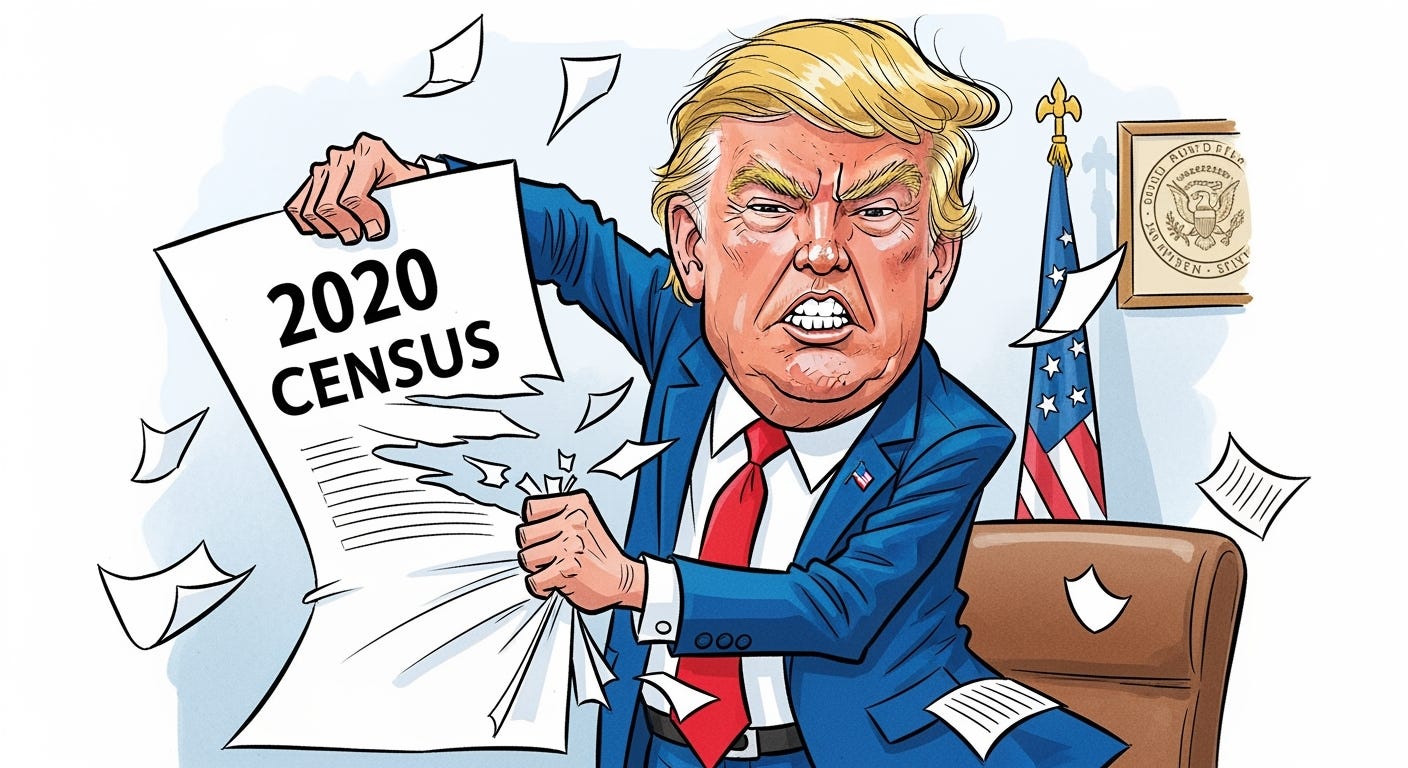
Donald Trump isn’t just dusting off the old playbook—he’s rewriting it with a Sharpie. This week, the president announced he wants a “highly accurate” census that would deliberately omit undocumented immigrants. In other words, a headcount that skips millions of people who live, work, pay taxes, and raise families in the U.S. The Constitution calls for counting everyone in the country. Trump’s version says, “Nah, only the ones I like.”
On Truth Social, Trump claimed he’s instructed the Commerce Department to “immediately” start work on this new census, based on “modern-day facts and figures” and “results from the 2024 election.” The timing’s fuzzy—is he ordering one now or laying groundwork for the 2030 census? Either way, it’s part of his ongoing campaign to redraw the political map in Republicans’ favor, especially in places like Texas, where he’s already cheerleading a mid-decade redistricting blitz to pick up five more GOP-held House seats.
Here’s the problem: The census isn’t just about seats in Congress. It decides where billions in federal dollars go. Remove millions from the official count, and you’re not just shrinking blue-state political clout—you’re yanking funding for schools, roads, and healthcare from communities that already get shortchanged.
And before you think this is purely a “coastal elite” problem, remember: States like Texas and Florida would also lose representation under this plan. Even Alabama and Ohio would see ripple effects, according to Pew Research Center’s analysis.
Trump’s history with the census is… let’s call it “checkered.” In 2019, the Supreme Court blocked his push to add a citizenship question, ruling that his administration’s reasoning was “contrived.” That same year, internal documents from the Brennan Center revealed repeated attempts to game the 2020 count by excluding undocumented immigrants. The census that did happen was marred by COVID disruptions, and later audits showed it undercounted minorities while overcounting whites and Asians—exactly the skew that benefits Republican strongholds.
The legal obstacles to a new census are huge. Article I, Section 2 of the Constitution says the census happens every 10 years, and the 14th Amendment is explicit about counting “the whole number of persons in each state.” The ACLU’s Adriel I. Cepeda Derieux—who helped beat Trump’s last attempt—says they’re ready to sue again if he tries to “weaponize the Census against immigrant communities.” And because Congress codified the process in the 1950s, even a willing Census Bureau might need legislative sign-off.
Meanwhile, Trump hasn’t even nominated a permanent Census Bureau director. The last one, Biden appointee Robert Santos, resigned earlier this year. Acting director Ron S. Jarmin is keeping the seat warm, but without strong leadership, the bureau could be vulnerable to political pressure—exactly the kind Trump thrives on.
Don’t forget: Even if this “instant census” doesn’t happen, he can still influence the 2030 count. Federal law requires the bureau to finalize its questions two years in advance, meaning the Trump administration gets first crack at shaping what gets asked—and how the answers get used.
What’s at stake here isn’t just the integrity of a headcount. It’s the foundation of representative democracy. Mess with the census, and you’re deciding who matters before a single vote gets cast. Trump’s plan isn’t about accuracy—it’s about exclusion.
When the guy who lost the popular vote twice tells you he’s just “fixing the math,” maybe don’t hand him the calculator.
Source: Washington Post