


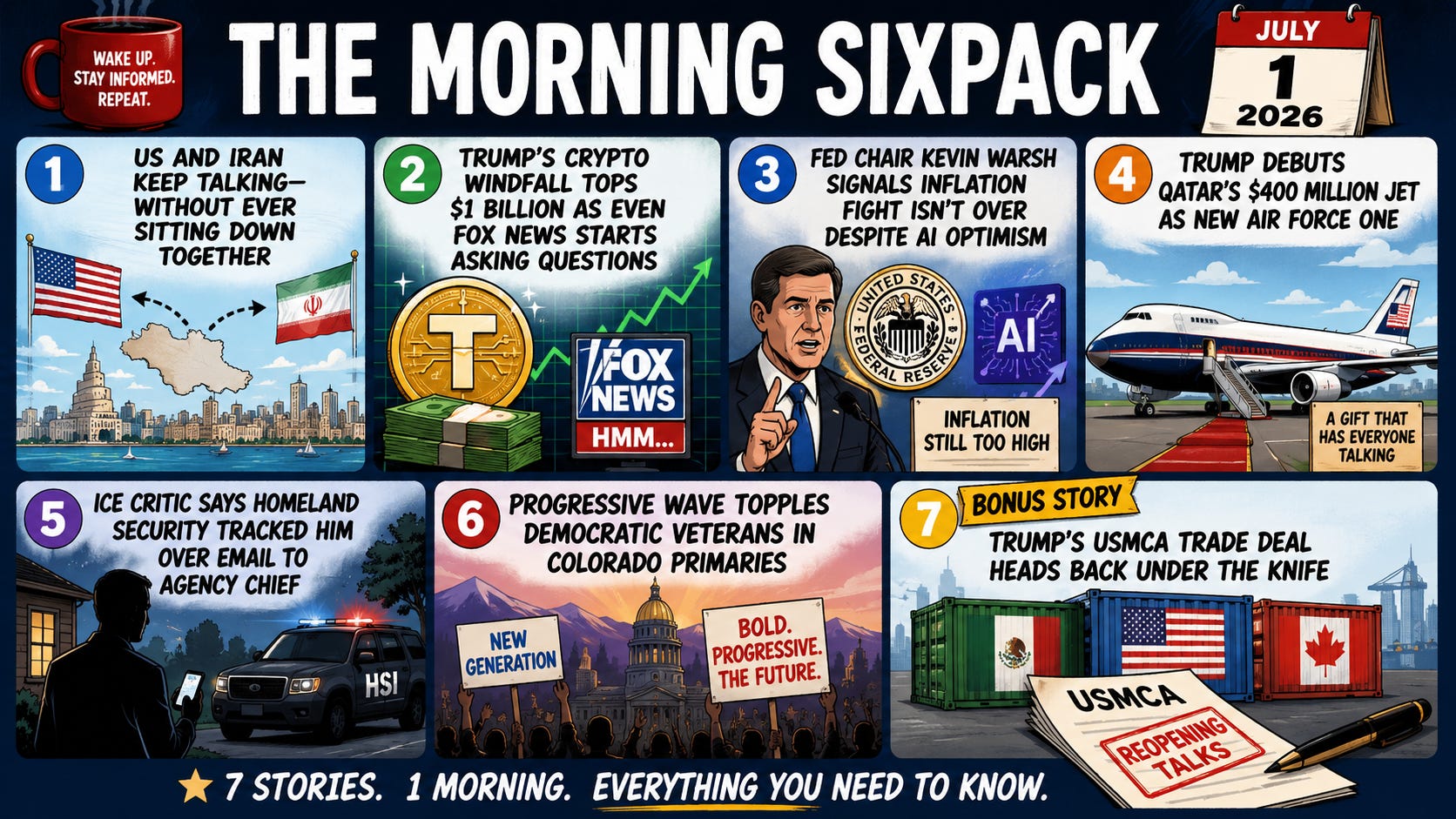
Washington and Tehran are back to indirect talks in Doha, proving that even when nobody wants to meet, the paperwork still piles up.
US and Iran Keep Talking—Without Ever Sitting Down Together
The U.S. and Iran are holding indirect negotiations in Qatar, with mediators shuttling between the two sides as disputes over shipping, sanctions, and a fragile ceasefire continue.
Despite the diplomatic activity, neither side plans to hold direct talks—highlighting just how much mistrust still dominates the relationship.
U.S. envoys Jared Kushner and Steve Witkoff met in Doha with Qatari mediators to discuss implementation of an initial agreement aimed at reducing tensions with Iran (i.e., “war”). Qatar’s Foreign Ministry said the current discussions are limited to technical-level negotiations covering nuclear issues, economic matters, state performance, and regional security. Officials confirmed there are no direct meetings scheduled between American and Iranian representatives.
Iran says its delegation is focused on enforcing the existing memorandum of understanding, particularly disputes involving shipping through the Strait of Hormuz and the release of $6 billion in frozen Iranian assets. Iranian Foreign Ministry spokesman Esmaeil Baghaei also made clear that Tehran has no plans to meet with U.S. officials “at any level in the next few days.”
One of the biggest sticking points remains Article 5 of the agreement. Iran argues it retains authority to organize vessel traffic through the Strait of Hormuz during the negotiation period, while Washington believes commercial shipping should move freely without Iranian interference. Tehran also objects to proposed new shipping routes near Oman, saying they were developed without its approval and violate the agreement.
Qatar says a dedicated hotline recently helped prevent a broader military escalation after an exchange of fire involving U.S. and Iranian forces near the strait. Doha is continuing to coordinate with Oman to keep one of the world’s busiest shipping lanes open, while confirming that the $6 billion in frozen Iranian assets has not yet been transferred.
Source: Al Jazeera
Editor: If diplomacy were measured by frequent-flyer miles instead of actual agreements, everyone involved would be celebrating by now. If only Trump had a free airplane given to him by… Qatar. (See below.)
Trump’s crypto empire made him richer than ever, and now even Fox News is asking the question a lot of people have been thinking.
Trump’s Crypto Windfall Tops $1 Billion as Even Fox News Starts Asking Questions
President Donald Trump’s latest financial disclosure shows he collected more than $1 billion from cryptocurrency ventures while serving in the White House, fueling renewed ethics questions over the intersection of public office and private business.
The biggest surprise may not be the money—it may be that some of the loudest questions are now coming from inside conservative media.
A 927-page financial disclosure released by the Office of Government Ethics shows Trump generated more than $1.2 billion in revenue from cryptocurrency businesses during the past year. The filing lists more than $500 million from World Liberty Financial’s token sales and more than $600 million from sales of Trump-themed meme coins. Additional income came from crypto-related equity sales, while Trump also earned millions from branded products including watches, Bibles, and sneakers. Forbes now estimates his net worth at roughly $6 billion. Last year, they pegged it at $2.3 billion.
The report also highlights the rapid expansion of Trump’s overseas business interests. New licensing and development deals in the United Arab Emirates, Saudi Arabia, Qatar, Romania and Vietnam generated tens of millions of dollars while those same countries were negotiating with the United States over issues ranging from tariffs to military cooperation. Mar-a-Lago also saw revenue jump roughly 50 percent as foreign leaders and business executives increasingly visited the Florida property.
Can you say “bribery”?
The disclosure has renewed conflict-of-interest concerns because Trump’s administration reversed many of the Biden administration’s tougher crypto policies while businesses tied to his family profited from the industry. Meanwhile, investors who bought many of Trump’s crypto products have seen steep losses, with World Liberty tokens reportedly falling about 80 percent since trading began and Trump meme coins dropping dramatically from their launch highs. The White House maintains Trump’s assets are managed through a trust overseen by his sons and says all presidential decisions are made solely in the public interest.
Yeah, right.
The disclosures also produced an unusual reaction on Fox News. Host Dana Perino called the figures “eye-opening” and admitted, “Maybe it is in crypto, maybe it’s not, but it does feel a little bit like, wait, what is going on?” She later added, “They’re not on the most solid ground here,” while noting the issue could become a focus of congressional investigations if political control shifts after the midterm elections.
Source: Associated Press / Raw Story
Editor: Washington has always attracted money and influence. The novelty here is watching digital coins become one of the biggest addresses in town.
The new Fed chairman isn’t promising rate cuts anytime soon—and he made it clear the White House won’t be calling the shots.
Fed Chair Kevin Warsh Signals Inflation Fight Isn’t Over Despite AI Optimism
Federal Reserve Chairman Kevin Warsh said inflation remains too high while refusing to hint at this month’s interest rate decision, signaling the Fed isn’t ready to ease up just yet.
Warsh also pushed back on political pressure, insisting the Federal Reserve will remain independent despite President Trump’s repeated demands for lower rates.
Speaking at the European Central Bank’s annual forum in Portugal, Warsh said central bankers remain focused on restoring price stability even as artificial intelligence promises to boost productivity and expand the economy’s supply side. While he acknowledged AI could eventually have major implications for monetary policy, he declined to predict whether it would ultimately reduce inflation or influence the Fed’s next move.
Warsh also unveiled plans to modernize how the Federal Reserve makes decisions, saying the central bank hopes to use new technologies and real-time economic data over the next year instead of relying so heavily on traditional government statistics. He said the leaders of five outside task forces reviewing Fed operations will be announced next week, including economists and financial experts from both the U.S. and abroad.
Perhaps his most closely watched comments came when asked about political pressure from the White House. Warsh said the Federal Reserve’s independence would not change under his leadership despite Trump’s public criticism of previous Fed decisions. He also declined to offer any guidance on whether rates could change later this month, saying policymakers would debate the latest economic data behind closed doors before making a decision.
Investors continue to watch every public appearance by the new Fed chairman for clues about future policy. For now, Warsh’s message was straightforward: Inflation remains the Fed’s top concern, AI could reshape the economy over time, and interest rate decisions will continue to be driven by economic data—not politics.
Source: CNBC
Editor: Wall Street was hoping for breadcrumbs about rate cuts. Warsh showed up with a broom and swept the crumbs off the table.
Air Force One is getting a new ride courtesy of Qatar—and the debate over whether that’s a gift or a headache isn’t going away. (It’s a bribe.)
Trump Debuts Qatar’s $400 Million Jet as New Air Force One
President Donald Trump will fly aboard a nearly $400 million Boeing 747 donated by Qatar for the first time as Air Force One, capping a fast-track effort to put the luxury aircraft into presidential service.
So much for “America First” and bringing back manufacturing to the United States. Sorry not sorry, Boeing.
The plane may be ready for takeoff, but questions about foreign influence, security, and ethics are still very much on the runway.
Trump will unveil the aircraft during a trip to North Dakota before it leads a July 4 flyover celebrating America’s 250th birthday. The jet, now designated the VC-25B Bridge, is intended as a temporary replacement while two new presidential aircraft remain under construction. (Don’t hold your breath, Boeing.)
Trump has also said the plane will ultimately be donated to his presidential library liquor store after he leaves office. The aircraft replaces the familiar Kennedy-era paint scheme with a red, white, and blue design chosen by Trump himself.
The White House and Air Force insist the aircraft has undergone exhaustive security inspections, countersurveillance sweeps, and engineering upgrades to meet presidential standards. Officials say no shortcuts were taken despite an accelerated timetable, explaining that the aircraft received the same FAA safety certifications and mission-critical protections required for transporting the commander in chief. The Air Force says it prioritized essential operational capabilities over cosmetic upgrades to speed delivery.
Critics remain unconvinced. Ethics watchdogs point to Trump’s business ties in Qatar and the Trump Organization’s recent development projects there, arguing the gift creates the appearance of a conflict of interest. (It’s a bribe, in case I hadn’t said that before.)
Former Air Force Secretary Frank Kendall questioned whether the compressed schedule allowed the aircraft to receive the same level of communications and defensive systems normally installed on Air Force One.
The White House rejects those concerns, saying the aircraft was donated to the U.S. government—not to Trump personally—and that the president “only acts in the best interests of the American public.” LOL.
Source: MS NOW
Editor: The White House says it’s simply accepting a useful airplane. Critics see a flying ethics seminar with four engines and first-class seating.
A strongly worded email used to disappear into a government inbox. Now it might bring federal agents to your front door.
ICE Critic Says Homeland Security Tracked Him Over Email to Agency Chief
A New York man says Homeland Security agents visited his home and later tracked him to an airport hotel months after he sent a sharply critical—but non-threatening—email to the acting head of ICE, raising fresh concerns about free speech and government intimidation.
Civil liberties advocates say criticizing government officials is protected by the First Amendment—and sending agents to someone’s home over it crosses a dangerous line.
David Streever, a former journalist who now works in the tech industry, said Homeland Security Investigations agents showed up at his Rochester, New York, home while he was vacationing in Finland with his daughter. His wife, an Episcopal priest, was told the agents wanted to question him about an email he had sent five months earlier to then-acting ICE Director Todd Lyons. The email harshly condemned Lyons over immigration enforcement and compared him to a Nazi official, but did not threaten violence.
The encounter became even more unsettling after Streever returned to the United States. He says an HSI agent somehow located the airport hotel where he was staying near JFK International Airport within hours of landing, leaving a business card and voicemail asking him to make contact. Streever says even his family did not know which hotel he had selected, prompting questions from privacy advocates about what surveillance methods may have been used. DHS declined to answer questions about the case, saying only that ICE investigates all credible threats against its personnel—if even 5 months later!
Attorneys with the Foundation for Individual Rights and Expression (FIRE) and the ACLU (donate!) argue Streever’s email is clearly protected political speech, not a criminal threat. They also criticized Homeland Security’s growing use of warning notices left with critics, calling the practice an intimidation tactic designed to discourage Americans from speaking out against government policies. Similar visits have reportedly occurred in other recent cases involving outspoken ICE critics.
Rather than backing down, Streever says the experience strengthened his resolve to speak publicly. “If they hadn’t come after me, I would have just been a guy whose sole act of defiance was writing a stern email,” he said. “But for them to come after me six months later for that one email, it makes me feel like we do have a lot of power. It makes me feel like they do care that we’re speaking up.”
Source: NPR
Editor: Governments should investigate real threats. Investigating angry emails is a much slipperier slope—and one Americans of every political stripe should be watching closely.
Democratic voters keep sending a message to party veterans: Move left or move aside.
Progressive Wave Topples Democratic Veterans in Colorado Primaries
Progressive Democrats scored a series of major primary victories in Colorado, defeating longtime party insiders and signaling that the Democratic base continues to push the party further to the left ahead of the 2026 midterms.
The biggest casualty was a 29-year congressional veteran who lost to a 29-year-old challenger backed by Bernie Sanders.
The night’s biggest upset came in the Denver area, where 29-year-old Melat Kiros defeated Rep. Diana DeGette, ending the congresswoman’s 29-year run in the House. Kiros, an Ethiopian-born former attorney and current doctoral student, built her campaign around anti-establishment themes and opposition to U.S. military aid for Israel. Despite DeGette’s fundraising advantage and long tenure, Kiros led comfortably as votes were counted.
Progressives also celebrated victories elsewhere in Colorado. State Rep. Manny Rutinel won the Democratic nomination in the battleground 8th Congressional District, setting up a high-profile showdown with Republican Rep. Gabe Evans this fall. Attorney General Phil Weiser also defeated Sen. Michael Bennet in the Democratic primary for governor after campaigning as a Trump adversary rather than a Washington insider. Sen. John Hickenlooper, however, survived his own challenge from the party’s left.
The results mirror recent Democratic primaries in New York and Maine, where voters have increasingly embraced younger candidates rejecting corporate PAC money while taking harder-line positions on immigration enforcement and Israel. California Rep.
Ro Khanna said the victories show “the energy in our party is with bold progressives willing to stand up against foreign wars, ICE and the billionaire class.”
Republicans immediately seized on the results. Evans labeled Rutinel a “Mamdani-wanna-be extremist,” hoping to tie Democrats to New York’s democratic socialist movement in one of the nation’s most competitive House races. With Republicans holding only a narrow House majority, Democrats need a net gain of three seats to reclaim control, making Colorado’s swing districts some of the most closely watched races of the 2026 election.
Source: Reuters
Editor: Democratic voters keep asking for fresh faces. Party leaders may discover that “experienced incumbent” isn’t the selling point it used to be.
BONUS STORY
Remember when USMCA was called the greatest trade deal ever? Now it’s headed back to the negotiating table.
Trump’s USMCA Trade Deal Heads Back Under the Knife
The United States is letting the deadline pass without extending the U.S.-Mexico-Canada trade agreement, setting the stage for months of negotiations over changes President Trump says are needed to protect American manufacturing.
The agreement once hailed by Trump as a historic achievement is now being treated as a work in progress—with billions in North American investment hanging in the balance.
Rather than automatically extending the U.S.-Mexico-Canada Agreement for another 16 years, the Trump administration will continue negotiating revisions with Mexico while preparing to open talks with Canada. If no deal is reached, the pact will face annual reviews until it expires in 2036, although few trade experts expect that outcome. Administration officials say they hope to complete a revised agreement before the end of the year.
Trump wants tougher rules aimed at bringing more manufacturing back to the United States while limiting China’s ability to use Mexico as a backdoor into the American market. Proposed changes include requiring half of a vehicle’s components to be made in the U.S. and increasing the North American content requirement from 75 percent to more than 80 percent for tariff-free treatment. Mexico has already raised tariffs on many Chinese imports as negotiations continue.
The uncertainty is creating headaches for automakers whose supply chains routinely cross U.S., Canadian, and Mexican borders multiple times before a vehicle is completed. Industry leaders warn that Trump’s broader tariff policies have already eliminated more than 21,000 U.S. auto manufacturing jobs since USMCA took effect and argue the proposed rules may be difficult to meet because many parts are no longer produced domestically in sufficient quantities.
The White House insists the strategy will ultimately strengthen American manufacturing, saying Trump is pursuing tariffs, tax incentives, and deregulation to rebuild the auto industry. But business groups are also complaining they have largely been shut out of the negotiations after industry advisory committees expired earlier this year, leaving many executives without the access they’ve traditionally had during major trade talks.
Source: The Washington Post (gift)
Editor: Trade agreements are supposed to create certainty. If they require yearly cliffhangers, they’re starting to look more like a TV series than an economic policy.
Better: Let ALL manufacturers from EVERY country sell in the United States and compel the US auto industry to make better cars and trucks. That includes Tesla, too. And stop giving subsidies to US manufacturers. Handouts don’t make companies better.