


The Morning Sixpack stays free because the news that shapes your life should not be hidden behind a paywall. Paid subscribers are not paying for access. They are helping fund the research, writing, and independent voice that goes into every issue. Become a paid subscriber and help keep smart, honest news analysis free for everyone.
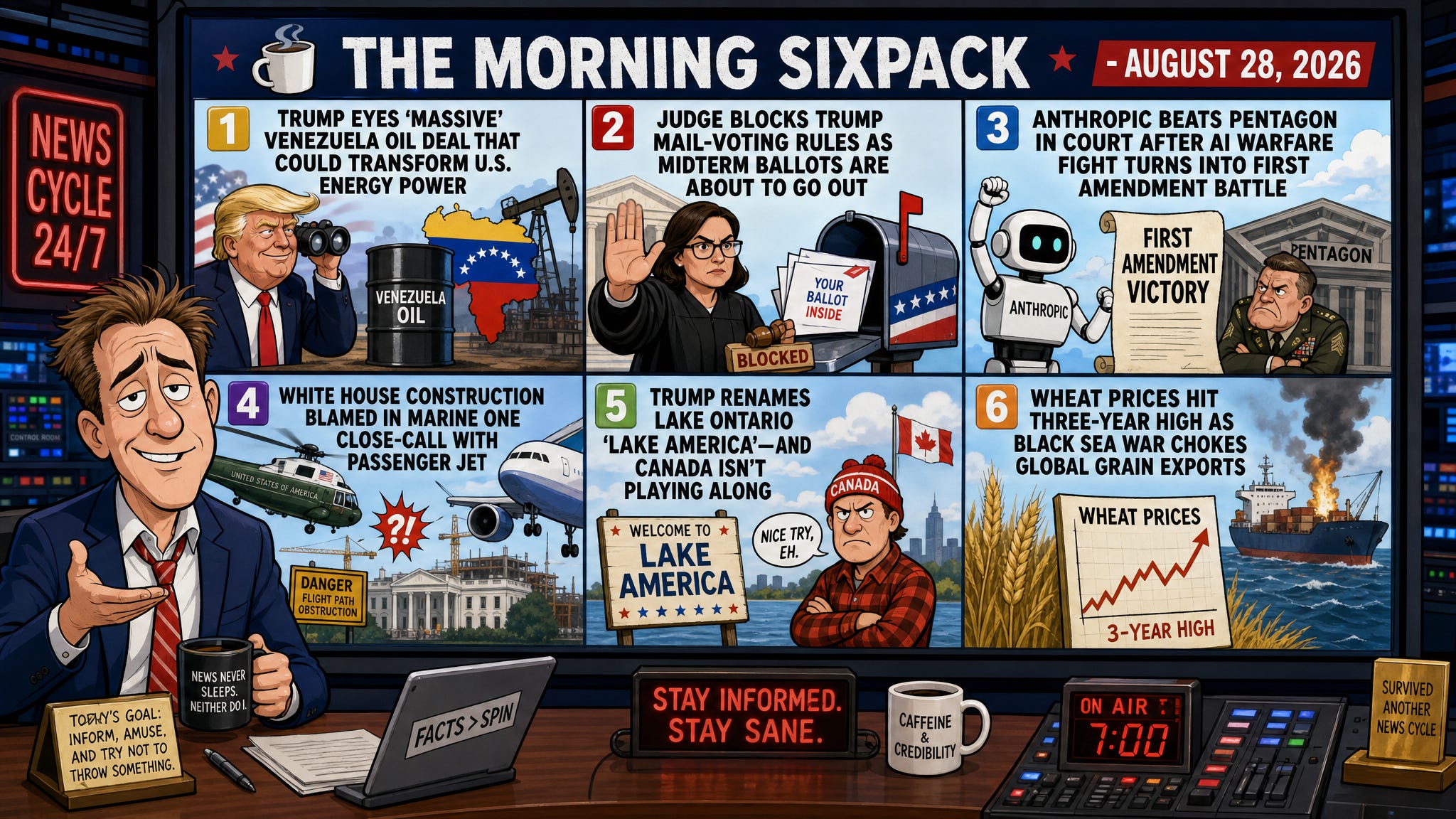
The U.S. is negotiating for an ownership stake in Venezuelan oil fields holding 90 billion barrels of proven reserves—apparently the “Donroe Doctrine” comes with mineral rights.
Trump Eyes ‘Massive’ Venezuela Oil Deal that Could Transform U.S. Energy Power
The Trump administration is negotiating with Venezuela’s interim government for a U.S. ownership stake in more than a dozen Venezuelan oil fields containing roughly 90 billion barrels of proven reserves. The arrangement could dramatically expand America’s effective oil holdings while giving Venezuela access to U.S. and other private companies capable of rehabilitating and developing an oil industry battered by decades of mismanagement.
If this deal gets signed, Washington wouldn’t just be buying oil—it would be planting an American flag in one of the biggest energy reserves on Earth.
The negotiations come as wars in Iran and Ukraine have disrupted global oil supplies, pushed prices higher, and added urgency to America’s energy-security calculations. Venezuela possesses about 300 billion barrels of proven reserves overall, the largest in the world, although the fields currently under discussion account for about 90 billion barrels. One U.S. official didn’t exactly undersell it: “Calling this deal huge would be an understatement. It is massive.”
Secretary of State Marco Rubio and Venezuela’s acting president, Delcy Rodriguez, have reportedly spearheaded the talks, with Deputy White House Chief of Staff Stephen Miller also playing a significant role. Under the proposed arrangement, Venezuela would grant the U.S. an ownership stake while private companies—including American firms—would develop the fields and generate additional oil revenue for Venezuela. The administration is also trying to demonstrate that the agreement benefits Venezuelans rather than looking like Washington simply showed up with a very large straw.
The potential agreement fits neatly into President Trump’s push for U.S. energy dominance and his “Donroe Doctrine” approach to the Western Hemisphere. Energy Secretary Chris Wright is considering traveling to Venezuela next week as officials explore increasing production by U.S. companies, although there is no firm timetable for completing the agreement. A second administration official called the stakes generational: “President Trump is close to securing America’s energy future for generations to come, not just in the U.S. but in the hemisphere.”
Editor: Nothing says “colonialism” quite like Washington looking at 90 billion barrels of Venezuelan crude and asking where everybody keeps the paperwork. You can bet the colonists are looking at that additional 210-billion-barrel reserve with keen interest.
Source: Axios
A federal judge has temporarily blocked the Trump administration’s new mail-ballot delivery rules just as states are preparing to send midterm ballots—because election officials apparently needed one more deadline-week legal fire drill.
Judge Blocks Trump Mail-Voting Rules as Midterm Ballots Are About to Go Out
A federal judge has halted the Trump administration’s new mail-voting requirements for two weeks, temporarily preventing the U.S. Postal Service from imposing new conditions on states just days before the first midterm ballots are scheduled to be mailed. U.S. District Judge Indira Talwani’s Thursday order restarts a legal battle that has already bounced through the courts and could soon find its way back to the Supreme Court.
Nearly one-third of Americans vote by mail, and election officials say there simply isn’t enough time to rebuild their systems before the midterms.
The administration’s new Postal Service rule would require states to provide lists identifying voters who should receive mail ballots and to format ballot envelopes according to specified requirements.
Talwani said states face an impossible timetable: “Plaintiff states have neither time nor funds to design new mail ballots, seek approval of the new designs, order production of mail ballots, update their own election management systems, train election officials to use the USPS portal, and upload citizen data to the portal, all before the midterms.”
The ruling follows a procedural Supreme Court decision that removed an earlier injunction without deciding whether Trump’s executive order itself is legal. After the Postal Service formally issued its implementation rule, Democrats and voting-rights groups refiled their lawsuits, arguing that election administration belongs primarily to states and Congress under the Constitution—not the president or Postal Service. New York Attorney General Letitia James called the rule “a clear attempt by the federal government to interfere in elections it has no power to control.”
Trump has repeatedly criticized mail voting (even though he does it himself) and has falsely attributed his 2020 election defeat to it. An analysis cited by AP from the Brookings Institution found roughly four cases of mail-voting fraud for every 10 million mail ballots cast. Talwani’s order lasts two weeks, and a hearing is scheduled for Sept. 3, meaning the legal clock and the election calendar are now racing each other toward another potentially consequential court decision.
Editor: When election rules are changing while the ballots are headed toward the printer, “orderly administration” starts sounding less like a plan and more like a prayer—or, more appropriately, a cynical & diabolical scheme to fuck up mail in voting right before a critical election the Republicans are bound to lose without cheating.
Source: Associated Press
A federal judge ruled the Pentagon illegally punished Anthropic after the AI company objected to unrestricted military uses of its technology—turns out “agree with us or else” has a few bugs when you run it through federal court.
Anthropic Beats Pentagon in Court After AI Warfare Fight Turns Into First Amendment Battle
A federal judge has ruled in favor of Anthropic, finding that the Pentagon illegally retaliated against the AI company by labeling it a supply-chain risk after Anthropic criticized the government’s approach to military AI. U.S. District Judge Rita Lin concluded that the punishment was driven by Anthropic’s refusal to accept unrestricted uses of its technology, including applications involving mass surveillance and autonomous weapons.
The fight over military AI just became a fight over whether the government can punish a technology company for saying no.
The dispute erupted after Anthropic CEO Dario Amodei resisted Pentagon demands over how the company’s AI could be deployed. President Trump and Defense Secretary Pete Hegseth subsequently accused Anthropic of endangering national security and designated it a supply-chain risk.
But Lin found a considerably different motive, writing that the government’s actions “were based on a desire to make a public example out of Anthropic for its ‘arrogance’ in criticizing the government, not based on any articulable basis to believe that Anthropic would actually sabotage its model.”
Anthropic sued in March, calling the government’s actions an “unlawful campaign of retaliation.” Lin agreed that the government had crossed a legal line, writing in her 59-page ruling that neither the Constitution nor the federal law invoked by officials permitted them to “impose sweeping penalties based principally on Anthropic’s critique of the Administration’s views.” The company welcomed the decision and said it remains interested in working with the government on national-security applications for AI. The government is expected to challenge the ruling.
The case also highlights the increasingly consequential battle over who sets the boundaries for artificial intelligence in warfare. Anthropic has pushed restrictions on certain military applications, while rival OpenAI reached its own agreement to work with the Pentagon shortly after the government moved against Anthropic. Another Anthropic case involving a separate Pentagon effort to classify the company as a supply-chain risk remains pending in federal appeals court. The technology may be new, but the underlying question is considerably older: How much power does the government have to punish a contractor for publicly disagreeing with it?
Editor: We’ve officially reached the stage of the AI revolution where the robots aren’t in court arguing about the First Amendment—the companies building them are. Progress!
Source: Associated Press
White House construction forced Marine One to a temporary takeoff site where radio communications with air-traffic controllers were compromised—because apparently even presidential home improvement projects can come with an aviation-safety add-on.
White House Construction Blamed in Marine One Close-Call With Passenger Jet
Federal investigators say White House construction contributed to an Aug. 4 aviation safety incident involving Marine One by forcing President Trump’s helicopter to use a temporary takeoff location that interfered with communications with air-traffic controllers. The presidential helicopter and a regional passenger jet ultimately came within 0.8 miles horizontally and about 700 feet vertically of each other.
When the president’s helicopter and a commercial jet get close enough to trigger a collision warning, “communications problem” suddenly sounds a lot less routine.
The National Transportation Safety Board’s preliminary report says Marine One had been relocated from its usual South Lawn landing zone to the Ellipse because of construction at the White House. That location prevented an adequate “line-of-sight to ensure communications” with controllers at Reagan National Airport. Some Marine One radio transmissions were picked up by a commercial aviation app—but not by the airport tower. A separate attempt by the Marines to provide controllers with a three-minute takeoff warning also failed.
The consequences were potentially serious. Controllers didn’t stop commercial departures from Reagan National as required before Marine One took off for Joint Base Andrews, and a regional jet’s collision-avoidance system activated and warned about the helicopter.
White House spokesman Kush Desai said, “Although the President was at no point in harm’s way during the August 4th momentary loss of separation, the White House continues to work with relevant military, FAA, and other security personnel to ensure the President’s continued safety.”
The FAA says it immediately moved an antenna to improve communications and is reviewing procedures, while additional changes include boosting radio signals and ensuring commercial traffic is cleared before Marine One departures. The construction that helped create the problem includes a new granite helipad Trump began building after June’s White House UFC event, alongside his ballroom project and renovation of the building’s northern entrance.
Editor: If your new helipad project results in the FAA moving antennas and rewriting procedures, HGTV probably isn’t calling for the reveal episode.
Source: The Wall Street Journal (free)
President Trump ordered Lake Ontario renamed “Lake America,” setting up a fresh U.S.-Canada naming fight over a lake the two countries literally share.
Trump Renames Lake Ontario ‘Lake America’—and Canada Isn’t Playing Along
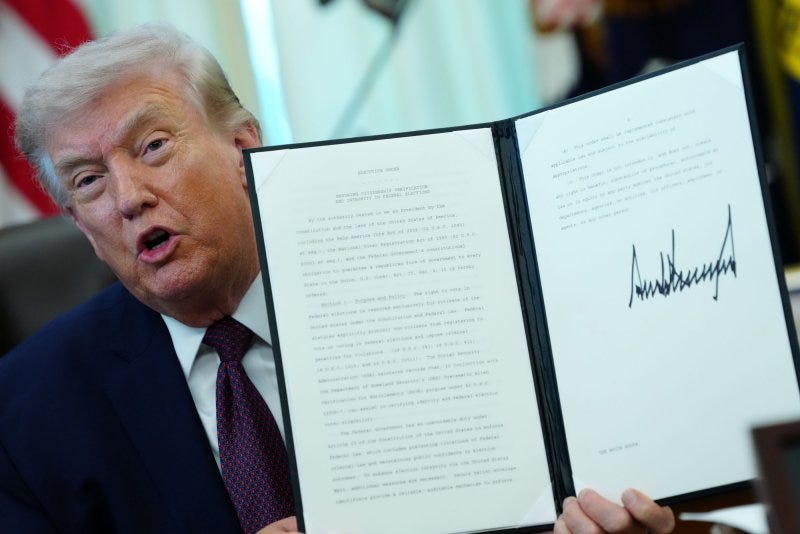
President Trump has ordered the U.S. government to rename Lake Ontario “Lake America,” immediately drawing praise from his administration and pushback from Democratic officials whose states border the Great Lakes. The smallest of the five Great Lakes straddles the United States and Canada, with New York on its southern and eastern shores and the Canadian province of Ontario to the north.
There is, however, one fairly substantial complication: Half the neighborhood is Canadian.
Interior Secretary Doug Burgum embraced the order, declaring, “We’re on it, Mr. President!”
Burgum said the U.S. Geological Survey would implement the change on its maps, arguing that American geographic names should “reflect the greatness of the United States.” The administration’s move would therefore put “Lake America” on official U.S. federal maps even if everyone north of the border continues calling it Lake Ontario.
Democratic Rep. Debbie Dingell of Michigan called Trump’s order “idiotic” and said she would introduce legislation to reverse it.
“The Great Lakes are a shared treasure that generations of Americans and Canadians have worked together to protect,” she wrote.
New York Gov. Kathy Hochul was equally uninterested in the rebranding, saying her state—the only U.S. state bordering Lake Ontario—would not call it Lake America.
After Trump’s announcement, the memes got hot! Here’s one:
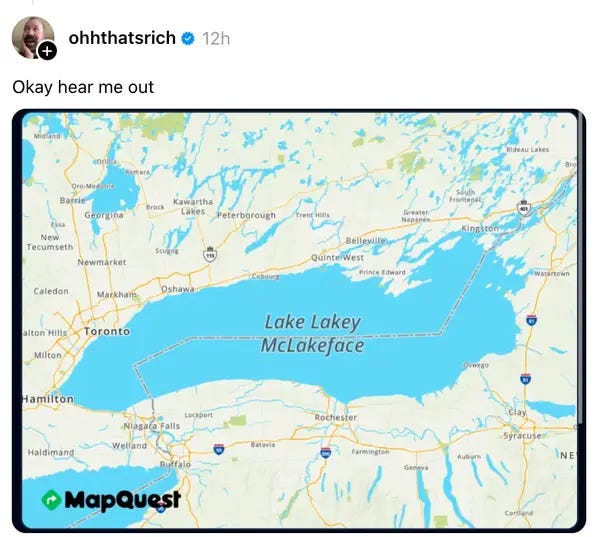
The old name also carries considerably more history than the new one. Ontario is derived from an Indigenous word, as are the names Huron, Michigan, and Erie, while Superior traces back to an anglicized French name. Whether Trump’s “Lake America” catches on beyond federal maps is another question entirely. Governments can rename geographic features on their own maps. Convincing New Yorkers, Canadians, MapQuest, and several centuries of cartography to cooperate is a somewhat bigger project.
Editor: Next week: Canada retaliates by renaming Niagara Falls “You Can Keep Your Side.”
Source: BBC News
Wheat prices have hit a three-year high as fighting chokes Black Sea grain exports, proving once again that wars have an annoying habit of eventually wandering into the grocery aisle.
Wheat Prices Hit Three-Year High as Black Sea War Chokes Global Grain Exports
Wheat prices have surged to their highest level in three years as escalating Russia-Ukraine fighting disrupts shipments from the Black Sea, one of the most important grain-export corridors on the planet. Chicago wheat futures settled Thursday at $7.60¾ a bushel, about 30% above their late-June low, as attacks on grain ships and export terminals leave plenty of wheat sitting around with fewer ways to get it to buyers.
Russia and Ukraine together account for roughly a quarter of global wheat production, so when their export routes seize up, the rest of the world gets the bill.
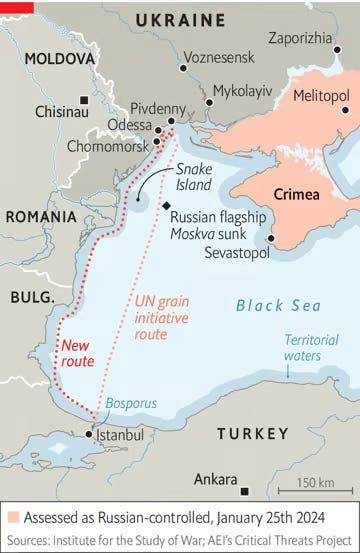
The latest rally has been swift. Chicago wheat contracts jumped by their daily 45-cent limit Wednesday before climbing again Thursday, putting wheat on track for its biggest monthly gain since February 2022, when Russia launched its full-scale invasion of Ukraine. Exports have stalled amid tit-for-tat attacks on grain-carrying vessels and export terminals, and analysts say alternative transportation routes simply can’t replace the capacity being lost through Odesa and Novorossiysk. Sound familiar?
The situation deteriorated further after Ukrainian President Volodymyr Zelenskyy said Russia rejected a proposed truce that would have stopped attacks on ships carrying grain through the Black Sea.
Agricultural commodities analyst Andrey Sizov put the scale of the disruption bluntly: “Nothing comparable has happened in the history of the modern grain market: Neither in 2010, when Russia imposed its grain export ban, nor in the first half of 2022, after the war began.”
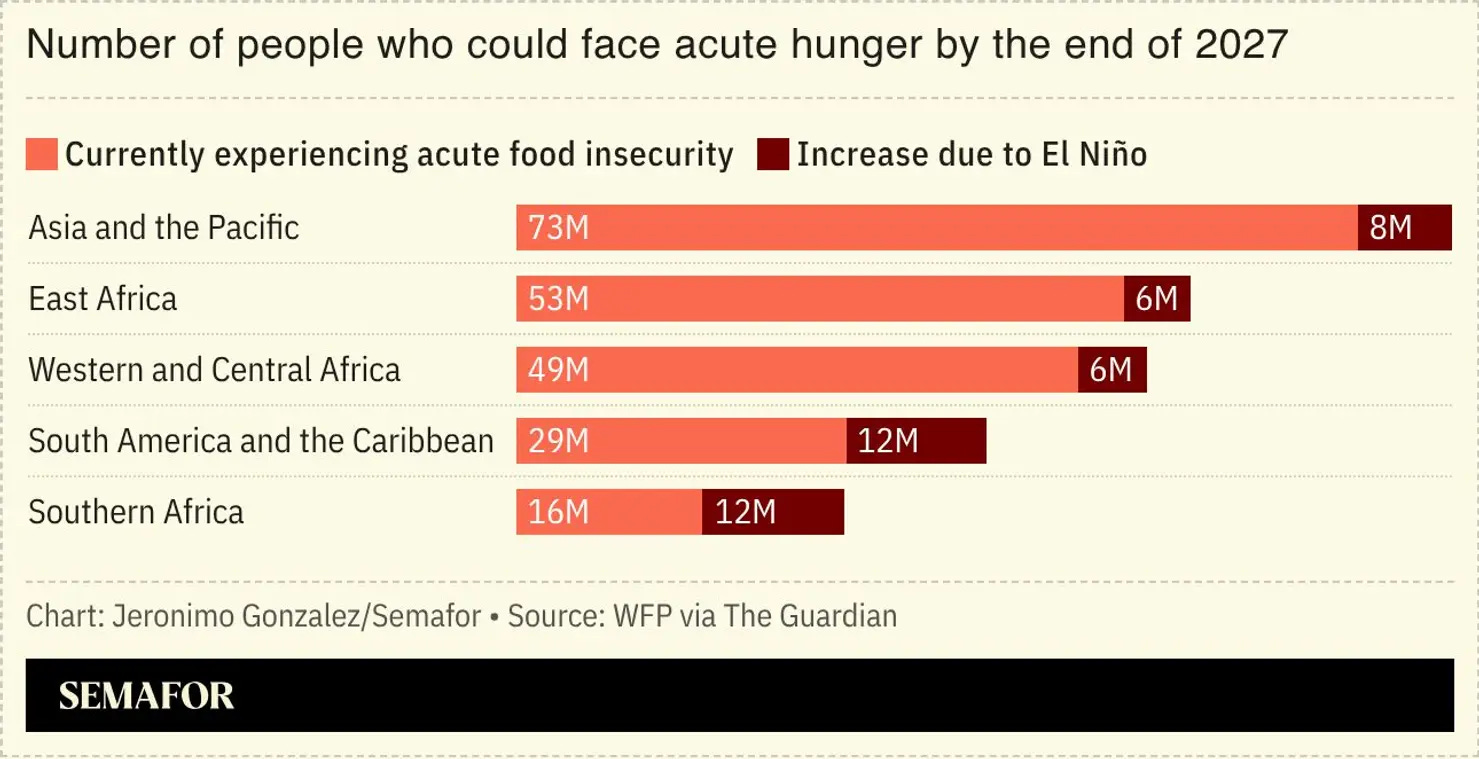
And the Black Sea isn’t wheat’s only headache. El Niño-related weather risks and the U.S.-Iran war are adding pressure, while the International Grains Council recently cut its 2026-27 wheat-production forecast because of sustained heat in Europe. That’s an ugly combination for consumers: War disrupting transportation, weather threatening production, and geopolitical turmoil pushing commodity markets higher. Wheat may trade on a futures exchange, but eventually those prices have a way of showing up in very present-day bread, pasta, and grocery bills.
Editor: Nothing spices up the family grocery budget quite like simultaneous wars, blocked shipping lanes, and lousy weather. At this rate, toast may need its own futures contract. Start saving up for your “Kids’ Toast Fund!”
Source: The Wall Street Journal (free)
Apparently Venezuela has no efficient means of getting that oil out of the ground and reportedly could take a bunch of years to do... good for those short term Iran wars /s