


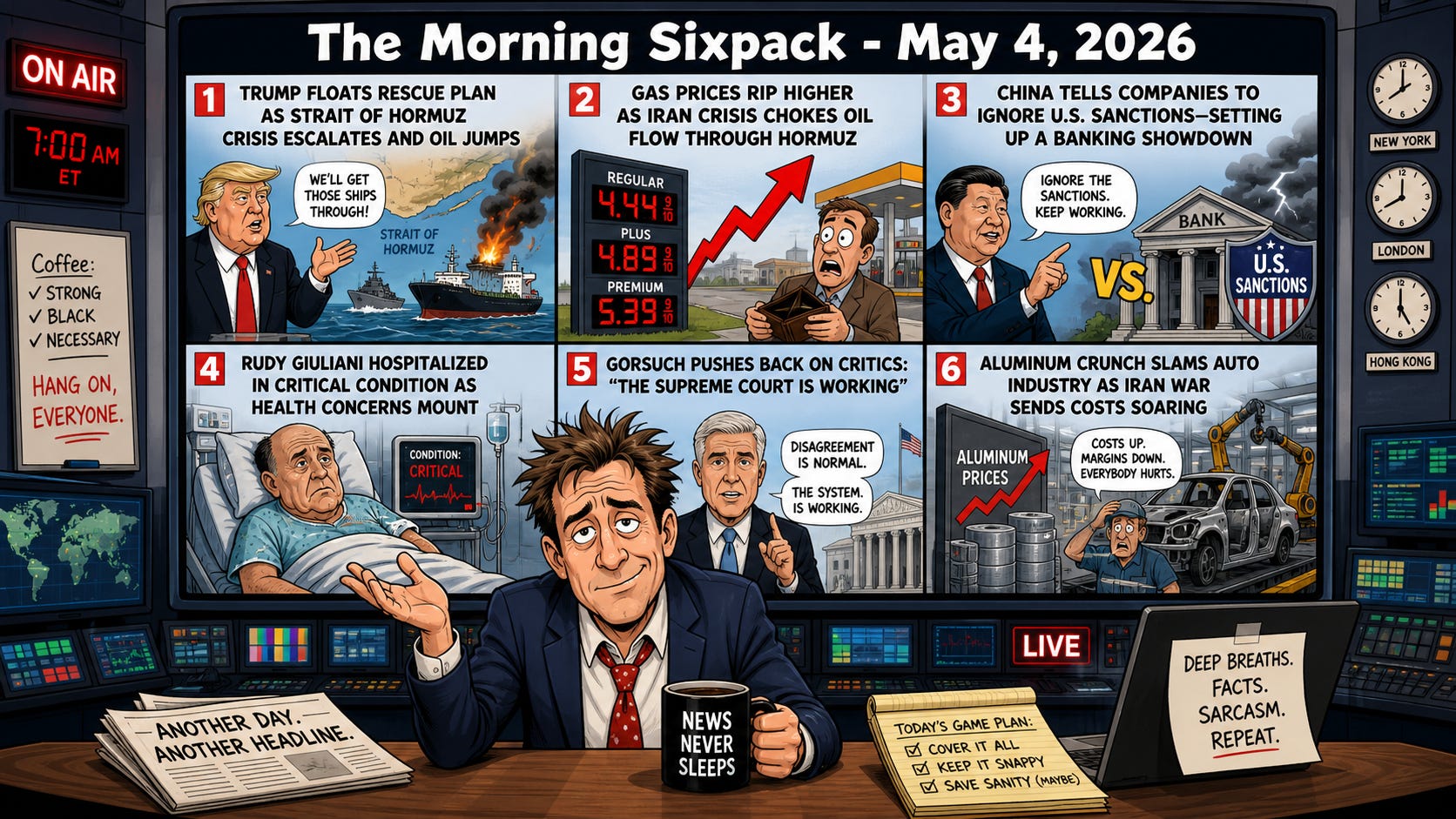
Trump Floats Rescue Plan as Strait of Hormuz Crisis Escalates and Oil Jumps
Hundreds of ships—and roughly 20,000 sailors—are stuck in the Strait of Hormuz as tensions between the U.S. and Iran keep one of the world’s most critical oil chokepoints effectively closed. Oil prices are spiking, nerves are fraying, and no one in global shipping seems ready to bet this gets resolved anytime soon.
The global economy just got a front-row seat to what happens when 20% of the world’s energy supply sits idle.
President Donald Trump says help is coming, rolling out a vague “Project Freedom” plan to guide stranded commercial vessels out of the danger zone. “We have told these Countries that we will guide their Ships safely out of these restricted Waterways,” Trump posted, though details remain thin and shipping companies aren’t exactly racing to restart routes.
Iran, meanwhile, is flexing control over the strait, warning that any uncoordinated movement could trigger an attack. Tehran claims it forced a U.S. warship to turn back with a warning shot—while U.S. Central Command flatly denies any strike occurred. Either way, the message is clear: Iran intends to control who moves and who doesn’t.
The stakes are enormous. Iran has effectively choked off nearly all traffic through the strait, disrupting about a fifth of global oil and gas shipments and pushing prices up more than 50% since the conflict began. Even with talk of negotiations and a paused bombing campaign, there’s little evidence of a breakthrough—and military escorts alone aren’t convincing insurers or shippers that it’s safe to return.
Source: Reuters
Editor: Oil markets love stability. What they’re getting instead is a geopolitical traffic jam with missiles, mixed signals, and a “plan” that sounds like it was sketched on a cocktail napkin.
Gas Prices Rip Higher as Iran Crisis Chokes Oil Flow Through Hormuz
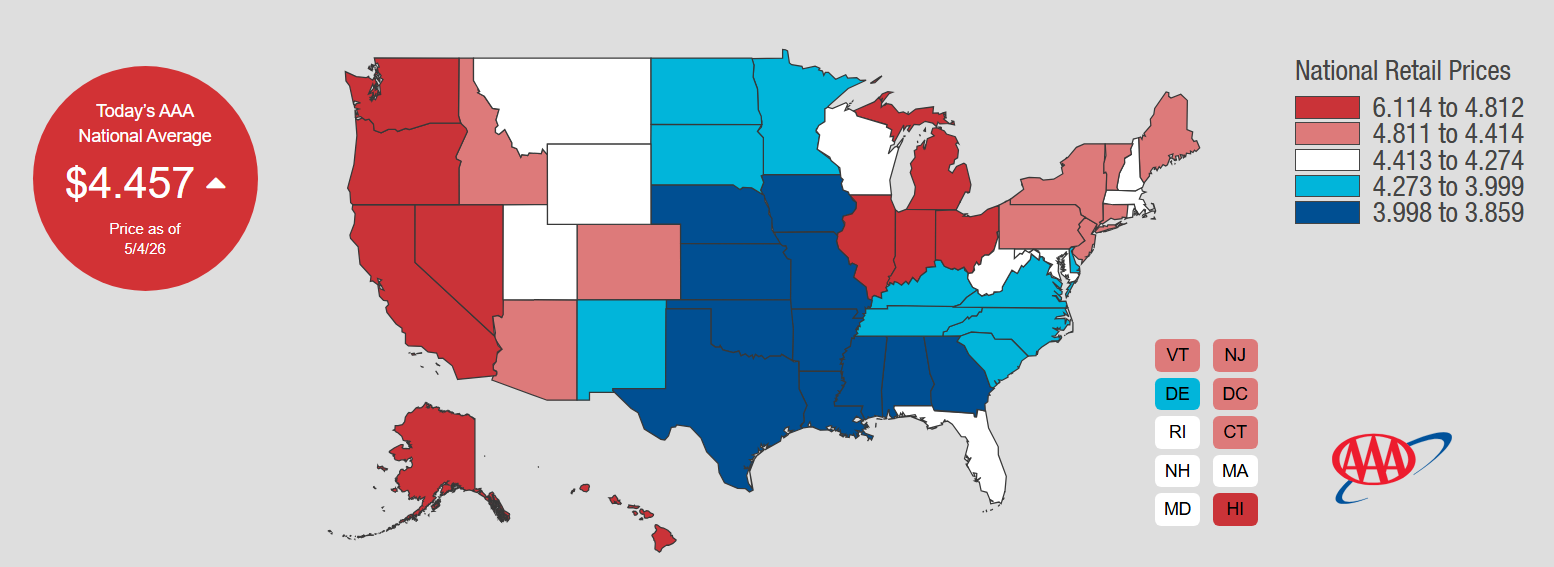
U.S. drivers are now paying an average $4.46 a gallon—up more than 30 cents in the past week—as the Strait of Hormuz shutdown squeezes global oil supply. That’s a brutal jump from $4.10 just days ago—and a far cry from the $2.98 Americans were paying right before the war started.
This is what happens when a global energy artery gets pinched—and there’s no quick fix in sight.
According to AAA, prices are now at their highest level since July 2022, and the trajectory is still pointing up. Even President Donald Trump is promising relief “when the war ends,” saying prices will “drop like a rock”—but there’s no timeline for that, and experts aren’t buying a fast turnaround.
Energy analyst Kevin Book laid it out plainly: “When inventories are low and you can’t get oil out of the ground or out of the strait, you should expect prices to keep rising… we may be weeks or even months… from the peak of prices from this crisis.” Translation: buckle up. Even if the strait reopens tomorrow, you’re still looking at a long cleanup—backlogged tankers, damaged infrastructure, and depleted reserves.
There are some attempts to soften the blow. The U.S. has already tapped its Strategic Petroleum Reserve, releasing 17.5 million barrels, while OPEC+ countries are nudging production higher. But those moves are more like pressure relief valves than real solutions—and a weaker U.S. dollar is quietly making everything worse, from fuel to international travel.
Source: NPR
Editor: Nothing like a global conflict to remind you your daily commute is tied to a narrow stretch of water halfway around the world—and that “temporary” price spikes have a funny way of sticking around.
China Tells Companies to Ignore U.S. Sanctions—Setting Up a Banking Showdown
China has ordered its companies to ignore U.S. sanctions tied to Iranian oil, a direct challenge to Washington that risks dragging its massive banking system into a financial crossfire. This isn’t the usual quiet workaround—Beijing just went public and formal with defiance.
The world’s two biggest economies are now testing who actually controls the rules of global finance.
Ahead of a planned meeting between Donald Trump and Xi Jinping, Beijing escalated by invoking a legal “blocking” mechanism that tells Chinese firms to flat-out ignore U.S. penalties. The target: private refiners tied to Iranian oil flows, including heavyweight Hengli Petrochemical.
China has complained about U.S. sanctions for years—but typically played along to protect access to the dollar system. Not this time. Officials are now calling the move “a pivotal step” to counter what they see as U.S. overreach, signaling a broader shift toward economic retaliation tools that include everything from rare earths to tech deal crackdowns.
The real tension point? Banks. Chinese lenders working with these refiners are now stuck in the middle—comply with Beijing and risk U.S. punishment, or comply with Washington and violate Chinese law. Analysts say what the U.S. does next—especially if it expands sanctions to major banks—will determine whether this spirals into a full-blown financial standoff.
China’s calculation is pretty clear: it’s less dependent on the U.S. financial system than it used to be, and it’s willing to push back harder—especially as the Iran conflict strains global alliances and energy markets. But if this escalates, we’re no longer talking about oil shipments—we’re talking about the plumbing of the global economy.
Source: Bloomberg (paid) Archive.ph (bypass)
Editor: For years, everyone played nice with U.S. sanctions because the dollar runs the show. Now China’s calling that bluff—and if this turns into a banking brawl, your 401(k) might feel it before diplomats fix it.
Rudy Giuliani Hospitalized in Critical Condition as Health Concerns Mount
Former New York City mayor Rudy Giuliani is in critical condition at a Florida hospital, marking a serious turn for the once high-profile political figure. At 81, Giuliani’s health scare comes after years of legal, financial, and physical setbacks that have steadily pulled him out of public view.
A central figure of post-9/11 leadership is now fighting his most personal battle yet.
A spokesman said Giuliani is “in critical but stable condition,” offering few details about when he was hospitalized or what led to the emergency. “Mayor Giuliani is a fighter who has faced every challenge in his life with unwavering strength,” the spokesman added, asking for prayers as he battles through.
President Donald Trump weighed in, calling Giuliani a “True Warrior” and praising his tenure leading New York City—while also using the moment to revisit claims about the 2020 election.
Giuliani’s recent years have been anything but quiet. Once hailed for guiding the city through the aftermath of the September 11 attacks, he later became deeply entangled in efforts to challenge the 2020 election results. That led to multiple indictments, defamation lawsuits, and ultimately his disbarment, shrinking his public role significantly.
His health has also been an issue. A 2025 car crash left him with a fractured vertebra and at least one public appearance in a wheelchair. Now, with few details and a serious condition, the focus has shifted from politics and courts to something far more immediate.
Source: New York Times
Editor: From “America’s Mayor” to courtroom regular to this—Giuliani’s arc has been one of the more dramatic political transformations in recent memory, and now it’s taken a turn no headline writer wants to script.
Gorsuch Pushes Back on Critics: “The Supreme Court Is Working”
Neil Gorsuch says the Supreme Court is functioning just fine—even as critics question its direction and rulings. In his view, the system is doing exactly what it’s supposed to do: Handle the toughest legal fights and actually reach agreement more often than you’d think.
Nine justices, constant disagreement—and still a 40% unanimity rate on the hardest cases.
In a TV interview, Gorsuch pointed to the sheer scale of the judiciary—roughly 50 million cases filed annually—and argued that the Supreme Court of the United States is tasked with resolving only the most complex disputes. “Can you get nine people to agree on where to go to lunch?” he joked, underscoring how unusual consensus can be.
Still, he emphasized that agreement happens more often than outsiders realize, with about 40% of decisions coming down unanimously—even among justices appointed by five different presidents over decades. That, he argues, is proof the institution isn’t broken, just noisy.
Gorsuch also leaned into ideological differences, noting he’s an originalist while colleagues like Sonia Sotomayor and former Justice Stephen Breyer approach the law differently. “I love them,” he said, adding that disagreement is part of the job—not a sign of dysfunction.
And while transparency has increased—with live audio of arguments now widely available—Gorsuch made the case for keeping some deliberations private. The reasoning: You don’t get honest compromise if every conversation is performative.
Source: The Hill
Editor: When a Supreme Court justice has to publicly insist the system is “working,” it usually means half the country thinks it isn’t—and the other half is bracing for the next ruling. And let’s face it: When the highest of stakes are before the highest court in the land, it ought to be recorded. I want to see the video! I mean, we aren’t suggesting that their deliberations or behind-the-scenes interchanges be recorded, just the public testimony.
Aluminum Crunch Slams Auto Industry as Iran War Sends Costs Soaring
A global aluminum shortage—fueled by the Iran war, tariffs, and supply outages—is hitting automakers hard, squeezing production of vehicles like the best-selling Ford F-150. What used to be a smart engineering shift is suddenly a major cost headache.
The metal that made trucks lighter and more efficient is now making them harder—and pricier—to build.
The numbers are ugly. Aluminum prices in the U.S. have nearly doubled from a year ago, driven in part by disrupted supply chains tied to the Persian Gulf and a hefty 50% U.S. tariff. Automakers, which have leaned heavily into aluminum for fuel efficiency, are now paying the price—literally.
At Ford Motor, the pain is especially acute. The company bet big on aluminum when it redesigned the F-150 a decade ago, becoming the industry’s largest buyer. Now, supply disruptions—including fires at a key supplier—have cut into production and profits, with executives doubling projected commodity cost increases to $2 billion this year.
Dealers are already feeling it. Inventory levels are tightening just as peak truck-buying season approaches, and one dealer summed it up bluntly: “We’d love to have more.” That may not happen anytime soon, with supply expected to recover slowly even after production resumes.
There’s talk of switching back to steel, but that’s easier said than done. Reengineering entire vehicle platforms isn’t quick—or cheap—so for now, automakers are stuck riding out the aluminum storm while costs ripple through the entire industry.
Source: Wall Street Journal (gift)
Editor: Turns out “lightweight and efficient” works great—right up until your entire supply chain gets geopolitically kneecapped and your best-selling truck becomes a hostage to commodities pricing.