


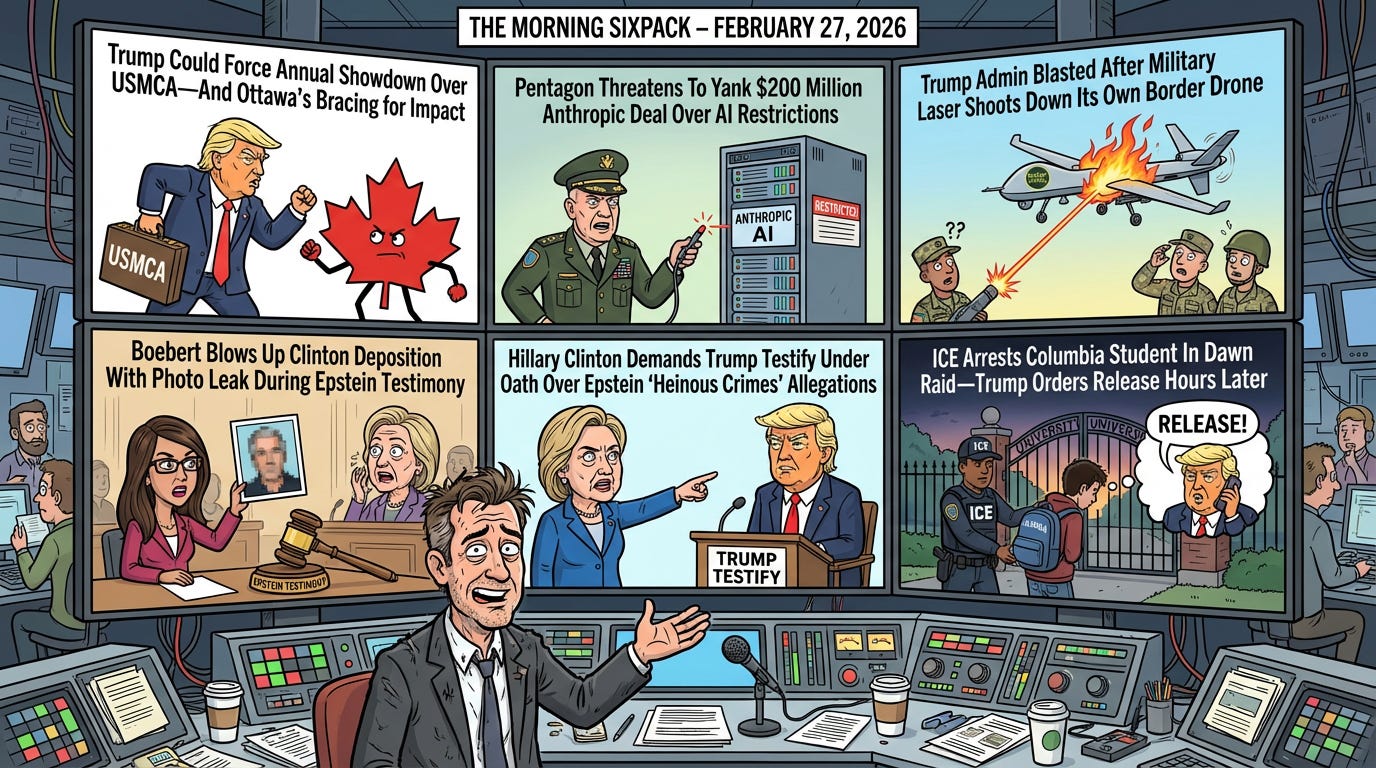
USMCA could slip into annual reviews this July if Trump refuses to renew—turning North American trade into a rolling cliffhanger.
Trump Could Force Annual Showdown Over USMCA (aka NAFTA)—And Ottawa’s Bracing for Impact
The North American trade pact could tumble into yearly renewals as early as July if Washington refuses to extend it, putting billions in cross-border commerce on edge.
That means businesses from Detroit to Monterrey could be planning investments one year at a time.
The six-year review clause in the United States–Mexico–Canada Agreement is coming due, and if all three countries don’t reconfirm the deal, it shifts to annual check-ins. Canada’s Minister for US Trade Dominic LeBlanc is warning that the U.S. might refuse to sign off—effectively turning North American trade into a recurring political drama.
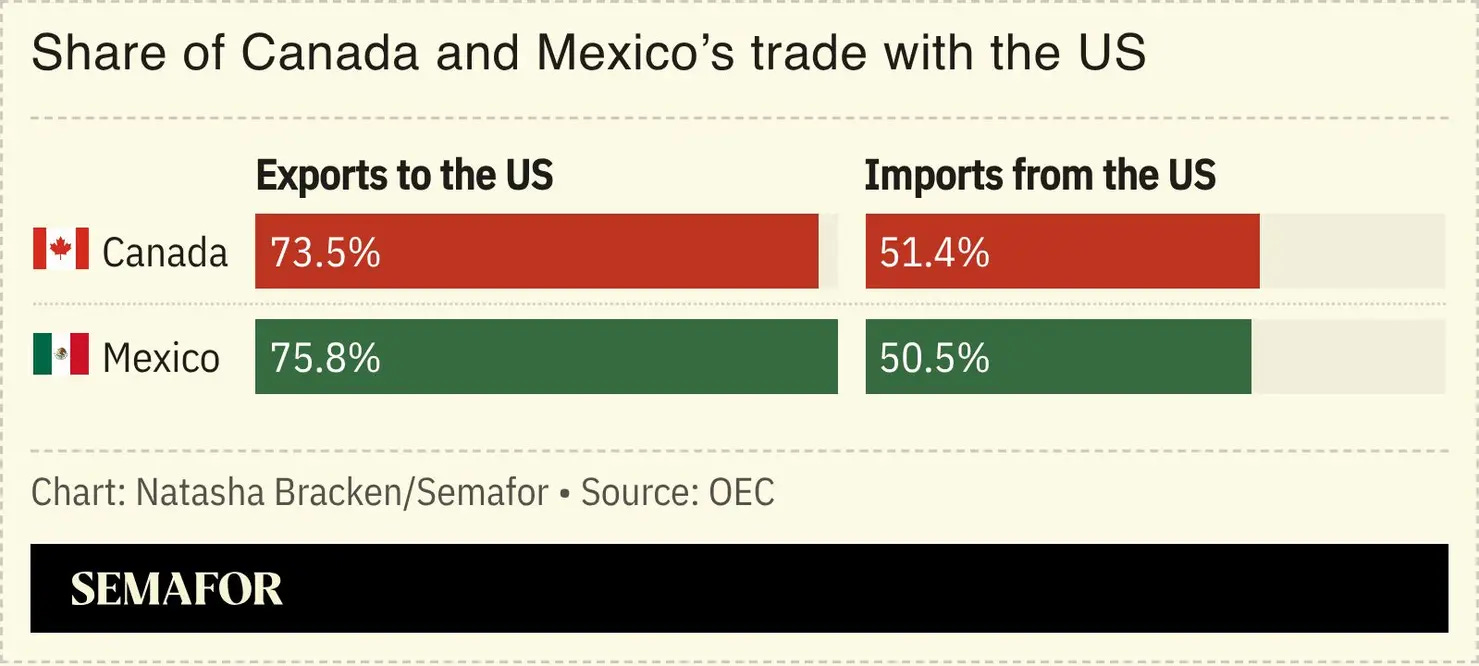
President Donald Trump has repeatedly floated the idea of pulling out of the agreement he originally negotiated during his first term. Canada and Mexico depend heavily on U.S. markets for exports, and both have been exploring other trade relationships as insurance. If this uncertainty is deliberate, as LeBlanc suggested, it’s leverage with a maple-leaf aftertaste.
The agreement, which replaced North American Free Trade Agreement, was supposed to modernize trade rules across the continent. Instead, we’re staring at a potential cycle of annual brinkmanship. Markets hate uncertainty. Supply chains hate it more.
If July comes and goes without a clean extension, expect a steady drumbeat of reviews—and a lot of corporate lawyers billing overtime.
Source: Semafor
Editor: If you’re trying to build a factory, hire workers, or sign a five-year supplier contract, nothing boosts confidence like wondering whether the trade rules expire next summer. Great for suspense. Terrible for business.
The Pentagon may slap Anthropic with a “supply chain risk” label and scrap its $200M deal because the AI firm won’t loosen military-use limits—Silicon Valley ethics meet Washington muscle.
Pentagon Threatens To Yank $200 Million Anthropic Deal Over AI Restrictions
The Pentagon is reviewing its $200 million contract with Anthropic after the AI company refused to allow unrestricted lawful military use of its models.
If Washington designates the firm a “supply chain risk,” Claude could be cut off from classified defense systems almost overnight.
San Francisco-based Anthropic has drawn a bright line: its AI can’t be used for mass domestic surveillance or fully autonomous lethal weapons. The Defense Department wants broader latitude—access to top-tier models for any lawful military application. That clash has put Anthropic’s standing inside the Pentagon under review.
Claude isn’t just another chatbot in uniform. It’s currently the only model authorized across certain classified Pentagon systems, and Anthropic was the first frontier AI company to place large language models on classified networks. The deal, signed last summer, is worth up to $200 million. Now it’s hanging in the balance.
“The Department of War’s relationship with Anthropic is being reviewed,” chief Pentagon spokesman Sean Parnell told Fox News Digital. “Our nation requires that our partners be willing to help our warfighters in any fight.”
Undersecretary Emil Michael made the expectation explicit: “We have to be able to use any model for all lawful-use cases. If any one company doesn’t want to accommodate that, that’s a problem for us.” Rivals including OpenAI and Google have reportedly agreed in principle to allow their models to be deployed for any lawful military use. OpenAI has already customized ChatGPT for the Pentagon’s unclassified genai.mil platform.
If Anthropic gets tagged as a supply chain risk—a label usually aimed at foreign adversaries—defense contractors would have to unwind integrations fast. The military would lose access to Claude for classified work. And Silicon Valley would get a blunt message: ethics policies don’t outrank procurement requirements.
This is the collision of two belief systems—tech’s self-imposed guardrails and the Pentagon’s all-lawful-means doctrine. One of them controls the contracts.
Source: Forbes
Editor: Washington doesn’t do “terms and conditions.” It does mission requirements. If your AI comes with fine print, don’t be shocked when the Pentagon reaches for a red pen.
The U.S. military used a laser to shoot down a Customs and Border Protection drone over Texas—lawmakers say the administration’s coordination failures are now lighting up the sky. Yes, they shot down their own drone.
Trump Admin Blasted After Military Laser Shoots Down Its Own Border Drone
The U.S. military fired a laser near the Texas border and ended up downing a Customs and Border Protection drone, prompting airspace closures and furious lawmakers.
Yes—the government just zapped its own aircraft out of the sky.
The Federal Aviation Administration temporarily closed airspace around Fort Hancock after the incident, the second laser deployment in the area in two weeks. The first strike hit nothing. This one took out a drone operated by Customs and Border Protection. Commercial flights weren’t affected—but members of Congress were.
Rep. Rick Larsen and two other senior Democrats on the House Transportation and Infrastructure and Homeland Security committees issued a blistering statement: “Our heads are exploding over the news... the White House’s decision to sidestep a bipartisan, tri-committee bill to appropriately train C-UAS operators and address the lack of coordination between the Pentagon, DHS, and the FAA was a short-sighted idea. Now, we’re seeing the result of its incompetence.”
Sen. Tammy Duckworth is calling for an independent investigation, saying, “The Trump administration’s incompetence continues to cause chaos in our skies.” The White House hasn’t exactly been subtle about ramping up counter-drone operations along the southern border, where cartels frequently use unmanned aircraft for smuggling and surveillance.
According to officials cited by The Washington Post, more than 27,000 drones were detected within 1,600 feet of the southern border in just the last six months of 2024. Homeland Security estimates more than 1.7 million registered drones are flying across the U.S. Anti-drone systems range from radio jammers to microwaves to high-powered lasers—the kind now making headlines in Texas.
The bigger issue? Coordination. When the Pentagon, DHS, and the FAA aren’t fully aligned, even lawful counter-drone tactics can spiral into self-inflicted damage. Shooting down cartel drones is one thing. Accidentally frying your own is another.
Source: Raw Story
Editor: If your border security plan involves vaporizing your own hardware, maybe pause the laser and pick up the phone. Interagency communication is cheaper than replacement drones.
Lauren Boebert derailed Hillary Clinton’s closed-door Epstein deposition by leaking a photo from inside the room—fueling demands to make the testimony public.
Boebert Blows Up Clinton Deposition with Photo Leak During Epstein Testimony
Rep. Lauren Boebert halted Hillary Clinton’s closed-door Epstein deposition after snapping and sharing a photo from inside the room, violating committee rules.
The leak instantly reignited the fight over transparency—and who’s playing politics with it.
The closed-door testimony of Hillary Clinton was paused Thursday after Lauren Boebert sent an image from the deposition room to a conservative influencer, who promptly posted it online. Committee rules bar photos and outside communication during depositions. Democrats said the stunt proved exactly why the proceedings should be public.
Clinton told lawmakers she had no knowledge of the crimes committed by Jeffrey Epstein or Ghislaine Maxwell at the outset of what’s expected to be two days of testimony. “Like every decent person,” she said in her opening statement, “I have been horrified by what we have learned about their crimes.”
The Clintons agreed to appear after the Republican-led House Oversight Committee, chaired by James Comer, rejected sworn written statements and threatened criminal contempt charges. Former President Bill Clinton is also set to testify—the first time a former president has been compelled to appear before Congress in this manner.
The depositions are taking place in Chappaqua, New York, as lawmakers push for a broader reckoning over Epstein’s abuse of underage girls. Democrats are now demanding full video and transcripts be released quickly, arguing that selective leaks only distort the record.
Meanwhile, President Donald Trump—who last year bowed to pressure to release additional Epstein case files—has expressed regret that the Clintons are being forced to testify.
The bigger takeaway? A deposition meant to be tightly controlled turned into a viral moment in seconds. In 2026, even a “closed door” comes with a camera lens.
Source: Colorado Sun
Editor: If you want transparency, vote to open the doors. If you want chaos, leak a selfie. Congress managed to do both in the same afternoon.
Hillary Clinton used her Epstein deposition to accuse DOJ of withholding Trump-related material and demanded he testify under oath—turning a closed-door hearing into a direct challenge to a sitting president.
Hillary Clinton Demands Trump Testify Under Oath Over Epstein ‘Heinous Crimes’ Allegations
Hillary Clinton told House investigators the Justice Department may be withholding Epstein files tied to Donald Trump and demanded the president be questioned under oath.
She didn’t just defend herself—she put Trump on the witness list.
Appearing before the House Oversight Committee, Hillary Clinton said authorities must “get to the bottom” of allegations that DOJ held back FBI interviews in which a survivor accuses Donald Trump of “heinous crimes.” She argued that true transparency would mean full file releases—with lawful redactions protecting victims, “not powerful men and political allies.”
“If this Committee is serious about learning the truth about Epstein’s trafficking crimes, it would not rely on press gaggles to get answers from our current president on his involvement; it would ask him directly under oath about the tens of thousands of times he shows up in the Epstein files,” Clinton said.
Rep. Robert Garcia, the panel’s top Democrat, accused the Justice Department of withholding material related to allegations Trump sexually abused a minor—an allegation Trump has long denied. In a letter to Attorney General Pam Bondi, Garcia wrote: “The Department of Justice (DOJ) is withholding materials in the Epstein files relating to alleged sexual abuse of a minor by Donald Trump.”
The Republican chairman, James Comer, has argued the committee cannot depose a sitting president. Still, Democrats say compelling testimony from Bill Clinton—set to appear after his wife—sets a precedent for equal treatment.
Clinton also reiterated she had no knowledge of the crimes of Jeffrey Epstein or Ghislaine Maxwell, saying, “I had no idea about their criminal activities. I do not recall ever encountering Mr. Epstein.”
The hearing briefly descended into chaos after Rep. Lauren Boebert shared a photo from inside the closed-door deposition, prompting renewed Democratic calls to make the proceedings public.
The political stakes are obvious. Democrats want Trump under oath. Republicans say that’s a nonstarter. And the Epstein files—still dripping out in pieces—remain Washington’s most combustible archive.
Source: Daily Mirror
Editor: When both parties claim they want transparency but only when it targets the other guy, don’t expect clarity—expect subpoenas.
ICE agents arrested a Columbia student after allegedly posing as police searching for a missing child—then Trump personally reversed it hours later because Mamdani told him to.
ICE Arrests Columbia Student In Dawn Raid—Trump Orders Release Hours Later
Federal agents detained a Columbia University student after allegedly using a missing-child ruse to enter her apartment—then President Trump intervened and she was released the same day.
From 6 a.m. arrest to Oval Office reversal in a matter of hours—that’s not policy, that’s whiplash.
According to university officials, agents from the Department of Homeland Security entered the university-owned residence of Columbia senior Ellie Aghayeva by claiming they were police searching for a missing child. Security footage reportedly shows agents displaying photos in the hallway. Aghayeva, an Azerbaijani student studying neuroscience and politics, quickly posted to Instagram: “DHS illegally arrested me. Please help.”
Columbia’s acting president, Claire Shipman, said staff have since been reminded not to allow federal law enforcement into non-public campus areas without a subpoena or warrant. DHS disputes that agents posed as NYPD officers but has not directly answered whether they invoked a missing-child claim.
A DHS spokesperson said Aghayeva’s student visa had been terminated in 2016 for failing to attend classes and that she was placed in removal proceedings before being released pending a hearing. Her attorneys say she entered the U.S. on a visa around that time but declined further comment on her current status.
The twist came hours later. New York Mayor Zohran Mamdani said he raised the arrest with Donald Trump during an unrelated meeting. According to Mamdani, Trump agreed to release her immediately. Aghayeva soon confirmed online: “I am safe and okay,” adding she was in “complete shock.”
The episode adds to growing tension between the Trump administration and elite universities, including Columbia University. It also revives scrutiny of immigration enforcement tactics that critics say increasingly rely on disguises and surprise operations.
For students and faculty already on edge over deportation cases tied to campus protests, the message was clear: enforcement can arrive before sunrise—and leave just as abruptly if politics intervene.
Source: Associated Press
Editor: When immigration policy hinges on who gets a meeting with the president that afternoon, consistency isn’t exactly the guiding principle.