


The Morning Sixpack stays free because the news that shapes your life should not be hidden behind a paywall. Paid subscribers are not paying for access. They are helping fund the research, writing, and independent voice that goes into every issue. Become a paid subscriber and help keep smart, honest news analysis free for everyone.
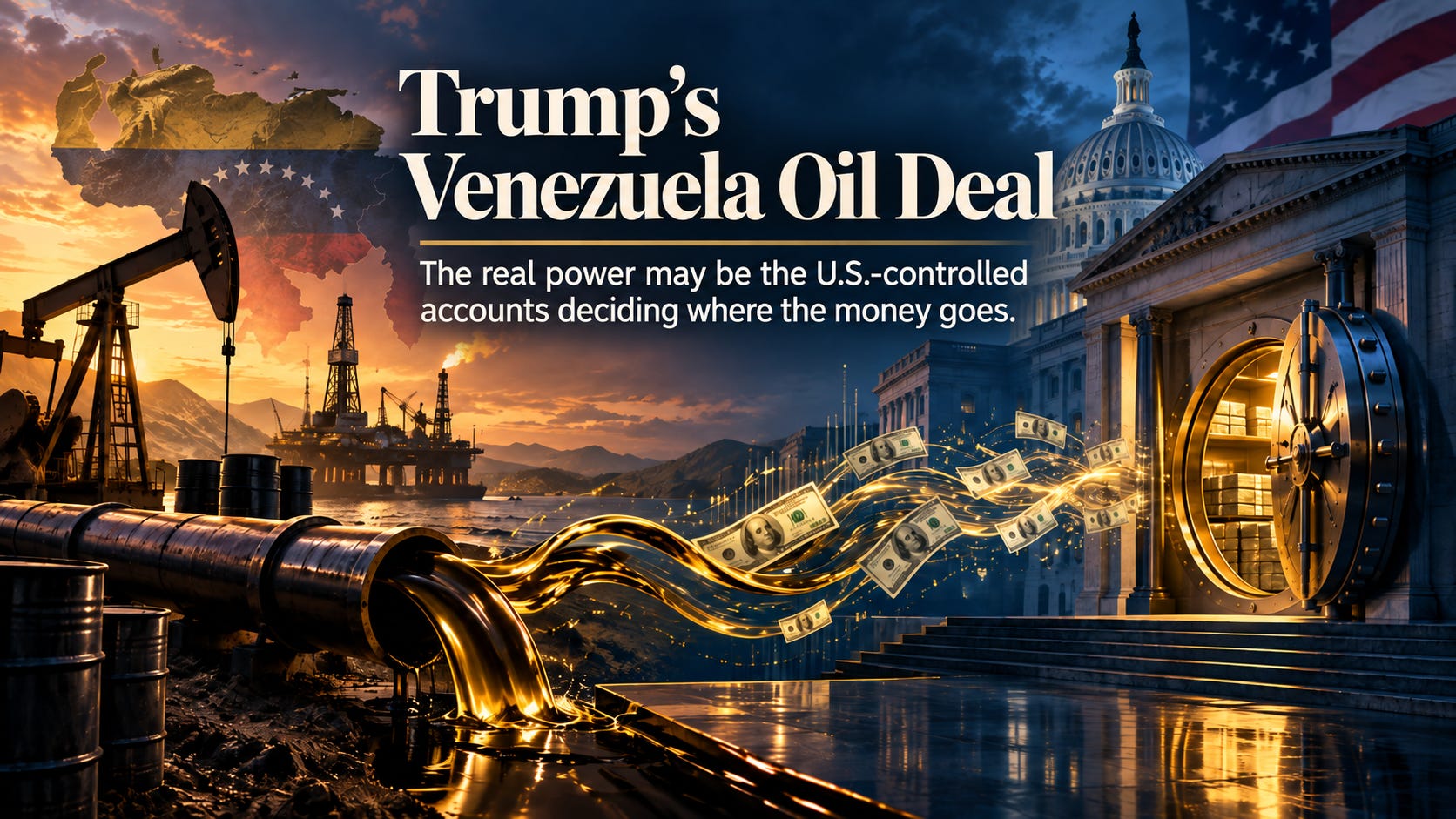
There’s a detail buried inside Donald Trump’s Venezuela strategy that deserves more attention than it’s getting. It’s not just the oil. It’s the bank account.
More specifically, the U.S. has built a system in which certain payments generated by Venezuela’s oil and other natural resources are routed into accounts controlled or administered by Washington before the Venezuelan government gets access to the money. That sounds like a technical wrinkle, but it may be one of the most consequential parts of the whole arrangement.
The public debate tends to focus on whether the United States is “taking Venezuela’s oil.” That framing is dramatic, but it misses the more interesting question: who controls the cash register?
Right now, Washington has an extraordinary amount of control over it.
So what exactly happened?
Back in January, the Trump administration announced that revenue from Venezuelan oil sales would be placed in U.S.-controlled bank accounts. Reuters reported on January 7 that the Department of Energy said proceeds from Venezuelan crude sales would be deposited in accounts controlled by the United States at major international banks.
Two days later, Trump signed Executive Order 14373, creating the legal framework around something called the Foreign Government Deposit Funds, or FGDF. The name is bureaucratic enough to put a room to sleep, but the structure behind it is anything but boring.
The executive order defines the funds broadly. They can include money held by the United States on Venezuela’s behalf that comes from the sale of Venezuelan natural resources, not merely petroleum, as well as money connected to diluents sold to Venezuela.
That distinction matters. This is not necessarily just an oil account. It can function more like a resource-revenue account, potentially touching oil, gas, minerals and other natural-resource proceeds.
Whose money is it?
Here’s where the arrangement gets unusual.
Legally, according to Trump’s own executive order, the money does not belong to the United States. It remains sovereign property of Venezuela. The U.S. government says it is holding those funds in a custodial capacity and explicitly states that the money is Venezuelan property, not American property.
But ownership is only half the story.
Treasury holds the money, the Secretary of State plays a central role in determining authorized disbursements, and the funds cannot simply be moved around as though Caracas had unrestricted access to an ordinary bank account. So while the money is legally Venezuelan, Venezuela does not necessarily have unfettered control over it.
That is a pretty important footnote.
This isn’t just some theoretical legal structure
Treasury has since turned the arrangement into an actual payment mechanism.
OFAC, the Treasury office that runs U.S. sanctions programs, tells companies that certain payments owed to Venezuela or state oil company PdVSA must go into the Foreign Government Deposit Funds rather than directly to the Venezuelan government. Depending on the transaction, that can include royalties, per-barrel levies and other payments.
And if a company needs to make one of those deposits, it doesn’t simply wire the money to Caracas and call it a day. It may have to provide the U.S. government with transaction information, contracts, invoices, payment amounts, license details and other documentation before receiving account instructions.
That is more than simple oversight. It is a financial checkpoint.
Why would Trump want this?
There are several reasons.
The first is creditors. Venezuela and PdVSA have spent years being sued by bondholders, companies and other creditors trying to recover unpaid debts. If billions of dollars suddenly start landing in ordinary commercial accounts, those creditors may try to seize the funds.
Trump’s executive order specifically protects the Foreign Government Deposit Funds from attachment, garnishment, liens and similar legal processes. In practical terms, that creates a kind of shield around the money.
The second reason is leverage. If Washington controls the gateway through which a meaningful share of Venezuela’s resource revenue travels, it gains significant influence over the Venezuelan government. You do not need to own every barrel if you have substantial control over the financial plumbing around the barrel.
The third reason is geopolitical. The administration has framed Venezuela as part of a larger contest over Iranian, Russian and Chinese influence in the Western Hemisphere. That strategy also appears to be expanding beyond petroleum, with growing U.S. interest in Venezuelan gold, minerals and other strategic resources.
So the resource story is getting broader, not narrower.
Then came the really big oil deal
At the end of August, Trump announced another major Venezuelan oil arrangement involving North American Blue Energy Partners, or NABEP.
The deal gives the company long-term rights connected to 17 Venezuelan oil fields containing an estimated 65 billion barrels of reserves. The U.S. government, meanwhile, secured a 35% stake in the venture and preferential access to some of its production.
The reported term is 100 years.
That is less an oil contract than a multigenerational relationship.
The White House describes the arrangement as a historic energy deal. Critics see it as something much closer to state-directed resource extraction. Both descriptions help explain why the agreement has generated so much attention.
But even here, the financial-control question may be more important than the physical oil itself.
Follow the money, not the barrel
The political argument is usually framed around whether America is taking Venezuelan oil. A better question is how much control the United States now exercises over Venezuela’s resource economy.
There are several layers operating at once. U.S. sanctions determine which companies can participate. U.S. licenses determine which transactions are legal. Certain payments to Venezuela can be routed through Treasury-controlled accounts. The U.S. government has influence over the release of money held in those accounts. And Washington now has a direct financial interest in one of the largest new Venezuelan oil ventures.
Taken together, that adds up to a remarkable degree of economic influence over another country’s principal source of national wealth.
Is the U.S. stealing Venezuela’s money?
Not according to the legal structure.
The executive order goes out of its way to say that the funds remain Venezuelan sovereign property. Treasury is supposed to hold the money in custody, and the funds are not simply absorbed into the U.S. federal budget.
That distinction matters. But another distinction matters just as much: ownership and control are not the same thing.
A country can legally own money while another government has enormous influence over when, where and how that money is released. That does not make the arrangement theft, but it does make it an unusually intrusive form of financial control.
There is a legitimate argument for doing it
The case for this system is not absurd.
Venezuela’s oil sector has been battered by corruption, sanctions, collapsing infrastructure, debt disputes and years of disastrous management. Putting revenue into protected accounts could make it harder for officials to siphon it off, prevent creditors from immediately grabbing the proceeds, and give Western companies a clearer legal framework for doing business.
If the money is genuinely used for Venezuelan reconstruction, public services and economic stabilization, supporters can argue that the arrangement is preferable to watching another resource windfall disappear into corruption or legal chaos.
That is the strongest argument for the system.
But there’s a very large “however”
The obvious problem is transparency.
We know quite a bit about how the mechanism is supposed to work. What is much harder to find is a simple, continuously updated public ledger showing how much money has entered the accounts, who deposited it, how much has been released, who received the funds, what they were used for and who authorized the disbursements.
That is the missing piece.
Once a foreign government effectively says, “We’ll hold your country’s oil money and help determine when it gets released,” the standard for transparency should be extremely high.
There should be receipts. Lots of them.
The bottom line
Trump’s Venezuela policy is much more sophisticated, and much more aggressive, than simply buying Venezuelan crude.
The United States has helped construct a financial architecture around Venezuela’s natural-resource economy. The oil may still legally belong to Venezuela. The money may still legally belong to Venezuela. But Washington controls critical parts of the pipeline connecting one to the other.
That gives the United States leverage over Venezuela without formally nationalizing anything.
Depending on your point of view, that can be seen as a clever mechanism for protecting Venezuelan wealth and stabilizing a battered economy, or as a breathtaking intrusion into another nation’s sovereignty.
The annoying answer is that it may be some of both.
And if this system keeps expanding from petroleum into gold, minerals and other natural resources, the bank account may ultimately matter more than the oil deal itself.
Because oil is power.
Controlling where the oil money goes is power with a password.