


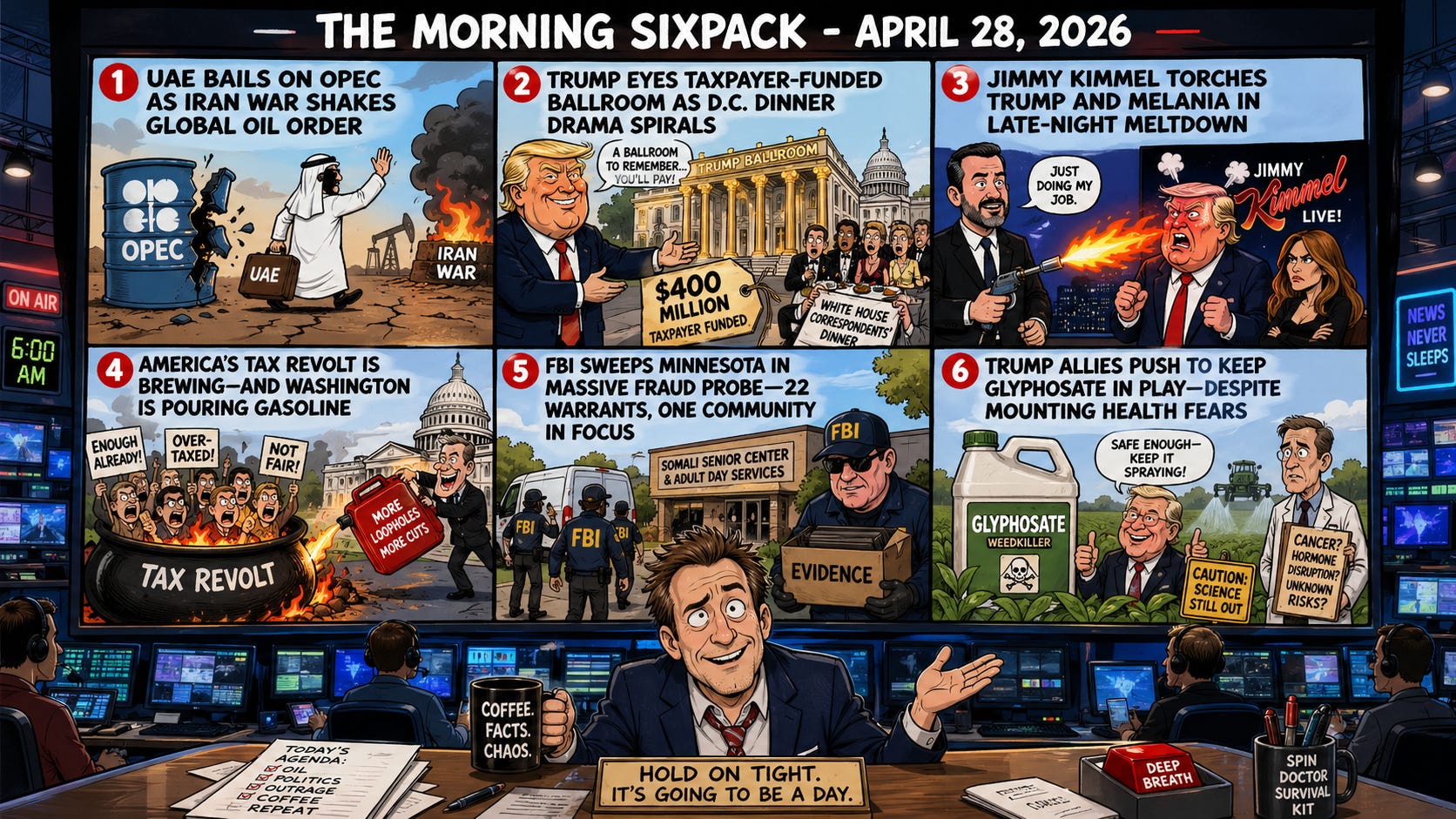
UAE Bails on OPEC as Iran War Shakes Global Oil Order
The United Arab Emirates just walked away from OPEC and OPEC+, fracturing the world’s most powerful oil cartel at the worst possible moment. With the Iran war choking supply routes and rattling markets, this isn’t just a policy shift—it’s a warning shot for the global economy.
This is what happens when geopolitics and oil collide—alliances crack fast.
The exit lands as tankers struggle through the Strait of Hormuz, where Iranian threats have already disrupted a critical artery that carries roughly 20% of the world’s oil and gas. The UAE, once a core OPEC player, is now signaling it’s done playing along while its own security is under fire.
Tensions have been building for a while. Donald Trump has blasted OPEC for “ripping off the rest of the world,” tying U.S. military protection in the Persian Gulf to what he calls inflated oil prices. That rhetoric suddenly looks less like bluster and more like backdrop.
But the real breaking point? UAE officials say their neighbors didn’t have their back. Anwar Gargash didn’t sugarcoat it: “The Gulf Cooperation Council countries supported each other logistically, but politically and militarily, I think their position has been the weakest historically.” Translation: thanks for the spare parts, not so much for the defense.
So now United Arab Emirates is out, OPEC+ takes a hit, and the oil market gets one more dose of chaos at a time it can’t afford it.
Source: Al Jazeera
Editor: When your security umbrella leaks and your partners shrug, suddenly “cooperation” starts to feel optional. Oil alliances aren’t forever—they’re just until the next crisis.
Trump Eyes Taxpayer-Funded Ballroom as D.C. Dinner Drama Spirals
A proposal tied to Donald Trump is raising eyebrows in Washington, with taxpayer dollars potentially funding a new White House ballroom amid escalating tensions around the Correspondents’ Dinner. It’s the kind of political theater that practically writes its own punchlines—and then charges the public for the set design.
Washington doesn’t just love a spectacle—it budgets for one.
At the center of the debate is a plan to construct a lavish ballroom at the White House, reportedly pitched as a way to host large-scale events like the White House Correspondents’ Dinner without relying on outside venues. Critics see something else entirely: a vanity project dressed up as logistical necessity.
The timing couldn’t be more awkward. The annual Correspondents’ Dinner has already been under scrutiny, and security concerns—including a reported shooting scare tied to the broader event environment—have only added fuel to the fire. Now, layering in a taxpayer-funded construction project? That’s a tough sell even by D.C. standards.
Opponents argue the optics are brutal, especially as Americans deal with economic uncertainty. Supporters, meanwhile, frame it as a long-overdue upgrade to White House infrastructure. But the question hanging over all of it is simple: who really benefits from a ballroom that most taxpayers will never step foot in?
For now, it’s another flashpoint in a capital city that rarely misses a chance to turn policy into performance—and vice versa.
Source: The Independent
Editor: Nothing says “public service” like a government-funded event space for the same crowd that roasts you once a year. At least the acoustics will be great for the boos.
Jimmy Kimmel Torches Trump and Melania in Late-Night Meltdown
Jimmy Kimmel unloaded on Donald Trump and Melania Trump in a blistering monologue that shows the late-night gloves are officially off again. The feud between comedians and politicians is back in prime form—and this one didn’t bother with subtlety.
Kimmel didn’t just cross the line—he set it on fire and kept talking.
The late-night host used his platform to go straight at Trump, mixing policy jabs with personal digs in a segment that felt more like a stand-up takedown than a traditional monologue. Melania wasn’t spared either, as Kimmel broadened the target in a way that’s guaranteed to keep the outrage cycle spinning.
This isn’t new territory for Kimmel, who’s built a reputation for going hard at Trump over the years. But the tone here signals something sharper: Less wink-and-nod, more full-send. In a media environment already cranked to eleven, that kind of escalation lands differently—and travels faster.
Predictably, reactions are split along familiar lines. Fans call it truth-telling with teeth; critics see cheap shots dressed up as comedy. Either way, it’s exactly the kind of content that keeps both late-night ratings and political blood pressure elevated.
And as election season noise ramps up, don’t expect Kimmel—or anyone else with a microphone—to dial it back.
Source: The Daily Beast
Editor: Late-night used to pretend it was comedy first, politics second. Now it’s basically a campaign ad with better lighting and a laugh track. AND—Kimmel is right.
America’s Tax Revolt Is Brewing—and Washington Is Pouring Gasoline
The U.S. tax system is drifting toward something dangerously close to voluntary, as both parties keep carving out breaks while spending keeps soaring. That’s not a political talking point—it’s a math problem with a deadline.
You can’t run a $7 trillion government on vibes and loopholes.
The numbers don’t lie: The IRS pulled in about $5.2 trillion, while Washington is spending roughly $7 trillion a year. Internal Revenue Service collections aren’t keeping up, and the gap is being filled with debt, inflation pressure, and a whole lot of wishful thinking.
Instead of fixing it, politicians—including Trump—are making it worse. Tax cuts, credits, carveouts—you name it, they’re handing it out. Donald Trump pushed sweeping cuts and floated replacing income taxes with tariffs (which, spoiler, Americans still end up paying). Democrats aren’t exactly playing the adult in the room either, protecting wide swaths of higher earners while adding their own maze of deductions and exemptions.
The result? A country where most people think they’re overtaxed—but still want someone else to foot the bill. That’s how you end up with a quiet, creeping tax revolt. Not the dramatic kind with pitchforks—just millions of people convinced the system is unfair and optional.
Meanwhile, the long-term picture gets uglier. Fewer workers, more retirees, rising costs for Social Security and Medicare, and interest payments piling up. If the economy takes a hit—say, from a geopolitical shock—you’re staring at the nightmare combo of inflation and unemployment.
And here’s the part nobody wants to say out loud: Modern governments don’t function without broad-based taxes. Not just on billionaires. Not just on “the rich.” Everyone.
Source: The Atlantic
Editor: Washington spent decades convincing voters taxes are theft—now it’s shocked people don’t want to pay. Turns out, you can’t campaign on “free stuff” and “no taxes” forever without the bill showing up. AND—If Trump hadn’t gone to war with Iran, he’d have gotten his interest rate cuts. #DUMMY
FBI Sweeps Minnesota in Massive Fraud Probe—22 Warrants, One Community in Focus
Federal agents fanned out across Minnesota executing at least 22 search warrants in a sweeping welfare fraud investigation Tuesday morning. The scale alone tells you this isn’t some small-time operation—it’s a full-court press.
When the FBI shows up in force before sunrise, something big is already on paper.
According to the Federal Bureau of Investigation and the Department of Justice, the raids are tied to an ongoing fraud probe—not immigration enforcement, despite the optics that tend to trigger assumptions. Authorities emphasized the operation is court-authorized and coordinated across federal, state, and local levels.
One of the locations drawing attention is the Somali Senior Center and Adult Day Services facility, where agents were seen entering and exiting during the operation. That immediately puts a spotlight on a specific community, whether officials like it or not.
Details are still thin—no clear word yet on how many total locations were hit or whether arrests have been made—but the number of warrants suggests investigators have been building this case for a while. These kinds of coordinated actions don’t happen overnight.
For now, it’s a developing story with more questions than answers: how widespread is the alleged fraud, who’s involved, and how deep does it go?
Source: NBC News
Editor: Twenty-two warrants isn’t a fishing expedition—it’s a blueprint. The only question now is whether this turns into a headline for a week or a scandal that sticks around a lot longer. OR—is it yet another #EpsteinFiles diversion?
Trump Allies Push to Keep Glyphosate in Play—Despite Mounting Health Fears
The Trump-aligned EPA is moving to preserve the use of glyphosate, the world’s most widely used weedkiller, even as health concerns and legal battles keep piling up. It’s a decision that puts regulators squarely between Big Agriculture and a public that’s increasingly skeptical of what’s in the spray.
When regulators say “safe enough,” critics hear “not our problem.”
At the center of this fight is Glyphosate, the key ingredient in popular weedkillers like Roundup. The Environmental Protection Agency has signaled it won’t ban the chemical, aligning with industry arguments that current evidence doesn’t justify pulling it from the market.
But that stance is anything but settled. Health advocates—and plenty of lawsuits—argue glyphosate exposure is linked to cancer and other risks. Courts have already forced manufacturers to pay out massive settlements, even as regulators stop short of declaring the chemical definitively unsafe.
The political overlay is impossible to ignore. Under Donald Trump, regulators have leaned toward maintaining access to agricultural tools that farmers rely on, while critics say that approach discounts long-term health uncertainty in favor of short-term economic stability.
So the status quo holds—for now. Glyphosate stays in the fields, the lawsuits keep moving through the courts, and the science remains contested in the public square as much as in the lab.
Source: NPR
Editor: Nothing inspires confidence like a chemical that’s “probably fine” depending on which expert—and which courtroom—you ask.