


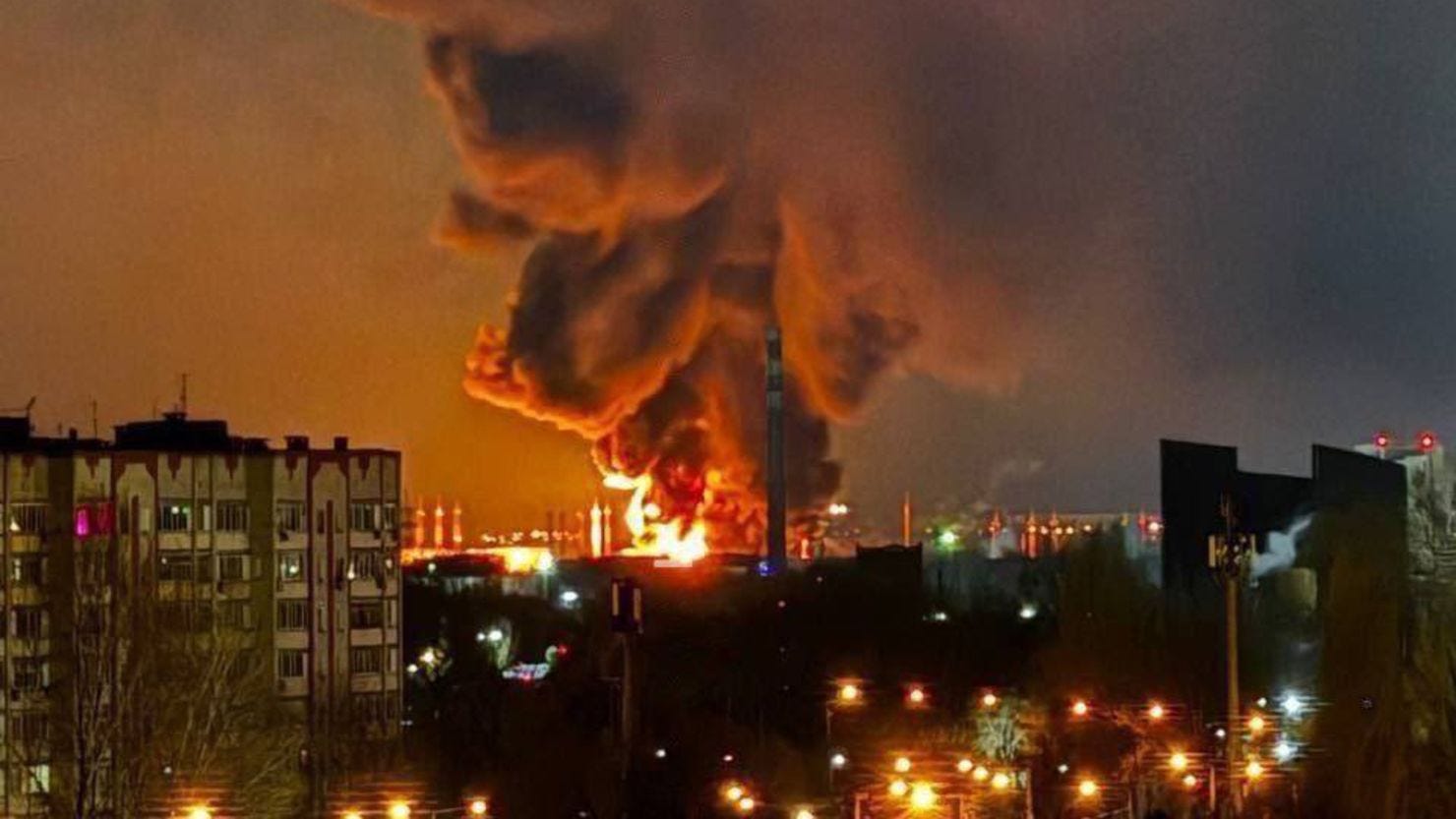
The late John McCain once called Russia “a gas station with nukes.” Well, that gas station is on fire—literally—and it’s Ukraine that keeps flicking the matches. With each passing week, Kyiv’s long-range drones are torching more of Russia’s oil refineries, storage depots, and pipelines, leaving Vladimir Putin scrambling to ration fuel at home while trying to keep his war machine humming abroad.
Ukraine’s drone war has now forced Moscow to ration gasoline in places like Crimea and Siberia, just as demand spiked with summer travel and the harvest season. Analysts say about 13% of Russia’s refining capacity is offline. Let that sink in—this is one of the world’s biggest energy exporters, and it can’t keep the pumps flowing for its own citizens.
What makes it worse for Putin is that Western sanctions have already kneecapped Russia’s ability to repair damaged facilities. You can’t just call up Siemens or Honeywell to ship replacement parts when your country’s been turned into an economic pariah. That means every Ukrainian drone that lands its payload creates a bottleneck Moscow struggles to fix before the next one hits. And lately, the hits keep coming.
Just this past week, Ukrainian drones torched the strategic Ust-Luga terminal on the Baltic Sea and disabled the Druzhba pipeline feeding Hungary and Slovakia. These aren’t pinpricks on the border—some of these strikes are hundreds of miles inside Russian territory. The message is clear: Distance is no longer protection. As one former Gazprom executive admitted, “If Ukraine can hit faster than Russia can repair, the entire system is at risk.”
This is about more than economics—it’s leverage. Trump has been leaning hard on Ukraine to cut a deal and accept Russia’s terms, even limiting the use of U.S.-supplied missiles. Kyiv’s answer? Build its own hardware. Ukrainian-made drones and cruise missiles don’t come with strings attached, and they’re proving effective enough to turn Russia’s sheer size into a weakness. Too much land, too many refineries, not nearly enough air defenses.
Too bad, so sad, Putin.
The domestic fallout in Russia is ugly. One could say, “BIGLY.”
Wholesale gasoline prices are up 45% this year, inflation is near 9%, and the IMF just slashed Russia’s growth forecast from over 4% in 2024 to under 1% in 2025. The central bank is stuck between high interest rates that strangle businesses and fuel shortages that enrage drivers. Ordinary Russians are queuing for hours at stations, and that discontent is toxic for Putin, who’s always treated cheap gas as a political shield.
Let’s not overstate it: No one thinks a few refinery fires will topple the Kremlin. As one analyst put it, “painful but not strategically disrupting.” Fair. But modern war is about attrition, logistics, and psychology as much as front-line battles. Every drone strike that shuts down a refinery for weeks is another crack in the myth of Russia’s invulnerability—and another drain on the ruble.
There’s also a long game here. Ukraine is developing its own cruise missile—the Flamingo—which carries a bigger warhead and could take “disruption” into “destruction.” That’s when this campaign shifts from economic harassment to actual strategic threat. If Kyiv can keep scaling up while Russia keeps patching holes with duct tape and prayers, Putin’s “gas station” could be permanently short on gas.
And don’t miss the irony. Russia’s war chest is built on energy exports, yet the very lifeline funding its war is now its Achilles’ heel. It’s David with a drone versus Goliath with a leaky pipeline. Ukraine doesn’t need to crush the Russian army outright—it just has to make sure the tanks run dry before they ever reach the battlefield.
Source: Wall Street Journal (gift article)
So yeah, turns out you can fight a petrostate by setting it on fire one drone strike at a time. Somebody tell Putin his “special military operation” just turned into a very expensive AAA roadside call. Hahahahahahahaha!