



The Morning Sixpack stays free because the news that shapes your life should not be hidden behind a paywall. Paid subscribers are not paying for access. They are helping fund the research, writing, and independent voice that goes into every issue. Become a paid subscriber and help keep smart, honest news analysis free for everyone.
The U.S. and Israel are reportedly preparing another attack on Iran, but apparently the calendar needs to clear both countries’ elections first.
U.S. and Israel Prepare for Possible November Attack on Iran as Gulf Economies Crumble
The United States and Israel are preparing for a possible new military offensive against Iran in early November, shortly after the November 3 U.S. midterm elections, according to a person briefed on the countries’ war planning. The source told NPR that Israel originally intended to strike in mid-October, ahead of its October 27 elections, but President Donald Trump objected. American forces are now reportedly gathering in the region to be ready for an attack after the U.S. elections. However, the military buildup could also be intended to pressure Tehran into a diplomatic agreement rather than launch another round of fighting.
Iran says it is ready for either negotiations or another war—and is warning that the consequences could extend well beyond the battlefield. Iranian Foreign Minister Abbas Araghchi told state media Thursday, “We are just as prepared for diplomacy as we are for war.” He acknowledged that another U.S.-Israeli attack remains possible. An Iranian security source warned that strikes against Iranian officials or civilian infrastructure would trigger retaliation against American interests and the infrastructure of countries participating in the conflict. Meanwhile, Israeli Prime Minister Benjamin Netanyahu, campaigning for reelection, is openly threatening to topple Iran’s government.
The latest tensions follow the U.S.-Israeli war launched February 28, which killed Iran’s supreme leader and several senior officials. Despite extensive damage to Iran’s air force, air defenses, and navy, the country retains the ability to threaten Israel, neighboring Gulf states, and American military installations. A ceasefire has repeatedly broken down, with both sides exchanging strikes over control of the Strait of Hormuz. Iran has targeted commercial shipping through the strategically vital waterway, while Washington has imposed a blockade on Iranian ports and oil shipments. Iranian state media reported Thursday that Revolutionary Guard forces attacked seven oil tankers, setting four ablaze while three others struck naval mines.
Iran’s Revolutionary Guard is also threatening to expand the conflict into the digital infrastructure supporting the region. Yadollah Javani, a senior political official in the Guard, warned that underwater internet cables running beneath the Strait of Hormuz could be destroyed if American and Israeli attacks resume. Data centers throughout the Gulf have also been identified as potential targets. Such threats underscore how a renewed military campaign could disrupt communications and technology infrastructure alongside energy shipments and international commerce.
The economic fallout is already severe, according to a new International Monetary Fund report. Disruptions to energy production, shipping, tourism, and trade have battered Gulf economies, with Iraq, Kuwait, and Qatar each projected to suffer economic contractions of approximately 16% this year. Saudi Arabia and the United Arab Emirates are also experiencing recessions, despite higher oil prices providing some relief to energy exporters. The IMF warns that if the war continues and energy supplies remain disrupted, oil prices could average $130 per barrel in 2027. With another possible offensive approaching, the consequences could reach far beyond the Middle East, affecting global energy markets and economic stability.
Editor: Two elections, another possible war, burning tankers, threatened internet cables, and $130 oil on the horizon. Apparently, the Middle East needed one more thing on its calendar.
Source: NPR
Russian operatives are reportedly recycling their 2024 election disinformation playbook, this time targeting a Texas Senate candidate with AI-generated smears. Apparently, election interference is one export Moscow never runs short of.
Russian Disinformation Network Targets Texas Democrat as Midterm Election Interference Intensifies
A covert Russian influence operation has targeted Texas Democratic Senate candidate James Talarico with a fabricated misconduct allegation, adding to growing evidence that Moscow is attempting to influence the November 3 midterm elections. Researchers tracking foreign disinformation attributed the attack to Storm-1516, a Russian-linked operation previously responsible for spreading an unfounded allegation against Democratic vice-presidential nominee Tim Walz during the 2024 election. The latest attack comes as Talarico faces Republican Texas Attorney General Ken Paxton in a closely contested Senate race. U.S. intelligence assessments indicate Russian influence operations have intensified in recent weeks, with coordinated bot networks spreading misleading content across social media platforms.
Most of the Russian-linked content identified so far has targeted Democratic candidates, particularly in competitive Senate races that could determine control of Congress. However, intelligence officials caution that their assessments do not establish an explicit Russian strategy to favor one political party over another. Representative Jim Himes of Connecticut, the ranking Democrat on the House Intelligence Committee, said Russian operations are broadly intended to undermine confidence in American elections and create political chaos. He also noted that Moscow has targeted politicians from both parties who support Ukraine. The tactics resemble previous Russian interference campaigns, which have relied on fabricated allegations, coordinated amplification, and efforts to exploit existing political divisions.
The latest attack began Tuesday when a recently created X account published a video containing an unfounded allegation against Talarico. The post initially attracted little attention, but approximately 12 hours later, three verified accounts with substantial followings amplified it. Researchers at Alethea and Clemson University’s Media Forensics Hub identified those accounts as previously involved in spreading Storm-1516 disinformation. Graphika, another threat intelligence firm, concluded that the original video and a subsequent recording appeared to have been created using artificial intelligence. According to Alethea, the video accumulated more than 850,000 views during its first 24 hours, demonstrating how quickly fabricated political content can spread once influential accounts promote it.
The operation unfolded against an unusual diplomatic backdrop, with President Donald Trump’s administration simultaneously pursuing improved relations with Moscow. Special envoy Steve Witkoff visited Russia this week as Washington sought progress toward ending the war in Ukraine and easing broader tensions between the two countries. During the visit, Witkoff publicly praised Russian President Vladimir Putin as a humanitarian for agreeing to release an imprisoned American. Meanwhile, Russian-linked accounts were circulating fabricated allegations against an American Senate candidate. Talarico’s campaign condemned the attacks, accusing powerful interests of using AI-generated material, foreign bots, and conspiracy theories to damage his candidacy. The Russian-linked video also followed a separate baseless allegation circulated by Republican opponents about Talarico supposedly traveling to Ohio for medical treatment.
Researchers warn that the latest incident may represent the beginning of a broader wave of election-related disinformation as November 3 approaches. Storm-1516 has established connections to the Foundation to Battle Injustice, a Russian organization with ties to the Kremlin, and has repeatedly used coordinated online networks to circulate fabricated political narratives. Darren Linvill, a founder of Clemson University’s Media Forensics Hub, said the operation closely follows the tactics deployed during the 2024 presidential campaign. The combination of AI-generated videos, established amplification networks, and politically charged accusations presents a continuing challenge for voters attempting to distinguish authentic reporting from manufactured propaganda. With control of Congress at stake, researchers expect additional opportunities for foreign influence operations before Election Day.
Editor: Russia allegedly manufactures the smear, AI helps package it, and verified social media accounts deliver the audience. Democracy gets another stress test, courtesy of a disinformation operation that apparently believes in recycling.
Source: The New York Times
Elon Musk reportedly slowed Ukraine’s battlefield communications, and now lawmakers from both parties want answers about why one billionaire gets to make decisions that can affect the outcome of a war.
Bipartisan Lawmakers Demand Investigation Into Musk Over Starlink Slowdown in Ukraine
Republican and Democratic lawmakers are demanding a congressional investigation into Elon Musk following reports that he personally ordered restrictions on Ukraine’s access to SpaceX’s Starlink satellite network. The Wall Street Journal reported that Musk directed a slowdown of the service, disrupting technology Ukrainian forces rely on for battlefield communications, drone operations, and defense against Russian attacks. Republican Representative Brian Fitzpatrick of Pennsylvania called for Musk and other witnesses to testify under oath, describing the situation as extremely serious. Fitzpatrick also suggested Congress could withhold funding from federal agencies or officials found to have participated in restricting the network.
The controversy is raising fundamental questions about whether a private technology executive should wield such extraordinary influence over American national security interests and an allied country’s military operations. Democratic Senator Adam Schiff of California called for a Senate investigation and sworn testimony from Musk, arguing that national security decisions should serve American interests rather than an executive’s personal preferences. Senator Chris Coons of Delaware questioned why Musk effectively possesses power comparable to a senior military commander when it comes to influencing battlefield outcomes. Coons also said he was considering subpoenaing Musk or Defense Secretary Pete Hegseth if Democrats regain control of the Senate in November.
According to the Journal, Musk imposed speed restrictions last week that limited how fast Ukrainian military hardware could travel while maintaining a Starlink connection. The changes have reportedly complicated Ukraine’s ability to intercept Russian attacks and conduct drone strikes. The restrictions followed public expressions of anger from both Musk and President Donald Trump over Ukrainian attacks on Russian diesel refineries. The Journal also reported that Musk and Trump spoke within hours of the slowdown becoming public, although the article did not establish whether Trump directed or approved the restrictions. SpaceX did not immediately respond to requests for comment about the allegations.
Concerns about the slowdown have already prompted bipartisan demands for an independent investigation. Republican Senators Thom Tillis of North Carolina, Lisa Murkowski of Alaska, and John Cornyn of Texas joined Democratic colleagues in requesting that the Defense Department’s inspector general examine whether the Pentagon or its contractors played a role in restricting Starlink service. The inspector general’s office said it was preparing a response to the lawmakers’ request. Investigators could face questions about who authorized the restrictions, whether government officials were involved, and how much control SpaceX retains over communications technology used in an active military conflict.
Musk has not publicly provided a detailed explanation for the reported restrictions. On Wednesday, he posted a dismissive comment about traditional news outlets on X, although it was unclear whether he was responding specifically to the Journal’s reporting. The controversy highlights the growing dependence of military operations on privately owned communications infrastructure and the potential consequences when a single corporate executive controls access to strategically important technology. With Ukraine relying on Starlink to support its defense against Russia, lawmakers are questioning whether decisions affecting military operations should remain subject to one company’s discretion. The dispute could also become a significant congressional oversight issue following the November midterm elections.
Editor: Congress controls military funding, generals command military operations, and apparently Elon Musk gets a speed-limit switch. Maybe it’s time someone explained why a private billionaire has that much influence over a war.
Source: The Wall Street Journal
Mark Zuckerberg threatened to leave California over a proposed billionaire tax, so Meta’s board worked out a stock deal that could help him pay the bill without surrendering control. Apparently, even billionaires need a little financial assistance.
Zuckerberg Threatened to Flee California Over Wealth Tax—Meta’s Board Cut Him a Deal to Stay
Meta CEO Mark Zuckerberg considered leaving California to avoid a proposed 5% billionaire wealth tax, prompting the company’s board to negotiate a special stock arrangement that could help him pay a multibillion-dollar tax bill without losing control of Meta. According to a regulatory filing, Zuckerberg warned directors that California’s Proposition 40 could force him to sell enough shares to substantially reduce his voting power. The ballot measure, scheduled for a November 3 vote, would impose a one-time tax on the net worth of California residents whose assets exceed $1 billion. Unlike traditional income taxes, the proposal would target accumulated wealth, potentially requiring billionaires whose fortunes are tied up in company stock to sell assets to cover their obligations.
The deal allows Zuckerberg to sell a portion of newly created nonvoting Meta shares while preserving the voting control that keeps him firmly in charge of the company. Meta announced a new Class C stock structure as part of a broader plan to finance its enormous artificial intelligence investments. Existing shareholders will receive the new shares through a dividend, but Zuckerberg’s shares will initially be linked to his original voting shares, restricting their sale. An exception allows him to immediately sell up to 20% of his new Class C holdings, representing approximately 10% of his financial stake in Meta. The company explicitly acknowledged that the proceeds could be used to pay his potential California wealth tax liability.
The negotiations reveal how seriously Zuckerberg considered relocating to a lower-tax state. During discussions in July, he told a board member that he had accepted a $1 annual salary since 2013 and that paying the proposed tax could reduce his voting interest in Meta from 60.6% to approximately 53%. By September, his outside attorneys were warning directors that he needed to begin establishing residency elsewhere before the election. Zuckerberg even told board members on September 9 that he intended to publicly list his Palo Alto home for sale just four days later. The filing shows that his advisers submitted multiple proposals involving different stock dividend ratios and restrictions before the two sides reached an agreement.
Meta’s board had its own reasons for keeping Zuckerberg in California. Directors argued that his physical presence at the company’s headquarters was particularly important as Meta prepared for a massive expansion of its artificial intelligence operations. Internal forecasts discussed in June indicated that Meta would need to raise hundreds of billions of dollars to support its AI ambitions, potentially beginning as early as the fall of 2026. The company also cited difficulties experienced during the COVID-19 pandemic when Zuckerberg worked away from the rest of Meta’s management team. Under the final agreement, Zuckerberg committed to maintaining his primary residence in the same state as Meta’s headquarters for eight years, barring significant unforeseen circumstances.
The arrangement illustrates the complicated relationship between billionaire taxation, corporate governance, and the enormous fortunes held in publicly traded stock. Proposition 40, backed by a healthcare union, has already prompted some wealthy Californians to consider relocating to states such as Florida and Texas, where tax burdens are generally lower. For Zuckerberg, the challenge was not simply finding the money to pay a potential tax bill but doing so without significantly weakening his voting control over Meta. The new stock structure gives him additional flexibility while allowing the company to pursue its AI financing strategy. Zuckerberg ultimately agreed to stay and never listed his Palo Alto home for sale, but the deal demonstrates how far corporate boards may go to accommodate the financial concerns of powerful executives.
Editor: Most Californians worried about their taxes get a bill. Zuckerberg got a custom stock structure, a boardroom negotiation, and an eight-year stay-at-home agreement. Must be nice when your tax planning comes with a corporate finance department.
Source: The Wall Street Journal
Trump’s economic approval has hit a record low, two-thirds of Americans disapprove of his handling of the economy, and even Republican voters are growing pessimistic. Apparently, telling people the economy is great doesn’t make their grocery bills disappear.
Trump’s Economic Approval Hits Record Low as Democrats Gain Ground Ahead of Midterms
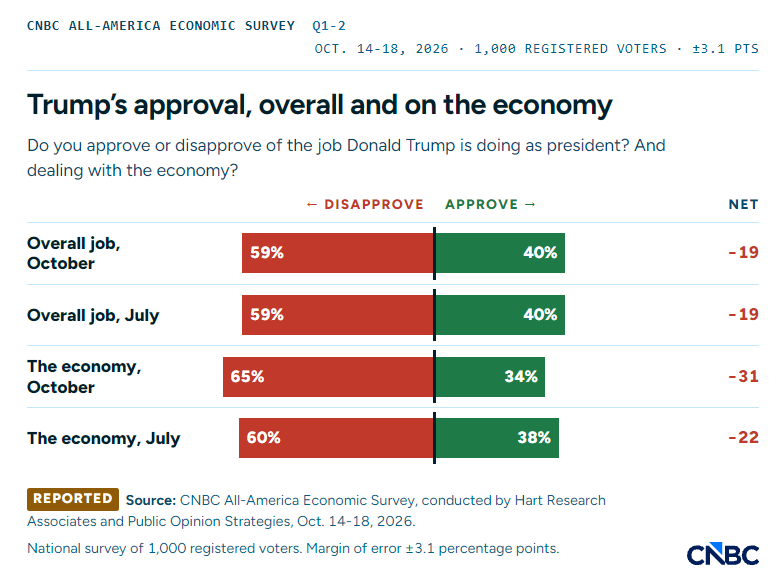
President Donald Trump’s economic approval rating has fallen to its lowest level across both of his presidential terms, with 65% of Americans disapproving of his handling of the economy, according to the latest CNBC All-America Economic Survey. Just 34% approve of his economic performance, down from 38% in July, while disapproval climbed from 60% to 65%. His net economic approval rating now stands at negative 31 percentage points, a nine-point deterioration in just three months. The disapproval figure is also the highest CNBC has recorded for any president since its surveys began tracking the measure during Barack Obama’s presidency, exceeding former President Joe Biden’s worst reading by one point. With the November 3 midterm elections approaching, the numbers present a significant challenge for Republicans hoping to maintain control of Congress.
The most troubling development for Republicans is that economic pessimism is spreading within their own political base. Overall, 80% of Americans describe the economy as fair or poor, the highest share since December 2023, while 63% express pessimism about current conditions and the outlook. Among Republicans, economic pessimism has climbed to 35%, up six percentage points since July and the highest level recorded among GOP voters during either Trump administration. Republican pollster Micah Roberts said the deterioration was driven not by Democrats or independents becoming more negative, but by Republicans losing confidence in economic conditions. Trump’s overall approval rating remains at 40%, with 59% disapproving, giving him a negative 19-point approval margin compared with negative eight points a year earlier.
The political consequences are becoming increasingly apparent in congressional polling. The survey of 1,000 registered voters, conducted with a margin of error of plus or minus 3.1 percentage points, found Americans favoring Democratic control of Congress by 52% to 45%, a seven-point advantage that has grown three points since July. Independents prefer Democratic control by a 49% to 33% margin, while women favor Democrats by 22 points. Democratic voters also appear more motivated, with 72% expressing high interest in the election compared with 62% of Republicans. In eight states featuring competitive Senate races, Democrats hold a four-point advantage on congressional control despite Trump having carried those states by a combined 10 points in the 2024 presidential election.
The cost of living remains a major source of voter frustration. Eighty percent of respondents believe prices are rising, with 55% saying they are increasing faster than usual. Food costs have overtaken gasoline as a leading concern, with 34% identifying groceries as a major worry compared with 23% citing gas prices. When food, gasoline, and housing costs are combined, affordability concerns rank as the top issue for 57% of voters. Democrats now hold a 16-point advantage over Republicans on handling food and grocery costs, up from seven points in July, while also leading on corruption, protecting democracy, employment, and gasoline prices. Republicans retain an advantage on immigration and border security, although their immigration lead has narrowed from 15 points to nine.
The survey also reveals growing skepticism about the war with Iran and widespread concern about government corruption. Only 46% of Americans believe the military campaign was worthwhile for disrupting Iran’s nuclear ambitions, down from 53% in April, while just 35% believe it justified higher gasoline prices. On ethics, 93% oppose elected officials personally owning or trading individual stocks in companies holding federal contracts, and 89% oppose federal contracts going to businesses owned or invested in by a sitting president’s immediate family. Government corruption ranks as the top individual concern for 36% of respondents. Despite the favorable polling trends for Democrats, both Republican and Democratic pollsters caution against assuming a sweeping electoral victory, noting that Democrats must still win numerous districts and states Trump carried comfortably in 2024.
Editor: Trump promised economic greatness, but voters are reporting expensive groceries, rising gas prices, and shrinking confidence. When even your own supporters start questioning the economy, the sales pitch might need more than another coat of gold paint.
Source: CNBC
The Trump administration says Elon Musk—not the White House—controls Ukraine’s Starlink slowdown. Congressional Republicans aren’t entirely buying it, and now they’re threatening to hold up Trump’s agenda until somebody explains who’s actually calling the shots.
Rubio and Hegseth Point to Musk Over Ukraine Starlink Slowdown as Republicans Demand Answers
Secretary of State Marco Rubio and Defense Secretary Pete Hegseth are placing responsibility for Ukraine’s Starlink communications slowdown on Elon Musk and SpaceX, distancing the Trump administration from a decision that has drawn bipartisan outrage in Congress. Rubio told reporters Wednesday that Starlink’s operating restrictions are governed by private commercial contracts, leaving decisions about access and connection speeds to the company. Hegseth similarly characterized the slowdown as a commercial matter rather than an order from the White House. Their explanations represent a shift from earlier statements by President Donald Trump and Rubio suggesting neither the administration nor Musk had ordered the restrictions. The controversy intensified after The Wall Street Journal reported that Musk personally directed the slowdown of satellite communications Ukraine depends on to defend against Russian missile and drone attacks.
The administration’s explanation has failed to satisfy several prominent Republicans, who are questioning whether Musk acted independently or with White House approval. Republican Senator John Cornyn of Texas said Wednesday that he doubted Musk would have restricted the service without at least the administration’s acquiescence. Cornyn called the decision shameful, arguing that the United States should support Ukraine rather than Russia. Republican Representatives Brian Fitzpatrick of Pennsylvania and Don Bacon of Nebraska have threatened to obstruct Trump’s legislative agenda during the lame-duck session unless the administration provides answers. Fitzpatrick warned that restricting Starshield, SpaceX’s military-grade satellite communications system, could violate federal law if Musk personally authorized it. The distinction matters because Starlink is a commercial product, while Starshield is designed for national security operations.
Conflicting reports have further complicated efforts to establish who ordered the slowdown. The Wall Street Journal reported that Musk directed the restrictions and that at least one source said Musk and Trump spoke before the disruption. Reuters previously reported that the directive originated inside the White House and was transmitted to the Pentagon, although its sources did not identify who issued or implemented the order. Trump denied involvement Wednesday, telling reporters, “I don’t know who did it but I was not involved.” Rubio, who also serves as national security adviser, has maintained that Ukraine does not currently have access to Starshield, despite Ukrainian President Volodymyr Zelensky discussing the restoration of Starlink and Starshield services with him. The conflicting accounts leave unresolved whether the restrictions originated with SpaceX, the administration, or some combination of the two.
The dispute comes amid renewed tensions between Trump and Zelensky over Ukraine’s attacks on Russian energy infrastructure. Trump has demanded that Kyiv stop striking Russian oil refineries, arguing that the attacks contribute to high diesel prices in the United States. Zelensky criticized Trump for easing sanctions on Russia and agreeing to purchase Russian diesel, while Russia has continued attacking Ukrainian energy facilities, including civilian electricity and heating infrastructure. Despite a public falling-out in 2025, Trump and Musk have recently rebuilt their relationship. Trump awarded Musk the National Medal of Science earlier this month, and Musk has reportedly contributed more than $276 million to Republican candidates and causes ahead of the midterm elections. Those connections have added to congressional questions about the relationship between private corporate decisions and American foreign policy.
A bipartisan group of 23 lawmakers, including seven Republicans and 16 Democrats, is now urging Trump to intervene directly with Musk to restore Ukraine’s communications capabilities and expand access inside Russia. Their proposal would allow Ukrainian forces to target Russian missile launchers more effectively in exchange for halting attacks on Russian energy facilities. Republican Senator Roger Wicker of Mississippi has supported the approach, arguing that it could help reduce pressure on fuel prices while strengthening Ukraine’s defenses. The lawmakers contend that reliable satellite connectivity is essential to countering Russian attacks and could provide Moscow with additional incentives to negotiate. With Congress demanding answers and Ukraine struggling with restricted communications, the administration faces growing pressure to clarify who controls a technology that has become critical to the war.
Editor: Rubio says it’s Musk’s call. Hegseth says it’s a commercial decision. Trump says he wasn’t involved. Meanwhile, Ukraine’s battlefield communications are restricted and Russia keeps attacking. That’s an impressive amount of finger-pointing for an administration that supposedly has someone in charge.
Source: The Hill
Read The Morning Sixpack here: