


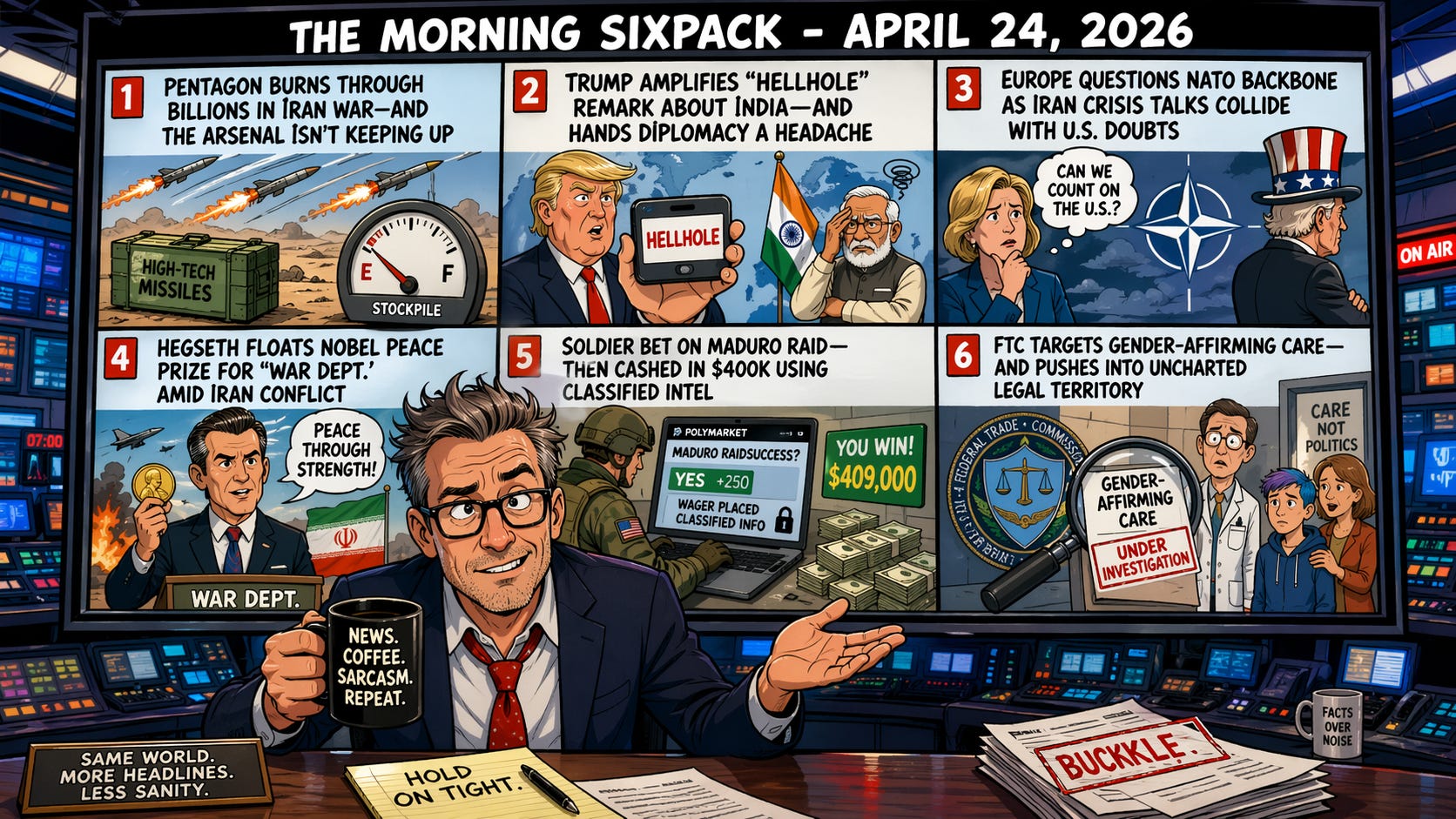
Pentagon Burns Through Billions in Iran War—and the Arsenal Isn’t Keeping Up
The U.S. has burned through thousands of high-end missiles in just over a month of war with Iran, leaving stockpiles dangerously thin and replenishment years away. In 38 days, the military chewed through weapons meant for a potential showdown with China—and now the bill, and the risk, are catching up.
At current production rates, replacing what’s already been fired could take years.
The numbers are staggering. The U.S. launched roughly 1,100 long-range stealth cruise missiles and more than 1,000 Tomahawks—about ten times the annual purchase rate—while also firing over 1,200 Patriot interceptors at $4 million apiece and another 1,000 ground-based missiles. The Pentagon hasn’t officially disclosed totals, but internal estimates paint a clear picture: this wasn’t just a campaign, it was a burn rate problem.
And it’s not just about cost—though that’s running somewhere between $28 billion and $35 billion so far, or just under $1 billion a day. It’s about readiness. To keep the Iran fight supplied, the Pentagon pulled weapons from Europe and Asia, leaving those regions thinner at a time when Russia and China aren’t exactly taking a sabbatical.
There’s also a structural issue the war exposed: the U.S. is heavily reliant on expensive, high-end munitions while lagging on cheaper, scalable options like drones. As one expert put it, “At current production rates, reconstituting what we have expended could take years.” Meanwhile, funding delays and slow industrial ramp-ups mean the restock plan is still mostly theoretical.
The White House insists everything is fine—“fully loaded,” in fact—but even military commanders are acknowledging limits. As one put it, there are “finite limits to the magazine.” Translation: you can only empty the clip so many times before you start counting bullets.
Source: New York Times
Editor: Turns out “infinite firepower” comes with a supply chain—and it doesn’t run on slogans. Trump’s ceasefire is an excuse for re-supply of weaponry.
Trump Amplifies “Hellhole” Remark About India—And Hands Diplomacy a Headache
Donald Trump shared a post calling India a “hellhole,” sparking backlash just as the U.S. tries to steady relations with a key ally. The timing couldn’t be worse—with top-level diplomacy on deck and tensions already simmering.
Calling a strategic partner a “hellhole” isn’t exactly how you smooth things over.
The post, shared on Truth Social, echoed comments from conservative host Michael Savage and veered into familiar territory—attacking birthright citizenship while taking aim at immigrants from India and China. It also tossed in claims about Indian tech workers and English proficiency that don’t hold up, but that didn’t stop the message from spreading.
India didn’t shrug it off. Foreign ministry spokesman Randhir Jaiswal called the remarks “obviously uninformed, inappropriate and in poor taste,” adding they don’t reflect the reality of U.S.-India ties. That relationship, built over decades, has been a cornerstone of U.S. strategy in counterbalancing China.
The blowback didn’t stop there. Congressman Ami Bera labeled the comments “offensive, ignorant and beneath the dignity of the office,” while advocacy groups warned the rhetoric risks fueling xenophobia at a moment when tensions are already running high.
All of this lands awkwardly ahead of a planned visit by Marco Rubio, who’s expected to do the diplomatic cleanup. Trump’s broader friction with Narendra Modi—from tariffs to bruised egos over regional politics—only adds to the strain.
Source: The Guardian
Editor: You can spend decades building a strategic partnership—or torch it in a single repost. Guess which one gets more clicks.
Europe Questions NATO Backbone as Iran Crisis Talks Collide with U.S. Doubts
Poland’s prime minister is openly questioning whether the U.S. would honor NATO commitments in a Russian attack—right as Europe scrambles to respond to the Iran crisis. The concern isn’t theoretical anymore—it’s creeping into real-time policy decisions.
If Europe can’t count on Washington, the entire security playbook gets rewritten.
Speaking ahead of an EU summit in Cyprus, Donald Tusk didn’t mince words, calling U.S. reliability the “biggest, most important question” facing Europe. For countries on NATO’s eastern flank, the issue isn’t abstract—it’s about whether the alliance would actually mobilize if Russia made a move in the coming months.
The backdrop is a messy geopolitical overlap. European leaders are meeting to address both the Iran war fallout and broader Middle East instability, while also quietly gaming out worst-case scenarios closer to home. Tusk is pushing for the EU to act less like a political club and more like a military alliance—with real capability to move troops and defend borders.
That includes revisiting the EU’s own mutual defense clause and accelerating integration now that Viktor Orban—long seen as a Russia-friendly outlier—is no longer shaping the bloc’s direction. Tusk’s message: Europe can’t afford half-measures when the threat window may be “months rather than years.”
For decades, the transatlantic alliance has been the bedrock of European security. Now, with Donald Trump injecting uncertainty into that equation, leaders are being forced to confront a once-unthinkable scenario—planning for defense without full confidence in the U.S.
Source: Reuters
Editor: When your alliance depends on trust and you start asking if it’s still there, that’s not a strategy—it’s a warning sign.
Hegseth Floats Nobel Peace Prize for ‘War Dept.’ Amid Iran Conflict LOL
Defense Secretary Pete Hegseth says the U.S. military deserves a Nobel Peace Prize—while actively waging war in Iran. The pitch: overwhelming force is actually the path to peace.
Calling it the “Department of War” and then lobbying for a peace prize is…a choice.
At a Pentagon briefing, Pete Hegseth defended both the conduct of the الحرب and his rhetoric, brushing off questions about the violence as missing the point. “Because war is violent,” he said. “War requires doing difficult things.”
Pressed on his repeated rebranding of the Department of Defense as the “Department of War,” Hegseth leaned in rather than backing off. The logic, he argued, is “peace through strength”—a framing that casts aggressive military action as the ultimate stabilizer.
Then came the kicker. “In fact, I once did a video about the one institution that you win the Nobel Peace Prize every single year is the United States military,” Hegseth said, arguing it acts as a global guarantor of security.
The comments land as the Iran conflict racks up casualties, drains U.S. resources, and rattles global oil markets—hardly the usual backdrop for Nobel speculation. Still, the administration continues to frame the campaign as necessary and justified under its broader security doctrine.
Source: Raw Story
Editor: If “peace” now requires a rebrand to “war,” the marketing team deserves hazard pay.
Soldier Bet on Maduro Raid—Then Cashed In $400k Using Classified Intel
A U.S. Special Forces soldier allegedly used top-secret details of the Nicolás Maduro raid to place bets—and walked away with more than $400,000. This wasn’t just insider trading—it was insider warfare.
When classified military ops become betting lines, you’ve got a problem no rulebook really covers.
Federal prosecutors say Gannon Ken Van Dyke wagered about $33,000 on a prediction market tied to the removal of Nicolás Maduro—while actively helping plan and execute the mission itself. The bets, placed just days before the January 2026 operation, paid off big once U.S. forces captured Maduro.
According to the indictment, Van Dyke used confidential, classified information to make highly specific wagers on the timing and outcome of the operation via Polymarket. Prosecutors say he then tried to cover his tracks—moving money through crypto accounts and attempting to delete evidence after the raid. (Reuters)
The charges are heavy: wire fraud, commodities fraud, theft of government information, and unlawful use of classified intel for personal gain. Authorities are framing it as a major breach of trust, not just a financial crime. “No one is above the law,” officials said, emphasizing the national security risks tied to exploiting sensitive operations.
Even Donald Trump weighed in, comparing the situation to a sports betting scandal—“like Pete Rose betting on his own team”—while adding that the world is starting to look “like a casino.”
The case may be the first of its kind involving prediction markets and military intelligence—and it lands at a moment when betting on geopolitical events is exploding in popularity, with very few guardrails.
Source: NBC News
Editor: Nothing says “discipline and chain of command” like checking your bets mid-mission. Somewhere, Vegas is taking notes—and that’s not a compliment.
FTC Targets Gender-Affirming Care—And Pushes Into Uncharted Legal Territory
The Federal Trade Commission is ramping up investigations into gender-affirming care, stretching its consumer protection mandate into one of the most politically charged fights in America. What used to be about scam products is now about medical standards—and that’s raising alarms inside and outside the agency.
When a consumer watchdog starts policing medical consensus, it’s not just enforcement—it’s policy by proxy.
According to internal accounts and experts, the FTC has been issuing sweeping demands for documents to major medical groups like the American Academy of Pediatrics and the Endocrine Society. These civil investigative demands—basically subpoenas—are typically used in fraud cases, not to scrutinize established medical guidelines.
The shift didn’t happen quietly. New hires and internal restructuring point to a focused effort, led in part by attorney Glenna Goldis, to investigate providers and potentially dismantle parts of the gender-affirming care system. Critics say the strategy is less about consumer protection and more about targeting the broader field itself.
Even within the FTC, the move is being called “very unusual.” Traditionally, the agency goes after fake cures or deceptive business practices—not nonprofits setting medical standards. The concern now is a chilling effect: doctors and organizations may back away from offering care simply to avoid becoming the next target.
Legal experts say going after these organizations could be a way to map out the entire ecosystem—providers, funding, and practices—potentially setting up broader enforcement actions. Meanwhile, the cost of fighting these probes is already mounting, with estimates running into the hundreds of thousands for nonprofits.
All of this fits into a wider push by the Trump administration to challenge transgender rights across multiple agencies, turning what was once a regulatory lane into a full-on policy battlefield.
Source: WIRED
Editor: When regulators start rewriting medicine through subpoenas, it’s not oversight—it’s a power play with a legal brief attached.