


America’s Job-Light Economy
The US jobs report came out today. Here’s how it looks:
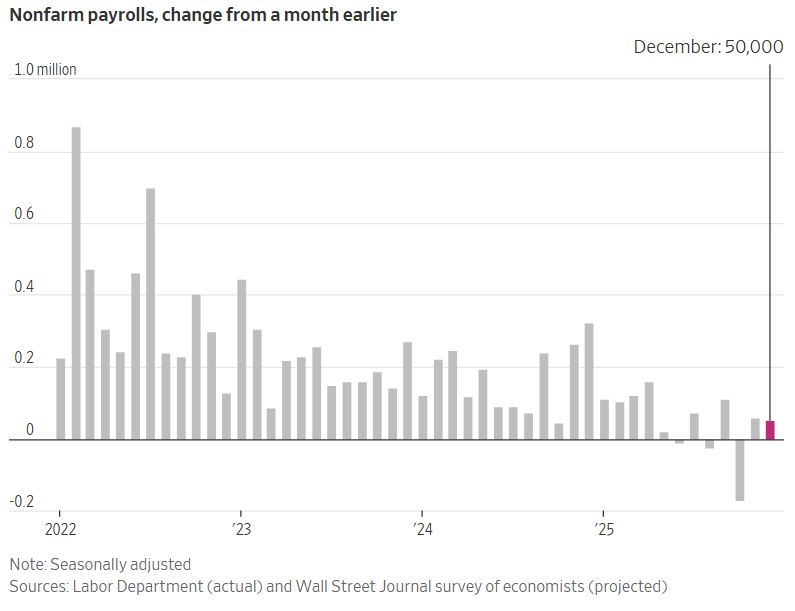
Source: WSJ
Employers added 50,000 jobs in December, far fewer than economists expected. Hiring was weaker than November, weaker than October once revisions were tallied, and dramatically weaker than the boom years that followed the pandemic. And yet the unemployment rate fell to 4.4%. Remember, though, that October 2025 is missing because of the federal government shutdown.
In another cycle, numbers like these might have signaled an economy on the brink. Instead, they closed out a year in which the United States kept growing—sometimes briskly—even as the labor market quietly cooled into something new: a low-hire, low-fire equilibrium that has left workers uneasy, employers cautious, and policymakers unsure how much further they can safely push.
The U.S. economy entering 2026 is neither hot nor cold. It is productive, restrained, and unusually sensitive to policy decisions made far from the factory floor.
Growth without hiring
The central puzzle of 2025 was how the economy kept expanding while job creation nearly stalled.
By the end of the year, payroll growth averaged just 49,000 jobs a month, down sharply from the 168,000-a-month pace in 2024. Entire sectors—retail, transportation, warehousing—shed workers outright. Hiring clustered narrowly in health care, education, and leisure, leaving broad swaths of the workforce stuck in place.
And yet output told a different story. Gross domestic product surged at a 4.3% annual rate in the third quarter, its fastest pace in two years. Consumer spending held up. Business investment rose, particularly in technology and automation. Corporate profits remained healthy.
Why?
In the third quarter, U.S. productivity jumped nearly 5%, allowing companies to produce more without adding workers. Unit labor costs fell at the same time, relieving inflation pressure even as wages cooled. For employers, it was the best of both worlds. For workers—especially younger ones trying to break in—it was something closer to limbo.
This is the anatomy of the current expansion: fewer job openings, fewer layoffs, less churn, and far fewer opportunities to trade up.
Inflation’s retreat—and its limits
Inflation, which dominated public life only two years ago, receded steadily through 2025. By November, consumer prices were rising at about 2.7% year over year, with core inflation near 2.6%.
That progress gave the Federal Reserve room to act. Over the course of the year, it cut interest rates three times, bringing its benchmark rate down to the 3.5%–3.75% range, a three-year low. Borrowing costs eased. Financial conditions loosened modestly. The economy kept moving.
But inflation never quite disappeared. Energy prices swung sharply. Housing costs remained stubborn. And looming over everything was trade policy—specifically, the return of sweeping tariffs as a defining economic force.
Tariffs operate differently from inflation shocks driven by demand. They raise costs selectively, unevenly, and often unpredictably. One announcement can change sourcing decisions overnight; one exemption can shift pricing power across an industry. The result is not necessarily runaway inflation, but persistent friction—just enough to keep central bankers on edge.
The tariff economy
Trade policy in 2025 reshaped corporate behavior as much as any interest-rate decision.
The Trump administration’s reciprocal tariffs unsettled global supply chains already strained by geopolitics and post-pandemic realignment. Companies responded not with mass layoffs, but with hesitation: slower hiring, delayed investment, and a renewed push toward automation and domestic capacity where feasible.
In some industries, tariffs encouraged onshoring and capital spending. In others, they raised input costs without offering a clear alternative. Across the economy, they injected uncertainty—an invisible tax that discourages risk-taking even when demand is strong.
This helps explain why job growth sputtered without collapsing. Firms were not pessimistic enough to fire workers en masse, but not confident enough to expand payrolls aggressively. Instead, they leaned on technology, productivity gains, and longer work hours for existing staff.
Globally, the effects rippled outward. Trading partners adjusted supply routes, absorbed costs, or prepared retaliation. Efficiency suffered. Resilience improved. Growth became more fragmented.
A confident economy, anxious consumers
The contradiction of 2025 was emotional as much as economic.
Objectively, the economy performed well.
GDP grew.
Inflation fell.
Interest rates came down.
Corporate earnings were solid.
But consumer sentiment sank.
Surveys showed Americans increasingly worried about job security, prices, and their future prospects.
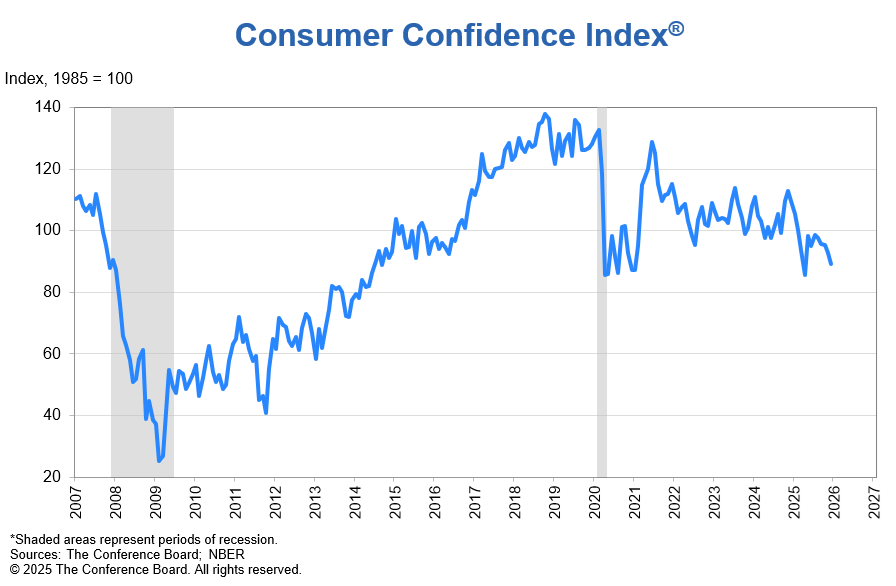
That disconnect reflects how the expansion has been experienced. Wage growth cooled. Promotions slowed. Job switching—once the fastest path to higher pay—became rare. For younger workers, entry-level opportunities thinned. For older ones, staying put became the safest option.
The economy, in short, stopped feeling dynamic.
The road ahead
Looking toward 2026, the path forward hinges on a narrow set of questions.
Can productivity gains continue without hollowing out entry-level employment?
Will tariffs stabilize enough to let companies plan confidently?
Can inflation keep drifting lower without renewed pressure from trade policy or energy markets?
There are plausible paths to renewed momentum. Lower rates and tax changes could support hiring. Investment in artificial intelligence and automation could raise long-term growth. A calmer trade environment could unlock deferred expansion.
There are also risks. A tariff-driven inflation flare-up could tie the Fed’s hands. A productivity boom without job creation could deepen labor-market anxiety. Geopolitical shocks could test the economy’s newly re-engineered supply chains.
For now, the United States sits in a rare economic moment: growing steadily, hiring sparingly, and balancing policy choices that matter more than usual.
It is not a boom. It is not a bust. It is an economy learning how to move forward without the engine that has powered nearly every recovery before it—rapid job growth—and hoping that productivity, investment, and confidence can fill the gap.
The biggest wildcards right now are consumer confidence, tariff anxiety, and world leaders acting like colonists from years gone by.