


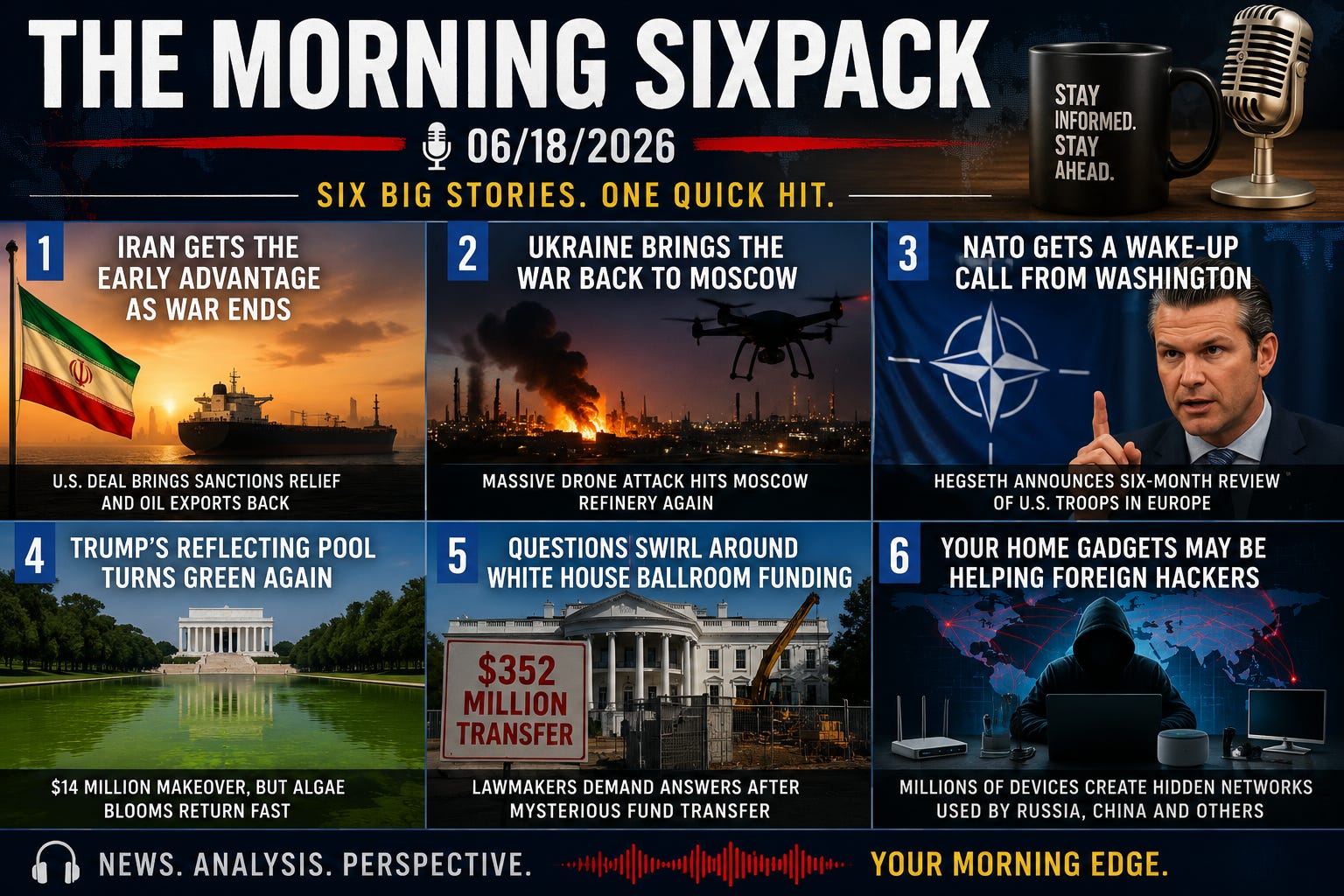
Iran just got sanctions relief, oil export access, and an end to the naval blockade while most of the hardest nuclear questions got pushed 60 days down the road—because apparently a war was the warm-up act for talks that could have happened months ago.
Iran Lands Economic Lifeline as U.S. Deal Delays Nuclear Fight
An initial U.S.-Iran agreement delivers immediate economic gains to Tehran while postponing the toughest nuclear negotiations for later.
The biggest winner, at least for now, is Iran.
The deal lifts the U.S. naval blockade of Iranian ports and allows Iran to resume oil exports through sanctions waivers before a final nuclear agreement is reached. For a country battered by inflation, a collapsing currency, and years of economic pressure, that’s a significant boost.
Iran’s primary obligation is reopening the Strait of Hormuz for commercial shipping over the next 60 days. Analysts noted that while Washington made tangible concessions immediately, Tehran’s most difficult commitments-particularly on its nuclear program-remain unresolved. As Nicole Grajewski of Sciences Po put it: “On balance, the memorandum appears to favor Iran.”
Markets reacted quickly. Oil prices fell on the news, helping push average U.S. gasoline prices below $4 per gallon. Critics argue the agreement weakens Washington’s strongest leverage by easing restrictions on both oil sales and related financial transactions, while supporters say it finally replaces a failed strategy of sanctions and military pressure with diplomacy.
Perhaps the biggest question is why it took a costly three-month war to get here. As several analysts noted, many of the agreement’s core provisions could have been negotiated before lives were lost, infrastructure was damaged, and global energy markets were rattled. The next 60 days will determine whether this is a genuine breakthrough-or simply another diplomatic timeout.
Source: New York Times
Editor: After months of conflict, billions in damage, and endless declarations that compromise was impossible, both sides appear to have arrived at a deal that starts with “we’ll figure out the hard stuff later.” Diplomatic procrastination remains undefeated.
Ukraine just launched one of its biggest drone barrages of the war, hitting Moscow’s fuel infrastructure again and reminding the Kremlin that distance is no longer much of a defense.
Ukraine Unleashes Massive Drone Swarm, Strikes Moscow Refinery Again
Ukraine launched one of its largest drone attacks of the war, targeting Moscow and key energy infrastructure deep inside Russia.
The message was simple: If Russia can strike Ukrainian cities, Ukraine can reach Russia’s economic nerve centers.
Russian officials said air defenses intercepted or shot down 555 drones overnight, making it one of the largest drone attacks on Russian territory in more than two years of war. Despite those defenses, several drones reportedly reached the Moscow Oil Refinery in Kapotnya, marking the second strike on the facility this week.
Dramatic videos circulating online showed towering flames, thick black smoke, and explosions lighting up the Moscow skyline. Authorities also reported damage to a shopping center, industrial facilities, and residential buildings around the capital. Moscow’s four major airports temporarily halted flights, and passengers at Sheremetyevo Airport were moved to shelters as a precaution.
Ukrainian President Volodymyr Zelensky framed the operation as retaliation for recent Russian missile and drone attacks that killed civilians and damaged infrastructure across Ukraine. Calling the strikes “Ukraine’s long-range sanctions,” Zelensky described them as “a completely fair response to Russian strikes on our cities and communities.”
The refinery strike carries particular significance because the Gazprom-owned facility supplies more than a third of Moscow’s fuel needs. Whether the physical damage proves severe or not, the attack underscores Ukraine’s growing ability to threaten strategic targets hundreds of miles from the front lines-and force Russia to spend increasing resources defending its own backyard.
Source: UPI
Editor: Russia spent years showcasing layers of air defenses around Moscow. Ukraine’s drones keep showing that even the world’s most heavily protected cities still have a way of discovering new skylights.
Pete Hegseth just told NATO allies they’ll be graded on defense spending, base access, and military readiness—because nothing motivates international cooperation quite like the threat of a Pentagon report card.
Hegseth Puts NATO on Notice with Six-Month Review of U.S. Troops in Europe
Defense Secretary Pete Hegseth warned NATO allies that America’s military presence in Europe could depend on how quickly they take over responsibility for their own defense.
The Pentagon is now effectively telling Europe: step up faster, or expect fewer American boots on the ground.
Speaking at NATO headquarters in Brussels, Hegseth announced a six-month review of U.S. military forces in Europe, saying the assessment will determine whether allies are moving “fast and irreversibly” toward leading Europe’s defense. He made clear that some countries would “pass with flying colors” while others would not.
The defense secretary didn’t stop there. In a sharply worded speech, Hegseth blasted some European allies for restricting U.S. access to military bases and overflight rights during operations against Iran, calling the lack of cooperation “shameful.” He also criticized European policies on migration, defense spending, and cultural priorities, arguing that military preparedness had taken a back seat to issues such as climate initiatives and gender equity.
The remarks add to growing uncertainty about America’s long-term military role in Europe under President Donald Trump. Recent administration signals have ranged from calls for allies to spend more on defense to indications that the United States may reduce the military support it would provide during a NATO crisis. At the same time, European governments have been dramatically increasing defense budgets, with NATO reporting a 20% spending increase last year alone.
One thing Hegseth did make clear is that U.S. nuclear weapons will remain in Europe, preserving a central pillar of NATO’s deterrence strategy. But beyond that, the message from Washington was unmistakable: Europe’s security future is increasingly expected to be Europe’s responsibility.
Source: Associated Press
Editor: For decades, European leaders complained that Washington acted like NATO’s parent. Now they’re discovering the downside of finally hearing, “You’re old enough to pay your own bills.”
After spending $14 million to make the Reflecting Pool look pristine for a July 4 showcase, Washington’s most famous puddle is greener than it has been in years.
Trump’s $14 Million Reflecting Pool Makeover Already Has an Algae Problem
Days after a $14 million renovation was completed, algae levels in the Lincoln Memorial Reflecting Pool reached their highest June levels in at least five years.
The pool was supposed to be a symbol of government efficiency—now it’s becoming a case study in how nature doesn’t read press releases.
President Donald Trump touted the project as a fix for what he called the Reflecting Pool’s “filthy” and “disgusting” condition. The renovation included resurfacing the basin, sealing leaks that reportedly wasted millions of gallons of water annually, and repainting the pool a deep blue color. Trump praised the “clean, beautiful water” when the pool began refilling earlier this month.
Then the algae came back. Fast. Analysis of satellite imagery conducted by a University of Virginia researcher for The Washington Post found algae concentrations in mid-June were higher than any June measurement dating back to 2021 and among the highest recorded over the last two years. Hot weather, abundant sunlight, and warming water created ideal conditions for growth.
Administration officials blame residual material left in dormant supply lines and say hydrogen peroxide treatments and new nanobubble ozone technology will solve the problem. Critics point out that concerns about water temperature, paint color, and environmental impacts were never fully examined because the administration classified the work as routine maintenance rather than conducting a broader federal review.
Trump is still planning a July 4 rally featuring the Lincoln Memorial and the renovated pool as a backdrop. Whether visitors will be admiring a gleaming national landmark or Washington’s most expensive algae farm remains a work in progress. One passerby may have summed it up best when he joked, “It’s the biggest tourist attraction now.”
Source: The Washington Post (gift)
Editor: Somewhere in Washington there’s a consultant preparing a PowerPoint explaining why painting a giant outdoor water feature darker right before a heat wave had absolutely nothing to do with algae growth. The slides should be fascinating.
After promising taxpayers wouldn’t pay a dime for his White House ballroom, the administration is now facing questions about why $352 million was quietly moved from a Secret Service fund into a vague “security” account.
Senators Demand Answers After $352 Million Transfer Fuels Ballroom Suspicions
Lawmakers from both parties are questioning whether the Trump administration quietly redirected federal funds toward a White House ballroom project after Congress declined to approve direct funding.
The controversy isn’t about the ballroom itself (though this whole endeavor is bullshit)—it’s about whether taxpayers are being asked to foot the bill after being told they wouldn’t.
The dispute centers on a $352 million transfer made by the White House Office of Management and Budget from a Secret Service fund that lawmakers say is legally restricted to personnel, training, technology, and related security programs. The money was reclassified under the broad label “White House Security Measures,” immediately raising questions on Capitol Hill.
Republican Sen. Thom Tillis called the move problematic on its face, while Democratic Sen. Brian Schatz said the description sounded suspiciously like funding for the ballroom project. Sen. Chris Coons went further, arguing that reports surrounding the transfer suggest Trump may be trying to route public money into a project he repeatedly described as privately funded.
The issue has gained traction because Trump spent months insisting taxpayers would not bear any of the cost. As recently as March, he declared, “We have no taxpayer putting up 10 cents.” But reports later surfaced indicating that construction estimates projected substantial public expenses connected to security and infrastructure needs surrounding the project.
Administration officials have not publicly confirmed that the transferred funds will be used for the ballroom, and senators are now demanding a detailed accounting of where the money is headed. Until those answers arrive, the transfer is likely to remain a flashpoint in Washington’s ongoing battle over spending transparency.
Source: Raw Story
Editor: Washington has a long tradition of moving money between accounts. The trickier part is convincing lawmakers that a $352 million transfer labeled “security measures” has absolutely nothing to do with the giant ballroom everyone is talking about.
Millions of everyday gadgets may be quietly helping foreign hackers hide their tracks-because apparently your digital picture frame wanted a side hustle in international espionage.
How Your Living Room Could Be Helping Russian and Chinese Hackers
Cybersecurity researchers say millions of consumer devices sold in the United States contain hidden software that can turn home internet connections into anonymous launchpads for cyberattacks.
The scariest part isn’t that hackers broke into these devices—it’s that many arrived with the back door already installed.
The alarm bells started ringing when Microsoft traced a major cyber intrusion linked to Russia’s Foreign Intelligence Service back to a handful of ordinary Comcast customer internet connections. Investigators eventually discovered those addresses were part of massive “residential proxy” networks that allow users to route internet traffic through unsuspecting homes and businesses.
According to the report, low-cost streaming boxes, digital picture frames, mobile apps, and even pirated video games have been used to spread the software. The result is a sprawling network of compromised devices that nation-state hackers from Russia, China, Iran, and North Korea can use to disguise their activity behind legitimate American internet addresses. One estimate puts the number of affected devices in the United States at roughly 20 million.
Researchers say the threat goes beyond masking traffic. In some cases, attackers can use one infected device to move deeper into a home network, potentially reaching phones, computers, and even corporate systems accessed through personal devices. Comcast investigators described the scale of the threat as unlike anything they had previously encountered.
Perhaps the most troubling revelation is how difficult the problem is to eliminate. Google obtained a court order and dismantled one major network earlier this year, only for it to reportedly return within weeks. Meanwhile, foreign intelligence services are increasingly using these residential networks to steal credentials, infiltrate organizations, and avoid detection by appearing to log in from ordinary American households rather than overseas locations.
Source: The Wall Street Journal (gift)
Editor: We spent years worrying about smart refrigerators spying on us. Turns out the bigger problem may be that your bargain-bin streaming box is moonlighting as infrastructure for a foreign intelligence service. That’s one way to get extra value from a $29 device.