


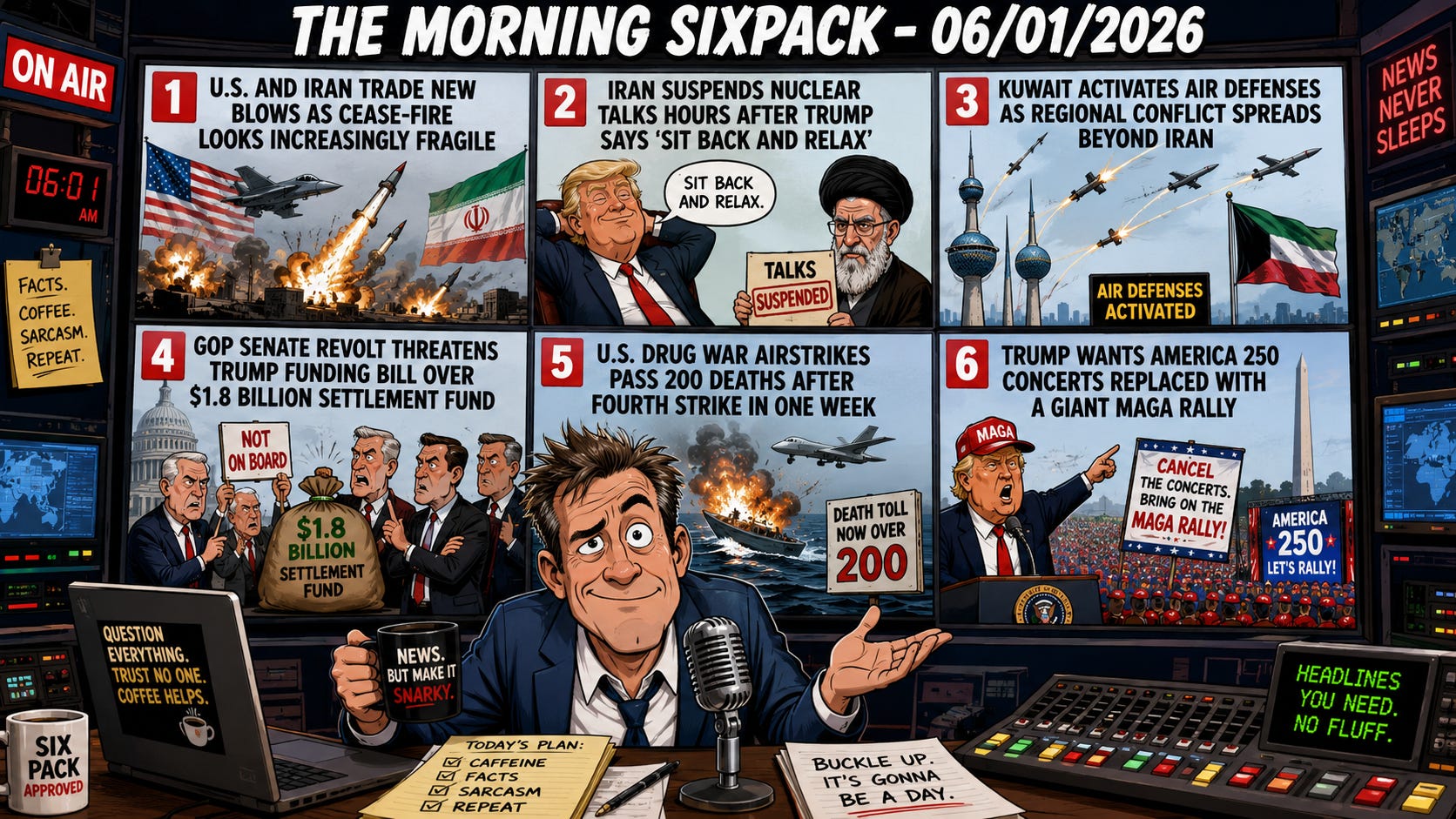
Each new strike may be “measured,” but the risk of a bigger conflict keeps getting less theoretical.
U.S. and Iran Trade New Blows as Cease-Fire Looks Increasingly Fragile
The United States and Iran exchanged fresh military strikes over the weekend, with both sides claiming successful attacks against military targets as tensions continue to rise despite an existing cease-fire.
U.S. Central Command said it carried out strikes against Iranian radar and command-and-control facilities in Goruk and on Qeshm Island after Iran allegedly shot down a U.S. drone operating in international waters. CENTCOM said American aircraft also destroyed air defenses, a ground control station, and two attack drones it viewed as threats to shipping in the region.
Iran’s Revolutionary Guards responded by claiming they struck the air base used by U.S. forces involved in an attack on a telecommunications tower on Sirik Island. The IRGC said its aerospace forces successfully hit their targets and warned that any future retaliation would bring a response that would be “completely different.”
Adding to the uncertainty, Kuwait’s military reported that its air defense systems responded to incoming missile and drone threats. It’s not yet clear whether those attacks were directly connected to the latest U.S.-Iran exchange, but the development underscores how quickly regional tensions can spread beyond the immediate combatants.
A key concern is that neither side appears to want a full-scale war, yet both continue taking actions that increase the odds of one. As Atlantic Council analyst Danny Citrinowicz put it: “In other words, the greatest danger may not be a deliberate decision to go to war, but a gradual escalation driven by recurring incidents in an increasingly volatile environment.”
Source: UPI
Editor: When both sides insist they’re avoiding a wider war while regularly launching missiles and airstrikes, that’s less a strategy and more a gamble that nobody miscalculates. History isn’t exactly loaded with success stories on that front.
The diplomatic breakdown came almost immediately after Trump publicly assured Americans that everything was under control.
Iran Suspends Nuclear Talks Hours After Trump Says ‘Sit Back and Relax’
Iran has reportedly halted nuclear negotiations with the United States, delivering a major setback to President Donald Trump’s push for a new agreement in the Middle East.
According to Iran’s semi-official Tasnim news agency, Tehran has suspended “talks and exchanges of texts through mediators” because of Israel’s continuing military operations in Lebanon. Iranian officials reportedly insist that developments in Lebanon must be addressed before negotiations can move forward.
The report also claimed that Iran and its regional allies have revived discussion of a possible “complete closure of the Strait of Hormuz,” one of the world’s most critical oil shipping routes. Any serious threat to the waterway would likely send energy markets into another round of turbulence and raise concerns throughout the region.
The news landed just hours after Trump took to Truth Social to defend his negotiating strategy and criticize opponents. “Just sit back and relax,” Trump wrote, arguing that Democrats and some Republicans were undermining talks through public criticism. The timing couldn’t have been much worse for the White House.
Complicating matters further, several prominent Republican senators—including Roger Wicker, Lindsey Graham and Ted Cruz—have already voiced concerns that the emerging agreement resembles the Obama-era nuclear deal Trump famously abandoned during his first term. Critics on the right argue the proposed framework gives away too much while leaving major questions about Iran’s nuclear ambitions unresolved.
Source: Raw Story
Editor: Foreign policy is difficult enough when your adversaries are cooperating. It’s even harder when they respond to “everything’s fine” by walking away from the table entirely. Timing remains undefeated.
Kuwaiti air defense systems were activated while U.S. forces reportedly intercepted missiles targeting American personnel stationed in the country.
Kuwait Activates Air Defenses as Regional Conflict Spreads Beyond Iran
Kuwait found itself on heightened alert as missile and drone threats spread beyond the immediate U.S.-Iran confrontation.
According to reports, Kuwait activated its defensive systems after missile and drone threats emerged during the latest round of hostilities between the United States and Iran. U.S. military officials later said American forces intercepted two Iranian ballistic missiles aimed at U.S. personnel based in Kuwait.
The incident marked a significant escalation because it expanded the geographic footprint of the conflict beyond direct exchanges between Washington and Tehran. Regional governments are increasingly concerned that even limited confrontations could spill across borders and drag neighboring countries deeper into the crisis.
The heightened alert comes as diplomatic efforts continue to prevent a broader regional war. However, each new exchange raises concerns about miscalculation and the possibility that additional countries could become entangled in a conflict neither side officially claims to want.
For Gulf nations that have spent years balancing security concerns with economic stability, the prospect of missile and drone attacks reaching their territory is a reminder that regional conflicts rarely stay contained for long.
Source: Reuters
Editor: The fastest way for a regional conflict to become everyone’s problem is for missiles and drones to start crossing more borders.
When members of your own party start calling something “self-dealing,” the political warning lights are flashing bright red.
GOP Senate Revolt Threatens Trump Funding Bill Over $1.8 Billion Settlement Fund
A growing rebellion among Senate Republicans has stalled a key Trump administration funding bill as lawmakers demand limits on a controversial $1.776 billion settlement fund.
The standoff centers on a Homeland Security funding package designed to support immigration enforcement agencies through the remainder of President Trump’s term. Senate Republicans say they lack the votes to move forward until the White House agrees to place restrictions on a settlement fund created through Trump’s lawsuit against the IRS over leaked tax returns.
Republican senators are particularly concerned that individuals involved in the January 6 Capitol riot could potentially qualify for payouts. While Acting Attorney General Todd Blanche reportedly assured lawmakers that violent offenders would not receive money, he has declined to publicly establish firm eligibility limits, telling reporters there is “no limit to who can apply.”
The dispute has exposed unusual fractures inside the GOP conference. According to Senator Ted Cruz, a closed-door meeting with Blanche became heated, with roughly half of the Republican senators present criticizing the administration’s handling of the fund. Cruz said some senators argued the arrangement “feels like self-dealing” and “feels like Trump cut a deal with himself.”
Democrats are preparing to force votes aimed at eliminating the fund entirely. Senate Minority Leader Chuck Schumer has labeled it a slush fund, while Michigan Senator Gary Peters called it “probably one of the most corrupt things that we’ve ever seen an American president do.” The controversy follows an earlier fight that led Republicans to drop $1 billion in proposed White House security spending, including funding for Trump’s planned ballroom project.
The larger irony is that Republicans broadly agree on funding Immigration and Customs Enforcement and Border Patrol operations. But a side battle over who might receive settlement money has become the obstacle threatening the entire package.
Source: Associated Press
Editor: Nothing unites Washington quite like immigration politics—until someone attaches a billion-dollar settlement fund and everyone suddenly starts checking the fine print.
What began as a crackdown has evolved into a sustained military operation with airstrikes becoming a regular tool of drug enforcement.
U.S. Drug War Airstrikes Pass 200 Deaths After Fourth Strike in One Week
The U.S. military says it killed three more suspected drug traffickers Saturday, pushing the death toll from its anti-cartel strike campaign to 205.
According to U.S. Southern Command, the latest strike targeted a vessel in the eastern Pacific Ocean that military officials said was involved in narcotics trafficking and operated by a designated terrorist organization. The military released video showing the small boat being destroyed in a fireball after being struck.
The attack was the fourth announced strike in a single week and the latest in a campaign that began in September. The Trump administration has argued that Latin American drug cartels represent a national security threat and has formally characterized the fight against them as an armed conflict rather than a traditional law enforcement challenge.
Notably, the military provided no public evidence supporting its claim that the vessel was engaged in drug trafficking or linked to a terrorist organization. U.S. Southern Command’s announcement relied on standard language that has accompanied previous strike reports throughout the campaign.
The operation was carried out under the direction of Gen. Francis L. Donovan, the top U.S. military commander for Latin America. With 205 reported fatalities since the campaign began, the scale of the operation now rivals some military counterterrorism missions conducted overseas.
Questions are likely to intensify as the casualty count rises and the administration continues to expand military involvement in what has traditionally been handled through interdiction, arrests, and international law enforcement cooperation.
Source: NPR
Editor: When a drug war starts generating battlefield-style body counts and missile-strike videos, it’s fair to ask whether the mission is still law enforcement—or something entirely different.
When performers start leaving the stage, Trump's answer is simple: become the show.
Trump Wants America 250 Concerts Replaced With a Giant MAGA Rally
President Donald Trump is calling for the cancellation of the struggling Freedom 250 concert series and wants to replace it with a massive MAGA rally headlined by himself.
The idea emerged after a growing list of artists backed out of the Freedom 250 concert series planned for Washington around the July 4 holiday. Several performers reportedly expressed concerns that what was presented as a patriotic celebration had become increasingly political.
Trump responded on Truth Social by dismissing the remaining entertainment lineup and suggesting that the country’s 250th birthday would be better celebrated with what he described as the world’s biggest attraction: himself. “We should have a giant MAKE AMERICA GREAT AGAIN RALLY, for 250, instead of having overpriced singers, who nobody wants to hear,” Trump wrote before concluding with a blunt directive: “Cancel it.”
The president also floated an “AMERICA IS BACK Rally” on the National Mall, saying he would deliver a speech designed to rally the nation forward. Earlier in the week, Trump joked that he attracts larger crowds than “Elvis in his prime” and referred to himself as “THE GOAT” while discussing alternatives to the concert series.
The artist exodus has become a headache for organizers. Country star Martina McBride and rocker Bret Michaels were among the latest performers to withdraw. Michaels explained his decision by saying the event had evolved into “something much more divisive than what I agreed to be a part of.”
Trump has already put his personal stamp on the semiquincentennial celebrations. Plans include a mixed martial arts event on the White House lawn on June 14—his 80th birthday—while the concert series continues to struggle to hold onto performers. The remaining lineup, which includes acts such as Vanilla Ice and C+C Music Factory, has become a frequent target of social media mockery.
Source: Yahoo News / AFP
Editor: It’s not every day a national birthday party loses so many musicians that the backup plan becomes a political rally starring the guest of honor. Then again, this isn’t exactly a normal presidency.