


The Morning Sixpack stays free because the news that shapes your life should not be hidden behind a paywall. Paid subscribers are not paying for access. They are helping fund the research, writing, and independent voice that goes into every issue. Become a paid subscriber and help keep smart, honest news analysis free for everyone.
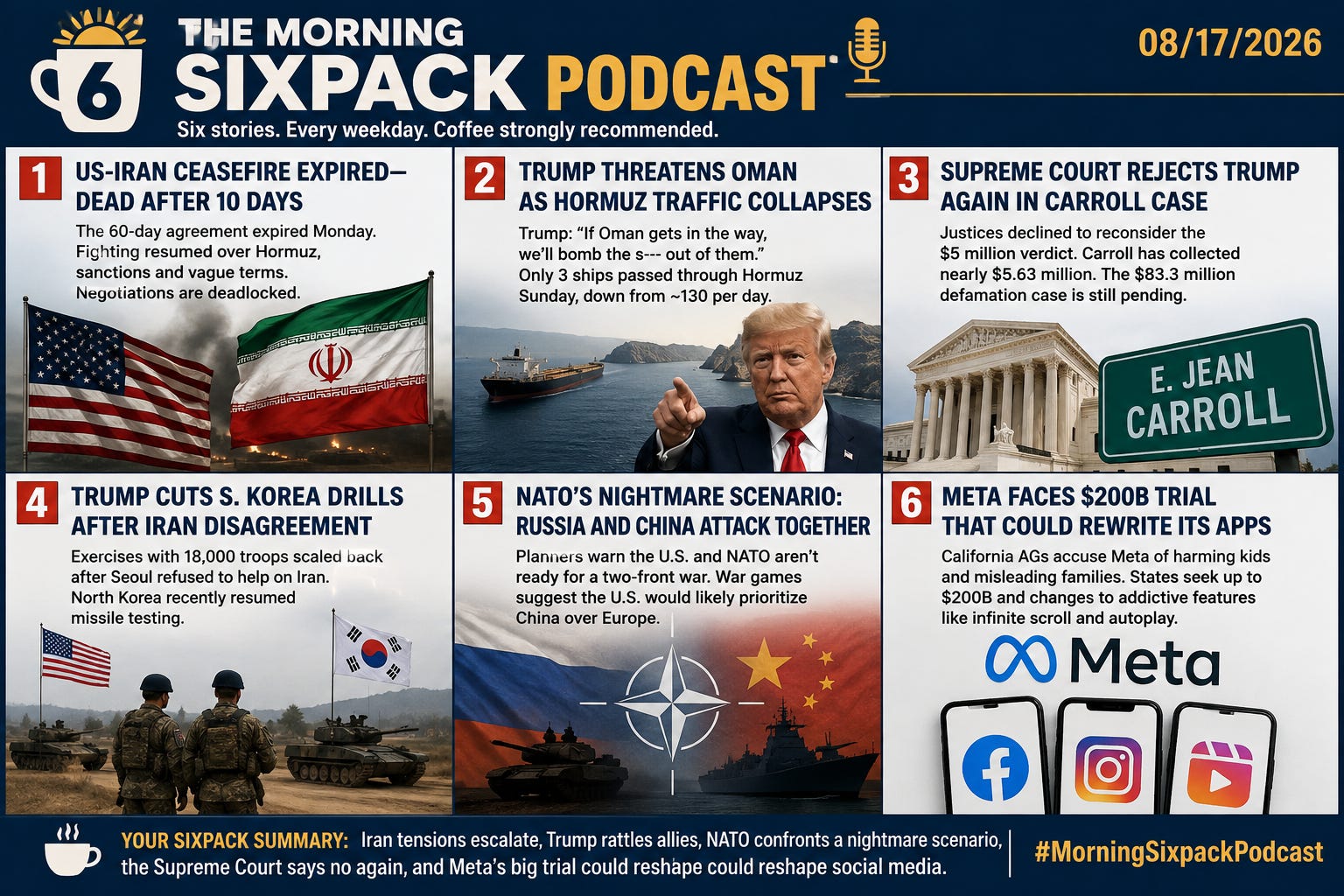
The US-Iran peace deal made it 60 days on paper, but renewed strikes, a fight over Hormuz and some spectacularly fuzzy diplomacy killed it almost immediately.
The US-Iran Ceasefire Just Expired—But It Was Basically Dead 10 Days After It Began
The 60-day US-Iran Memorandum of Understanding expired Monday with negotiations deadlocked and both countries accusing the other of wrecking a ceasefire that barely survived its first two weeks. Brokered by Pakistan and signed June 17, the 14-point agreement was supposed to halt military operations, reopen the Strait of Hormuz and create a runway toward a broader peace deal. Instead, it became a pretty good demonstration of what happens when enormously consequential agreements leave enormously consequential questions unanswered.
Ten days after signing a deal to stop fighting, the United States and Iran were trading strikes again.
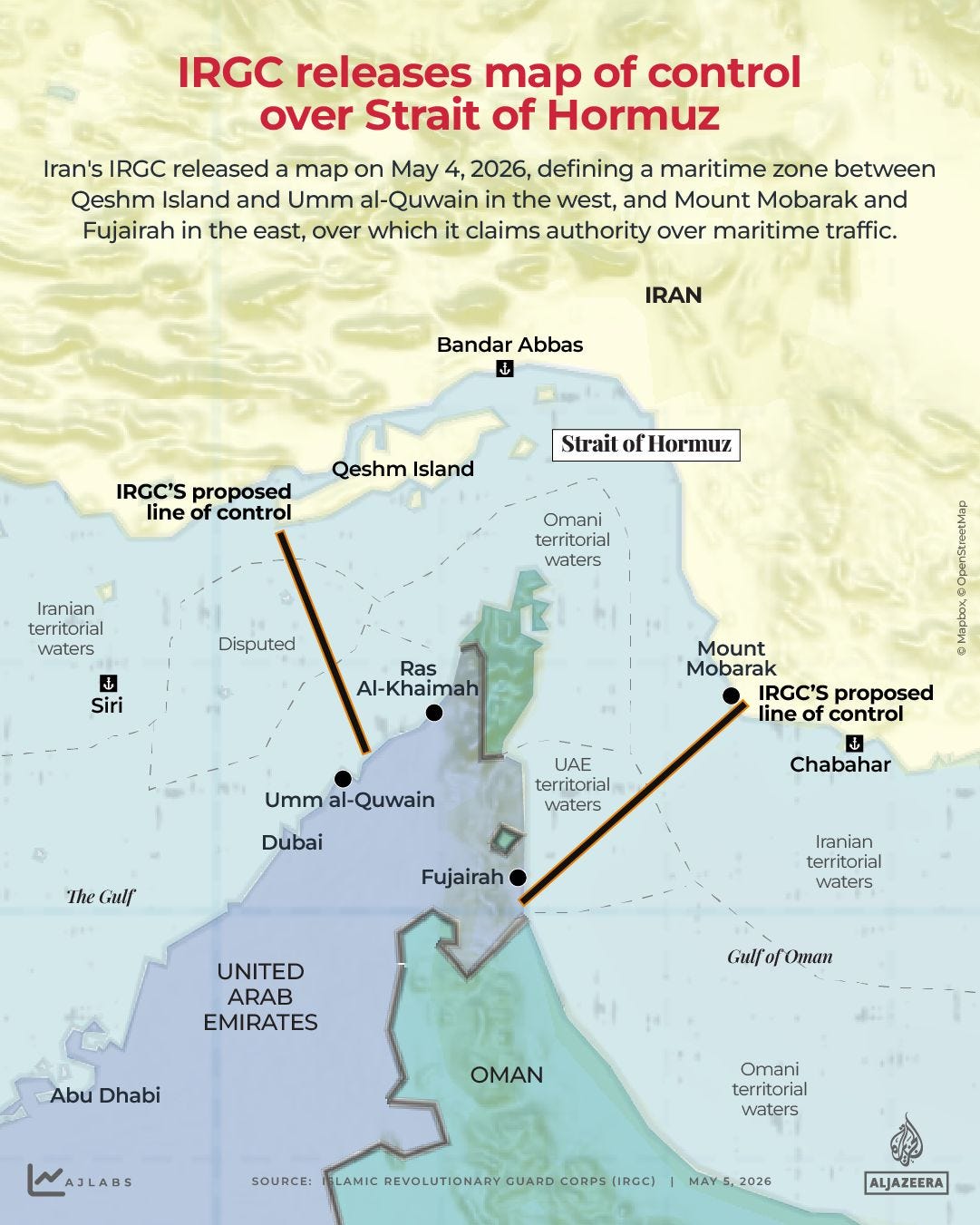
The biggest problem was the Strait of Hormuz. Article 5 promised safe passage for commercial vessels but left enough ambiguity over routes and control for Washington and Tehran to reach very different conclusions. After ships using an Oman-backed route were targeted, the US resumed strikes against Iranian military sites. Iran retaliated against US installations in the region. Former State Department official Joey Hood put it plainly: the agreement “was doomed to fail” because “it was very poorly written and it gave Iran the chance to interpret the MoU as giving it sovereignty over the Strait of Hormuz and the future of Lebanon.”
The ambiguity didn’t stop at Hormuz. The agreement called for an “immediate and permanent termination of military operations on all fronts, including in Lebanon,” yet Israel wasn’t explicitly named even as its operations there continued. Another provision envisioned at least $300 billion for Iran’s reconstruction and development without specifying who would actually provide the money. Even the promised sanctions relief left unanswered whether it covered only US sanctions or UN measures as well. That’s less a peace agreement than a very expensive group project where nobody checked who was responsible for which slides.
By July 7, President Donald Trump was calling the agreement “over.” Iran subsequently said it had suspended its commitments after accusing Washington of violating the deal, and direct negotiations have since stalled. Iranian Foreign Ministry spokesman Esmaeil Baghaei said the original deadline was now “entirely moot,” while Hood said there was “no sign” the MoU would be revived with both sides having “locked horns.” The document may have officially expired Monday, but the real question is whether its wreckage can provide enough of a framework for another attempt—or whether Hormuz becomes the fuse for the next escalation.
Editor: Sixty days to negotiate peace sounded ambitious. Making it ten days before swapping missiles again suggests somebody should’ve spent a few more hours negotiating the ceasefire.
Source: Al Jazeera
Trump says America isn’t in a hurry for an Iran deal, but threatening to bomb Oman while one of the world’s most important shipping lanes is nearly frozen certainly adds some pep to the diplomacy.
Trump Threatens to Bomb Oman as the US-Iran Ceasefire Runs Out
President Donald Trump threatened Monday to “bomb” Oman if the Gulf nation interferes with US objectives, escalating the rhetoric just as Washington’s 60-day ceasefire arrangement with Iran expires without a negotiated settlement. Oman, meanwhile, has been talking with Tehran about reopening the Strait of Hormuz to commercial shipping while the United States maintains its blockade of Iranian ports.
“If Oman gets in the way, we’ll bomb the s--- out of them.”
Trump made the threat during an interview with Fox News in which he also claimed informal discussions were taking place with Iran’s Revolutionary Guard. Iran denies that direct negotiations with Washington are happening. “They’re good poker players, but they’re dying,” Trump said of the IRGC. “I have no time schedule. I’m not in a hurry.” Iranian Foreign Minister Abbas Araghchi offered a much different description, saying, “No negotiations have been held between the United States and us at this time.” Qatar and Pakistan, he said, are exchanging messages between the parties—but that doesn’t constitute negotiations.
All of this is happening while traffic through the Strait of Hormuz is collapsing. According to Kpler data cited by CNBC, only three ships passed through the critical energy corridor Sunday, compared with roughly 130 vessels per day before the war began Feb. 28. The five-day average has fallen to just 12 transits. Iran’s deputy foreign minister Kazem Gharibabadi has also insisted the strait will remain “Iranian” and will be opened or closed “under Iran’s command.” That’s a fairly consequential argument considering how much of the world’s energy supply normally travels through those waters.
Trump separately reiterated that preventing Iran from obtaining a nuclear weapon remains Washington’s central objective. “The number one Goal is, and always will be, that Iran cannot have, in any way, shape, or form, a Nuclear Weapon,” he wrote on Truth Social. But with the ceasefire period expiring, US-Iran negotiations stalled, Hormuz nearly shut down and now Oman receiving a presidential bombing threat, the diplomatic off-ramp isn’t exactly getting wider.
Editor: Nothing helps convince a regional mediator to keep mediating quite like publicly putting it on the potential bombing list. Diplomacy apparently comes with an air-strike footnote now.
Source: CNBC
The Supreme Court has now turned Trump away twice on the $5 million E. Jean Carroll verdict, leaving the judgment—and the money Carroll already collected—firmly in place.
Supreme Court Rejects Trump Again in E. Jean Carroll $5 Million Case
The U.S. Supreme Court on Monday declined for a second time to hear President Donald Trump’s challenge to the $5 million verdict finding him liable for sexually abusing and defaming writer E. Jean Carroll. The justices rejected Trump’s request to reconsider their June decision refusing his appeal, leaving intact the 2023 civil jury verdict against the sitting president.
Trump has already paid Carroll nearly $5.63 million—the original judgment plus interest.
The case stems from Carroll’s allegation that Trump attacked her in a Bergdorf Goodman dressing room in Manhattan in the 1990s. After Carroll publicly accused him, Trump repeatedly denied the allegations and attacked her credibility. The case resulting in the $5 million judgment focused on statements Trump made in 2022, including calling Carroll’s accusation a “hoax” and a “con job.” A jury in 2023 found Trump liable for sexual abuse and defamation, though it did not find him liable for rape under the specific legal standard presented to jurors.
There’s still considerably more money hanging over this legal fight. The Supreme Court is separately considering whether to hear Trump’s appeal of an $83.3 million defamation judgment Carroll won in 2024 over statements Trump made while president in 2019. Trump’s lawyers argue presidential immunity protects him from those claims and that lower courts improperly concluded he had forfeited that defense. Their rehearing request argued that the immunity question in the $83.3 million case could also affect the earlier $5 million judgment.
The Supreme Court’s landmark 2024 presidential-immunity ruling gave former presidents substantial protection from criminal prosecution for certain official acts, but Carroll’s cases are civil lawsuits. For now, the smaller of Trump’s two Carroll judgments is effectively settled: the Supreme Court wouldn’t hear his appeal in June, wouldn’t reconsider that decision Monday, and Carroll already has the money. The remaining $83.3 million question is the one worth watching.
Editor: When the Supreme Court says no, asking it to reconsider the no is certainly an option. Getting another no, however, tends to clarify the situation.
Source: Reuters
Trump is scaling back major U.S.-South Korea military exercises after Seoul declined to join his Iran strategy, while praising Kim Jong Un as “unthreatening and respectful.”
Trump Orders South Korea Military Drills Cut After Seoul Says No on Iran
President Donald Trump ordered the Pentagon to substantially reduce planned joint military exercises with South Korea, tying the decision to Seoul’s refusal to help Washington denuclearize Iran and his relationship with North Korean leader Kim Jong Un. The 11-day Ulchi Freedom Shield exercises were set to involve 18,000 South Korean troops and were designed to strengthen readiness against threats from North Korea.
Trump is dialing back exercises meant to deter North Korea just days after North Korea resumed ballistic missile testing.
Trump said the exercises were too expensive and “send a signal that is totally inappropriate and hostile” toward North Korea, which he described as having been “unthreatening and respectful” during his presidency. He also offered another reason: “I recently asked the President of South Korea if they would join us in Denuclearizing Iran, and they said, ‘No thanks!’” Trump wrote. “Therefore, and based on the fact that it is too late to cancel, I have instructed Secretary of War, Pete Hegseth, to substantially reduce the Joint Military Exercises!”
The order lands in the middle of a familiar cycle on the Korean Peninsula. North Korea threatened “stern” measures ahead of the exercises, calling them “a rehearsal for an aggressive war.” At the same time, Pyongyang recently resumed ballistic missile launches prohibited by the United Nations. U.S. and South Korean forces had been preparing exercises including live-fire training, precision targeting, maneuver operations and moving prepositioned military equipment. The U.S. military has called the alliance a “linchpin for regional peace and security” and described Washington’s commitment to South Korea as “ironclad.”
Trump has been here before. After meeting Kim in Singapore in 2018, he unexpectedly announced plans to stop what he called “war games,” arguing they were provocative and expensive. Trump met Kim three times during his first term, and since returning to office has repeatedly signaled interest in renewing their diplomacy. A day before announcing the latest reduction, Trump posted a photo of himself with Kim and said the two leaders “get along great.” So Washington’s Korea policy is once again getting the Trump treatment: less military signaling toward Kim, more emphasis on the personal relationship—and this time, an Iran dispute with Seoul thrown into the equation.
Editor: Punishing an ally’s refusal to help with Iran by reducing exercises designed to deter its nuclear-armed neighbor is certainly one way to connect two foreign-policy problems that were doing just fine being separate.
Source: PBS NewsHour
Western planners have spent years worrying about Russia and China separately; the nightmare is discovering they coordinated their calendars while NATO was still scheduling meetings.
NATO’s Nightmare Scenario: Russia and China Attack at the Same Time
Western military planners acknowledge the U.S. and NATO are not adequately prepared for a nightmare scenario in which Russia attacks Europe while China simultaneously moves against Taiwan, forcing America to fight two major wars at once. Add the ongoing U.S. war with Iran, depleted weapons stockpiles and strained relations with European allies, and a once-theoretical scenario suddenly looks considerably less theoretical.
“Let’s just say this is the scenario we’re currently not ready for.”
That assessment comes from Florence Gaub of the NATO Defense College, who told The Atlantic that strategists know about the planning gap but haven’t done enough to close it. Retired Rear Admiral Mark Montgomery said the last major exercises he participated in examining a two-front Russia-China conflict happened roughly 15 years ago—and “It didn’t go well.” The U.S. lacked sufficient weapons stockpiles and industrial capacity then, he said, and allies couldn’t adequately compensate. His assessment of what’s happened since is even less comforting: “Every one of those metrics has gone down. None of them has gotten better.”
Russia and China, meanwhile, haven’t been sitting around waiting for NATO’s PowerPoint presentation. Russia has shifted much of its industrial base toward wartime production and gained extensive battlefield experience with drones in Ukraine. China has surpassed the U.S. in the number of warships and long-range missiles in its arsenal, while Beijing and Moscow have deepened military cooperation under their “no-limits” partnership. The Atlantic reports that roughly two-thirds of America’s advanced air-defense missile arsenal has been depleted since February as U.S. resources have shifted toward the Middle East. Former NATO Military Committee chair Admiral Rob Bauer said a Russian move against NATO could become especially dangerous if timed with a Chinese attack on Taiwan: “What are we going to do? Who’s getting which troops?”
War games conducted by Prague’s European Values Center for Security Policy offer one especially ugly answer. Across roughly 20 simulations of simultaneous conflicts in Europe and Asia, the U.S. generally prioritized China and shifted resources toward Asia, leaving European NATO members with greater responsibility for stopping Russia themselves. Other scenarios exposed economic vulnerabilities, including Europe’s dependence on Chinese raw materials for defense manufacturing. The lesson isn’t that a coordinated Russia-China attack is inevitable. It’s that if it happens, alliance unity, weapons production and decisions about who gets scarce American military resources could matter before the shooting even starts. And apparently the West hasn’t spent nearly enough time rehearsing that exam.
Editor: Preparing separately for Russia and China works beautifully—as long as Russia and China promise to attack separately. Perhaps NATO should get that commitment in writing.
Source: The Atlantic
Meta's latest child-safety trial isn't just about another giant check—California could force changes to the algorithms and addictive features powering its advertising machine.
Meta Faces a California Trial That Could Cost $200 Billion—and Rewrite Instagram
Meta heads to federal court in California Tuesday facing a coalition of 29 state attorneys general seeking potentially hundreds of billions of dollars and fundamental changes to Facebook and Instagram over allegations the platforms harmed children and teens. Lawyers for the states have suggested damages could reach roughly $200 billion, while Meta’s attorneys have previously warned the theoretical exposure could climb as high as $1.4 trillion. When lawyers start debating whether the number has 11 zeroes or 12, you’ve officially left parking-ticket territory.
But the biggest threat to Meta may not be the money—it could be a court order forcing the company to change how Facebook and Instagram actually work.
The states accuse Meta of designing products that foster addictive behavior among young users, misleading families about safety and violating laws including the Children’s Online Privacy Protection Act. California Attorney General Rob Bonta says Meta “designed a dangerous product for young users, knew it to be dangerous, and then lied to children, families, and the community about how dangerous it was.” Meta calls the remaining claims “unsubstantiated” and says the states’ financial demands are “vastly disproportionate.” The company also argues that officials are attempting to punish it for industry-wide problems such as age verification.
The case follows Meta’s major defeat in New Mexico, where a jury ordered $375 million in damages and a judge subsequently required another $567 million for an abatement fund. California could go considerably further. The states are seeking nationwide injunctive relief that could require Meta to delete personal data collected from children under 13—and potentially delete “algorithms and models” trained using that information. They also want changes to features they describe as addictive, including infinite scroll, autoplay, disappearing content, beauty filters and engagement-optimized recommendation algorithms.
That’s where this trial starts looking less like another corporate lawsuit and more like a potential business-model problem. Meta generates roughly 98% of its revenue from advertising, and CEO Mark Zuckerberg is relying on that cash machine to finance an AI push that could cost as much as $145 billion this year. New Mexico Attorney General Raúl Torrez thinks Wall Street hasn’t fully absorbed the risk: “The analysts aren’t pricing this correctly right now.” He added that a California judgment “could be gargantuan enough that it changes the ability of this company to do what it needs to finance into the future.” The jury may ultimately decide far more than what Meta owes—it could help determine what Instagram and Facebook are allowed to become.
Editor: A $200 billion judgment would get anyone’s attention. Telling Silicon Valley it may have to redesign the engagement machine instead of simply writing a check? Now you’ve made it personal.
Source: CNBC