


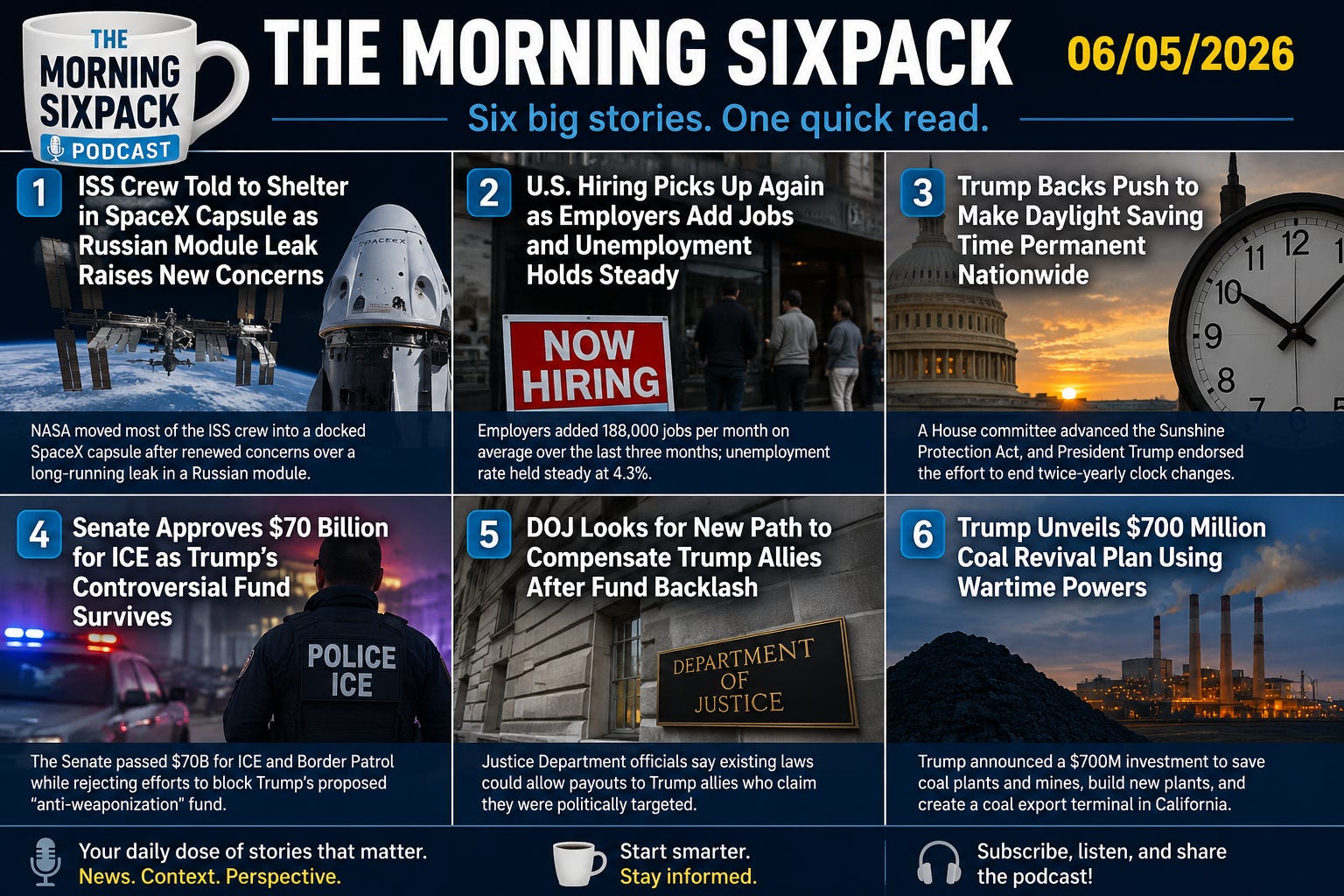
NASA just had astronauts pile into their SpaceX lifeboat because a six-year-old air leak problem in a Russian station module still isn’t fully fixed—apparently duct tape has limits in orbit.
ISS Crew Told to Shelter in SpaceX Capsule as Russian Module Leak Raises New Concerns
NASA briefly ordered most of the International Space Station crew into a docked SpaceX Crew Dragon as a precaution while engineers evaluated renewed concerns about a long-running air leak in a Russian transfer tunnel.
The issue centers on cracks in a transfer tunnel attached to the Russian segment of the station. Those cracks have been linked to a slow air leak that has appeared on and off for roughly six years and remains one of the station’s most closely watched safety concerns.
The precaution came after Russian space agency Roscosmos detected a gradual pressure drop following the arrival of a cargo spacecraft last month. NASA initially expected Russian teams to carry out a more extensive repair effort Friday before plans shifted to gathering additional measurements instead.
“The cracks have always been a concern that NASA watches very closely,” NASA said. Once Russian officials opted to focus on measurements rather than repairs, Mission Control cleared the crew to leave the safe-haven configuration and resume normal operations.
NASA says it will continue working with Roscosmos and other international partners to identify the root cause and find a lasting solution. For now, the station remains operational, but the episode underscores how even a seemingly minor leak can command immediate attention 250 miles above Earth.
Source: CBS News report
Editor: Nothing inspires confidence quite like discovering that a “top safety risk” has been hanging around the space station for six years. At this point, that leak has been on the job longer than some mission managers.
The job market keeps chugging along despite inflation, higher rates, and enough economic uncertainty to keep cable news producers fully employed.
U.S. Hiring Picks Up Again as Employers Add Jobs and Unemployment Holds Steady
American employers added jobs for a third straight month in May, signaling that the labor market is finding its footing after a sluggish stretch last year.
According to the Labor Department, employers added an average of 188,000 jobs per month over the last three months, with March and April job totals revised higher. Restaurants and bars led the way with 48,000 new positions as summer hiring ramped up, while construction firms, local governments, and healthcare providers also expanded payrolls.
Healthcare remained a reliable engine of growth, adding another 35,000 jobs in May. Not every industry joined the party, however. Banks and insurance companies reduced staffing, helping drive a loss of 22,000 jobs across the broader financial sector.
The labor force also expanded modestly, with 83,000 people either finding work or beginning a job search. Despite that increase, the unemployment rate remained unchanged at 4.3%, suggesting the market is absorbing new workers without significant deterioration.
The catch is wages. Average pay rose just 3.4% from a year earlier, while inflation has been running higher. With hiring stabilizing but prices still elevated, the Federal Reserve—now led by Chair Kevin Warsh—is expected to remain focused on inflation rather than cutting interest rates, despite pressure from the White House. Next week’s inflation report could provide another important clue about where monetary policy heads from here.
Source: NPR report
Editor: The economy added jobs, unemployment stayed put, yet wages are still losing ground to inflation. In other words, the labor market passed the test, but workers are still waiting for the raise that makes the math work. I mean, it could be worse—we could be shedding jobs like in Trump’s last term :)
Congress may finally be ready to stop the twice-a-year clock ritual, though lawmakers are still arguing whether Americans want more evening sunlight or sunrise before lunch.
Trump Backs Push to Make Daylight Saving Time Permanent Nationwide
A House committee has advanced legislation that would make daylight saving time permanent, giving new momentum to a debate that has frustrated Americans for decades.
With President Trump now publicly backing the effort, the Sunshine Protection Act has its best chance in years of becoming more than another clock-changing conversation.
The House Energy and Commerce Committee approved the measure by a 48-1 vote, sending it to the full House for consideration. The proposal would effectively end the twice-yearly clock changes by keeping the nation on daylight saving time year-round, while allowing states to opt out if they choose.
The legislation has been championed for years by Florida Republican Rep. Vern Buchanan, who argues that the current system is outdated and disruptive. “The biannual clock change is inconvenient, unnecessary, and out of step with the needs of today’s families and economy,” Buchanan said. “Permanent Daylight Saving Time will provide Americans with greater stability and more usable daylight hours throughout the year.”
Trump endorsed the bill following its committee approval, saying, “I am going to work very hard to see The Sunshine Protection Act signed into Law. It’s time that people can stop worrying about the ‘Clock,’ not to mention all of the work and money that is spent on this ridiculous, twice yearly production.”
The proposal still faces hurdles. It must clear the full House and then win approval in the Senate, where similar efforts have stalled before. Critics, including Arkansas Sen. Tom Cotton, argue that permanent daylight saving time would create extremely late winter sunrises, leaving many children heading to school in darkness.
The debate has also divided sleep experts. While many Americans dislike changing clocks twice a year, some researchers argue that permanent standard time—not permanent daylight saving time—is more closely aligned with the body’s natural circadian rhythm.
Source: KCRA report
Editor: Washington has spent years proving it can’t agree on much. If lawmakers finally unite around stopping the clock changes, it may be the first time Congress literally saves time instead of wasting it.
Personally, I think Congress—if it really wants to boost worker productivity—should outlaw nights.
Congress just approved another $70 billion for immigration enforcement while refusing to permanently kill a controversial compensation fund that even some Republicans wanted gone.
Senate Approves $70 Billion for ICE as Trump’s Controversial Confederate Fund Survives
The Senate handed President Trump a major immigration victory Friday, approving $70 billion in new funding for ICE and Border Patrol while rejecting efforts to permanently block his proposed “anti-weaponization” fund.
Lawmakers found bipartisan reasons to worry about the fund, but not enough votes to eliminate it.
The measure passed 52-47, with no Democratic support and only one Republican—Alaska Sen. Lisa Murkowski—voting against it. The bill now heads to the House, where lawmakers are expected to take it up next week. The funding would support the administration’s immigration enforcement and deportation operations over the next three years.
A significant portion of the debate centered not on immigration but on a proposed $1.8 billion “anti-weaponization” fund. Critics argue the fund could be used to compensate Trump allies who claim they were unfairly targeted by the government. Democrats repeatedly tried to eliminate the fund, while several Republicans expressed concerns about its political and legal implications.
Senate Majority Leader John Thune argued the issue had effectively been resolved after acting Attorney General Todd Blanche testified that the Justice Department would not move forward with the program. Democrats countered that a verbal assurance was not the same as a statutory prohibition. Meanwhile, Trump publicly continued praising the concept, saying, “I love it. I think it’s so important.”
The vote exposed some unease within Republican ranks ahead of the midterm elections. Several GOP senators backed amendments to either eliminate or repurpose the fund, but every effort failed. Even lawmakers who voiced concerns ultimately voted for the broader immigration package.
The battle now shifts to the House, where the immigration funding is likely to receive a warmer reception than the lingering controversy over the anti-weaponization fund. For Trump, it marks another step forward in his effort to expand immigration enforcement. For critics, it leaves unanswered questions about a program that many lawmakers seemed uncomfortable defending but unwilling to kill.
Source: CNBC report
Editor: Washington’s latest specialty is opposing something in speeches, warning about it in interviews, proposing amendments to stop it—and then voting for the bill anyway. Apparently, that’s what bipartisan concern looks like in 2026.
The White House may have shelved its controversial “anti-weaponization” fund, but the Justice Department appears to be looking for another route to get money into the hands of Trump allies who claim they were politically targeted.
DOJ Looks for New Path to Compensate Trump Allies After Fund Backlash
The Trump administration’s proposed $1.776 billion “anti-weaponization” fund may be on life support, but Justice Department officials are signaling that payouts could still happen through existing legal channels.
Editor: Congress may have blocked the front door, but the administration is now testing the side entrance.
According to a Wall Street Journal report, Justice Department officials have emphasized that they already possess authority to settle claims against the federal government through the decades-old Federal Tort Claims Act. That law allows individuals to seek compensation for damages caused by wrongful government actions or negligence.
The shift comes after intense political pressure forced the administration to retreat from the original fund, which had drawn criticism from both Democrats and Republicans. Acting Attorney General Todd Blanche told lawmakers this week that the Justice Department would not move forward with the fund, although President Trump later stopped short of declaring it dead, saying, “I love it. I think it’s so important.”
A growing number of Trump supporters are already preparing lawsuits. Nine pardoned Jan. 6 defendants recently filed claims arguing they were victims of politically motivated prosecutions. Others are expected to follow, potentially seeking compensation through the courts rather than through a dedicated government fund. One Trump ally, Michael Caputo, had already filed a $2.7 million claim under the now-scrapped program.
The administration also has precedent on its side. Earlier this year, the Justice Department agreed to pay former National Security Adviser Michael Flynn $1.25 million to resolve claims tied to his prosecution. Similar settlements have been reached in other politically charged cases, suggesting the government may have broad discretion to negotiate payouts if it chooses.
Legal experts note that such claims are often difficult to win. The difference this time is that plaintiffs may be facing an administration that is sympathetic to their arguments rather than aggressively contesting them. As one law professor told the Journal, the plaintiffs’ attorneys may be “pushing on an open door.”
Source: The Wall Street Journal report (gift)
Editor: Washington’s favorite magic trick is declaring a program dead while quietly searching the statute books for another way to accomplish the same thing. If the fund disappears but the checks still get written, voters may decide the obituary was a little premature.
That we’re still talking about coal in 2026 is pathetic.
Trump Unveils $700 Million Coal Revival Plan Using Wartime Powers
President Trump announced a $700 million federal investment aimed at reviving the U.S. coal industry, including new coal plants, mine support, and a major export terminal.
At a time when much of the world is moving away from coal, the White House is betting that energy security and rising power costs can bring it back.
Speaking at the White House, Trump said the initiative would use the Defense Production Act—a Cold War-era law that gives presidents broad authority to support industries deemed critical to national security. The administration argues that strengthening domestic energy production is essential as Americans face higher energy costs following the conflict with Iran.
“So today we’re taking historic action to bring down the price of energy and the cost of living for all Americans with the power of clean, beautiful coal,” Trump said.
According to the president, $500 million will be used to preserve 14 coal-fired power plants, support 42 coal mines, and construct a new coal export terminal in California. Another $200 million from the Department of Energy will help finance new coal plants in Alaska and West Virginia—the first new coal-fired plants built in the United States since 2013.
Trump said the Oakland export terminal alone could create more than 1,400 jobs, while the broader package would support roughly 14,000 jobs nationwide. The administration is framing the investment as both an energy-security initiative and an economic-development program for coal-producing regions.
The announcement marks one of the largest federal interventions in the coal sector in years and underscores the administration’s willingness to use emergency executive powers to advance its energy agenda. Whether the investment can reverse decades of coal’s decline remains an open question, but the White House is clearly signaling that it sees coal as part of America’s future energy mix.
Source: BBC News report
Editor: For years, coal has been the energy industry’s equivalent of a farewell tour that never quite ends. Now Washington is spending $700 million to book an encore and hoping the audience still remembers the lyrics.