


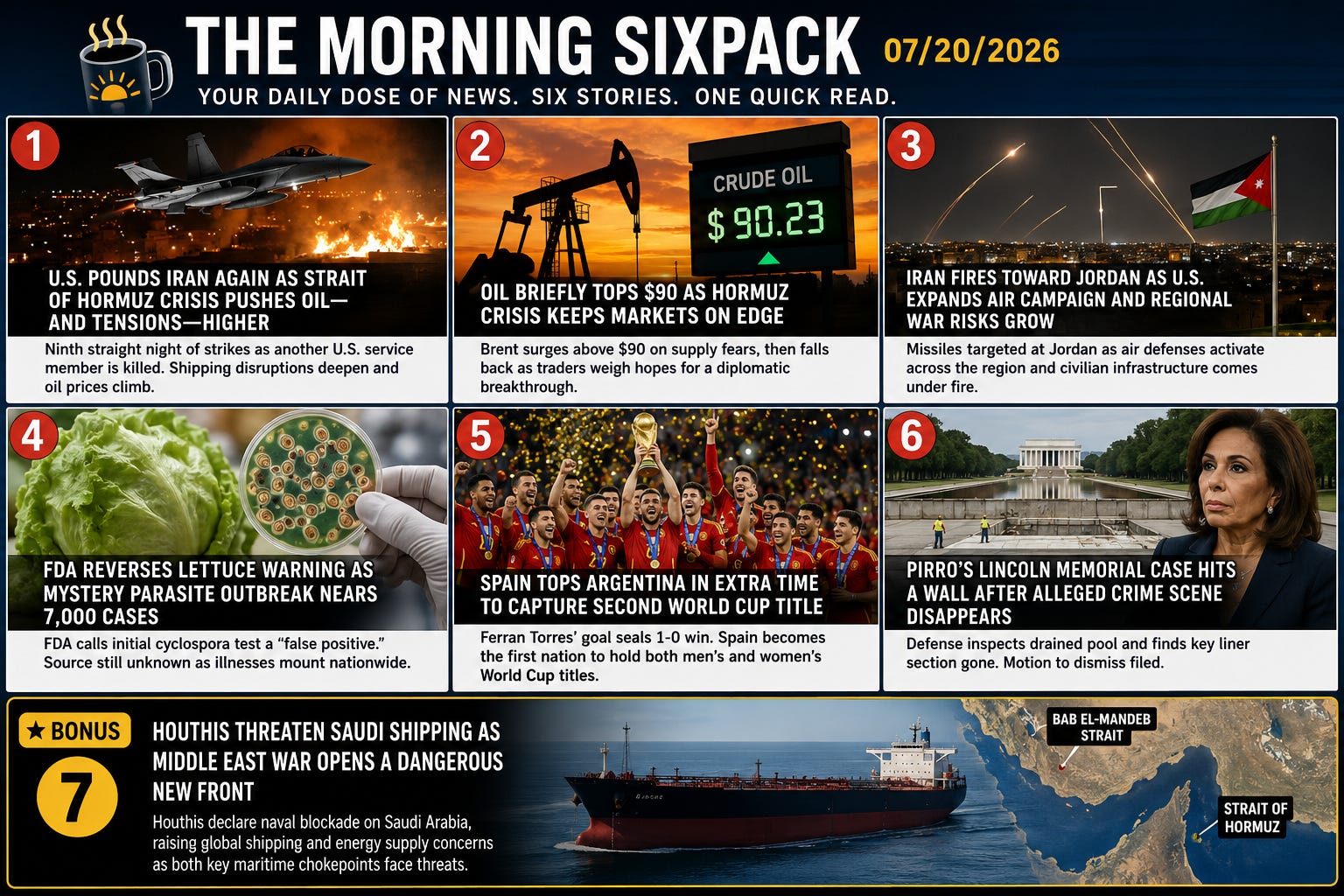
Washington and Tehran just took another step toward a wider war—and the price at the gas pump is already reminding everyone who ends up paying the bill.
U.S. Pounds Iran Again as Strait of Hormuz Crisis Pushes Oil—and Tensions—Higher
The U.S. launched a ninth straight night of airstrikes on Iran after another American service member was killed, while Tehran answered with missile attacks aimed at Bahrain and Kuwait.
The interim peace deal is effectively dead, the Strait of Hormuz is grinding to a halt, and every new strike makes a broader regional war more likely.
American forces said they struck missile sites, command centers, air defenses, communications networks, and other military targets, including areas around Tabriz that are believed to house underground missile bases. Iran reported casualties from the attacks, while a vessel caught fire after being hit near Oman as the Guard claimed it was targeting tankers in the strategic waterway.
The economic fallout is becoming impossible to ignore. Brent crude climbed above $86 a barrel (Editor: Wait, it gets worse), U.S. gasoline prices reached an average of $4 a gallon, and shipping through the Strait of Hormuz has been severely disrupted. Yemen’s Houthi rebels also announced a maritime embargo against Saudi Arabia, adding another headache for global energy markets.
“We hit them very hard again tonight,” President Donald Trump said. “And we did that in honor of” the soldiers killed.
Secretary of State Marco Rubio insisted diplomacy remains possible, saying,
“We’re going to continue to respond. If the door opens to diplomacy…it’ll be a very positive development. That’s not where we are tonight, unfortunately.”
Former Iranian Foreign Minister Mohammad Javad Zarif also argued that military force alone cannot resolve the conflict, writing,
“As the current conflict makes clear, Washington cannot eliminate the Iranian government. Only diplomacy, a new peace agreement, and a new security framework produced by regional states and for regional states will allow the United States to turn its attention elsewhere.”
That’s true enough—but every missile launched by either side makes that outcome look a little more distant.
Source: Associated Press
Editor: Oil doesn’t care who’s right. It just sends the bill, and drivers everywhere end up funding the latest round of geopolitical brinkmanship.
Wall Street keeps betting this crisis will cool off. The oil market keeps hinting that may be wishful thinking.
Oil Briefly Tops $90 as Hormuz Crisis Keeps Markets on Edge
Oil prices swung wildly Monday as investors weighed fresh U.S.-Iran tensions against renewed hopes that diplomacy could still prevent a wider conflict.
Markets may be acting calm, but every threat against the world’s busiest oil chokepoint raises the odds of higher prices at the pump.
Brent crude briefly climbed above $90 a barrel before retreating below $88 after Iran signaled negotiations with the U.S. could continue through intermediaries. At the same time, American forces carried out a ninth straight night of strikes against Iranian military targets, while the Houthis announced a maritime embargo against Saudi Arabia, adding another layer of uncertainty to global energy supplies.
The Strait of Hormuz remains the biggest concern. Before the war, roughly one-fifth of the world’s oil moved through the waterway. Iran’s Revolutionary Guard insists it controls the strait and vowed that “not a single drop of oil, gas, or chemical fertilizer” would pass through it. Meanwhile, U.S. gasoline prices climbed back to an average of $4 per gallon as shipping disruptions continue.
Energy Aspects founder Amrita Sen warned the market may be underestimating the risks.
“Do we think prices should or could go to triple digits? Absolutely,” she said, adding that many investors remain complacent despite worsening conditions in the region. “The market is still quite complacent despite the price increase we have seen.”
If shipping through Hormuz slows even further—and the Houthis also disrupt traffic through the Bab el-Mandeb Strait—the global energy market could be facing a squeeze that consumers will feel long before diplomats find common ground.
Source: CNBC
Editor: Traders can ignore geopolitics for only so long. Eventually the tanker traffic—and your gas receipt—gets the final vote.
The map of the conflict keeps getting bigger, and so does the list of countries hoping they don’t become the next target.
Iran Fires Toward Jordan as U.S. Expands Air Campaign and Regional War Risks Grow
The U.S. launched a ninth straight night of strikes against Iran, while Tehran answered with missiles aimed at Jordan, widening fears that the conflict could spread across the Middle East.
I predicted this —> Post by @billspaced.com — Bluesky
With the ceasefire deal in ruins and oil topping $90 a barrel, the war is becoming everyone’s problem—not just Washington’s or Tehran’s.
American forces struck missile sites, command centers, coastal defenses, and communications networks after announcing the death of another U.S. service member, bringing the US military death toll to 17 since the war began. Iran also said a U.S. strike hit the construction site of a planned nuclear power plant, though the International Atomic Energy Agency said the unfinished facility contained no nuclear material.
The fighting spread beyond Iran as Jordan intercepted incoming Iranian missiles, Bahrain and Kuwait activated air defenses, and a ship caught fire in the Strait of Hormuz after coming under attack. Kuwait also reported another strike on a power and water desalination facility, highlighting how civilian infrastructure is increasingly being pulled into the conflict.
The military campaign now extends well beyond direct U.S.-Iran exchanges. With shipping through the Strait of Hormuz disrupted, energy prices climbing, and neighboring countries repeatedly activating air defenses, the danger isn’t just a larger war—it’s a conflict that’s becoming harder for anyone in the region to avoid.
Source: Associated Press
Editor: Regional wars have a bad habit of ignoring borders. Missiles don’t check passports before they land.
Nothing builds confidence in food safety quite like announcing the culprit one day and taking it back the next.
FDA Reverses Lettuce Warning as Mystery Parasite Outbreak Nears 7,000 Cases
The FDA has withdrawn its claim that Taylor Farms lettuce tested positive for the parasite behind a nationwide cyclosporiasis outbreak, leaving investigators back at square one.
With thousands already sick and no confirmed source identified, consumers are still left wondering what’s actually safe to eat. Editor: Do not eat lettuce—EVER! LOL
Taylor Farms voluntarily recalled iceberg lettuce from central Mexico after the FDA initially reported detecting Cyclospora on one of its products. Less than 24 hours later, the agency acknowledged the result was a “false positive,” telling the company there are currently no confirmed positive product tests. Taylor Farms said the FDA apologized for the mistake. Editor: Could it be because Taylor Farms gave Trump’s MAGA PAC $1 million? NO WAY! Link
The outbreak continues to grow. Federal investigators are looking into nearly 7,000 confirmed and suspected cases, while some state totals suggest the real number may be even higher. The parasite can cause severe diarrhea, nausea, fatigue, and fever, with symptoms sometimes taking more than two weeks to appear, making it far more difficult to trace the original source.
“What’s different this year is the unusually high number of cases and the fact that investigators still haven’t identified a specific source,” infectious disease specialist Dr. Suraj Saggar said.
Public health experts also warned that staffing reductions have slowed outbreak investigations.
“The response is being hampered by the loss of specialized staff and the loss of hands-on-deck needed to identify the source of the outbreaks,” former federal laboratory director Dr. Joel Barratt said.
For now, health officials continue investigating contaminated produce as the most likely source while advising consumers to thoroughly wash fruits and vegetables before eating them before throwing them in the trash. Until investigators identify the culprit, the biggest question isn’t where the parasite came from—it’s where it turns up next.
Source: The Independent
Editor: First it was the lettuce. Then it wasn’t. Hey, maybe we stop firing critical FDA employees who do good work?
Spain didn’t just win the World Cup—they spent the tournament reminding everyone that defense still wins championships—even in soccer.
Spain Tops Argentina in Extra Time to Capture Second World Cup Title
Spain defeated defending champion Argentina 1-0 in extra time Sunday, completing one of the most dominant World Cup runs the sport has ever seen.
A tournament built around offense ended with a defensive masterpiece that left Lionel Messi’s title defense—and perhaps his World Cup career—just short.
Spain finished the expanded eight-match tournament unbeaten while allowing just one goal, the fewest ever conceded by a men’s World Cup champion. After knocking off Portugal, Belgium, and France, Spain capped its remarkable run by shutting down the world’s top-ranked team. Ferran Torres finally broke through in extra time after Argentina was reduced to 10 men following Enzo Fernández’s red card.
“I am very happy, I’m ecstatic. I’m flabbergasted. I can’t believe it,” Spanish defender Pedro Porro said after the victory.
On the other side, Argentina coach Lionel Scaloni summed up the heartbreak:
“It really hurts in our soul not being able to take the trophy with us.”
Lionel Messi, 39, finished the tournament with eight goals and four assists, but couldn’t add another World Cup trophy to his legendary career. Goalkeeper Emiliano Martínez kept Argentina alive with a record 11 saves in a men’s World Cup final before Spain finally found the winner in extra time.
Spain’s victory also completes an extraordinary milestone. With the Spanish women already reigning Women’s World Cup champions, Spain becomes the first nation ever to simultaneously hold both the men’s and women’s World Cup titles. That’s the kind of soccer dominance every other country will be chasing for the next four years.
Source: NPR
Editor: Somewhere, every youth soccer coach who preached “play defense” is feeling pretty vindicated today. Defense almost always wins—in any sport. And if it doesn’t, maybe it’s not a sport. (I’m looking at you, golf.)
It’s tough to prove someone damaged something after you’ve removed the very thing you say they damaged.
Pirro’s Lincoln Memorial Case Hits a Wall After Alleged Crime Scene Disappears
A felony case championed by U.S. Attorney Jeanine Pirro is facing dismissal after prosecutors escorted defense attorneys to the alleged crime scene—only to find the key piece of evidence was gone.
When the government destroys the evidence at the center of its own case, convictions tend to get a whole lot harder.
David Hearn, a 67-year-old three-time Olympian, is charged with damaging about two square feet of the Lincoln Memorial Reflecting Pool’s liner after allegedly pulling it up with his bare hands.
Pirro announced the indictment by insisting park employees witnessed Hearn “forcefully and violently” damaging the liner. But when defense lawyers inspected the drained pool with a federal prosecutor present, the section of liner in question had already been removed.
According to a sworn court filing, “This entire section of the pool liner is missing.” Defense attorneys also argue government photographs taken before Hearn touched the pool show the damage already existed. Hearn has consistently maintained he merely touched an already-detached piece of liner and released it when instructed by a park employee.
The defense says prosecutors were specifically asked to preserve the physical evidence, but instead the government drained the pool again and completed repairs. Their motion argues,
“The government’s failure to preserve this evidence, in the face of an express demand no less, has destroyed Mr. Hearn’s ability to collect evidence material to his defense. Dismissal is the only appropriate remedy.”
If the court agrees, the case could become less about whether Hearn damaged the reflecting pool and more about whether prosecutors damaged their own prosecution. That’s never the headline a high-profile felony case is hoping to generate.
Source: Raw Story
Editor: Chain of custody is a wonderful thing. It works even better when there’s actually something left in the chain to examine.
BONUS
Closing one global shipping chokepoint wasn’t enough—now another one is being dragged into the fight.
Houthis Threaten Saudi Shipping as Middle East War Opens a Dangerous New Front
Yemen’s Houthi rebels declared a naval blockade against Saudi Arabia Monday, widening the regional conflict and raising fresh concerns about global oil supplies and international trade.
If both of the Middle East’s key maritime choke points become battle zones, the economic fallout won’t stay in the region for long.
The Iran-backed Houthis said the blockade is retaliation against Saudi Arabia and comes as U.S. forces launched a ninth consecutive night of strikes against Iranian military targets. The announcement also follows repeated Iranian threats to disrupt both the Strait of Hormuz and the Bab el-Mandeb Strait—two waterways that handle a significant share of the world’s energy shipments.
Despite the escalation, diplomatic channels remain open. Iranian officials confirmed they have received ceasefire proposals through mediators, while Pakistan has reportedly been asked to revive its role in negotiations. Secretary of State Marco Rubio said the United States remains open to diplomacy but warned military operations will continue as long as Iran threatens international shipping.
“As long as Iran insists on controlling an international waterway, we’re gonna have to respond to that. The United States always remains open to a diplomatic solution,” Rubio said.
The military exchanges continued across the region, with Iran claiming missile attacks against U.S. military assets in Jordan, Kuwait, and Syria, while Bahrain and Kuwait activated air defenses again. Civilian infrastructure—including desalination plants that provide drinking water to millions—has increasingly become part of the conflict, adding another layer of risk beyond the battlefield.
Source: Reuters
Editor: Energy markets can handle uncertainty. What they really hate is when everyone starts taking turns blocking the exits.