


The Morning Sixpack stays free because the news that shapes your life should not be hidden behind a paywall. Paid subscribers are not paying for access. They are helping fund the research, writing, and independent voice that goes into every issue. Become a paid subscriber and help keep smart, honest news analysis free for everyone.
U.S. Sends Third Aircraft Carrier Toward Iran as 10,000 More Troops Could Join the Fight
The U.S. is sending a third carrier strike group and thousands more troops toward Iran while diplomacy sputters—apparently Washington’s latest negotiating language comes with F-35s.
The United States is deploying the USS Theodore Roosevelt carrier strike group toward the Middle East, potentially adding 9,000 to 10,000 personnel as Washington dramatically expands its military presence around Iran. By the end of November, three U.S. aircraft carriers and two amphibious landing groups are expected to be positioned near Iran, according to a U.S. official cited by Al Jazeera.
That is not exactly the hardware you send when you want everybody to stop worrying.
The Theodore Roosevelt left San Diego on Sunday, followed by the Makin Island Marine Expeditionary Unit carrying more than 2,000 Marines. The deployment adds to roughly 50,000 U.S. service members already in the region, along with F-35s and other aircraft. The stated objective, according to Al Jazeera’s reporting, is to preserve military options for President Donald Trump while negotiations continue. Defense Secretary Pete Hegseth has said U.S. forces are “ready to go” if Trump orders additional strikes.
The buildup arrives as Washington and Tehran remain stuck over the Strait of Hormuz, sanctions, and Iran’s nuclear program. Iran proposed reopening the strait under conditions including sanctions relief and an end to strikes, but the Trump administration rejected the proposal. Trump, meanwhile, told Time that increased bombing after the November midterms was “possible,” while declining to discuss potential targets. Iran’s Foreign Minister Abbas Araghchi offered his own carefully calibrated message: “we did not come to New York to sell a war. We came to forge peace.”
Trump’s rhetoric has become considerably less diplomatic. Speaking Thursday in Texas, he said Iran would either “do something very proper and smart, or they won’t be around very long.” Whether the growing American armada is intended primarily as negotiating leverage or preparation for expanded military operations remains unclear. What isn’t unclear is the scale: three carriers, amphibious forces, thousands of additional personnel, and enough airpower to make “keeping options on the table” sound like a rather understated description.
Editor: Diplomacy is still technically happening. It’s just happening beneath the shadow of three aircraft carriers, which tends to make the conference-room coffee taste a little stronger.
Source: Al Jazeera
U.S. Adds Just 29,000 Jobs as Wage Growth Falls Behind Inflation
September delivered just 29,000 new jobs, unemployment rose to 4.2 percent and wage growth fell behind inflation—the economy is technically hiring, but it appears to have misplaced the enthusiasm.
The U.S. economy added only 29,000 jobs in September, well below economists’ expectations of roughly 84,000, while the unemployment rate climbed to 4.2 percent. The latest Labor Department numbers point to a labor market where layoffs remain relatively limited, but new jobs are increasingly hard to find.
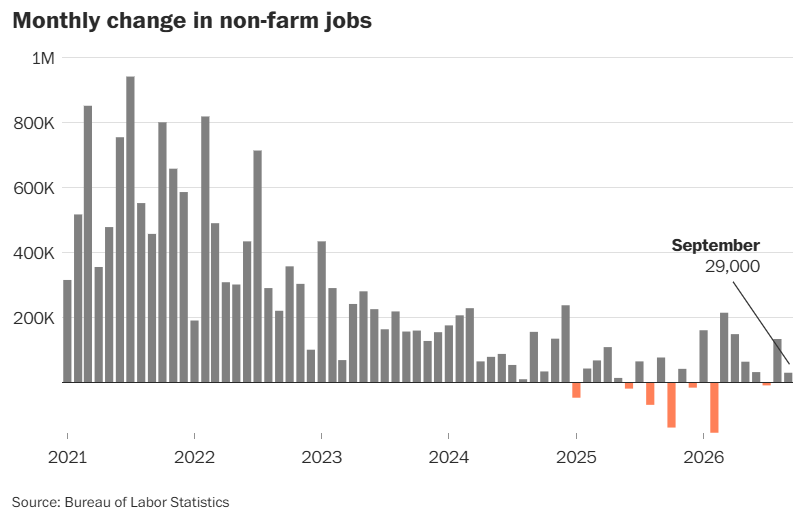
America’s job market hasn’t fallen off a cliff—it has apparently decided to sit very close to the edge.
Health care, construction, and manufacturing added workers, while most other industries barely grew or shed jobs, including parts of the white-collar economy. The slowdown is particularly rough for recent college graduates entering a market where companies are increasingly deploying artificial intelligence for entry-level work. Nicole Bachaud, a labor economist at ZipRecruiter, expects the turbulence to continue: “We’re probably going to see more volatility in the labor market this year.”
Then there’s the paycheck problem. Average hourly earnings reached $37.81 in September, up 3 percent from a year earlier, but that increase trailed inflation. Higher gas prices associated with the Iran war, tariffs, and immigration restrictions are adding economic pressure, while workers are increasingly staying put instead of jumping to new jobs. Bachaud said, “Stability remains the leading strategy for workers who have a position already.” That lack of worker movement also gives employers less incentive to boost wages.
Consumer spending remains relatively strong, but economists cited by The Washington Post warn that persistent price increases and weaker wage growth could eventually force households to cut back. The Federal Reserve’s September interest-rate increase could add another brake to hiring in the months ahead. As KPMG chief economist Diane Swonk put it, “Monetary policy works with a lag.” Translation: the economy may not have finished digesting the medicine yet.
Editor: Twenty-nine thousand jobs when economists expected 84,000 isn’t a rounding error. It’s the kind of number that makes “stable but sluggish” sound like something you’d put on the résumé after “proficient in Microsoft Office.”
Source: The Washington Post (no paywall)
Cornell Rape Case Documents Reveal Sweeping Investigation as New York Takes Over
Cornell’s internal investigation into an alleged 2024 fraternity-house rape involved dozens of witnesses, months of interviews, and a 12-day hearing—but the absence of criminal charges has now helped push the case into the hands of New York’s attorney general.
Newly unsealed court documents show Cornell University conducted an extensive Title IX investigation after a student alleged she was drugged and raped by multiple men at a Chi Phi fraternity house in October 2024, interviewing 32 witnesses and ultimately imposing sanctions that included suspensions and expulsions. The case has drawn national attention because none of the accused students initially faced criminal charges, raising questions about what Cornell investigators, campus police, and local prosecutors knew, and when they knew it.
Now New York Gov. Kathy Hochul says she has lost confidence in the local district attorney’s ability to fairly oversee the case and has appointed Attorney General Letitia James as special prosecutor.
The woman, identified in court filings as Jane Doe, alleges she was intoxicated, pressured to inhale ketamine, and incapable of consent when the assault occurred. According to her civil lawsuit, fraternity members circulated messages inviting others into the room, including one referring to “free p---y.” At a May 2025 disciplinary hearing, Doe described her experience this way: “I felt like bait. I felt like lions around me. It just was a totally debilitating place to be in.” Cornell’s investigation began in November 2024 and included months of witness interviews followed by a 12-day hearing in May 2025.
Tompkins County District Attorney Matthew Van Houten has said his office did not pursue charges in 2024 because it lacked information now available, while also saying Doe initially described the sexual activity and drug use to police as voluntary and consensual. Cornell says its police department provided prosecutors with Doe’s sworn statement and screenshots of Snapchat messages. After Doe filed her civil lawsuit, Van Houten announced that his office would revisit potential criminal charges. Hochul has now reassigned the matter to James, saying: “The young woman at the center of this case deserves to know that every fact will be examined and justice pursued.”
Meanwhile, at least one fraternity member disciplined by Cornell is challenging the university’s findings in court. He admitted entering the room after seeing the group message but denied assaulting Doe, and Cornell’s panel did not find that he sexually assaulted her. His attorney, Andrew Miltenberg, defended the need for due process while describing Cornell’s proceeding as extensive: “This investigation wasn’t perfect, the hearing wasn’t perfect, but after 45-plus witnesses, five months of investigations, 12 days of hearings, a thousand pages of transcripts and evidence, it’s hard to say they were not thorough.” The fraternity chapter was closed in 2024 and remains barred from campus.
Editor: A university disciplinary process, a civil lawsuit, a reopened criminal investigation, and now a special prosecutor—two years later, the central question is no longer whether this case received attention. It’s whether the institutions involved turned the information they had into the accountability the evidence ultimately supports.
Source: The Washington Post
Local Police Can Collect Millions for Joining Trump’s Immigration Crackdown
The Trump administration’s immigration partnership is funneling hundreds of millions of federal dollars to local police departments, sometimes producing a remarkable equation: millions in taxpayer money, a handful of immigration arrests.
The Department of Homeland Security has distributed more than $200 million to state and local law-enforcement agencies participating in the Trump administration’s immigration crackdown, with some departments becoming eligible for millions of dollars despite making few, or even zero, immigration arrests during individual quarters. More than 1,800 agencies have signed up for the revived federal task-force program, and Congress has provided $1 billion for the partnerships, according to a Wall Street Journal analysis.
Nothing gets local government’s attention quite like discovering that immigration enforcement comes with a new-car smell.
The numbers can get extraordinary. Miami-Dade’s sheriff’s office signed up more than 970 deputies and was eligible for about $14.5 million from April through June while recording seven immigration arrests that quarter, more than $2 million in eligible funding per arrest. Florida’s Orange County Sheriff’s Office was eligible for $2.16 million while reporting zero arrests during the same period, while Manatee County’s sheriff was eligible for $2.235 million with zero. Agencies can qualify for $60,000 annually for each deputized officer after meeting the program’s enforcement requirements, according to the Journal.
The incentives reach much smaller departments, too. Doddridge County Sheriff Clinton Boring signed his West Virginia department up despite saying, “I honestly don’t think there are any Hispanics that live in Doddridge.” After deputies detained two people living in the country illegally, the department received more than $137,000 and is awaiting two new squad cars purchased with DHS money. Boring said the opportunity to potentially receive $100,000 for equipment or vehicles was “a no-brainer.” He also said he would not seek additional funding without another arrest.
The program, known as 287(g), allows participating local officers to perform certain federal immigration-enforcement functions. The Obama administration discontinued this task-force model in 2012 after Justice Department investigations found discriminatory enforcement by departments in Arizona and North Carolina; the Trump administration revived it in 2025. DHS says agencies become eligible for reimbursement only after an ICE-directed enforcement action and must demonstrate “continued performance” for quarterly funding. Despite its rapid expansion, the broader 287(g) program accounted for about 46,500 of roughly 576,000 immigration arrests between January 2025 and July 2026, according to the Journal’s analysis.
Editor: When a police department can become eligible for $14.5 million while producing seven arrests in a quarter, somebody is going to ask whether this is immigration enforcement with a funding program attached, or a funding program with immigration enforcement attached.
Source: The Wall Street Journal (no paywall)
Trump’s Cost-of-Living Approval Craters to 17% as Americans Blame His Policies
Trump won in part by promising relief from high prices; now an AP-NORC poll finds only 17% of Americans approve of his handling of the cost of living, and even Republican patience is wearing thin.
Just 17% of U.S. adults approve of President Donald Trump’s handling of the cost of living, while only 26% approve of his management of the economy overall, according to a new AP-NORC poll conducted Sept. 24-28. Sixty-five percent say Trump’s policies deserve more blame for persistently high prices than factors beyond his control, putting an issue he hammered Democrats on in 2024 squarely back on his own desk.
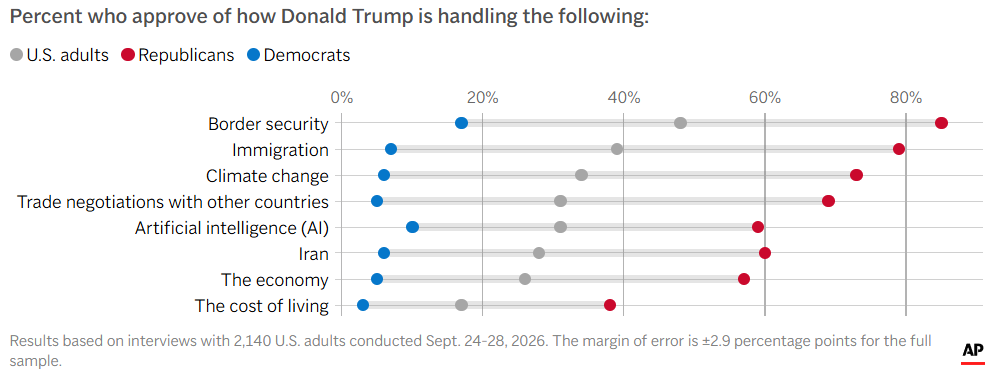
Running on “I’ll lower your prices” gets considerably less fun when voters start checking the receipts.
The frustration reaches into Trump’s own party. About six in 10 Republicans disapprove of his handling of the cost of living, while roughly half say his performance on the issue has been worse than they expected. Americans are increasingly worried about basics, too: about half say they are extremely or very concerned about affording gasoline, up from 39% in July, and roughly half express the same level of concern about food. Republican voter Robert Gault summed up his disappointment: “He said, ‘Make America Great Again.’ And I have not seen him do that.”
Trump is also taking hits over Iran and trade. Sixty-nine percent of Americans say the war with Iran has not been worth fighting, while 28% approve of Trump’s handling of Iran. Meanwhile, 64% say he has gone too far in imposing tariffs on other countries. Overall, only about three in 10 Americans approve of Trump’s job performance, while about six in 10 say the country is worse off than when his second term began. Border security remains a comparatively stronger issue for Trump, with about half approving of his performance there.
The poll lands just weeks before the November midterm elections, when control of Congress will be decided. Its 2,140 respondents were drawn from NORC’s probability-based AmeriSpeak Panel, with a margin of sampling error of plus or minus 2.9 percentage points. The numbers describe national public opinion rather than predict election results, but they document substantial dissatisfaction with prices, tariffs, and the economy as Trump campaigns for Republican candidates.
Editor: Turns out voters can tolerate plenty of political theater, but the grocery receipt gets the final rebuttal, and it doesn’t need a microphone.
Source: Associated Press
Hegseth Taps Musk and Luckey for Pentagon Warfare Project as Their Companies Chase Defense Billions
Pete Hegseth has tapped Elon Musk and Palmer Luckey to help advise the Pentagon on the future of warfare, giving two major Republican donors whose companies hold or pursue federal defense business a seat at a particularly lucrative table.
Defense Secretary Pete Hegseth has appointed Elon Musk and Palmer Luckey to advisory roles in a new Pentagon initiative called Project Meridian, putting two prominent Republican political donors with major defense-industry interests in positions to help discuss the future of American warfare. The project will be led by Pentagon official and former Uber executive Emil Michael and will also include former House Speaker Newt Gingrich.
Apparently the military-industrial complex has discovered the founder package.
The financial and political connections are substantial. Musk spent more than $250 million supporting Donald Trump’s 2024 election effort and continues spending through America PAC in the 2026 midterms. His SpaceX has long been a major federal contractor and has emerged as a participant in Trump’s Golden Dome missile-defense initiative, which the Guardian reports could eventually cost as much as $1.2 trillion. Luckey, meanwhile, founded defense contractor Anduril and has become a significant Republican fundraiser, hosting or co-hosting events for Trump and numerous GOP candidates.
Project Meridian will be led by Michael, whose own financial connections to Musk have drawn scrutiny. The Guardian previously reported that Michael made millions in profits from holdings in Musk’s privately held xAI while serving in government and helping guide Pentagon artificial-intelligence efforts. Brendan Glavin of the nonpartisan campaign-finance organization OpenSecrets said industry participation in Pentagon advisory roles isn’t unprecedented, but added: “what feels different now is the substantial financial support these two have, and continue to, deliver for the Republican party.”
Luckey has already offered some unconventional ideas about where combat technology may be headed. He has predicted that warfare later this century could include “subterranean” conflict involving vehicles capable of moving through the Earth’s crust similarly to submarines moving through water, and he says Anduril has working prototypes of subterranean systems. His company has expanded into underwater drones, unmanned aircraft, and space technology, all areas with obvious relevance to Pentagon planning. The Pentagon did not immediately respond to the Guardian’s request for comment.
Editor: When political megadonors who own defense companies get invited to help contemplate the future of warfare, “conflict of interest” isn’t an accusation by itself. It is, however, a phrase worth keeping prominently displayed on the conference-room whiteboard.
Source: The Guardian