


The Morning Sixpack stays free because the news that shapes your life should not be hidden behind a paywall. Paid subscribers are not paying for access. They are helping fund the research, writing, and independent voice that goes into every issue. Become a paid subscriber and help keep smart, honest news analysis free for everyone.
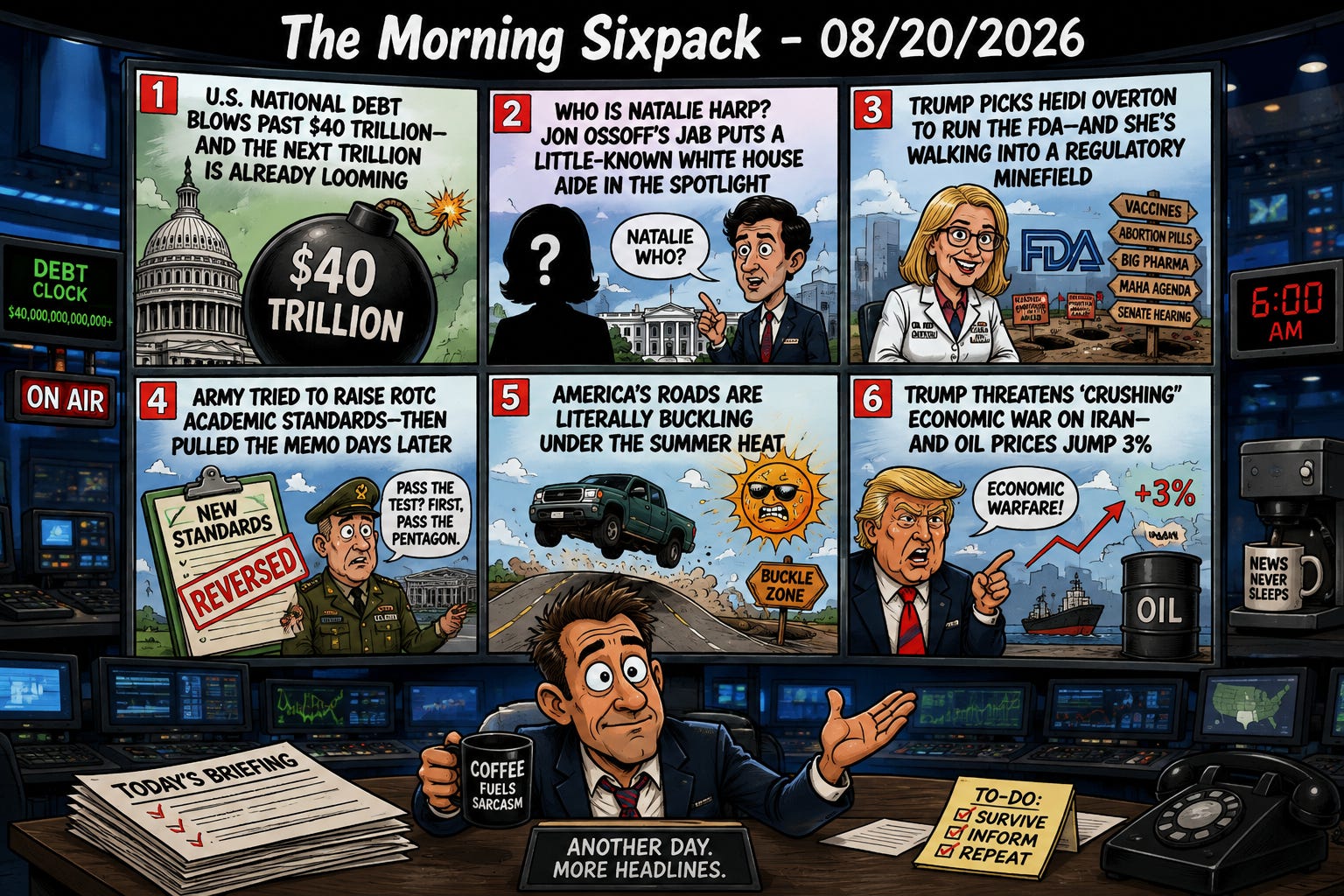
The United States just blew through $40 trillion in national debt, because apparently $39 trillion wasn’t enough to get Washington’s attention.
U.S. National Debt Blows Past $40 Trillion—and the Next Trillion Is Already Looming
America’s national debt topped a record $40 trillion Wednesday, just five months after crossing $39 trillion and only 10 months after hitting $38 trillion. Defense spending, Social Security, Medicare, and mounting interest costs are consuming huge chunks of federal spending while Washington continues to spend more than it collects.
That’s roughly $1 trillion in new debt every five months—and the bill doesn’t stay in Washington.
The debt has piled up across Republican and Democratic administrations, including massive borrowing during the COVID-19 pandemic under Donald Trump and Joe Biden. More spending followed after Trump signed Republicans’ tax-cut and spending legislation last year, while the current administration is also juggling higher defense costs tied to the war in Iran and pressure to bring down everyday prices. White House spokesman Kush Desai said the administration “has been focused on slashing waste, fraud, and abuse in federal spending while accelerating economic growth to get America’s debt-to-GDP ratio trending in the right direction.”
The Trump Regime is FAILING. Grade: FFF
But economists and budget experts say Americans are already paying for the borrowing spree through higher costs for mortgages and cars, reduced business investment and pressure on wages and prices. Michael A. Peterson of the Peter G. Peterson Foundation put it plainly:
“If we want to improve our living standards, today and for the next generation, now is the time for lawmakers to put our nation on a more affordable and sustainable path.”
And $40 trillion isn’t the finish line. The Bipartisan Policy Center estimates the U.S. could hit its $41.1 trillion debt limit sometime between late winter and mid-summer 2027, setting up yet another congressional showdown over raising or suspending the ceiling. BPC President and CEO Margaret Spellings warned, “Our current fiscal trajectory is plainly unsustainable, and that’s the best-case scenario. AI disruption, a recession, global war, or any number of other events could quickly push us over the edge from a challenge into a full-blown crisis.”
Editor: Washington has spent decades proving that fiscal restraint is everybody’s favorite campaign promise and nobody’s favorite governing strategy. At $40 trillion, the meter isn’t just running—it appears to have been welded to the accelerator.
Source: AP News
A single line from Sen. Jon Ossoff turned Trump aide Natalie Harp from an influential behind-the-scenes figure into the latest main character in Washington’s favorite sport: making everyone wonder what, exactly, was meant by that.
Who Is Natalie Harp? Jon Ossoff’s Trump Jab Puts a Little-Known White House Aide in the Spotlight
Natalie Harp, President Donald Trump’s 35-year-old executive assistant and a constant presence at his side, is suddenly drawing national attention after Democratic Sen. Jon Ossoff dropped her name into a pointed campaign attack on the president. There is no evidence of an improper relationship between Trump and Harp, but Ossoff’s carefully worded remark was enough to light up political media and social networks.
Ossoff said just enough to make everybody else do the talking.
Harp has been close to Trump for years, traveling with him, accompanying him to court, and staying nearby during both 2024 assassination attempts. Fox News reported that she has worked alongside Trump since 2022, while Republican Sen. John Barrasso described her as an important conduit to the president: “If he doesn’t pick up the phone, I know to go to Natalie, and he gets the message.”
Harp reportedly operates a traveling mobile office, complete with a printer for quickly putting articles and other propaganda in front of Trump.
The latest frenzy began when Ossoff, campaigning for re-election in Georgia, accused Trump of not wanting to do the job of president. “He wants to build his ballroom and travel with Natalie on their apparently defenseless flying palace gifted by the emir of Qatar,” Ossoff said. Trump responded when asked about the comment by ridiculing Ossoff as a “Pee-wee Herman look-alike,” while White House communications director Steven Cheung attacked the senator in considerably less restrained terms. (Takes one to know one?)
Conservative commentators accused Ossoff of sexism, while Democrats amplified the remark and the questions it generated.
The intrigue comes partly from Harp’s unusually close working relationship with Trump. New York Times reporters Maggie Haberman and Jonathan Swan wrote in their book Regime Change that Harp had left admiring letters for Trump during the campaign, including one saying, “You are all that matters to me.” Harp herself has publicly praised Trump in deeply personal terms, telling Fox News, “He is on a totally different plane, at peace with God and unshakably focused.”
Pod Save America co-host Tommy Vietor summed up the political effect of Ossoff’s remark: “I think there’s a question of whether it might kick up media coverage of these allegations now in a way that is frustrating to the White House.”
Editor: Ossoff tossed one first name into a campaign speech and walked away while Washington assembled a full detective agency. Whatever his intention, “Who’s Natalie?” is now a political question that a whole lot more people know to ask.
Source: CBC News
Trump wants Dr. Heidi Overton running the FDA, handing a trusted White House health-policy aide one of Washington’s toughest jobs at precisely the moment everyone seems to want something different from the agency.
Trump Picks Heidi Overton to Run the FDA—and She’s Walking Into a Regulatory Minefield
President Donald Trump has nominated Dr. Heidi Overton to lead the Food and Drug Administration, putting a close White House ally in line to oversee everything from vaccines and abortion pills to drug approvals, food additives, and nicotine products. If confirmed by the Senate, Overton will inherit an agency caught between Trump’s health agenda, traditional Republican deregulation priorities and Health Secretary Robert F. Kennedy Jr.’s Make America Healthy Again movement.
Running the FDA is complicated enough before your bosses start pulling the agency in three different directions.
Overton, a physician and deputy director of the White House Domestic Policy Council, has helped advance several of Trump’s second-term health initiatives. Trump called her a respected “rockstar” who would push faster cures, lower drug prices, and MAHA priorities, while Kennedy praised her “exceptional judgment, professionalism, discipline, and an unwavering commitment to the American people.” She has also appeared alongside Trump during announcements on drug pricing and his order seeking separate measles, mumps, and rubella vaccinations—a policy opposed by medical groups.
Confirmation may not be a stroll through the Senate. Republican Sen. Bill Cassidy, a physician who chairs the Senate Health, Education, Labor, and Pensions Committee, said he has “strong concerns” about Overton’s lack of management experience and involvement with Trump’s vaccine order, calling the latter “almost disqualifying.” Democratic Sen. Patty Murray went considerably further, calling Overton “a far-right, anti-abortion extremist who has no business leading the FDA.” Overton has previously criticized abortion pills, meaning the FDA’s policies governing access to mifepristone could become a major confirmation fight.
Then there’s the actual job. Overton would replace Dr. Marty Makary, who resigned in May with major issues unresolved, including ultraprocessed foods, antidepressants, COVID-19 vaccines, and vaping products. She would also inherit disputes over accelerated drug approvals, peptide regulation, and Kennedy’s MAHA agenda, while the FDA simultaneously handles major foodborne-illness investigations. Some MAHA activists are already skeptical: Pesticide critic Kelly Ryerson accused Overton of echoing industry arguments during a White House roundtable, saying, “I was stunned by the blatant, undisguised corruption.” Add pharmaceutical companies, abortion opponents, vaccine critics, public-health officials, and food manufacturers to the guest list, and Overton’s confirmation hearing could be merely the appetizer.
Editor: The FDA commissioner is supposed to referee science, medicine, industry and public safety. Overton may first have to referee the people who nominated her—and there’s no approved medication for that headache yet.
Source: AP News
The Army proposed minimum test scores for future officers, yanked the policy a week later and somehow turned “should officers meet an academic minimum?” into an internal Pentagon argument.
Army Tried to Raise ROTC Academic Standards—Then Pulled the Memo Days Later
The Army is considering new minimum academic standards for ROTC cadets after abruptly rescinding a policy that would have required future officers to clear standardized-test benchmarks before contracting into the program. The proposal isn’t necessarily dead—the Army says it needs more review—but the rollout exposed disagreements over who approved it, whether the standards were high enough, and whether standardized tests are the right measuring stick in the first place.
Apparently, setting minimum academic standards for future Army officers requires its own battle plan.
The Aug. 5 memo would have required incoming ROTC cadets to meet academic benchmarks, including a 20 on the ACT, 1000 on the SAT or 50th percentile on the ASVAB, with new requirements scheduled to take effect in January 2027. “The Army must cultivate intelligent and adaptive officers to build a lethal and ready Army prepared to deter, fight, and win our nation’s wars,” wrote Jay Hurst, then assistant secretary of the Army for manpower and reserve affairs. Days later, however, the Army rescinded the memo, saying the proposal required “further staffing and analysis.”
The reversal produced frustration inside the Pentagon. Some officials reportedly support tougher academic requirements as part of Defense Secretary Pete Hegseth’s broader push for higher military standards, while others said key Army leaders weren’t properly consulted before the memo went out. One official told The Hill that part of the debate was actually whether the proposed standards were high enough, with some leaders wanting something more “stringent.” Critics, meanwhile, argue SAT and ACT scores aren’t necessarily good predictors of who will become an effective military officer.
For now, Army ROTC scholarship applicants must have at least a 2.5 unweighted high-school GPA and take the SAT or ACT, but there is no minimum test score. The withdrawn proposal would have extended minimum academic standards across Army Senior ROTC, including the majority of cadets who aren’t receiving scholarships. The Army says it remains aligned with the administration’s push for military readiness and is evaluating changes for senior-level approval. Translation: Higher standards may still be coming—they just need to survive the Pentagon before cadets have to survive them.
Editor: There’s a legitimate debate over whether an SAT score predicts battlefield leadership. But if the Army decides future officers should meet minimum academic standards, figuring out who gets to approve the minimum academic standards seems like a pretty reasonable minimum management standard.
Source: The Hill
America’s aging transportation network is discovering that hotter summers come with a nasty engineering footnote: roads can turn into ramps, rails can bend and bridges can simply refuse to cooperate.
America’s Roads Are Literally Buckling Under the Summer Heat
Extreme summer heat is buckling highways, warping railroad tracks, and shutting down bridges across the United States as infrastructure designed for yesterday’s climate struggles with today’s temperatures. The most spectacular example came in Greenville, Texas, where a section of U.S. Highway 69 expanded until the pavement erupted into a roughly two-foot-high ramp—and a pickup truck hit it at about 30 mph and went airborne.
When your interstate suddenly doubles as a launchpad, the infrastructure discussion has officially become less theoretical.
The Texas blowup was hardly an isolated case. Wisconsin warned drivers statewide to watch for pavement buckles, while heat-related failures have closed stretches of highway in Maryland and Louisiana. A New Jersey vertical-lift bridge has been closed to boat traffic four times this summer because heat prevented components from operating properly. July was the hottest month on record in the contiguous United States, according to federal scientists, and engineers say extreme temperatures can soften asphalt, expand concrete, and bend steel rails. Louisiana transportation engineer David North described pavement blowups succinctly: “unpredictable and instant.”
The bigger problem is that much of America’s transportation system was engineered using historical temperature assumptions that increasingly don’t match current conditions. The Federal Highway Administration warned in 2023 against relying exclusively on historical climate records when designing roads, recommending predictive climate models instead. Engineers are already adapting: Some asphalt incorporates polymers for added rigidity, cities including Phoenix, Los Angeles, and San Antonio have experimented with reflective “cool pavement,” and New Jersey is changing road designs and repairing concrete slabs to reduce future heat-related failures.
Railroads have the same physics problem. Extreme heat can cause steel rails to buckle into dangerous “sun kinks,” potentially leading to derailments, so operators increase inspections and impose slower speeds during heat waves. Washington’s Metro watches for rails reaching 135 degrees, while Union Pacific has experimented with painting rails white to reduce temperatures. It sounds almost comically simple, but reflecting sunlight could become another tool for keeping transportation systems moving as temperatures climb.
Editor: We spent decades debating whether infrastructure could handle the future, and apparently the future responded by turning a Texas highway into a Dukes of Hazzard stunt ramp. Maybe “paint it white” isn’t the grand infrastructure strategy anyone envisioned, but neither was airborne commuter traffic.
Source: The Washington Post (free)
Trump threatened Iran and countries doing business with it with an unprecedented economic campaign, and oil traders responded in the traditional manner: By making everybody’s next tank of gas more expensive.
Trump Threatens ‘Crushing’ Economic War on Iran—and Oil Prices Jump 3%
Oil prices jumped roughly 3% Thursday after President Donald Trump threatened what he called the “MOST CRUSHING ECONOMIC OPERATION EVER TAKEN AGAINST ANY COUNTRY” against Iran, while also warning of consequences for nations that continue doing business with Tehran. Brent crude climbed 2.9% to $94.31 a barrel, while U.S. benchmark West Texas Intermediate rose 3.3% to $88.67 for September futures.
Nothing says “economic warfare” quite like the oil market immediately sending everyone an invoice.
Trump said Iran rejected an opportunity to reach an agreement with the United States and would now face “Economic Warfare and Isolation on an unprecedented scale.” But he offered few specifics about exactly what measures the United States would impose or which countries could be targeted for continuing to trade with Iran. That uncertainty alone gives energy markets plenty to worry about, especially with the Strait of Hormuz already severely disrupted.
The strait is one of the world’s most important oil-shipping routes, normally carrying millions of barrels of oil and more than 100 vessels each day. But amid the U.S. naval blockade and Iranian attacks in the area, just 12 ships traveled through the strait Wednesday, according to maritime data firm Kpler. That bottleneck makes every new threat involving Iran potentially consequential for global oil supplies—and prices.
Adding to the pressure, the United Arab Emirates announced it would halt trade with Iran after accusing Tehran of launching two ballistic missiles toward the UAE. Iran denies the allegation. Between the disrupted Strait of Hormuz, escalating regional tensions, and Trump now threatening countries that continue economic relations with Tehran, the oil market has plenty of reasons to keep the price ticker moving—and motorists have plenty of reasons to keep watching the gas-station sign.
Editor: Trump is promising economic isolation on an unprecedented scale, but oil markets have a funny habit of making sure isolation doesn’t stay isolated. Tehran may be the target; your neighborhood gas pump still gets a vote.
Source: UPI
Oh no!! But communism and socialism is evil. Stop worrying about the world and get America fixed.