


The Morning Sixpack stays free because the news that shapes your life should not be hidden behind a paywall. Paid subscribers are not paying for access. They are helping fund the research, writing, and independent voice that goes into every issue. Become a paid subscriber and help keep smart, honest news analysis free for everyone.
If you create dozens of different tariff rates, don’t act surprised when businesses start looking for the cheapest lane out.
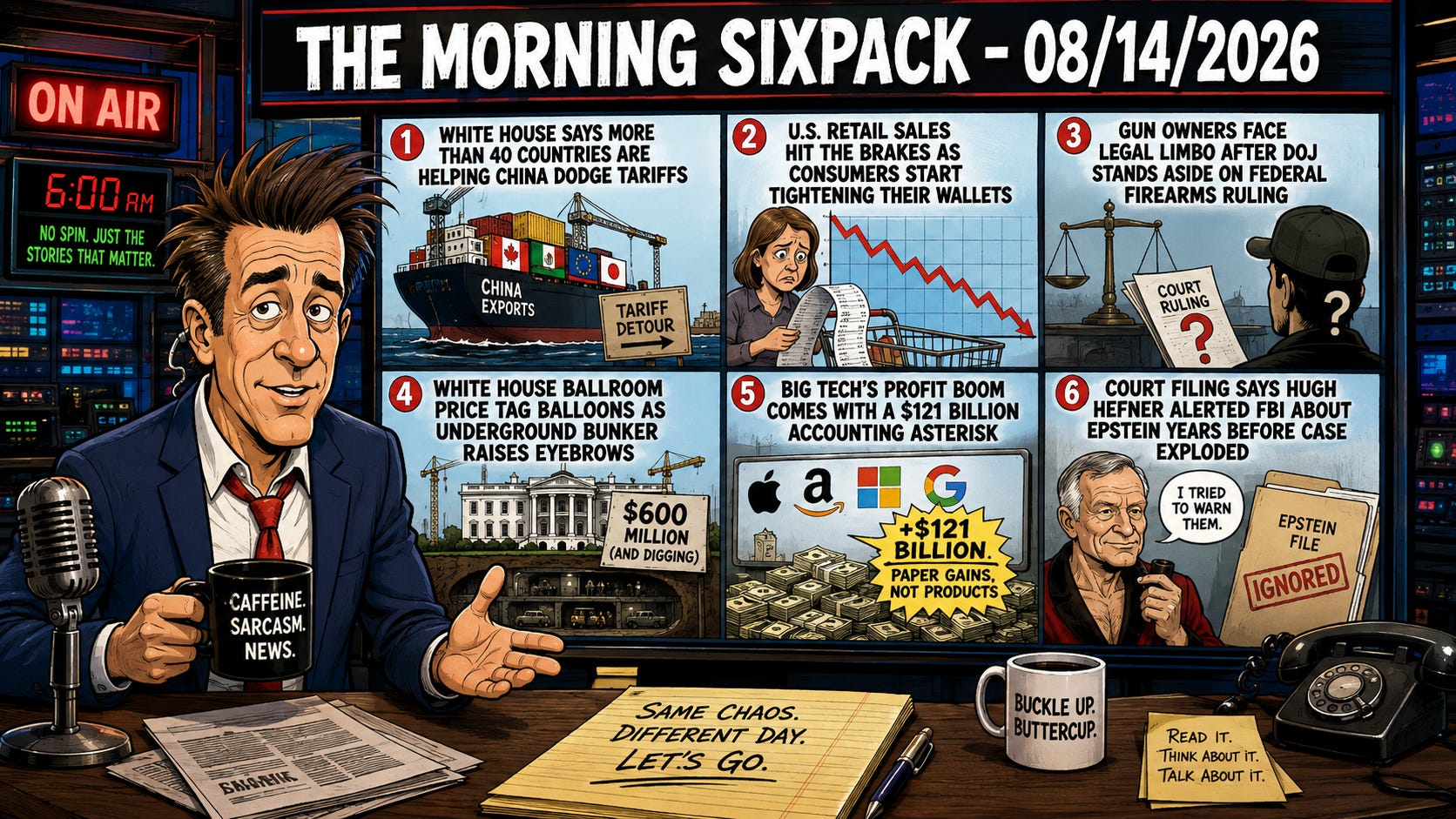
White House Says More Than 40 Countries Are Helping China Dodge Tariffs
The White House is accusing more than 40 countries of helping China reroute exports to dodge U.S. tariffs worth an estimated $60 billion in trade.
The administration says it’s cracking down with AI, but critics will argue the tariff maze created the incentive in the first place.
The White House says countries including Canada, Mexico, Japan, and members of the European Union are helping Chinese goods skirt higher U.S. tariffs by routing products through nations facing lower import duties. A new report calls it “The Great Transshipment Scam” and estimates the practice affects roughly $60 billion in trade.
Peter Navarro says China has spent years perfecting what he called an “extremely sophisticated” system of transshipment and warned other countries are now following the same playbook. “For years, the great transshipment scam has let communist China launder its exports to more than 40 countries, rob our Treasury of tens of billions of dollars, and steal the pay checks of American workers,” Navarro said.
The administration says Customs and Border Protection is deploying an AI-powered system called “Detective Border” to better identify where products are actually made and collect the proper tariffs. Officials also say future trade agreements will include tougher rules aimed at blocking transshipment.
Source: Financial Times (paywalled—link may not work for you)
Editor: Tariffs may be designed in Washington, but supply chains are designed by people whose job is finding the cheapest legal route from Point A to Point B. That’s not a bug in global trade—it’s pretty much the business model.
It turns out there’s only so long tax refund money can keep the shopping carts rolling.
U.S. Retail Sales Hit the Brakes as Consumers Start Tightening Their Wallets
U.S. retail sales fell 0.6% in July—the first monthly decline in nine months—signaling consumers are becoming more cautious with their spending.
The economy isn’t falling apart, but the consumer is finally showing signs of fatigue.
Commerce Department data showed retail sales dropped unexpectedly in July after a modest gain in June, missing economists’ expectations for another increase. The slowdown reflects the end of generous tax refund spending, weaker gasoline prices that reduced service station receipts, and the timing shift of Amazon’s Prime Day into June, which pulled sales forward.
The biggest declines came from online retailers, auto dealers, and electronics stores, while clothing sales got a boost from back-to-school shopping. Restaurant spending also continued to rise, suggesting Americans are still willing to spend on experiences even as they’re becoming more selective about buying goods.
“This points to a material slowdown in real consumer spending growth in the third quarter,” said Sal Guatieri, a senior economist at BMO Capital Markets. “This, together with a weaker jobs report and subdued core CPI inflation, raises the odds of the FOMC staying patient again in September.”
The weaker retail sales report, combined with softer inflation and recent job losses, strengthens expectations that the Federal Reserve will leave interest rates unchanged next month. While economists don’t expect consumer spending to collapse—thanks in part to rising stock market wealth—they say households are clearly becoming more deliberate about where they spend their money.
Source: Reuters
Editor: Consumers are still spending—but they are pulling back.
When the government can’t explain what’s legal, don’t be surprised when nobody knows what the rules are.
Gun Owners Face Legal Limbo After DOJ Stands Aside on Federal Firearms Ruling
A federal court ruling striking down key National Firearms Act registration requirements has left gun owners, dealers, and even the ATF struggling to determine what’s legal.
The Justice Department skipped its first chance to block the ruling—but it still has weeks to decide whether to appeal.
A federal judge in Texas ruled that registration requirements for firearm suppressors, short-barreled rifles, and certain other weapons are unconstitutional after Congress eliminated the tax tied to the 1934 National Firearms Act. The Justice Department declined to seek an emergency stay before the deadline, but it still has about seven weeks to decide whether to appeal the decision.
The ruling appears to apply only to the plaintiffs—including Gun Owners of America and affiliated sellers—as well as certain future customers, creating widespread uncertainty over who is actually covered. Even the Bureau of Alcohol, Tobacco, Firearms, and Explosives says it will continue processing National Firearms Act paperwork while declining to interpret the court’s decision or provide legal advice.
“This is a confused mess,” one gun-rights advocate told CNN. “It’s utter chaos about what to do or what not to do.”
The dispute has become a political flashpoint as gun-rights groups urge the Trump administration to let the ruling stand while gun-control advocates warn that nearly a century of federal safeguards could be dismantled. For now, the legal landscape remains unsettled until the Justice Department decides whether to appeal—or higher courts weigh in.
Source: CNN
Editor: This is what happens when a major court ruling lands before anyone has figured out who it actually applies to. If even the government is saying, “Talk to your lawyer,” you’ve got a pretty good idea how murky things are.
Funny how a ballroom keeps getting more expensive the deeper they dig. It’s almost like they’re lying to us!
White House Ballroom Price Tag Balloons as Underground Bunker Raises Eyebrows
President Trump’s White House ballroom project has grown from a $200 million proposal into a $600 million undertaking, with an underground security complex driving much of the cost.
The project is no longer just about hosting dinners—it’s becoming one of the biggest White House construction efforts in decades.
The latest estimates put the ballroom at roughly $600 million, triple the original projection, with reports indicating taxpayers could cover about half the bill. The administration is also planning at least another $300 million in White House campus upgrades, including a helipad, visitor screening center, and Rose Garden renovations, while a separate request for up to $1 billion in additional security improvements has also surfaced.
You read that right: Total cost of $1.9 billion, which will turn into 4x that. Mark my words.
Much of the attention is focused on what’s below ground. Trump has described a six-story-deep complex featuring bomb shelters, medical facilities, a drone-proof roof, and a drone port. Court filings and planning documents describe military-grade infrastructure designed to protect the president from modern threats, while replacing or expanding the aging Presidential Emergency Operations Center beneath the White House.
The entire project remains tied up in court after a federal appeals court ruled congressional approval is required before construction can move forward. The administration plans to ask the Supreme Court to reverse that decision, arguing the security upgrades are essential to protecting the president and the White House complex.
Source: Axios
Editor: Washington has a long history of projects coming in over budget. This one just happens to include a ballroom on top and what sounds like a Cold War command center underneath.
When tech companies start making as much money from owning other tech companies as they do from their own business, investors should probably read the fine print. Almost sounds like a massive Ponzi scheme…
Big Tech’s Profit Boom Comes with a $121 Billion Accounting Asterisk
A Wall Street Journal analysis says roughly $121 billion in recent Big Tech profits came from paper gains on investments—not from selling more products or services.
The earnings are real on paper, but many of the biggest gains could disappear as quickly as they appeared.
Alphabet and Amazon posted enormous quarterly profits, but a huge share came from marking up the value of investments such as Anthropic and SpaceX rather than their core businesses. According to the Journal, those one-time gains accounted for about 71% of Alphabet’s quarterly profits and 66% of Amazon’s, inflating overall S&P 500 earnings in the process.
The issue isn’t that the accounting violates the rules—it’s that Wall Street applies those rules inconsistently. Some companies, including Nvidia, tell analysts to exclude unrealized investment gains when evaluating performance. Others don’t, allowing paper profits to boost earnings while analysts often ignore recurring expenses like stock-based compensation.
Even after stripping out Alphabet and Amazon’s investment windfalls, corporate earnings remain strong. But the Journal argues investors deserve a clearer picture of what’s driving profit growth instead of metrics that mix temporary investment gains with ongoing business performance.
“Counting gains in volatile equities when they go up while subtracting everyday operating costs isn’t analysis. It’s marketing,” the Journal’s Jonathan Weil wrote.
Source: The Wall Street Journal (free)
Editor: There’s nothing wrong with making money on smart investments. The problem comes when Wall Street starts valuing those lottery tickets like they’re recurring revenue. That’s how bubbles get dressed up as business models.
And do they mark down these “investments” when they decline in value? Let’s stick to actual profits and losses, shall we?
If the allegations are accurate, the biggest failure wasn’t a lack of tips—it was what happened after they were received.
Court Filing Says Hugh Hefner Alerted FBI About Epstein Years Before Case Exploded
Newly filed court documents allege Hugh Hefner alerted the FBI in 2005 about Jeffrey Epstein after a Playboy Playmate said she had been sexually abused and trafficked by the financier.
The lawsuit claims the FBI acknowledged the tip but failed to investigate it for roughly 15 years.
According to a federal lawsuit filed by 34 Epstein survivors, former Playboy Playmate Audra Christiansen told Hugh Hefner she had been raped and trafficked by Jeffrey Epstein and asked him to contact the FBI because she believed authorities would take his call more seriously than hers. The complaint says the FBI agreed to assist and investigate her allegations, but little happened afterward.
The lawsuit alleges Christiansen did not hear from the FBI until October 2020, despite first reporting her allegations in 2005. The complaint argues the bureau failed to follow its own policies for investigating child sexual abuse and sex trafficking claims, allowing additional victims to be harmed in the years that followed.
“For about fifteen years, the FBI did not investigate Ms. Christiansen’s tips or follow up on her allegations,” according to the court filing.
The allegations are part of an ongoing lawsuit against the federal government and have not been proven in court. The Justice Department has not been found liable, and the litigation is continuing as plaintiffs seek accountability over how the FBI handled early reports involving Epstein.
Source: Raw Story
Editor: The Epstein story keeps coming back to the same question: Who knew what, and when? If these allegations are borne out in court, the focus won’t be on the celebrity who made the call—it’ll be on why the call allegedly went nowhere.