


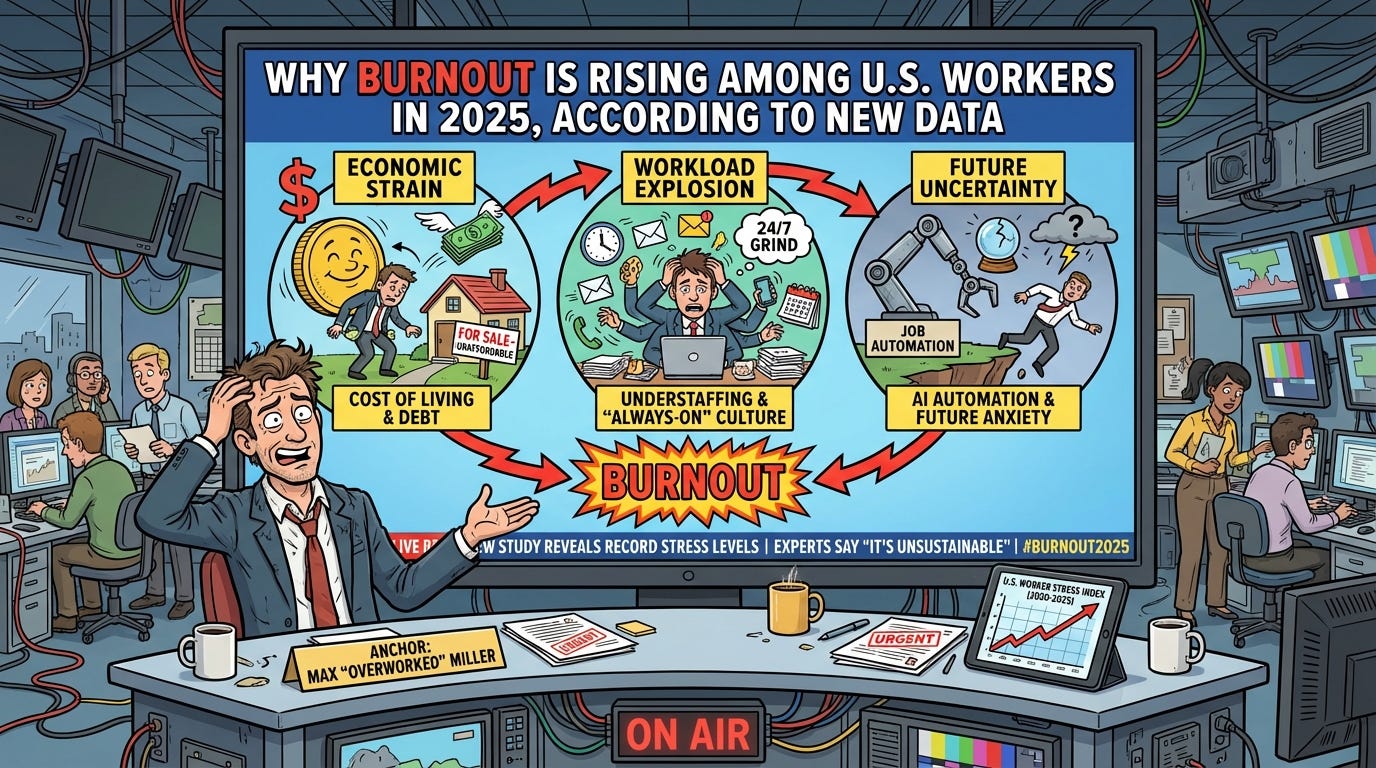
Burnout among U.S. workers is climbing again in 2025, reversing the modest declines seen immediately after the pandemic and raising fresh concerns about how sustainable modern work really is.
New surveys from workplace research firms, labor organizations, and health researchers point to a familiar but intensifying pattern: more employees report feeling emotionally exhausted, mentally checked out, and persistently stressed—especially in white-collar, hybrid, and fully remote roles.
The issue isn’t simply that people are working longer hours. Often, they aren’t. The problem is how work now shows up in their lives.
What the data shows
While definitions of burnout vary, most recent studies converge on the same themes:
Fewer official hours, more constant presence. Employees report logging slightly fewer scheduled hours than in prior years but feeling perpetually “on call.” Work hasn’t shrunk—it has spread.
Digital creep into personal time. Slack, email, and collaboration tools have extended the workday into evenings, weekends, and vacations, often without explicit expectations or boundaries.
Diminishing returns on availability. Despite being reachable more often, productivity gains have stalled. More access hasn’t translated into better output.
Control matters more than volume. Health researchers increasingly link burnout not to workload alone, but to low autonomy, shifting priorities, and unclear expectations about what actually matters.
In short: people aren’t burning out because they’re working nonstop. They’re burning out because work never fully turns off—and no one is sure where the lines are anymore.
Why this matters now
Much of 2023 and 2024 was dominated by debates over return-to-office policies. Where people worked received far more attention than how work was designed.
Issues like workload planning, communication norms, meeting overload, and recovery time were often treated as secondary—or left to individual managers to figure out. The result was inconsistency, ambiguity, and friction across teams.
Heading into 2025, economic uncertainty adds another layer of pressure. Hiring remains cautious in many sectors, while performance expectations continue to rise. Teams are being asked to do more with fewer resources, less clarity, and little margin for recovery.
Experts warn that without structural changes, burnout is likely to accelerate—not because employees can’t handle hard work, but because the system itself lacks guardrails.
What comes next
Some large employers are beginning to test alternatives aimed at reducing cognitive overload rather than just cutting hours. Early experiments include:
Meeting-free days to protect focused work time
Output-based performance reviews that emphasize results over constant availability
Shorter workweek pilots designed around recovery, not just efficiency
Whether these initiatives scale beyond pilot programs remains an open question. What is clear is that incremental fixes—another wellness app, another resilience webinar—are unlikely to move the needle on their own.
Burnout in 2025 isn’t a personal failure problem. It’s a systems problem. And the data is making that harder to ignore.
Related coverage:
→ Companies Are Rethinking Hustle Culture as Productivity Stalls
→ What Daily Work Actually Looks Like for Knowledge Workers in 2025