


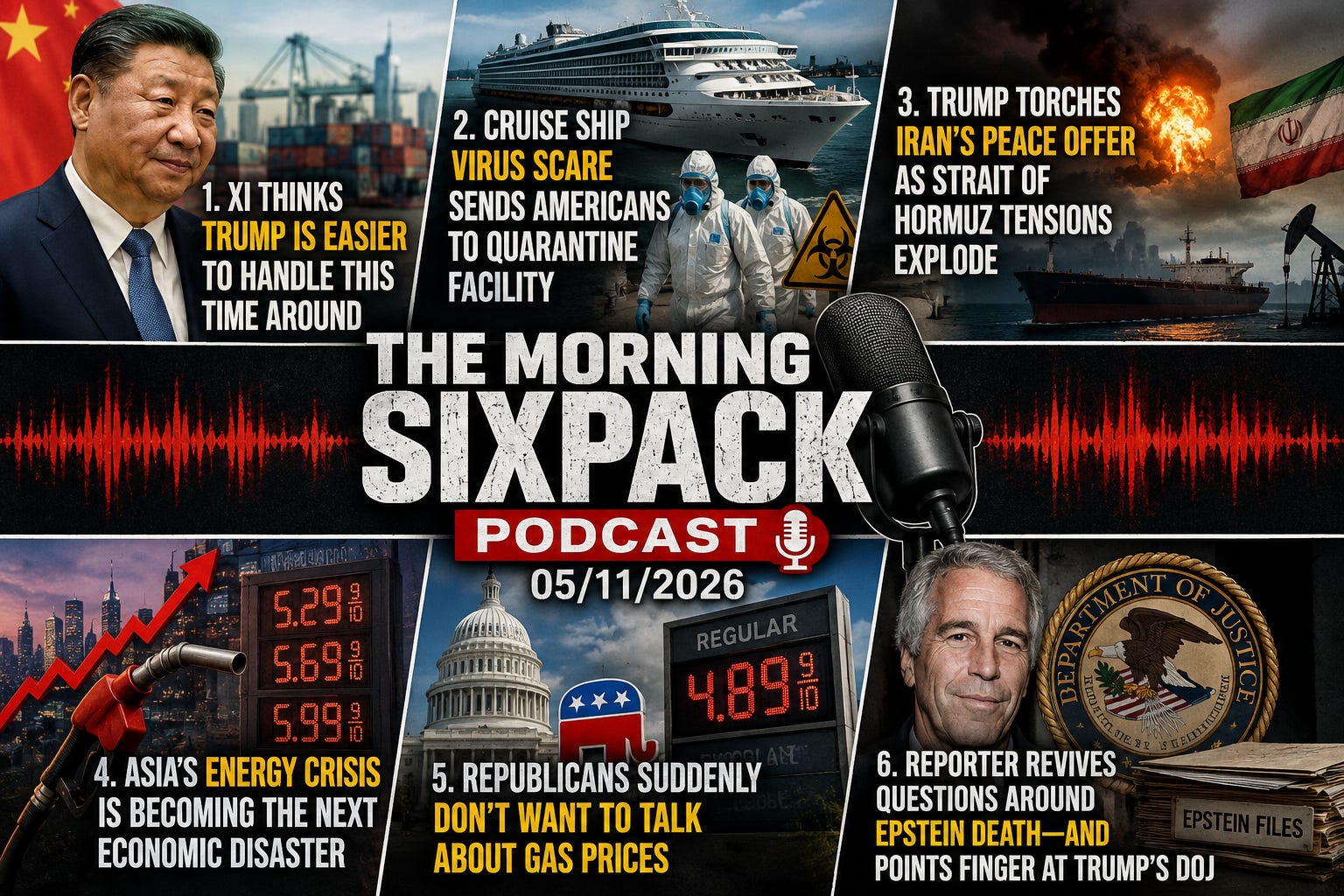
After years of tariffs, trade fights, and geopolitical chest-thumping, Beijing now believes the U.S. needs China more than China needs the U.S.
Xi Thinks Trump Is Easier to Handle This Time Around
China’s Xi Jinping is heading into this week’s summit with Donald Trump convinced Beijing has the leverage-and no reason to play nice just to keep Washington calm.
Xi isn’t walking into this meeting looking for some grand bargain. According to The Washington Post, Chinese officials think Trump’s unpredictability can be managed-and maybe even exploited-while China projects itself as the “stable” global power as America gets bogged down in another Middle East mess. The article notes China has become far more aggressive since Trump’s first Beijing visit in 2017, especially after flexing its control over rare earth minerals during the recent trade showdown.
One quote says it all: “China believes that it’s such a powerhouse that it does not need to humor Trump’s transactional politics, and that it’s able to beat the U.S. at its own game,” Shanghai researcher Shen Dingli told the Post. That’s not exactly subtle diplomacy. It’s Beijing openly saying the balance of power has shifted.
The piece also highlights growing fears among U.S. allies that Xi could push Trump toward concessions on Taiwan while America’s military focus stays locked on Iran. Chinese analysts reportedly believe Trump has been less confrontational on Taiwan than prior administrations-a detail Beijing clearly notices.
Trump got the royal treatment during his 2017 visit-complete with a private Forbidden City tour and opera performances. This time? Chinese officials apparently expect far less. They don’t think Trump is focused on trade anymore, and they’ve learned that accommodating him just leads to more demands.
Source: Washington Post (gift)
Editor: Xi spent years studying Trump like a casino whale at the baccarat table-and now Beijing seems convinced the house odds are finally in its favor.
Nothing says “relaxing cruise vacation” quite like hazmat suits, military flights and a six-week monitoring period.
Cruise Ship Virus Scare Sends Americans to Quarantine Facility
A hantavirus outbreak aboard a cruise ship near Spain just triggered a full-scale international evacuation-and now U.S. passengers are being flown to a Nebraska quarantine center in biocontainment units.
According to The Wall Street Journal, 17 Americans from the MV Hondius were repatriated after at least one passenger tested positive for hantavirus and another showed symptoms. Three people connected to the outbreak have reportedly died so far, while additional infections were identified among passengers who had already left the ship earlier.
The scenes coming out of Tenerife looked more like a sci-fi outbreak movie than a luxury cruise. Passengers in protective gear were escorted off the ship by crews wearing full-body hazmat suits before boarding government and military aircraft headed home. Two Americans were reportedly transported in specialized biocontainment units.
Health officials are trying to calm fears by stressing that hantavirus is far less contagious than Covid-19 or influenza. Still, the World Health Organization advised countries receiving passengers to monitor them daily for up to six weeks because of the virus’s long incubation period and potentially severe respiratory complications.
One particularly grim detail: a French passenger tested positive during her repatriation flight and was hospitalized after her condition worsened overnight. Meanwhile, authorities are still disinfecting the ship-and even transporting a deceased passenger’s body back to the Netherlands with the luggage.
Source: Wall Street Journal (gift)
Editor: Cruise lines spent years convincing people buffets and norovirus were the biggest onboard risks. Nature apparently decided to workshop a sequel.
The world’s most important oil chokepoint is turning into a geopolitical pressure cooker-and everyone from shipping companies to gas stations is now watching nervously.
Trump Torches Iran’s Peace Offer as Strait of Hormuz Tensions Explode
Donald Trump just blew up hopes for a quick end to the Iran war, calling Tehran’s latest response “TOTALLY UNACCEPTABLE” as attacks near the Strait of Hormuz intensify and oil prices spike again.
According to USA Today, Iran’s counterproposal demanded recognition of its sovereignty over the Strait of Hormuz, war reparations from the United States and terms that reportedly looked less like compromise and more like Tehran daring Washington to blink first. Iranian President Masoud Pezeshkian declared, “We will never bow our heads before the enemy,” while insisting negotiations would not mean surrender.
Meanwhile, the region is getting uglier by the day. The UAE intercepted Iranian drones, Qatar condemned an attack on a cargo ship and Kuwait activated air defenses after hostile drones entered its airspace. Iran also warned France and Britain that any naval deployment into the strait would face a “decisive and immediate response.” So much for de-escalation.
Israeli Prime Minister Benjamin Netanyahu added fuel to the fire during a “60 Minutes” interview, saying the war “is not over” and suggesting Iran still possesses nuclear material that could require direct intervention. He also claimed Trump expressed interest in “going in there,” though neither side clarified exactly what that means. Markets heard enough: oil prices jumped sharply as traders realized this conflict may be nowhere near containment.
One revealing stat buried in the story: support for Israel among Americans keeps sliding. A new Pew survey found 60% of Americans now hold an unfavorable view of Israel-a major shift that adds even more political pressure to an already volatile situation.
Source: USA Today
Editor: The Strait of Hormuz carries roughly a fifth of the world’s oil supply, which means every drone launch now doubles as a potential inflation announcement for American drivers.
What started as an oil shock is now threatening to shove millions of people back into poverty while governments burn through cash trying to stop public panic.
Asia’s Energy Crisis Is Becoming the Next Economic Disaster
The Iran war is no longer just a Middle East conflict-it’s rapidly turning into an economic wrecking ball for Asia as fuel shortages, inflation and supply chain chaos spread across the region.
An Associated Press report lays out the growing fallout from the Strait of Hormuz crisis, where disrupted oil and gas flows are hammering Asian economies that depend heavily on Middle East energy. Governments initially relied on emergency fixes-fuel subsidies, rationing and stockpile releases-assuming the war would end quickly. It didn’t.
Now the second wave is hitting. India is redirecting fuel toward household cooking gas while fertilizer shortages threaten agriculture during a weak monsoon year. Thailand already abandoned its diesel price cap after subsidies dried up. Vietnam is cutting flights because of jet fuel shortages, while the Philippines shifted to four-day workweeks to conserve fuel. Brent crude briefly surged near $120 a barrel, far above the roughly $70 governments had budgeted for.
One quote captures the dilemma perfectly: governments can either keep expensive fuel subsidies and blow up public finances-or cut them and risk voter fury. An energy analyst called it a looming “fiscal time bomb.” That’s economist-speak for “every option is painful.”
The AP also notes the fallout won’t disappear even if the war ends tomorrow. Restarting damaged infrastructure and restoring global shipping routes could take months, while higher transport and energy costs continue rippling through supply chains worldwide. Southeast Asia is currently taking the hardest hit, but Europe and the Americas are expected to feel the squeeze too.
Source: Associated Press
Editor: Politicians spent years promising cheap energy and endless growth. Turns out both plans depended heavily on nobody setting the Persian Gulf on fire.
Turns out those “I Did That” gas pump stickers don’t work as well when your own guy is sitting behind the Resolute Desk.
Republicans Suddenly Don’t Want to Talk About Gas Prices
After spending years blaming Joe Biden for every painful stop at the gas pump, Republicans are now scrambling to explain why prices exploded under Donald Trump’s Iran war.
A new NOTUS report details the political gymnastics unfolding inside the GOP as gas prices surge nearly 50% following the U.S.-Israeli conflict with Iran. Republicans who built entire campaigns around inflation, groceries and fuel costs are suddenly changing the subject, blaming the war, blaming oil companies-or just staying very quiet.
Michigan Rep. Tom Barrett, who once warned voters about scary minivan fill-ups, reportedly dodged questions about gas prices by pivoting to Iran’s nuclear ambitions. New York Rep. Mike Lawler, who campaigned against rising costs, now says the higher prices are “absolutely worth it.” Other Republicans have simply gone radio silent after years of hammering Democrats over inflation.
One GOP operative quoted in the story gave away the entire game: “You hope and pray it’s temporary.” Another admitted, “I can’t with a straight face come up with anything better.” That’s about as close to political honesty as Washington gets without a subpoena involved.
The deeper problem for Republicans is that gas prices are one of the few economic indicators voters physically see every week. People may not track bond yields or manufacturing indexes, but they absolutely notice when filling the tank suddenly costs another $20. GOP strategists are now worried the issue could become politically “baked in”-the exact problem Democrats faced during Biden’s presidency.
Source: NOTUS
Editor: Politicians love using gas prices as campaign weapons right up until voters realize the pump doesn’t care which party’s talking points are on cable news that night.
Seven years later, Epstein’s death still functions less like a closed case and more like America’s favorite unresolved political Rorschach test.
Reporter Revives Questions Around Epstein Death-And Points Finger at Trump’s DOJ
A longtime investigative journalist is openly accusing Donald Trump’s Justice Department of helping create the conditions that allowed Jeffrey Epstein to die before he could go to trial.
In a new Substack report highlighted by Raw Story, journalist Alisa Valdes-Rodriguez argues former Attorney General William Barr should never have overseen the Epstein investigation because of his family and professional ties to the disgraced financier. Barr’s former law firm reportedly represented Epstein during negotiations over the infamous 2008 plea deal, while Barr’s father allegedly hired Epstein at New York’s Dalton School decades earlier despite Epstein lacking a college degree.
Valdes-Rodriguez goes even further, claiming Trump had a major political incentive to keep Epstein from ever reaching trial. “Epstein alive, in federal custody, facing trial, with his archive potentially accessible to prosecutors, was Donald Trump’s single greatest existential threat,” she wrote. That’s the kind of sentence guaranteed to set cable news producers sprinting toward the studio lights.
To be clear, the official federal finding remains that Epstein died by suicide while being held in a Manhattan jail in 2019. A Justice Department probe released in 2023 said investigators found no evidence of foul play. But skepticism has never disappeared-partly because the circumstances surrounding Epstein’s death were so catastrophically dysfunctional, from broken cameras to sleeping guards to apparent protocol failures that sounded ripped from a bad conspiracy thriller.
The article also revisits lingering claims surrounding Epstein’s wider network, including controversial comments allegedly made by former Labor Secretary Alexander Acosta that Epstein “belonged to intelligence.” Those allegations have circulated for years without definitive proof, but they continue fueling public suspicion about how Epstein managed to avoid meaningful consequences for so long.
Source: Raw Story
Editor: The Epstein story survives because every new detail somehow makes the original explanation feel even less satisfying-and Washington has spent years proving it can turn incompetence and secrecy into the exact same public reaction.