


Apologies for not publishing yesterday. I am currently on the road and the ONLY reason I’m “able” to post today is because I can’t f#$@$ sleep! I may—or may not—publish another Sixpack tomorrow. Schedule should be back to normal on Thursday.
The Morning Sixpack stays free because the news that shapes your life should not be hidden behind a paywall. Paid subscribers are not paying for access. They are helping fund the research, writing, and independent voice that goes into every issue.
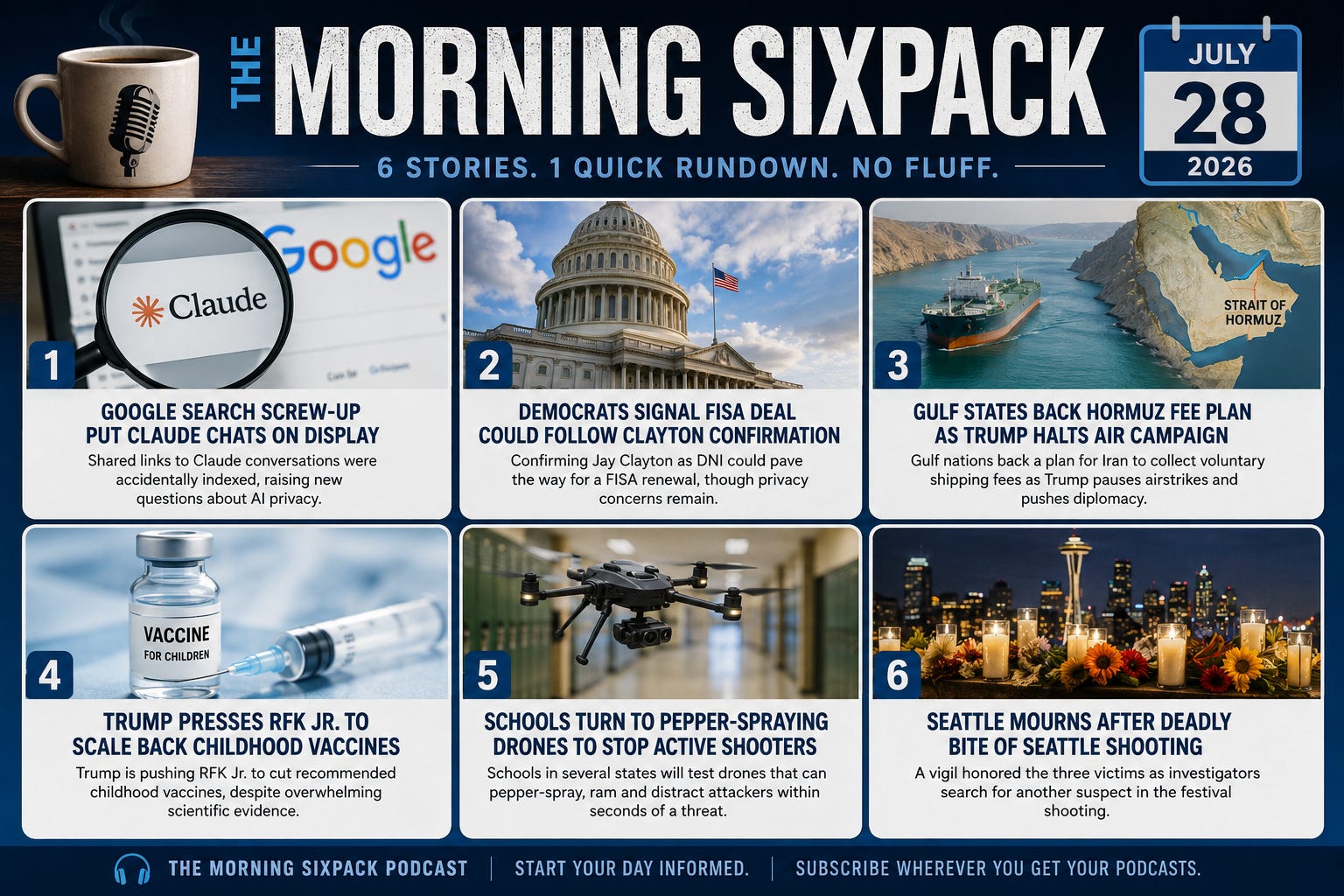
If you're going to promise "shared" doesn't mean "searchable," maybe make sure Google gets the memo.
Google Search Screw-Up Put Claude Chats on Display
People who shared Anthropic Claude chats discovered some of those conversations could be found through Google and Bing search results.
Privacy promises don’t mean much if search engines can still find what users thought was tucked away.
Anthropic lets users create public links to share chatbot conversations, but over the weekend people realized some of those links had been indexed by search engines. The exposed chats ranged from legal ethics questions and political advice to erotic role play. The issue appears tied to how Anthropic handled search engine instructions rather than a hack or data breach.
The problem comes down to a technical detail. Anthropic relied on a robots.txt file to tell search engines not to crawl shared chats, but both Google and Bing recommend using a “noindex” tag on individual pages as well. WIRED found the exposed chat pages lacked that extra protection, making them eligible to appear in search results under certain conditions.
Google says this wasn’t its mistake. Spokesperson Ned Adriance told WIRED,
“Neither Google nor any other search engine controls what pages are made public on the web, and these pages were indexed across many search engines. We give site owners clear controls to decide whether pages can be crawled or indexed, and we always respect those directives.”
Anthropic did not respond to multiple requests for comment.
While Google has since stopped displaying the shared chats in search results, Bing was still showing hundreds of them when WIRED checked. More importantly, the pages still reportedly lack the recommended “noindex” tag, meaning they could potentially be indexed again. If you’ve shared Claude conversations, now might be a good time to review your privacy settings.
Source: WIRED
Editor: The internet has one ironclad rule: If something can accidentally become public, eventually it probably will. “Shared” and “private” are words that deserve a lot more engineering than marketing.
Washington may finally move on FISA—not because everyone suddenly agrees, but because even critics think almost anyone is an upgrade over the guy in charge.
Democrats Signal FISA Deal Could Follow Clayton Confirmation
Senate Democrats say confirming Jay Clayton as director of national intelligence could finally break the month-long stalemate over renewing the government’s surveillance powers.
The biggest obstacle may not be FISA anymore—it may have been who was running the intelligence community.
Democrats have blocked reauthorizing the Foreign Intelligence Surveillance Act since it expired in June, largely over concerns about acting Director of National Intelligence Bill Pulte. Critics questioned Pulte’s lack of experience and his swift staffing cuts across the intelligence community, making his removal a key condition for some lawmakers.
Sen. Mark Warner, the top Democrat on the Senate Intelligence Committee, said he won’t vote to confirm Clayton, but still called him “a vast improvement” over Pulte. Other Democrats, including Sens. Mark Kelly and Angus King, also indicated they’re more willing to move forward on FISA once Clayton is officially in place.
Not everyone is on board. Sen. Andy Kim said replacing Pulte doesn’t solve his broader concerns about privacy protections and court oversight under FISA, particularly during the Trump administration. Even if enough Democrats eventually support the bill, a final Senate vote may wait until lawmakers return in September because of a packed legislative calendar.
Source: NOTUS
Editor: Congress has a talent for turning “urgent national security” into “we’ll get to it after recess.” Apparently even surveillance laws have to wait their turn.
Nothing says "free navigation" quite like suggesting ships voluntarily pay up to keep moving.
Gulf States Back Hormuz Fee Plan as Trump Halts Air Campaign
Gulf nations are backing an Omani proposal that would let Iran collect voluntary fees from ships using the Strait of Hormuz in an effort to stabilize one of the world’s most important energy routes.
After months of conflict, the fight over the Strait of Hormuz may be shifting from missiles to money.
According to Reuters, Oman has won support from Gulf states for a proposal that would allow Iran to collect voluntary contributions from ships using the Strait of Hormuz, rather than imposing mandatory transit fees. The plan would mirror the Strait of Malacca model, where shipping companies voluntarily help fund navigation, environmental protection, and search-and-rescue operations.
The proposal comes after President Trump abruptly ended a renewed U.S. bombing campaign against Iran over the weekend, saying “good talks” are underway while warning military action could resume if negotiations fail. The conflict disrupted one of the world’s busiest oil chokepoints, sending energy markets into turmoil before the ceasefire eased tensions.
Iran says it wants to jointly manage the strait with Oman, while the U.S. insists international shipping should continue moving freely without any payment requirement. Tehran maintains it has not sought new negotiations with Washington, despite Trump’s optimism that diplomacy could still end the five-month conflict.
Markets welcomed the pause in fighting. Reuters reported Brent crude prices dropped sharply after the bombing campaign ended, reflecting hopes that oil shipments through the Strait of Hormuz can return to normal if a broader agreement holds.
Source: Reuters
Editor: “Voluntary” has a funny way of becoming “highly encouraged” when your cargo is worth millions and the alternative is sitting in the Gulf wondering what happens next.
White House staff wanted to change the subject. Trump apparently wanted to change the vaccine schedule.
Trump Presses RFK Jr. to Scale Back Childhood Vaccines
President Trump is reportedly pushing Health and Human Services Secretary Robert F. Kennedy Jr. to move faster on reducing the number of vaccines recommended for children, despite overwhelming scientific evidence rejecting a link between vaccines and autism.
The biggest pressure on RFK Jr.’s vaccine agenda isn’t coming from critics—it’s coming from the president himself.
According to The Wall Street Journal, Trump has repeatedly urged Kennedy to make childhood vaccines and autism his top health priority, even as White House political advisers encouraged Kennedy to focus instead on more popular issues like improving food quality ahead of the midterm elections. The report says Trump has grown frustrated with what he sees as slow progress.
The Journal reports Trump wants federal officials to reduce the number of recommended childhood vaccines and hopes doing so would lower autism rates over time. That position runs counter to decades of scientific research. Multiple large studies have found no evidence that childhood vaccines—including the measles, mumps, and rubella (MMR) vaccine—cause autism, and public health experts continue to support the current vaccine schedule.
The administration has already faced legal setbacks after a federal judge blocked earlier efforts to reduce the childhood vaccine schedule. Meanwhile, Kennedy’s team is pursuing new vaccine studies while also dealing with measles outbreaks, staffing shortages, and other public health challenges. The Journal also reports White House insiders have speculated about Kennedy’s long-term future, although both Trump and Kennedy have publicly praised one another.
Source: The Wall Street Journal (free article)
Editor: Every administration gets to choose its priorities. The challenge comes when politics starts chasing conclusions that science has already spent decades testing.
We've officially reached the point where schools are shopping for anti-shooter drones instead of asking why they need them.
Schools Turn to Pepper-Spraying Drones to Stop Active Shooters
Schools in Florida, Georgia, and Colorado are rolling out drones designed to confront active shooters within seconds of an attack.
The latest answer to school violence isn’t another security guard—it’s a flying robot armed with pepper gel.
At least nine schools will begin testing the nonlethal drones this school year. Built by Texas-based Mithril Defense, the plastic aircraft can be launched by teachers through a panic button or app, then remotely piloted to reach a suspected shooter in as little as 15 seconds. The drones can flash strobe lights, blast sirens, spray pepper gel, and even ram a target at speeds of up to 60 mph.
The company says the technology was inspired by the delayed police response during the 2022 Uvalde school massacre and is intended to buy time until law enforcement arrives. Supporters argue the system could be especially valuable at schools without on-campus resource officers, while Florida and Georgia lawmakers have approved pilot programs worth more than $1 million combined.
Critics aren’t convinced. School safety experts warn remote operators could mistake students or responding officers for attackers, and gun-control advocates argue the money would be better spent preventing violence before it starts rather than responding after shots are fired. The drones have been tested in simulations but have never been used during an actual school shooting.
Source: The Washington Post (free)
Editor: Every new gadget promises to solve the last tragedy. Here’s hoping these drones spend their entire lives collecting dust in a storage box.
A summer festival should end with full stomachs and good memories—not another candlelight vigil.
Seattle Mourns After Deadly Bite of Seattle Shooting
Hundreds gathered in Seattle to honor the three people killed in the Bite of Seattle mass shooting as investigators continued searching for another suspect.
The shooting may be over, but the investigation—and the grief—are just beginning.
About 100 people gathered Monday evening at Seattle Center’s International Fountain for a vigil honoring the victims of Sunday’s shooting, which left three people dead and four others wounded. Mayor Katie Wilson, Police Chief Shon Barnes, and community members called for unity, healing, and an end to gun violence before observing three minutes of silence and singing “This Little Light of Mine.”
Authorities identified the victims as 19-year-old Junior Cee Niko Semo, 44-year-old Carlos Israel Sanchez Villalba, and 56-year-old Ashley Whitehead. Police now believe the violence was gang-related and that Semo was one of at least two people who exchanged gunfire during the crowded festival.
A 15-year-old suspect remains in custody on assault and firearms charges, while detectives continue searching for a third person believed to have been involved. Investigators are reviewing surveillance footage, though officials say no cameras directly captured the shooting itself. No one has yet been arrested on homicide charges as the investigation continues.
Source: KOMO News
Editor: Every community deserves festivals where the loudest sound is live music, not gunfire. Sadly, that keeps becoming a harder promise to keep.