



The Morning Sixpack stays free because the news that shapes your life should not be hidden behind a paywall. Paid subscribers are not paying for access. They are helping fund the research, writing, and independent voice that goes into every issue. Become a paid subscriber and help keep smart, honest news analysis free for everyone.
Federal agents searched Ilhan Omar’s home, and the Justice Department says it’s part of a criminal investigation, while offering few details.
Federal Agents Search Ilhan Omar’s Home In Criminal Investigation
Federal agents searched Democratic Rep. Ilhan Omar’s home on Monday as part of a criminal investigation, according to two people familiar with the matter. The search was conducted by Homeland Security Investigations agents, the people told The Associated Press. They spoke anonymously because they were not authorized to discuss an ongoing investigation. The focus of the investigation was not immediately clear.
The Justice Department confirmed that HSI agents carried out a court-authorized search in the Washington, D.C., area. In a statement, it said the search warrant was secured by the department and that the action was part of an ongoing federal criminal investigation. The department did not provide further details.
The search comes months after Vice President JD Vance said the administration would investigate allegations of immigration fraud involving Omar. She has denied the allegations. An email seeking comment was sent to a representative for Omar, while a message left with the Department of Homeland Security was not immediately returned.
Omar, 44, represents Minnesota’s 5th Congressional District, which includes Minneapolis. First elected in 2018, she is part of the group of progressive Democratic lawmakers known as The Squad and has been a prominent opponent of President Donald Trump.
Republicans have questioned Omar’s past since before her election, including making allegations that she married her brother and committed immigration fraud. Omar has broadly dismissed those claims as “disgusting lies.” In May, Vance said, “It certainly seems like something fishy is there, but everybody’s entitled to equal justice under the laws,” adding that the administration would investigate and prosecute if it believed a crime had occurred.
Editor: A search warrant is a serious development. The lack of detail leaves plenty unknown, and no room to treat old allegations as proven.
Sure sounds like the Trump administration is continuing its weaponization of the justice department.
Source: AP News
Trump announced an energy ceasefire, Russia kept striking energy sites, and Moscow still won’t say whether it agreed. That’s a shaky start for a truce.
Zelenskyy Says Russian Strikes Continue After Trump Announces Energy Ceasefire
Ukrainian President Volodymyr Zelenskyy said Russia continued attacking Ukraine’s energy facilities after President Donald Trump announced an energy ceasefire. Zelenskyy said Ukraine learned of the proposed deal through media reports and was prepared to honor a mutual pause in strikes. But he said he had not heard Russia approve it. Kremlin spokesman Dmitry Peskov said Monday that “Contacts are ongoing.”
Zelenskyy said Russian attacks hit several energy facilities after Trump’s announcement, including a power plant in Kharkiv, a gas production site, and a civilian gas station. Trump’s social media post said the ceasefire took effect immediately but offered few details. Zelenskyy remarked that Russian President Vladimir Putin “does not read Truth Social.” (Nobody does.)
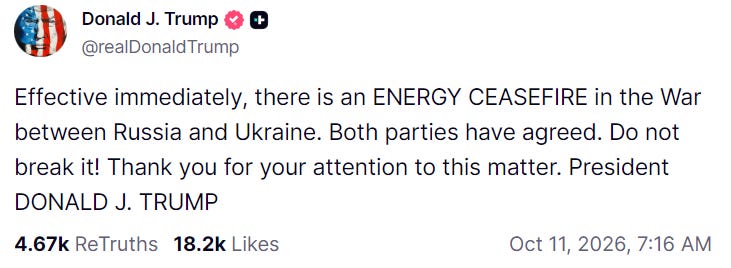
Trump had announced a similar energy-strike agreement in September, but that proposal also lacked details—and clearly didn’t happen.
Zelenskyy said Ukraine would stop striking Russian refineries if Moscow halted attacks on Ukraine’s energy system. He asked Trump to press Russia to agree, warning that Ukraine would respond if Russia did not observe a ceasefire this winter. Zelenskyy said the agreement could be a major step toward ending the war, but Ukraine was waiting for details of U.S.-Russia discussions.
EU foreign policy chief Kaja Kallas welcomed the prospect of a pause but said there was no sign Russia would respect one. She also argued that a ceasefire should protect people, not just energy infrastructure. Zelenskyy said wartime elections were impossible under current conditions, though he would work toward holding them after a full ceasefire lasting at least 60 days. Peskov said Putin would be ready to halt strikes on election day, while dismissing Kyiv’s request for a longer pause.
Russian attacks also caused casualties. Ukrainian officials said a drone strike in the Kharkiv region killed three people and injured nine, including children; two people were injured in daytime strikes on Kyiv. Ukraine’s Air Force said it had shot down or suppressed 89 of 121 Russian drones overnight, while Russia’s Defense Ministry said it intercepted 151 Ukrainian drones. The Russian ministry also said its forces struck Ukrainian port infrastructure and a bulk carrier heading to Odesa with military cargo.
Editor: A ceasefire announced on social media is still waiting for the two direct sides to say it exists. Meanwhile, the strikes keep coming. And Trump continues to look like a chump.
Source: AP News
Saudi Arabia’s crown prince is juggling Houthi attacks, strained defenses, and costly economic ambitions. The “Vision 2030” spreadsheet is having a rough year.
Houthi Attacks Test Saudi Arabia’s Security and Economic Plans
Saudi Arabia is facing escalating Houthi attacks that threaten its security and Crown Prince Mohammed bin Salman’s drive to diversify the oil-dependent economy. The strikes have hit airports and energy facilities, including the East-West pipeline that lets the kingdom ship oil to the Red Sea while the Strait of Hormuz is blocked. The Wall Street Journal reports that the attacks have also raised doubts about a major investment conference scheduled for later this month. The Saudi press office did not respond to the Journal’s request for comment.
A Houthi missile strike on Riyadh’s international airport killed at least 13 people and injured hundreds, according to officials briefed on the attack. The Journal reported that two terminals were hit, with partial roof collapses, and that another attack on the closed airport the next day caused a fire and one death. The Houthis have also targeted the King Khalid International Airport at least four times, while Saudi officials say they are running low on air-defense interceptors. President Trump said the United States was communicating with the Houthis and might join Saudi strikes against the group.
The violence is adding to the economic pressure on Prince Mohammed’s ambitious development agenda. Foreign investment is running behind the kingdom’s 2030 target, non-oil economic activity contracted in the second quarter, and the Finance Ministry expects GDP to shrink by 3.6% in 2026. Several large projects are stalled or under review, and Saudi Arabia abandoned plans to host the 2029 Asian Winter Games. The country still faces the expense of hosting the World Expo in 2030 and the soccer World Cup in 2034.
The conflict also threatens Saudi oil exports and the kingdom’s broader economic ambitions. After the Houthis announced a maritime blockade in July, an attack on the East-West pipeline in September struck at the route Saudi Arabia had relied on to bypass Hormuz. Attacks on aviation add another risk for a country trying to make tourism a pillar of its economy. The Journal said the costs of war have widened the budget deficit and could push the economy into contraction.
The Houthis’ renewed campaign follows years of conflict with Saudi Arabia, which intervened in Yemen’s civil war in 2015 and reached a ceasefire with the group in 2022. Saudi officials reportedly believe Iran has pressed the Houthis to enter the current conflict, though some also assessed the group would act in its own interests. The United States has so far resisted Saudi requests for military help to reverse Houthi gains, despite Prince Mohammed’s efforts to build ties with Trump and a pledge of major U.S. investment. Riyadh is seeking help from Pakistan, searching globally for air defenses, and exploring diplomacy, while weighing the risks of a deeper military response.
Editor: Saudi Arabia’s grand plans now have to compete with missiles, interceptor shortages, and the bill for a war it hoped to keep contained.
Source: The Wall Street Journal
Two economists won the Nobel for explaining why expectations matter when policymakers try to keep the economy from careening between inflation and unemployment. Turns out people don’t just wait around for officials to pull the levers.
Nobel Economics Prize Goes To Scholars Behind New Keynesian Thinking
Americans Robert Hall of Stanford University and Michael Woodford of Columbia University have won the 2026 Nobel Memorial Prize in Economic Sciences. They were honored for work on how households and businesses make decisions about spending and prices. Their research became a foundation of the “New Keynesian” approach, which aims to soften economic booms and busts and reduce the risks of high unemployment and runaway inflation.
The economists’ work puts people’s expectations at the center of economic policy. Hall studied how households make purchasing decisions based not only on current income but also on what they expect to earn later. Woodford focused on how businesses set prices, often looking ahead because changing prices can be costly. The prize committee said the pandemic and subsequent supply shocks showed how economic disruptions can drive both job losses and higher living costs.
The award recognizes a shift in economic thinking after the Great Depression, when John Maynard Keynes argued that governments could stimulate demand during downturns and restrain it during inflationary booms. That approach faced a major challenge in the 1970s, when the economy experienced rising unemployment and inflation at the same time. Hall and Woodford’s work added a focus on the choices households and businesses make, and how those choices shape the wider economy.
Because consumers and businesses look ahead, the laureates argued that policymakers should clearly explain their plans. Woodford told reporters that stabilizing the economy should not be treated as officials simply pulling levers without regard to what people understand. He said policy tools work better when the public knows what authorities are trying to accomplish.
The economics award is a memorial prize established in Alfred Nobel’s name, rather than one of the original five Nobel Prizes. Prize committee chairman John Hassler said governments and central banks should try to reduce the scale of economic swings and limit the risk of prolonged high unemployment or uncontrolled inflation. Woodford urged policymakers to explain “why the things that are being done are being done.”
Editor: Turns out economic policy works better when people know what the plan is. A modest bar, but one worth a Nobel.
Source: NPR
Kimberly Guilfoyle could be on her way out as ambassador to Greece, as allegations mount and the State Department’s inspector general looks into them.
Trump & Rubio Weigh Guilfoyle’s Future as Ambassador to Greece
President Donald Trump and Secretary of State Marco Rubio are considering whether to remove U.S. Ambassador to Greece Kimberly Guilfoyle after reports of alleged misconduct. A senior U.S. official told The Associated Press that the two were angry about the reports and could decide what to do this week. The official said Rubio was particularly frustrated after hosting Guilfoyle during his recent visit to Athens. The allegations have not been established as fact.
The reported allegations include accepting improper gifts and services, threatening a Greek official, and offering access to administration officials in exchange for help paying a $100,000 credit card bill. Guilfoyle’s lawyers deny wrongdoing, saying the money she sought from a Trump donor was payment for previously arranged public appearances and speaking engagements. They also said she sought and followed State Department guidance before private-plane travel. The lawyers said they were considering legal options to collect the alleged debt.
The State Department’s inspector general is looking into the allegations, according to a second U.S. official, though that official could not say whether a formal investigation had begun. The department declined to comment. Democratic lawmakers on House and Senate foreign affairs committees, along with the top Democrat on the House Oversight Committee, have called for an investigation.
The allegations have drawn public irritation from Rubio, who initially defended Guilfoyle and called her a strong ambassador. After additional reports appeared, he told reporters he would not treat unnamed-source accounts as gospel and said he would not comment on claims he could not confirm. A U.S. official said Rubio had grown more frustrated as the reports continued.
Guilfoyle, a former Fox News host and California prosecutor, was once engaged to Donald Trump Jr. and married to California Governor Gavin Newsom. The reports cited by the AP include claims that she boasted to guests about the United States’ ability to undermine the Greek government, promoted a Greek company’s business interests, and allowed its lobbyist into private diplomatic meetings. Other accounts alleged she pressed to attend a Greek-themed event at the World Economic Forum and alienated embassy staff. Guilfoyle has not directly addressed the reports.
Editor: Washington’s ambassadorial job description seems to include diplomacy, paperwork, and keeping your credit-card bill out of the headlines.
Source: AP News
They came to Washington promising to cut government; a Washington Post analysis says former DOGE staffers have since helped raise at least $500 million for private ventures.
Former DOGE Staffers Turn Washington Stints Into Startup Capital, Post Finds
Roughly two dozen former DOGE staffers have moved into private-sector jobs or investments connected to their government work, according to a Washington Post analysis. Some have founded companies, taken executive roles, or invested in startups seeking government contracts or approvals. Startups founded by, or with key investment from, DOGE alumni have raised at least $500 million, the analysis found. The businesses span cybersecurity, defense technology, artificial intelligence, and data centers.
Investors appear to value the alumni’s mix of technology experience and government connections, even though many served only briefly in federal roles. Several of the startups are new and have little public activity, while some have attracted billion-dollar valuations. At least six alumni registered on Sam.gov, the federal contracting portal, according to the Post. The findings draw on government records, investor databases, and funding disclosures.
One example is Cathedral, an AI-enabled cybersecurity company founded by former DOGE members Gavin Kliger and Luke Farritor. Investors value it at $1.4 billion, and the company aims to sell to businesses and government agencies, including the Pentagon, according to a person familiar with the firm. Kliger served as the Defense Department’s chief data officer until April 2026 and began fundraising for Cathedral by May. A 2020 Pentagon instruction bars senior employees from seeking government contracts for up to two years after leaving, but an ethics expert said fundraising for a startup that may later seek government work could fall into a gray area.
Other alumni have moved into ventures that may benefit from government business or approvals. Former DOGE members founded Special, an AI startup whose founders said they wanted to extend the ethos of their government work into the private sector; the company has drawn investment from at least seven DOGE staffers or associates. Former Interior Department DOGE staffer Tyler Hassen became CEO of a cleaning-supply company that pivoted toward data-center infrastructure and permitting, then announced a $100 million public offering. Elie Mishory, who previously held roles at the Commodity Futures Trading Commission, joined sports prediction market company Novig, which later touted its regulatory approval as among the fastest in agency history.
The Post reports that the revolving door has long been criticized, but ethics experts say the short DOGE stints raise questions existing rules may not address. Former officials and investors argue the experience gave alumni a useful view of government operations; critics warn the combination of agency knowledge and private financial interests can create the appearance of monetizing public service. Investors have reportedly advised some founders to prepare for scrutiny if Democrats regain control of Congress. Jeff Hauser of the Revolving Door Project said federal ethics laws were built for longer-serving employees and may need to be reconsidered.
Editor: Washington’s revolving door has always spun. DOGE just seems to have added a venture-capital fund on the way out. So much for rooting out “waste, fraud, and abuse.” Pot, meet Kettle.
Source: The Washington Post
Check out the Archives here: