



Editor: You may notice that I’ve combined the podcast with the regular Morning Sixpack today. Tell me what you think!
The Morning Sixpack stays free because the news that shapes your life should not be hidden behind a paywall. Paid subscribers are not paying for access. They are helping fund the research, writing, and independent voice that goes into every issue. Become a paid subscriber and help keep smart, honest news analysis free for everyone.
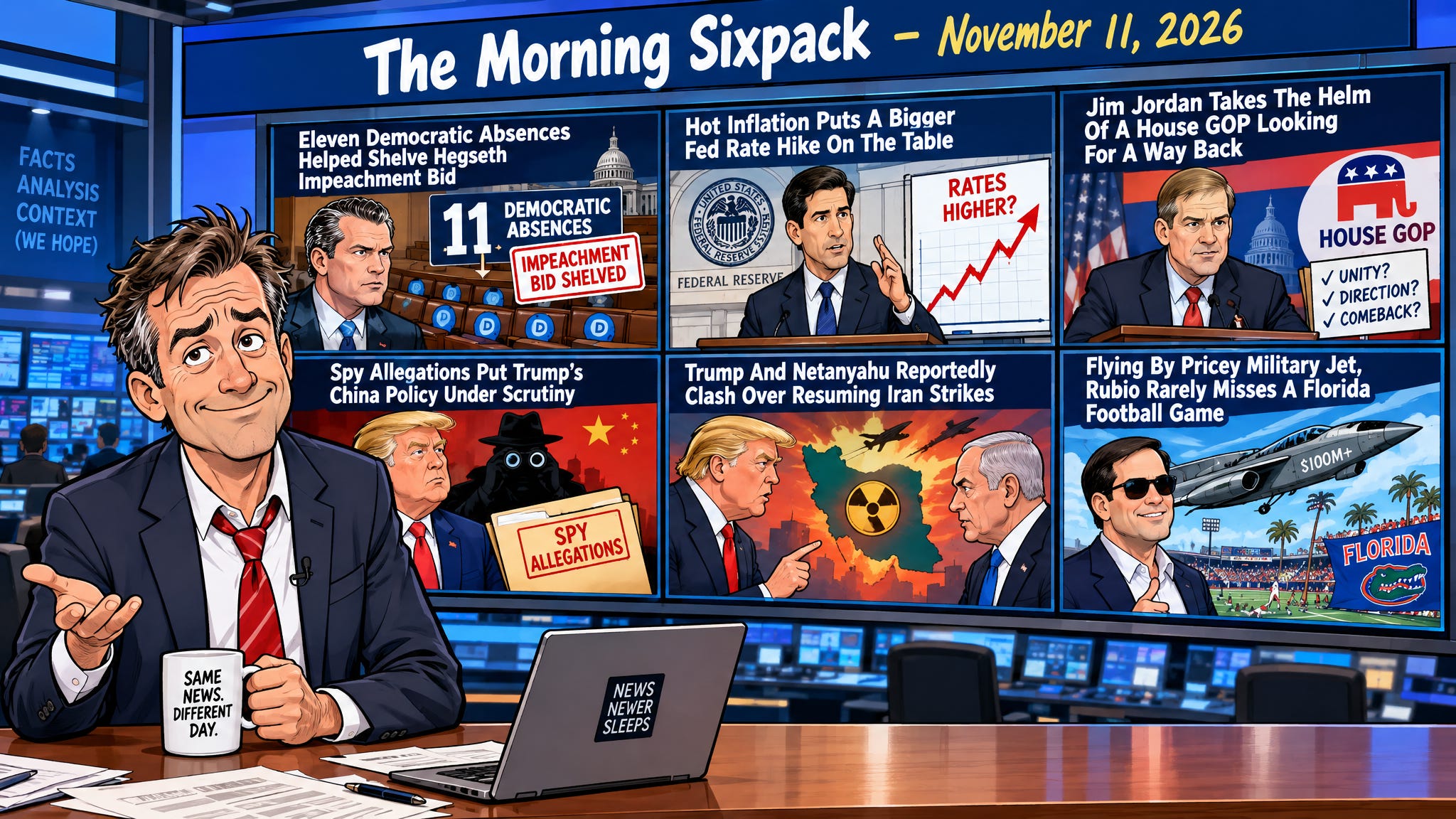
The House shelved Pete Hegseth’s impeachment bid by seven votes, with 11 absent Democrats helping the procedural maneuver do its job.
House Shelves Hegseth Impeachment Effort As 11 Democrats Miss The Vote
The House voted 211–204 to send impeachment articles against Defense Secretary Pete Hegseth to the Judiciary Committee, effectively sidelining the effort for the rest of the current Congress. The vote was about referring the articles—not whether to impeach Hegseth. Introduced by Republican Thomas Massie, the articles accuse Hegseth of abusing his power and conducting illegal military operations. The Republican-led House has eight weeks left before the current Congress ends.
Eleven absent Democrats made the narrow result possible. Eighteen lawmakers missed the vote: 11 Democrats and seven Republicans. Massie was the only Republican to oppose sending the articles to committee; the remaining votes fell along party lines. Had the absent Democrats voted against the measure with their colleagues, they would have had enough votes to defeat it and force a full House vote on impeachment.
The absent Democrats were Julia Brownley, Lou Correa, Nancy Pelosi, Laura Gillen, Steven Horsford, Jonathan Jackson, Brittany Pettersen, Melanie Stansbury, Haley Stevens, Marilyn Strickland and Frederica Wilson. Strickland, Jackson, Stansbury and Gillen cited Washington traffic; Pelosi said she was in California for a veterans event, Correa was there ahead of a health procedure, and Horsford’s office cited a personal emergency. Pettersen said she had been “denied the ability to vote on this motion,” without explaining further.
Several lawmakers said they would have opposed the procedural move, and Jackson and Stansbury said they recorded their opposition in the Congressional Record—a gesture that does not change the official tally. Stevens, Brownley and Wilson offered no immediate explanation for their absences. The result drew sharp criticism from Democrats and progressive commentators, who faulted the attendance and questioned whether House Democratic leader Hakeem Jeffries had done enough to rally his caucus. Trump declared the impeachment effort had “miserably FAILED!”
The effort could return when Democrats take control of the House and Senate on January 3, and Jeffries said he would discuss another impeachment bid with members. But impeachment by the House would only bring charges; it would not automatically remove Hegseth. A Senate conviction requires a two-thirds vote, meaning Democrats would likely need about a dozen Republicans to join them. The Senate has convicted only eight federal officials—all judges—and acquitted Trump in both of his impeachments.
Editor: If your caucus knows the vote is coming, “traffic” is a lousy whip count.
Source: Al Jazeera
Inflation came in hot again, and one Fed official says the numbers are getting “borderline disturbing”—not exactly the report shoppers wanted.
Goolsbee Calls October Inflation “Borderline Disturbing” As Fed Weighs Bigger Hike
Chicago Fed President Austan Goolsbee called the latest inflation report “borderline disturbing” and said the country has a real inflation problem to address. The Consumer Price Index rose 0.4% in October, above economists’ expectations and marking the third consecutive month of unusually strong price increases. Goolsbee said tariffs had not faded as a source of price pressure as he had hoped, while persistent services inflation also worries him. He said high prices are on the minds of businesses, nonprofits and consumers.
The report landed just as Federal Reserve officials are weighing whether to raise interest rates again—and by how much. Fed Governor Christopher Waller said a half-point increase could be on the table in December if core inflation came in around 0.3%; that is where it landed. Dallas Fed President Lorie Logan said she sees a need for two more quarter-point increases and that the Fed could move faster this winter. The committee last raised rates by a quarter point in September, bringing its target range to 3.75%–4%, then held rates steady in October.
Goolsbee warned that people may start expecting inflation to remain high, which could make bringing it down “much more painful.” He did not say whether he supports a December rate hike, saying he does not want to tie his hands ahead of future meetings. Goolsbee will be a voting member of the rate-setting committee next year; Waller and Logan are voting members this year.
Market expectations shifted sharply after the report and officials’ comments. Fed funds futures now point to a December rate hike, with a 15% chance of a half-point increase. Futures put the odds of rates reaching 4.25%–4.5% by January at 60%, whether through one half-point move or two quarter-point increases. They assign a 10% chance to rates reaching 4.5%–4.75% by then.
The Fed typically changes rates in quarter-point steps, but persistently high inflation has made a larger move part of the discussion. Goolsbee has not endorsed a specific December action, and the decision remains with the full committee. For borrowers, businesses and anyone waiting for price pressures to ease, the central bank’s next move could matter well beyond the trading screens.
Editor: “Borderline disturbing” is Fed-speak for inflation refusing to take the hint.
Source: CNBC
Republicans lost the House, then chose a fighter to lead them from the minority—because apparently the postmortem called for more combat.
House Republicans Pick Jim Jordan To Lead Them Through The Minority
House Republicans have chosen Rep. Jim Jordan of Ohio to lead their conference in the next Congress, betting his combative style can help the party recover from its midterm losses. Jordan said Republicans would answer Democratic proposals for more government with “more freedom,” promising to carry that fight through committees, the House floor and the campaign trail. His task is to unite a fractious party, shape a message for voters ahead of 2028 and defend President Trump from investigations Democrats have promised.
Jordan’s win also reflected Republicans’ appetite for change after the election defeat. He defeated outgoing Majority Leader Steve Scalise, whose years in leadership became a liability for some members after the party’s losses. Rep. Darin LaHood said Jordan had a detailed plan to get Republicans out of the minority and was seen as a fighter. He added that the result might have been different if the election had been closer.
Jordan is a co-founder of the House Freedom Caucus, a group of hard-line conservatives that has often challenged Republican leaders and blocked party legislation. As Judiciary Committee chair, he has also led investigations into Democrats and Trump’s political opponents. His elevation follows a turbulent 2023 House speaker contest: Scalise won the Republican nomination, then withdrew when he lacked enough support, and Jordan later failed in several floor votes for speaker.
The leadership vote did not produce the wholesale reset some Republicans wanted. Tom Emmer retained the whip post, and Lisa McClain remained conference chair after beating back challengers. Trump did not intervene in the contests, even as some Republicans blamed his policies—including the Iran war, tariffs and deportation surge—for hurting the party. Rep. Rich McCormick said Jordan argued Republicans should lead with their own message rather than wait to see what Trump would say.
Democrats condemned the choice as evidence Republicans had learned little from the election, pointing to Jordan’s conservative record and the promotion of Stephen Miller to White House chief of staff. Republicans countered that the conference had become more conservative and that Jordan could unite its factions and prepare for fights with Democrats, including any future impeachment effort against Trump. Jordan now has to turn that confidence into a workable strategy—and prove that a party built around political combat can do more than keep swinging.
Editor: The GOP’s new plan for winning back voters appears to be giving the microphone to one of its best-known brawlers.
Source: The Hill
Trump says the alleged spy case made little impact on him, even as it raises questions about who gets heard when chip policy is on the table.
Rubio Briefed Trump On Huang Affair Claims Aboard Air Force One, Report Says
A reported Chinese espionage case involving Nvidia CEO Jensen Huang is sharpening questions about President Trump’s approach to China and advanced technology. The Washington Post reports that Secretary of State Marco Rubio briefed Trump in May on intelligence alleging Huang had an affair with a woman believed to be a Chinese spy. Trump said Monday he did not recall knowing about it before his trip to China, though the report says Rubio delivered the warning aboard Air Force One before Huang joined the trip. Trump later said the matter “didn’t make much of an impact” on him.
Trump’s response sits uneasily alongside his warnings that the United States cannot afford to lose the AI race to Beijing. He has supported allowing Nvidia to sell some less advanced chips to China, despite objections from administration China hawks who fear the exports could help Beijing narrow the technology gap. Huang has lobbied to preserve access to the Chinese market and has become a frequent presence in Trump’s orbit. The president has not said he will raise the allegations with Chinese leader Xi Jinping at their upcoming summit, and left open the possibility Huang could join him.
Huang’s access to Trump is part of why analysts say the alleged operation matters. Craig Singleton of the Foundation for Defense of Democracies said a trusted relationship with Huang could have helped Beijing shape arguments over chip controls or learn about U.S. plans. The allegations have not established that Huang’s policy views were influenced by China. But Singleton said they could make those views harder to defend in Washington, even if they were entirely Huang’s own.
Democrats are demanding answers and tighter export controls. Senate Minority Leader Chuck Schumer accused Trump of defending Huang instead of protecting national security, while House Intelligence Committee Democrat Jim Himes said his committee was seeking information on whether chip-export decisions were improperly influenced or compromised. Nvidia and Trump’s former AI and crypto adviser David Sacks have argued that keeping China’s AI industry dependent on U.S. chipmakers could benefit the United States. The allegations have handed the administration’s China hawks a fresh argument against that approach.
Beijing has called the allegations groundless and suggested the leaks may be intended to disrupt improving U.S.-China relations. Analysts cited by the Post said the White House and Beijing appeared unlikely to let the episode derail the summit. Trump has continued to back Huang and has signaled he wants to preserve the diplomatic thaw with Xi. That leaves a pointed question hanging over the meeting: how seriously will Washington treat the alleged security risk when the people involved also have a seat near the president?
Editor: When national security and a favored executive’s access collide, “it didn’t make much of an impact” is not exactly a confidence-building answer.
Source: The Washington Post
President Donald Trump and Israeli Prime Minister Benjamin Netanyahu reportedly had a heated phone call over whether to resume military action against Iran.
Report: Trump And Netanyahu In “Shouting Match From Hell” Over Iran Strikes
Trump and Netanyahu reportedly shouted over whether to restart strikes on Iran, while both governments insist the call was less dramatic than the headlines.
Israeli outlet Ynet, citing people familiar with the conversation, described it as “a shouting match from hell.” Netanyahu has reportedly pressed for renewed strikes, while Trump has signaled he wants to give diplomacy another chance as negotiations continue.
The accounts of the call sharply differ. Netanyahu’s office dismissed the report as “fake news” and “complete nonsense.” A senior Israeli official confirmed the two leaders spoke, but said it was “very much not a difficult conversation.” The disagreement itself has not been independently established in the material provided.
Netanyahu told Israel’s parliament Tuesday that Iran was working to renew its nuclear threat and said permanently removing it required toppling the ayatollah regime. Trump took a more cautious public line after meeting with Qatari Prime Minister Sheikh Mohammed bin Abdulrahman Al Thani, whose country is mediating talks between Washington and Tehran. Trump said military action did not seem “a very necessary thing,” while adding that U.S. forces remained “locked and loaded.”
The reported dispute comes amid concern among Arab leaders about Netanyahu’s efforts to persuade Trump to restart the war. The Financial Times reported that one source familiar with the matter said Netanyahu was calling Trump every day. Trump also said in a CBS 60 Minutes interview that he was not looking to take military action and saw no reason to do so.
For now, Trump’s public remarks favor continuing diplomacy, but his warning about U.S. military readiness leaves the possibility of escalation open. Netanyahu’s stated position points in the opposite direction, with regime change framed as the only permanent solution. Whether their reported clash changes policy—or was even as fierce as described—remains unclear.
Editor: “Locked and loaded” is a curious way to reassure people you’re hoping diplomacy works.
Source: Mediaite
Marco Rubio says his trips to see his son play football are about showing up as a father. The government aircraft involved have racked up an estimated $1.2 million in flight costs.
Rubio’s Government Jet Trips To Florida Football Games Cost An Estimated $1.2 Million
Since taking office, Secretary of State Marco Rubio has flown to at least 10 University of Florida football games, including at least five this fall, according to Washington Post analysis and State Department records. The department confirmed at least 23 government-aircraft trips to Gainesville, 15 of them classified as solely personal. Using Defense Department hourly rates, the Post estimated the flights cost taxpayers more than $1.2 million.
Rubio is required to use government aircraft for security and secure-communications reasons, even for personal travel. Federal rules require him to reimburse the government an amount equivalent to an economy-class ticket, which covers only a fraction of the aircraft’s operating cost. Rubio and the State Department defended the trips but declined to say how much he has repaid. The Post estimated an average round-trip commercial fare of about $820; if that were the reimbursement basis, the Gainesville trips would amount to roughly $18,000.
Rubio said he would keep trying to attend events important to him and his family. His son Anthony is a walk-on running back at Florida, and Rubio has attended every game his son has played in, along with games where he did not see the field. Flight records also show six Gainesville trips aligned with campus holidays, graduation ceremonies or breaks in the football schedule; the State Department did not explain those trips.
Ethics experts cited by the Post said the travel appears to follow federal rules, but raises questions about stewardship of public funds and transparency. The department has not disclosed trip classifications or reimbursement records. Watchdog groups say the public should be able to see how the trips were categorized and what Rubio repaid.
There is an added wrinkle: As a senator in 2023, Rubio called for an investigation into then-Transportation Secretary Pete Buttigieg’s use of government aircraft, saying taxpayers deserved assurances that public funds were not wasted. The inspector general later found Buttigieg had complied with the rules and used military aircraft for eight trips, costing $59,000. Rubio’s case is not identical—ethics experts noted that visiting his son differs from leisure travel—but the questions he once raised about accountability now apply to his own travel.
Editor: Showing up for your kid is good parenting. Sending taxpayers the jet bill makes it a much more expensive hobby. Where is the bellyaching about “waste, fraud, and abuse?”
Source: The Washington Post
Read The Morning Sixpack Archives here:


