




The Morning Sixpack stays free because the news that shapes your life should not be hidden behind a paywall. Paid subscribers are not paying for access. They are helping fund the research, writing, and independent voice that goes into every issue. Become a paid subscriber and help keep smart, honest news analysis free for everyone.
A condo dispute over mold and water damage ended in a deadly attack—a lawsuit nobody wanted to see reach its final act.
Washington Gunman Told Building Manager Condo Dispute Drove Deadly Attack
The man who killed one person and wounded four others in a Northwest Washington shooting told a building manager that long-running frustrations with his condominium had driven him to act, according to the manager. Charelle Ferguson said Matt Lambert called her around 9 a.m. Thursday, after she had been checking on residents. He told her he was tired of mold and water damage in his unit, which he had previously described as unlivable. “The only way people will pay attention, you have to do something,” Ferguson recalled him saying, before he told her he had shot five people.
Police identified Lambert, 55, as the gunman and said he died of a self-inflicted gunshot wound inside his apartment. James Stuart, a manager at the Metropole condominium building, was killed inside a Vida Fitness gym on a lower level, police said. Gym owner David von Storch said security video showed Lambert shooting Stuart point blank in the back. “It’s not random gun violence,” von Storch said. “It’s some guy targeting his neighbor.”
Lambert lived in a seventh-floor penthouse above the gym, in the Logan Circle building where he had bought a one-bedroom condo for nearly $1.1 million in 2016. In 2025, he sued the condo association and property management company, alleging they had failed for years to address water damage, mold, and elevated moisture in his unit. Lambert claimed the mold began appearing around 2024 after exterior work allowed water to seep through the walls. He sought at least $300,000 in damages.
In court filings, Lambert alleged that independent testing documented the damage and that Stuart dismissed the mold smell as “like cologne” when Lambert invited him to inspect the unit. The condo association and management company denied responsibility; the association later argued that Vida and the commercial unit’s owners might be liable because of an exhaust system. Vida and its landlords denied that claim, and von Storch said the system was nowhere near Lambert’s apartment. The lawsuit remains ongoing.
Lambert also complained about the building to residents, employees and on an X account that appeared to be his, posting about mold, mice, air conditioning, and other problems. A post shortly before the shooting called his “manifesto” an engineering report and included images of a document about repairs; another showed an apartment with windows covered by tarps. Friends said Lambert had become agitated by the condo dispute, though one longtime friend described him as frustrated, not violent. Ferguson said he had always been kind to her: “I never thought he’d do something like this.”
Editor: A building dispute can be serious. The shooting was a deliberate act of violence, and the unresolved lawsuit does not excuse it.
Source: The Washington Post
Nvidia’s China chip sales and a spy scandal are now tangled in the same Washington inquiry—because apparently one national security headache wasn’t enough.
China Chip Purchases And Huang Scandal Put Nvidia Under Congressional Scrutiny
A Chinese university with ties to the country’s defense sector bought Nvidia H200 AI chips, according to procurement notices, as U.S. lawmakers intensify scrutiny of the company after former CEO Jensen Huang’s departure. Northwestern Polytechnical University in Xi’an purchased two H200 chips for its management school for 874,700 yuan, or about $131,200, from a Chinese technology supplier, according to a notice dated Oct. 21. A separate notice showed the university’s cybersecurity school bought two more in September for 796,000 yuan. Both notices were no longer accessible on the university’s website Thursday.
The purchases raise questions about how advanced chips subject to U.S. export controls reached a university known for defense-related research and links to China’s military. The H200 is subject to controls limiting direct shipments to China, as well as restrictions on some global resales. China’s foreign ministry spokesperson Mao Ning said she was unfamiliar with the purchases, while reiterating Beijing’s opposition to what it calls discriminatory U.S. restrictions. The university did not respond to AFP’s requests for comment.
The chip purchases come amid a widening controversy over Huang’s relationship with Alice Huang, a former executive at Singapore-based data center company Megaspeed who U.S. intelligence suspects of working for Beijing. The two are not related, and Beijing has denied the spying allegations. Huang acknowledged having an affair with her, according to the Barron’s report, and Nvidia’s board announced his departure, effective immediately. He had advocated easing restrictions on U.S. chip sales to China.
Lawmakers from both parties are seeking answers about what the Trump administration knew and how it handled chip exports. Senate Democratic leader Chuck Schumer called for Congress to question Huang and others at Nvidia, while three Republican House committee chairmen had already requested a closed-door meeting with Huang for Nov. 18. Democratic committee leaders also wrote to Commerce Secretary Howard Lutnick, saying they were investigating the administration’s approval and taxation of Nvidia chip exports to Chinese firms linked to the government and military. Senate Republican leader John Thune said an investigation would make sense given the national security stakes.
The scrutiny also reaches the White House. The New York Times reported that Trump was briefed on suspicions involving Alice Huang last year, and Secretary of State Marco Rubio confirmed them to him in May; Trump later said he knew the FBI was investigating and that Jensen Huang had told him he did not know she was a spy. Democrats have questioned whether the administration’s chip policy was influenced by Huang’s access to Trump, and raised Nvidia’s reported $25 million pledge toward a White House ballroom after chip sales to China resumed. Nvidia has said the donation was unrelated to its business interests.
Editor: Export controls are only as strong as their enforcement—and Congress now has two Nvidia stories to untangle.
Source: Yahoo News (AFP); Barron’s
Chuck Schumer just helped Democrats win back the Senate. Now he has to defend his leadership job before the victory confetti settles.
Chris Van Hollen Challenges Chuck Schumer For Senate Democratic Leader
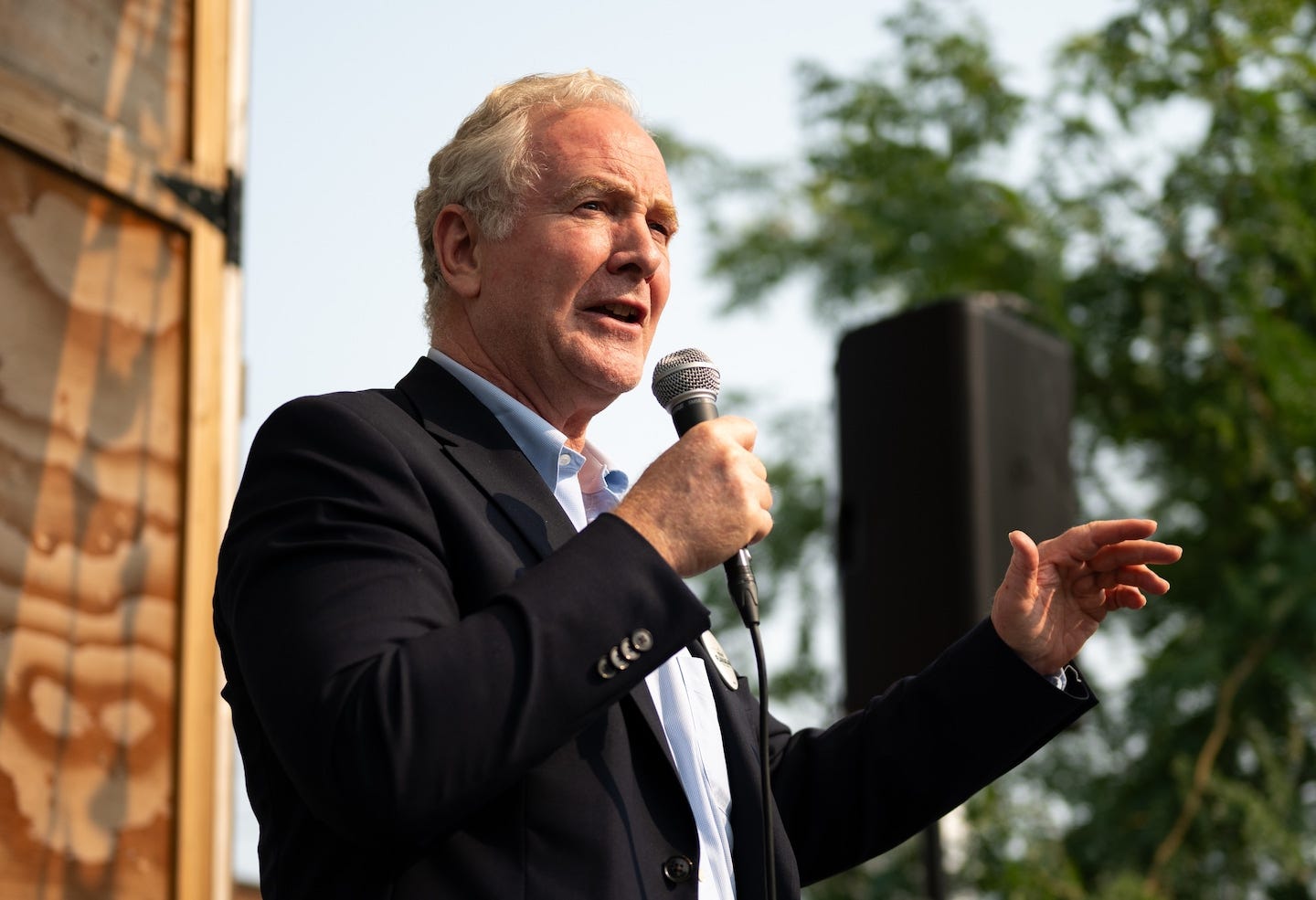
Sen. Chris Van Hollen is challenging Chuck Schumer for Senate Democratic leader, setting up a contest over the party’s direction after Democrats retook the Senate in the midterm elections. Van Hollen said the results showed voters wanted change, though he acknowledged that defeating Schumer would be difficult. “The voters called for big change, and this is a time that we have to deliver for people across the country,” he said. The caucus will choose its leader in a closed-door vote on Dec. 1.
The challenge tests how much support Schumer still has among Democrats frustrated by his approach to President Trump. Schumer has led Senate Democrats for a decade and helped the party win back the chamber, but his response to Trump and his stance on Israel have angered some progressives. Sens. Bernie Sanders and Sen.-elect Abdul El-Sayed endorsed Van Hollen. Schumer said he welcomed discussion about the caucus’s future and declared, “I have the votes to continue serving as Democratic Leader.”
Van Hollen, 67, represented a Washington-area district in the House for 14 years before winning election to the Senate in 2016. He called for new Senate leadership after the midterms, then said last week he was considering a 2028 presidential run rather than challenging Schumer. He said pressure from progressive groups and newly elected senators helped change his mind. Van Hollen insists the contest is about delivering for voters, not a fight between ideological factions.
The two senators have taken different approaches on several high-profile issues. Van Hollen has been a vocal critic of Israel’s actions toward Palestinians, tried to enter Gaza on a fact-finding mission and voted to block arms sales to Israel; Schumer did not. Van Hollen also criticized Schumer last year for not endorsing New York City mayoral nominee Zohran Mamdani, calling that approach “spineless politics.” He has also confronted the Trump administration, including traveling to El Salvador after the deportation of Maryland resident Kilmar Abrego García.
Schumer has public support from several senators, including Sheldon Whitehouse, Kirsten Gillibrand, and Ruben Gallego, as well as Nevada’s Catherine Cortez Masto and Jacky Rosen. Independent Angus King, who caucuses with Democrats, questioned why the party would change leaders after its recent wins: “Why would you fire the manager when you just won the World Series?” The coming vote will determine who leads a Democratic majority expected to hold as many as 56 seats and shape the party’s response to Trump’s administration. Van Hollen cast himself as the underdog, saying “the demand for change will overcome the inside game.”
Editor: Schumer won the Senate majority. Now comes the trickier part: convincing his own caucus he should lead it.
Source: The Washington Post
The administration’s chip policy is now producing a Washington tradition: officials pointing fingers while Congress asks who was minding the controls.
Howard Lutnick Faces Pressure Over Nvidia Chip Policy And Fallout
Commerce Secretary Howard Lutnick is facing pressure from Trump advisers who blame him for the political fallout surrounding Nvidia and former chief executive Jensen Huang, according to The Wall Street Journal. His critics say he resisted tighter controls on AI chip exports and had a close working relationship with Huang. Some Trump allies have previously urged the president to remove Lutnick, while officials discussed the mounting criticism Thursday. The White House said Trump maintains “complete confidence” in the commerce secretary.
The dispute centers on whether the administration did enough to restrict advanced chip shipments and address concerns about Alice Huang, a former executive at Singapore-based Megaspeed whom U.S. intelligence suspects of working for Beijing. The company had been under Commerce Department investigation since 2024 for potential export-control violations, but was not blacklisted. The Journal reported that Lutnick sometimes stalled or pushed back on proposed action, citing concerns about trade talks and the U.S. economy. Commerce oversees export controls, though other agencies, including Treasury, also approve decisions.
Administration officials are also trading blame over what happened. Treasury Secretary Scott Bessent and others confronted Lutnick in a recent Oval Office meeting over the lack of restrictions on Nvidia chip sales, according to people familiar with the discussion. Some officials have faulted Bessent in turn, noting that Treasury has not sanctioned Alice Huang or Megaspeed. The White House has said it has confidence in Lutnick, who has previously weathered calls for his removal.
The fallout is drawing congressional scrutiny from both parties. Senate Banking Committee Chairman Tim Scott, a Republican, requested that Lutnick and Jensen Huang testify at a Dec. 3 hearing, citing concerns about national security and sensitive U.S. technology. Other Republican senators have criticized Lutnick, while Democratic leaders expected to chair key committees next year have launched an investigation and asked him to preserve records. The Justice Department is leading multiple probes involving Alice Huang, the Journal reported.
Commerce is now advancing a rule aimed at restricting companies from giving Chinese technology firms remote access to powerful AI chips held elsewhere. The proposal would add seven countries to a group subject to export restrictions and licensing requirements, including Malaysia, Thailand, Indonesia, and Singapore, according to people familiar with the matter. The department says Lutnick and Huang had no special relationship beyond the secretary’s effort to maintain ties with a major U.S. company. For now, Lutnick’s job appears secure—but the policy fight and the congressional hearings are just getting started.
Editor: Washington’s export-control system has plenty of agencies to approve decisions—and plenty of officials ready to say the failure belonged to someone else.
Source: The Wall Street Journal
Outlook and Teams went down for half a day, and somewhere in the global economy a fax machine got called back into service.
Microsoft 365 Outage Disrupts Businesses And Government Services Worldwide

A Microsoft outage lasting more than 12 hours disrupted Outlook and Teams for businesses and government agencies around the world on Friday. The problem also affected Microsoft’s Copilot assistant and cloud-based Exchange Online, which handles email and calendars. Microsoft attributed the incident to server issues and said a wider rollout of software fixes was beginning to stabilize services. The company said it had no indication of malicious activity.
The disruption stopped people from handling routine work and spilled into financial, travel, and public services. The UK government said it was working with Microsoft, while the Metropolitan Police reported problems with some online crime reports but said its ability to respond to calls remained unaffected. NHS services turned to alternative IT systems or paper records. Reuters reported that organizations using Microsoft services on their own servers were somewhat spared.
The effects reached companies and markets across several regions. European exchange operator Euronext reported email problems, insurer Aviva activated backups for earnings calls, and shipping company Maersk warned customers of delayed updates. Indian airlines IndiGo, Akasa Air, and Air India said their email support was affected. In Taiwan, financial firms faced disruptions to fund management; one canceled a bond repurchase, while another used fax to confirm trades.
Some businesses changed public announcements because of the outage. U.S. electric truck maker Workhorse Group rescheduled its results announcement to Nov. 16, and Swiss luxury group Richemont briefly delayed its first-half results. OpenAI and Anthropic also experienced problems with Microsoft connectors. The company’s shares fell 1.7 percent before the market opened, underperforming the broader market.
The outage was among the longest in Microsoft’s history and the second major service disruption reported this year, renewing questions about how much organizations depend on a small number of technology providers. Analysts noted that repeated reliability problems could prompt IT departments to reconsider putting more operations with one provider, though steep switching costs make a quick move to competitors difficult. Australia’s cyber security minister said Microsoft did not suspect a cyberattack and that the impact was concentrated in email systems.
Editor: The modern office runs on cloud services—until the cloud has a bad day and everyone rediscovers paper.
Source: Reuters
Pete Hegseth dodged one impeachment push. Democrats are already preparing the next round—and trying to make it harder for Republicans to dismiss.
Democrats Prepare Impeachment Inquiry Into Defense Secretary Pete Hegseth

House Democrats are considering an impeachment inquiry into Defense Secretary Pete Hegseth when they take control of Congress next year, according to Democratic aides cited by Wired. They are expected to focus on a narrower set of allegations that could attract Republican support. House Republicans recently tabled an impeachment effort brought by Rep. Thomas Massie, a Republican, which accused Hegseth of waging the Iran war without congressional approval and ordering “extrajudicial killings.” House Democratic leader Hakeem Jeffries said he would discuss next steps with the lawmakers expected to lead the Armed Services and Judiciary committees.
The effort follows months of controversy over Hegseth’s leadership and military decisions. He has faced criticism for firing generals and blocking promotions under criteria that, according to the article, disproportionately affected women and people of color. He was also involved in the Signalgate controversy and has faced scrutiny over strikes against suspected drug traffickers in the Caribbean and Pacific. Democrats are expected to argue their case around specific issues, some of which have also drawn Republican criticism.
The article reports that Trump administration officials expect Hegseth to become Democrats’ top target, with one source close to the president saying he is “a passenger in whatever comes next.” Some officials believe a House impeachment and Senate trial are likely, even if conviction is not. A Senate conviction would require 67 votes, so Democrats would need substantial Republican support. Several Republicans have criticized aspects of Hegseth’s performance, though some of his most vocal GOP critics are leaving Congress.
Republican senators who have raised concerns include Roger Wicker, Mike Rounds, Rand Paul, Lisa Murkowski, and Todd Young. Wicker has criticized cuts to senior military officers, while other Republicans have questioned Hegseth’s leadership. Democrats’ strategy, according to the report, is to build a focused case around matters that could appeal beyond their own caucus. The article also notes that Republican leaders will no longer be able to dismiss charges with a majority vote once Democrats control the Senate.
Hegseth has shown no sign of stepping aside. Asked about Vice President JD Vance’s suggestion that the Iran war contributed to Republican losses in the midterms, Hegseth called Vance a “critical member of the team” and said he agreed with Trump that the war was worth undertaking. Trump’s advisers reportedly do not expect Democrats to win enough Republican votes to remove Hegseth, but an impeachment trial could keep the defense secretary under sustained public scrutiny. For now, the fight is about whether Democrats can make their case compelling enough to turn a failed House effort into a lasting political problem.
Editor: The first impeachment push fizzled. The next one may be narrower, better aimed, and much harder to wave away.
Source: WIRED
Read The Morning Sixpack Archives here:


