



The Morning Sixpack stays free because the news that shapes your life should not be hidden behind a paywall. Paid subscribers are not paying for access. They are helping fund the research, writing, and independent voice that goes into every issue. Become a paid subscriber and help keep smart, honest news analysis free for everyone.
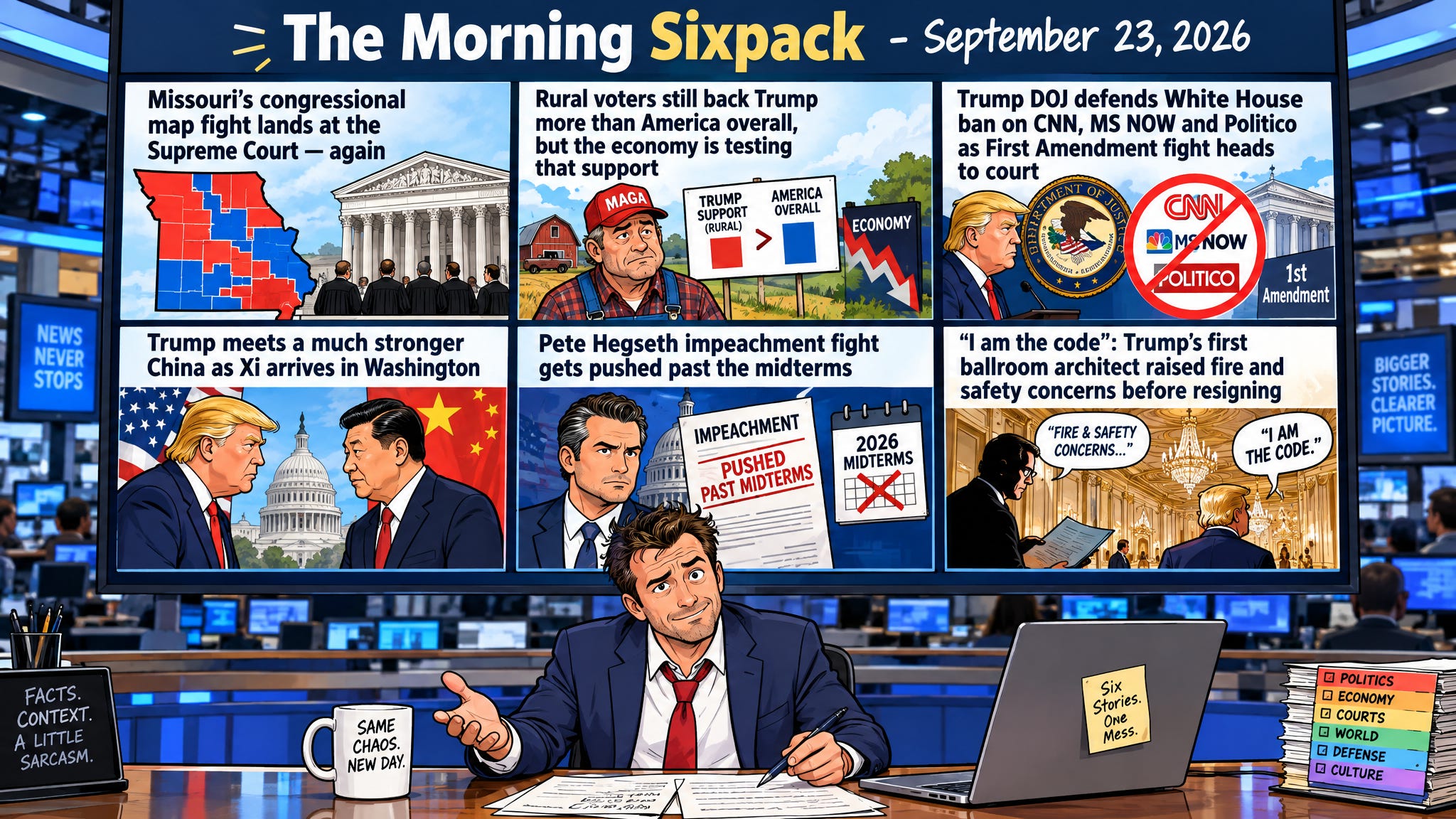
1. Missouri’s Congressional Map Fight Lands at the Supreme Court—Again
Missouri’s redistricting battle is back at the Supreme Court for a third time, and this time ballots are already going out. Opponents of the Republican-drawn congressional map asked the justices Tuesday night to block its use in November, arguing that an 8th Circuit ruling effectively resurrected relief the Supreme Court had already stayed twice this month. The dispute traces back to Missouri’s 2025 redistricting, a referendum fight that the state Supreme Court said kept the newer map from taking effect, and a subsequent U.S. Supreme Court order blocking a conflicting federal ruling. Challengers argue the 2022 map should govern the general election since officials are already using it, while the state says switching maps again would create administrative chaos. Election-law professor Justin Levitt noted that with voting underway and ballots already distributed, the timing pressure has never been higher. Source: The Washington Sun
2. Rural Voters Still Back Trump More Than America Overall, but the Economy Is Testing That Support
A new AP-KFF poll shows rural voters approving of President Trump at a higher rate than Americans overall, even as many of those same voters say the economy has gotten worse. About half of rural registered voters said conditions are worse than when Trump returned to office, and only about four in ten approve of his handling of the economy, yet his overall approval among rural voters sits at 48%. Roughly three-quarters rated the local cost of living as only fair or poor, with groceries, gas, and healthcare cited as top pressures; about a quarter of rural Republicans said good-paying jobs have declined in their area over the past five years. Healthcare offered little comfort, either, with just 17% saying Trump’s healthcare policies had lowered their costs. Even so, about six in ten rural Republicans credited Trump with improving the national economy. As Ohio teacher Nate Lawrence put it about promises to lower prices, “Trump said that, and it didn’t happen.” Source: Associated Press
3. Trump DOJ Defends White House Ban on CNN, MS NOW and Politico as First Amendment Fight Heads to Court
The Justice Department is defending President Trump’s decision to strip CNN, MS NOW, and Politico of White House access, arguing the outlets published sensitive information and failed to meet standards of professionalism and decorum. The three organizations have sued, alleging the ban violates their First Amendment rights and that revoking credentials without adequate notice violated due process. The DOJ’s Tuesday filing cited coverage of the East Wing bunker, U.S. ammunition stockpiles during the Iran war, Russia sanctions, and the Republican midterm convention, summing up its stance bluntly: “Access to the White House is a privilege—not a right.” The outlets counter that the ban “could not be a more direct assault on the First Amendment,” and note that journalists were denied entry before the White House explained its reasoning. The case echoes the 2018 fight over CNN’s Jim Acosta, and a federal hearing on emergency relief was set for Wednesday. Source: NPR
4. Trump Meets a Much Stronger China as Xi Arrives in Washington
Chinese President Xi Jinping arrives in Washington this week leading a China with far more economic and technological leverage than it had at his 2017 Mar-a-Lago summit with President Trump. The three-day visit covers trade, technology, Taiwan, and Iran, with China now a bigger competitor in AI, electric vehicles, batteries, robotics, and advanced manufacturing, plus continued dominance in parts of the rare-earth supply chain. That strength coexists with real weaknesses, including soft consumption, local-government debt, a struggling property sector, and elevated youth unemployment. Beijing is signaling both confidence and limits: Chinese Ambassador Xie Feng called Taiwan, human rights, and China’s political system “red lines,” while both governments appear to want to preserve their trade truce rather than reignite an escalation. As former U.S. diplomat Kurt Tong told CNN, “In the economic space, there isn’t really any superior player.” Source: CNN
5. Pete Hegseth Impeachment Fight Gets Pushed Past the Midterms
A House impeachment push against Defense Secretary Pete Hegseth has been delayed until after the November elections after Speaker Mike Johnson ended the chamber’s September session early. Rep. Thomas Massie’s eight articles of impeachment accuse Hegseth of abuses of power tied to the Iran war and alleged strikes on suspected drug smugglers in international waters; because Massie filed it as a privileged resolution, the House would have had to act on it within a limited window had it stayed in session. Johnson said the early adjournment gives members more time to campaign, while Massie argued it simply dodged the vote. Democratic leaders remain noncommittal, with Judiciary Committee ranking member Jamie Raskin saying he is “not a huge fan of pop-up impeachments” and preferring committee scrutiny first. The House returns November 9, when Massie can revive the effort and force the same reckoning lawmakers avoided this month. Source: The Hill
6. “I Am the Code”: Trump’s First Ballroom Architect Raised Fire and Safety Concerns Before Resigning
James McCrery II, the original architect for President Trump’s White House ballroom, resigned in October 2025 after repeatedly warning that early designs lacked adequate emergency exits and fire-containment measures, according to The Washington Post. The Post reports McCrery raised concerns about insufficient exit routes, inadequate protection against a kitchen fire spreading into the event space, and too few restrooms for a venue meant to seat more than 1,300 guests; meeting notes reportedly flagged “Life safety—big concern” shortly before his departure. When McCrery raised the code issue, Trump reportedly replied, “I am the code.” The project’s unusual routing through the White House Executive Residence—rather than an agency like the GSA—and Washington, D.C.’s lack of authority to enforce its building code on federal property add to the ambiguity. The White House disputes any link between McCrery’s exit and safety issues, saying life-safety concerns have been addressed as the design evolved, though later meeting notes reportedly continued to flag the topic, including one saying safety “needs POTUS buy-in.” Source: The Washington Post (no paywall)
From a Supreme Court trilogy to a president who thinks he is the fire code, today’s stories are a reminder that in Washington, nothing ever seems to get settled the first time—or the second.
Prefer to read The Morning Sixpack? Do that here:


