


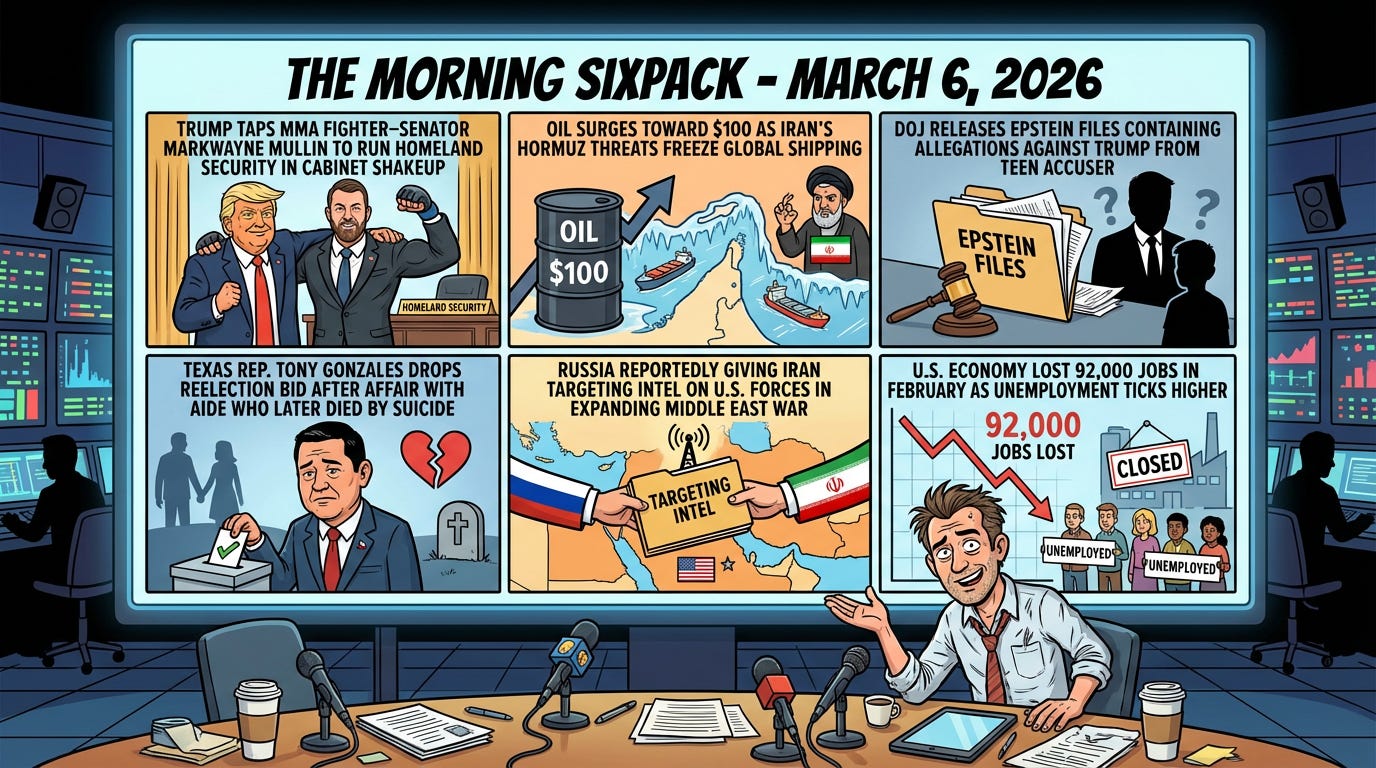
Trump just handed the Homeland Security keys to an MMA fighter turned senator—because apparently Washington needs more cage matches.
Trump Taps MMA Fighter–Senator Markwayne Mullin to Run Homeland Security in Cabinet Shakeup
President Donald Trump announced that Sen. Markwayne Mullin will take over as Secretary of Homeland Security on March 31, 2026, replacing Kristi Noem in a move that keeps immigration politics front and center heading into the 2026 cycle.
The headline isn’t subtle: a former undefeated MMA fighter is now in charge of the nation’s border security apparatus.
Trump praised Mullin as the “Highly Respected United States Senator from the Great State of Oklahoma,” while shifting current DHS chief Kristi Noem to a newly created role as Special Envoy for “The Shield of the Americas,” a hemispheric security initiative expected to be unveiled in Doral, Florida.
In announcing the pick, Trump leaned hard into Mullin’s brand, calling him “A MAGA Warrior, and former undefeated professional MMA fighter,” and promising he will “work tirelessly to Keep our Border Secure, Stop Migrant Crime, Murderers, and other Criminals from illegally entering our Country, End the Scourge of Illegal Drugs and, MAKE AMERICA SAFE AGAIN.”
Trump also highlighted Mullin’s background as the only Native American in the Senate and a strong advocate for tribal communities. The reshuffle keeps DHS squarely focused on border enforcement, migrant crime, and drug trafficking—while Noem’s new hemispheric “Shield of the Americas” job sounds big, ambitious, and just vague enough to leave plenty of questions about what it actually does.
Source: My Daily Grind
Editor: MMA fighter to Homeland Security chief? Washington’s about to test whether cage-match instincts translate to managing a 260,000-employee bureaucracy. Grab the popcorn. 🍿
Iran didn’t physically block the Strait of Hormuz—but threatening to torch ships was apparently enough to shut down 20% of the world’s oil traffic.
Oil Surges Toward $100 as Iran’s Hormuz Threats Freeze Global Shipping
Oil prices jumped and global markets slid after Iran effectively shut down the Strait of Hormuz with threats to attack any vessel attempting to pass through the vital shipping lane.
When the world’s most important oil chokepoint becomes a warzone, energy markets react fast—and everyone else pays the bill.
Brent crude surged to $80 a barrel while natural gas prices jumped 30% to $1.97 per therm after Tehran warned its forces would “set fire to anyone who tries to pass” through the strait. The escalation followed weekend military strikes on Iran by the United States and Israel—and retaliatory Iranian attacks across the Gulf.
The fallout quickly spread to regional energy infrastructure. QatarEnergy halted production at its massive Ras Laffan liquefied natural gas facility after reported military attacks, while Saudi Aramco shut down its Ras Tanura refinery following a drone strike that set the complex ablaze. Analysts say if disruptions persist, oil prices could climb past $100 a barrel—translating to about a 25-cent-per-gallon increase for U.S. drivers.
Shipping companies are already treating the Strait of Hormuz as closed. Sanne Manders of logistics platform Flexport told the BBC the problem isn’t just fear of attacks—it’s that insurers now refuse to cover vessels operating in the area. Tanker charter costs for routes from the Middle East to China doubled overnight to roughly $400,000 per day as fleets scrambled to avoid the region.
Markets around the world reacted immediately. Japan’s Nikkei 225 fell more than 3%, European indexes dropped sharply, and U.S. futures slid ahead of the opening bell. Meanwhile, energy and defense stocks climbed as investors braced for higher fuel costs, renewed inflation pressure, and a broader economic ripple effect.
Source: UPI
Editor: The Strait of Hormuz carries about a fifth of the planet’s oil. Threaten it, and suddenly every tanker captain, insurer, and trader remembers just how fragile the global economy really is. Funny how geopolitics shows up at the gas pump. ⛽
DOJ says these Epstein-related FBI records sat mislabeled as “duplicates” for years—now they’re out and dragging Trump’s name back into the mess.
DOJ Releases Epstein Files Containing Allegations Against Trump From Teen Accuser
Newly released Justice Department records describe FBI interviews with a woman who alleged that Donald Trump sexually assaulted her as a teenager after she was introduced to him by Jeffrey Epstein.
The documents had been withheld from earlier Epstein file releases because they were mistakenly labeled “duplicative.”
The records summarize multiple FBI interviews conducted in 2019 with a woman who said she was assaulted by both Epstein and Trump when she was between 13 and 15 years old. According to the documents, she told investigators Epstein took her to “either New York or New Jersey,” where she was introduced to Trump.
During one interview, the woman said she bit Trump when he allegedly tried to force her to perform oral sex. She also told investigators that she and people close to her received threatening calls over the years demanding she remain silent—threats she believed were connected to Epstein.
FBI records suggest agents stopped interviewing her later in 2019. In the final documented interview that October—during Trump’s first presidency—agents asked whether she would provide additional information about Trump. According to the report, she responded by questioning the point, asking what good it would do “when there was a strong possibility nothing could be done about it.”
The White House rejected the allegations. Press secretary Karoline Leavitt called them “completely baseless accusations, backed by zero credible evidence,” while Trump has repeatedly denied any wrongdoing connected to Epstein. The Justice Department has previously warned that some documents in the Epstein files contain “untrue and sensationalist claims.”
Source: Al Jazeera
Editor: Whenever the Epstein files resurface, the same pattern follows—allegations, denials, political crossfire, and a public left wondering why the full story still feels like it’s locked in a filing cabinet somewhere.
A Texas congressman admitted to an affair with a staffer who later died by suicide—now he’s abandoning his reelection campaign before voters finish the job.
Texas Rep. Tony Gonzales Drops Reelection Bid After Affair With Aide Who Later Died by Suicide
Rep. Tony Gonzales announced he will not seek reelection after admitting to an affair with a congressional staff member who later set herself on fire and died.
The scandal detonated inside the GOP conference—and leadership quickly made it clear his political clock had run out.
Gonzales confirmed the relationship with former aide Regina Ann Santos-Aviles after months of denial, calling it “a mistake” and “a lapse in judgment.” Santos-Aviles died in September after lighting herself on fire in her backyard in what authorities ruled a suicide.
Text messages released by her estranged husband appear to show Gonzales asking the aide for a “sexy pic” and about her preferred sex position. Santos-Aviles responded bluntly: “This is going too far boss.” Under House rules, members of Congress are prohibited from engaging in sexual relationships with staff members.
House Republican leaders—including Speaker Mike Johnson—called for Gonzales to step aside as the House Ethics Committee opened a formal investigation into whether he engaged in sexual misconduct and granted special favors to the aide. Facing mounting pressure and a primary runoff against gun-rights activist and YouTuber Brandon Herrera, Gonzales announced late Thursday he would finish his current term but abandon his reelection campaign.
“I made a mistake, and I had a lapse in judgment, and there was a lack of faith, and I take full responsibility for those actions,” Gonzales said during a radio interview, adding that he had reconciled with his wife and asked God for forgiveness.
Source: The Washington Post
Editor: Affairs in Washington are hardly new. The part that forces the political class to stop pretending it’s just another tabloid story is when ethics rules, power dynamics—and a tragic death—collide in the same headline.
Russia is reportedly feeding Iran targeting intel on U.S. forces—because nothing says “not our war” like quietly helping aim the missiles.
Russia Reportedly Giving Iran Targeting Intel on U.S. Forces in Expanding Middle East War
Russia is reportedly supplying Iran with intelligence on the locations of U.S. military assets in the Middle East, marking the first sign that another major American adversary is indirectly participating in the conflict.
That turns what looked like a regional war into something a lot closer to a great-power chess match—with American troops caught on the board.
According to officials familiar with the intelligence, Moscow has passed Tehran information on U.S. warships, aircraft and other military positions since fighting erupted over the weekend. The assistance comes as Iran launches waves of drones and missiles at American bases and facilities across the region.
The conflict has already turned deadly. Six U.S. troops were killed in Kuwait after an Iranian drone strike, while Iranian forces have launched thousands of attack drones and hundreds of missiles at American military sites, embassies and civilian targets. At the same time, a joint U.S.–Israeli campaign has struck more than 2,000 targets across Iran, including missile infrastructure, naval forces and leadership compounds.
Analysts say the accuracy of Iran’s recent strikes—hitting radar systems, command centers and other high-value targets—suggests access to better intelligence than Tehran normally possesses. Iran lacks a sophisticated satellite network of its own, making imagery and targeting information from Russia’s far more advanced capabilities potentially decisive.
U.S. officials have not publicly confirmed Moscow’s involvement, and the Pentagon declined to comment. But experts say the arrangement would mirror the dynamic seen in the Ukraine war, where Washington has shared intelligence with Kyiv while Russia has benefited from military support from Iran, China and North Korea.
Source: The Washington Post
Editor: If Russia is quietly helping Iran aim at U.S. forces, we’re no longer talking about a contained regional fight. That’s the kind of escalation that turns proxy conflicts into something far more dangerous—especially when nuclear powers start comparing notes.
The U.S. economy just posted its first monthly job loss in a while—right as energy shocks and war jitters are creeping back into the inflation picture.
U.S. Economy Lost 92,000 Jobs in February as Unemployment Ticks Higher
The U.S. lost 92,000 jobs in February, a sharp miss that signals the labor market may be weakening across multiple sectors.
The timing couldn’t be worse—with rising energy prices and a widening Middle East war already threatening to push inflation back up.
The Labor Department’s report showed the unemployment rate edging up to 4.4%, while the job loss was far worse than economists expected. Forecasters surveyed ahead of the release predicted a gain of about 50,000 jobs, making the negative number an unwelcome surprise for markets and policymakers.
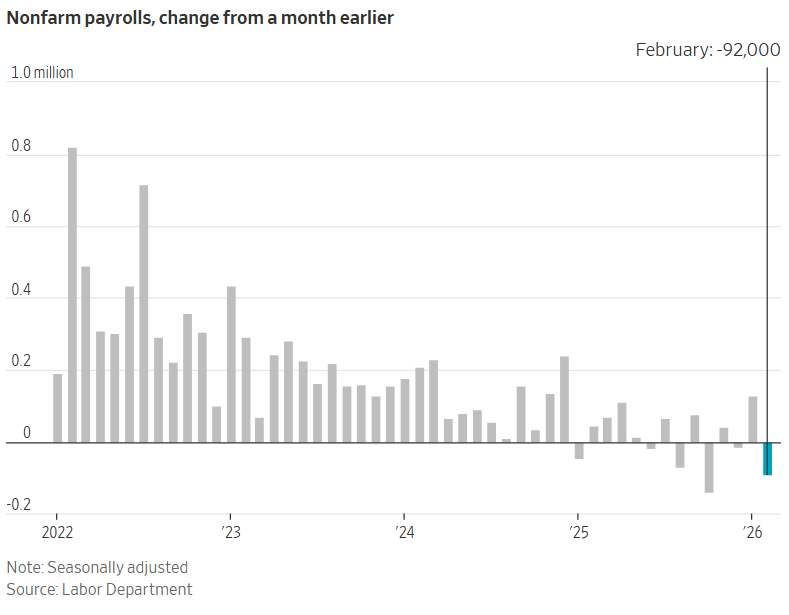
For the Federal Reserve, the data lands in an awkward spot. A cooling labor market would normally push the central bank toward cutting interest rates—but the surge in oil and commodity prices tied to the U.S.–Israel war with Iran raises the risk that inflation could flare again.
Treasury yields dropped after the report as investors began betting the Fed may have to resume rate cuts by midyear if unemployment continues rising. Stocks also slid early in trading, with the Dow, S&P 500 and Nasdaq all opening more than 1% lower.
While layoffs remain relatively low, companies have slowed hiring significantly across most sectors. Healthcare had been carrying job growth in recent months, but a major strike in that industry during February’s survey period weighed on hiring numbers.
Source: The Wall Street Journal (free)
Editor: The Fed’s nightmare scenario is simple: inflation climbing while the job market weakens. That’s called stagflation—and once it shows up, there’s no easy lever to pull. 📉