


The Daily Grind News is a reader-supported publication. To receive new posts and support my work, consider becoming a subscriber.
Congress just reminded the White House that declaring war isn’t supposed to be a solo activity—even if some presidents treat it like one.
Senate Rebukes Trump’s Iran War as GOP Cracks Begin to Show
The Senate has approved a war powers resolution directing President Donald Trump to halt U.S. hostilities with Iran or seek congressional authorization. The 50-48 vote exposed growing Republican unease over a conflict that has dragged on for months and increasingly divided Trump’s own party.
For the first time, enough Republicans crossed the aisle to publicly challenge Trump’s handling of the Iran War.
Four Republican senators joined Democrats in backing the measure, while Democratic Sen. John Fetterman voted against it. The resolution had already cleared the House, giving both chambers an opportunity to signal that Congress—not the president alone—holds the constitutional authority to authorize war.
The legal impact remains disputed. Democrats argue the resolution is binding because it was adopted under the War Powers Resolution, while the Trump administration insists it carries little weight, particularly after the cease-fire that took effect in April.
Rep. Gregory Meeks, the measure’s sponsor, didn’t mince words: “Both chambers have now made clear that the president cannot continue this war of choice and must cease all hostilities against Iran.” He added that he would pursue “all legal avenues” to ensure the administration complies.
Trump blasted the vote on social media, calling the measure “poorly timed and meaningless” and accusing the four GOP senators of making his job harder while negotiations with Iran continue. Whether the resolution has legal teeth or not, Tuesday’s vote showed that support for the war is no longer a given—even inside Trump’s own party.
Source: UPI report
Editor: Nothing unsettles Washington quite like lawmakers rediscovering powers that have been sitting in the Constitution the whole time.
And if the actual lawmakers in the federal government cannot make laws that stick, then what the hell are we doing here?
It turns out countries don’t love having their economies routed through a system Washington can switch off whenever relations get ugly.
China’s Yuan Is Chipping Away at One of Washington’s Biggest Weapons
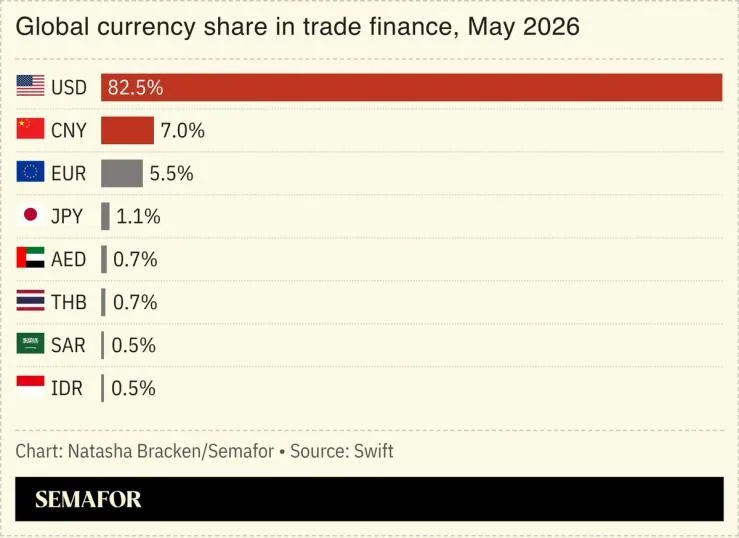
The Chinese yuan is gaining ground in global trade finance, making it harder for the United States to use the dollar as a geopolitical pressure tool. As more nations build alternatives to dollar-based systems, one of America’s most effective levers of influence is becoming a little less powerful.
When rivals can bypass the dollar, sanctions lose much of their bite.
For decades, the dominance of the U.S. dollar has given Washington extraordinary reach. Because most international trade flows through dollar-based banking networks, the United States can effectively isolate adversaries from the global financial system through sanctions.
That advantage is being tested. According to reporting cited by The Wall Street Journal, Iran has increasingly relied on yuan payments, cryptocurrency transactions, and Chinese-backed financial infrastructure instead of traditional Western banking channels. Russia has followed a similar path since Western sanctions were imposed in 2022, with roughly 90% of its trade with China now settled in yuan or rubles.
The yuan still trails the dollar by a wide margin, accounting for about 7% of global trade finance compared to the dollar’s dominant share. But that figure has tripled in just five years, signaling that countries facing U.S. pressure are actively building workarounds.
Washington isn’t losing the dollar’s crown anytime soon. But every transaction that moves outside the U.S.-controlled financial system weakens a tool American policymakers have relied on for decades. The question isn’t whether the dollar remains dominant. The question is how much dominance is enough. And for how long…
Source: Yahoo News / Semafor article
Editor: The more sanctions become America’s foreign policy Swiss Army knife, the more incentive rivals have to build a different toolbox—and they have.
Want a story about how the global trade currencies are about to change in a VERY BIG WAY? Stay tuned for a Special Report from the Daily Grind News.
UPDATE: Here’s that SPECIAL REPORT (link)
Promising to give your Senate paycheck to veterans and then apparently keeping most of it is the kind of detail that tends to come back when you’re asking voters for a job.
Tuberville Hit With New Scrutiny Over Unfulfilled Veterans Donation Pledge
Alabama Sen. Tommy Tuberville is facing renewed criticism after a report alleged he failed to follow through on a campaign promise to donate his Senate salary to veterans organizations.
The controversy erupted after tax records released by Tuberville’s own campaign appeared to show only a fraction of the money ever reached charitable causes.
A report from Alabama outlet Lagniappe examined Tuberville’s residency claims as he pursues a run for governor and uncovered questions about a pledge he made during his 2020 Senate campaign. Tuberville had promised to donate his Senate salary to veterans groups, but the tax filings reviewed by the outlet suggest far less was donated than voters may have expected (which was ALL OF IT).
According to the report, Tuberville reported more than $529,000 in wages over four years while listing only about $38,000 in charitable contributions or related deductions during that period. Even assuming every dollar went to veterans causes, the total would still represent a small portion of the salary he pledged to give away. The filings also showed he reported more than $2.9 million in total income when investment and real estate earnings were included.
The allegations quickly sparked backlash from journalists, political observers, and Alabama figures. Former NBC host Chuck Todd called it “a pretty high profile promise to break,” while journalist John Harwood labeled Tuberville “possibly the worst person in the Senate.” Former U.S. Attorney Joyce Vance added a blunt plea to Alabama voters: “Please don’t make this guy our governor.”
Source: Raw Story
Editor: Campaign promises are easy to make. The paperwork tends to be less cooperative.
Peace deals get a lot harder when one side says the war is over and the other side says its troops aren’t going anywhere.
Israel Refuses Lebanon Pullout as Cracks Emerge in Trump’s Iran Peace Deal
Israel says it will keep troops in southern Lebanon despite ongoing negotiations tied to the Trump administration’s newly signed peace accord with Iran.
The disagreement underscores how fragile the deal remains, with key provisions already being interpreted very differently by the countries involved.
Israeli Defense Minister Israel Katz declared Wednesday that Israeli forces will remain in southern Lebanon, calling it a political victory that Washington has not demanded a withdrawal. The statement comes as Lebanon and Israel continue discussing a U.S.-backed proposal that would transfer some occupied territory to Lebanese army control.
The dispute strikes at one of Iran’s core demands. Tehran has repeatedly insisted that ending hostilities in Lebanon is just as important as ending the war between Iran and the United States. Iranian Parliament Speaker Mohammad Baqer Qalibaf reinforced that position Wednesday, saying, “For us, a ceasefire in Lebanon is as important as a ceasefire in Iran, and further, an end to the war in Lebanon is as important as an end to the war in Iran.”
Meanwhile, Secretary of State Marco Rubio is touring Gulf allies to sell the agreement amid growing skepticism throughout the region. Several Middle Eastern governments believe the deal gives Iran significant concessions, including sanctions relief and economic incentives, while providing too few guarantees about Tehran’s future behavior.
Questions are also mounting over other provisions. Iran is disputing President Trump’s claims about unlimited nuclear inspections, while negotiations continue over the future management of the Strait of Hormuz. Trump insisted Wednesday that Iran has assured the U.S. there will be no tolls or fees imposed on shipping through the critical waterway.
The ceasefire may have lowered oil prices and reopened shipping lanes, but the arguments over Lebanon, sanctions, nuclear inspections, and regional security suggest the toughest negotiations may be starting just as the shooting (kinda) stops.
Source: Reuters
Editor: Diplomatic agreements are usually strongest when everyone agrees on what’s in them. This one appears to be operating under a more experimental model.
Washington is already blaming the next government shutdown on the other party, which is usually a sign that nobody thinks things are going especially well.
Senate Spending Talks Collapse as Shutdown Fears Return Before Midterms
Bipartisan budget negotiations have stalled in the Senate, raising the prospect of another government shutdown just months before voters head to the polls.
Lawmakers aren’t arguing over whether a shutdown is possible—they’re arguing over who gets blamed when it happens.
Senate Appropriations Chair Susan Collins was forced to cancel Thursday’s markup of four spending bills after negotiations with Democrats broke down and Republican leaders lacked the votes needed to move the legislation forward. The collapse marks a sharp contrast from last year, when appropriations bills advanced with broad bipartisan support.
Republicans are accusing Senate Minority Leader Chuck Schumer and Democrats of intentionally setting up a funding fight ahead of the midterm elections. Sen. John Kennedy warned that Democrats may refuse to support spending bills or agree to overall funding levels, while Sen. Shelley Moore Capito flatly declared, “Democrats want to shut us down.”
Democrats see things differently. They argue Republicans control the White House and both chambers of Congress, making them responsible for any lapse in funding. Sen. Chris Murphy dismissed Republican management of the process, saying a shutdown remains possible because GOP leaders “don’t know how to run the government.” He’s not wrong.
At the center of the dispute are disagreements over defense and domestic spending levels. Democrats object to what they describe as an outsized increase for defense spending ($1.5 TRILLION, or 1 1/2 Elon Musks) compared with nondefense programs, while Republicans insist their offers have been reasonable and accuse Democrats of moving the goalposts.
Collins, who always seems “concerned,” acknowledged the talks are struggling. “I certainly hope not,” she said when asked about a shutdown. “But we’ll have to see.” With October 1 funding deadlines approaching and campaign season in full swing, lawmakers appear to be spending as much time crafting political messaging as they are crafting spending bills.
Source: The Hill
Editor: Congress has months to avoid a shutdown. Judging by the early finger-pointing, they’re determined to use every minute of it.
Campaign finance laws generally work on the theory that voters should know where campaign money goes. That’s apparently become a matter of debate.
Vivek Ramaswamy’s Campaign Put $500,000 on a Credit Card—and Won’t Say What It Bought
Ohio gubernatorial candidate Vivek Ramaswamy’s campaign has charged more than $500,000 to a credit card while disclosing little about where the money was actually spent.
The spending may be legal, but the lack of transparency is raising questions from watchdogs, election experts, and even some fellow politicians.
According to an investigation by the Ohio Capital Journal, Ramaswamy’s campaign has reported more than $509,000 in credit card reimbursements while failing to itemize the underlying purchases as required under Ohio campaign finance rules. Instead of listing vendors and expenses, the campaign has largely reported monthly lump-sum payments to American Express.
(Editor: AmEx, what the hell were you thinking? This guy may NEVER repay you.)
Campaign finance experts note that Ohio law generally requires campaigns to disclose individual expenditures and maintain documentation such as receipts or statements. Critics argue that reporting only the monthly credit card bill creates a barrier for voters trying to understand how campaign funds are being used. Common Cause Ohio’s Catherine Turcer summed it up bluntly: “How you spent the campaign cash should not be an obstacle to reporting what you spent it on.”
The controversy is amplified by the scale of the spending. Ramaswamy has already spent more than $28 million on his gubernatorial campaign, putting the race on pace to become the most expensive governor’s race in Ohio history. Yet the campaign has not provided requested documentation to reporters, and Ohio Secretary of State Frank LaRose’s office has not released records that could clarify the expenditures.
Not everyone believes there’s wrongdoing. Former Ohio Elections Commission director Phil Richter suggested the issue could ultimately amount to delayed paperwork if supporting documents are eventually produced. Others are less charitable. Campaign finance attorney Brendan Fischer warned that when candidates fail to disclose underlying transactions, voters lose the ability to determine whether campaign funds are being used for legitimate campaign purposes or something else entirely.
Whether this turns out to be an administrative oversight or something more significant, the central question remains simple: If campaigns are required to tell voters where the money goes, why is it taking so much effort to find out?
Source: Ohio Capital Journal
Editor: Half a million dollars on a campaign credit card might be perfectly innocent. Then again, that’s usually why campaigns show the receipts.