


The Morning Sixpack stays free because the news that shapes your life should not be hidden behind a paywall. Paid subscribers are not paying for access. They are helping fund the research, writing, and independent voice that goes into every issue. Become a paid subscriber and help keep smart, honest news analysis free for everyone.
Senate confirmation gives Blanche the job, but history suggests keeping it may depend more on pleasing Trump than protecting the Justice Department’s independence.
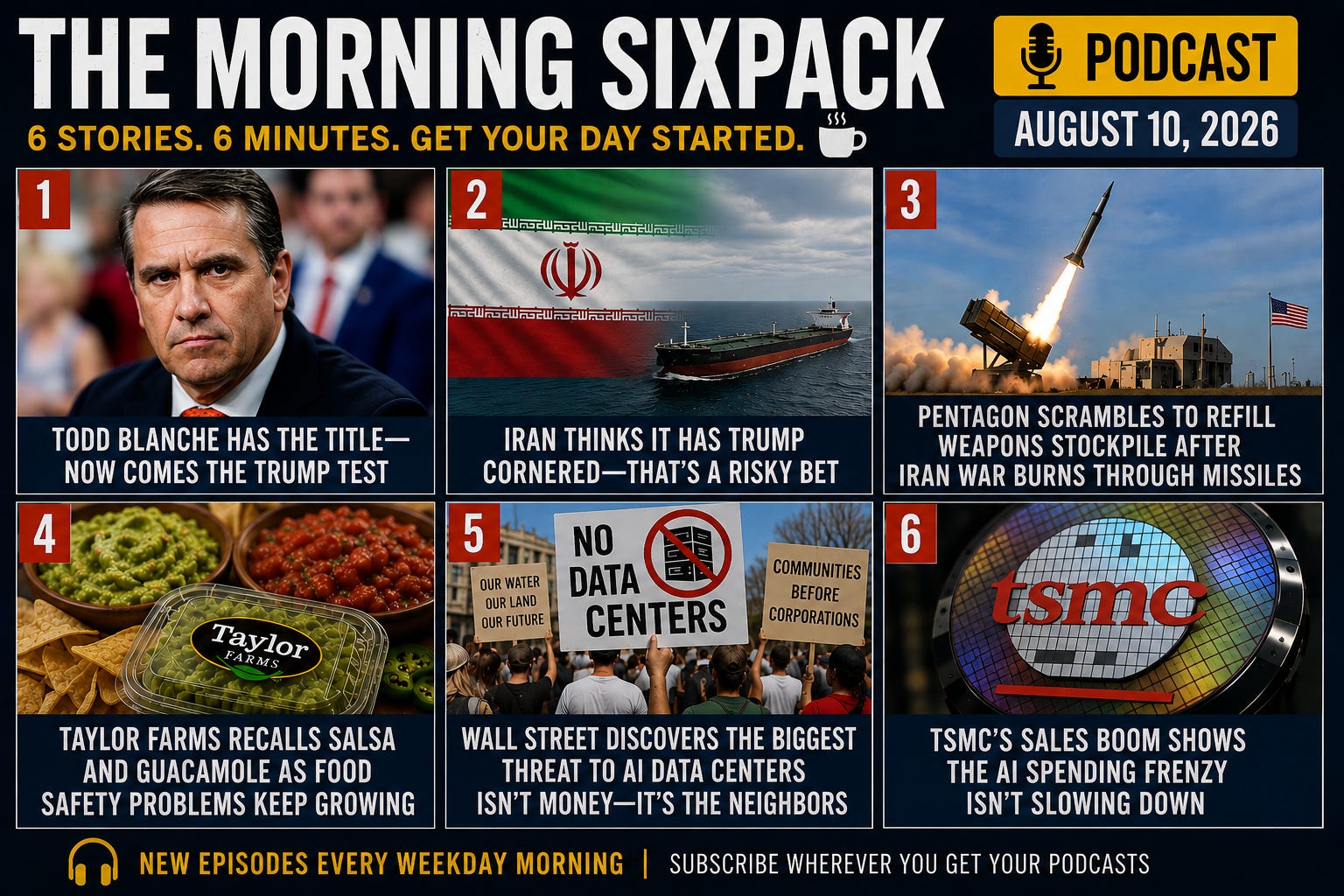
Todd Blanche Has the Title—Now Comes the Trump Test
Todd Blanche is finally the Senate-confirmed attorney general (in a 50-49 vote), but his biggest challenge won’t be Democrats or the courts—it’ll be telling Donald Trump “No” when it matters.
That’s a whole lot easier to promise senators than it is to do from the attorney general’s office.
Blanche officially takes over the Justice Department after months as acting attorney general, inheriting an agency battered by firings, low morale, and an expanding list of politically charged investigations. He insists President Trump’s expectations aren’t a threat, saying, “President Trump trusts me to give him counsel. Counsel does not mean a ‘yes man,’ and that’s true in my case like it should be in any attorney general’s.”
That promise helped win over enough skeptical Republican senators to secure confirmation, even as several openly questioned whether Blanche could put the country’s interests ahead of those of his former client. Those concerns aren’t disappearing anytime soon. Trump continues pushing investigations into longtime political rivals while publicly pressing prosecutors to pursue cases many critics say lack evidence.
Blanche argues his relationship with Trump gives him credibility to offer honest advice. But the president’s track record with attorneys general isn’t exactly reassuring. Jeff Sessions was fired. William Barr resigned after breaking with Trump over the 2020 election. Pam Bondi was shown the door after Trump grew frustrated with the pace of prosecutions targeting his political opponents and her bungling of the Epstein Files (which Blanche has successfully buried).
And then there’s the quote that may end up defining Blanche’s tenure if the pressure finally becomes too much. Asked earlier this year what he’d do if Trump fired him, Blanche answered:
“I will say, ‘Thank you very much. I love you, sir.’”
That’s a remarkable thing for the nation’s top law enforcement officer to say about the president who may someday decide his fate. Whether that reflects loyalty, realism, or simple political survival is a question that may answer itself soon enough.
Source: Washington Post
Editor: Every attorney general says they’ll follow the law first. The real test comes when the law and the president stop traveling in the same direction.
Tehran thinks time is on its side. The problem is wars have a nasty habit of ignoring everyone’s timetable. Ask Trump and his “4-week war.”
Iran Thinks It Has Trump Cornered—That’s a Risky Bet
Iran believes it’s holding the winning hand by squeezing the Strait of Hormuz, but history has a way of humbling leaders who think they’ve got America boxed in.
The gamble isn’t just whether Donald Trump TACOs—it’s whether Iran’s own economy and people crack first. At this point, I’d bet on Iran.
Iran’s leadership is betting that closing the Strait of Hormuz and disrupting one of the world’s most important shipping lanes will force the United States to back down. Tehran believes soaring energy prices, dwindling U.S. missile stockpiles, and political pressure ahead of the November elections will eventually leave President Trump with little choice but to negotiate on Iran’s terms.
Iran’s demands are sweeping. It wants the U.S. to permanently end military operations, lift its naval blockade, withdraw forces from the region, remove sanctions, release frozen Iranian assets, and pay compensation for war damage before the strait fully reopens. Iranian officials also want formal recognition of their management of the strategic waterway—a major shift from decades of international norms protecting freedom of navigation.
But this isn’t a one-sided story. Iran’s economy has been hammered by war, sanctions, and blockades. Inflation is soaring, oil exports have collapsed, and anti-government protests have already shaken the regime. Former Iranian Foreign Minister Mohammad Javad Zarif warned that while the conflict has created “an exceptional window for diplomacy,” failing to strike a deal soon could make “economic recovery...difficult” while increasing the risk of renewed unrest.
The White House hasn’t publicly embraced Iran’s demands, and Trump continues alternating between threatening more military action and expressing optimism about negotiations. That leaves both sides playing a dangerous game of chicken, each convinced the other will blink first. History suggests that’s often when miscalculations happen. The Strait of Hormuz may be Iran’s biggest source of leverage today, but leverage only works if the other side believes you can afford to keep pulling on the rope.
Source: Associated Press
Editor: Every side in every conflict eventually declares it “holds all the cards.” Funny how the deck always seems to get reshuffled once the bills come due. I fear this will get far worse before it gets better. Will it be “boots on the ground?” I don’t know. But it could be even bigger than that.
Iran Thoughts

The Morning Sixpack stays free because the news that shapes your life should not be hidden behind a paywall. Paid subscribers are not paying for access. They are helping fund the research, writing, and independent voice that goes into every issue. Become a paid subscriber and help keep smart, honest news analysis free for everyone.
Washington spent decades building these arsenals. A few months of modern warfare showed just how fast they can be emptied.
Pentagon Scrambles to Refill Weapons Stockpile After Iran War Burns Through Missiles
The Pentagon is demanding that defense contractors speed up weapons production after months of fighting with Iran exposed how quickly America’s missile stockpiles can disappear.
When the military starts telling suppliers that “years-long development cycles are not acceptable,” it’s admitting the cupboard isn’t as full as everyone hoped.
The Pentagon is ordering U.S. defense companies to move much faster in producing critical weapons, particularly Patriot and THAAD missile interceptors, after the war with Iran sharply depleted inventories. Deputy Defense Secretary Steve Feinberg gave contractors just 21 days to submit plans for dramatically faster production, writing,
“Years-long development cycles are not acceptable. We must dramatically accelerate our program schedules and expand our production capacity now.”
The numbers explain the urgency. According to the Center for Strategic and International Studies, Patriot interceptor inventories have fallen by at least 65 percent since before the conflict, while THAAD interceptor stockpiles remain at least 38 percent below pre-war levels. Analysts warn those shortages could force U.S. commanders to become more selective about which incoming missiles and drones they try to intercept, increasing the risk that some attacks succeed.
President Trump has pushed back against reports that America faces a dangerous munitions shortage, insisting the U.S. still has “massive amounts” of weapons and that new factories are ramping up production. Pentagon officials say the accelerated manufacturing push is part of a broader effort to rebuild the defense industrial base, even as Congress remains divided over Trump’s request to boost defense spending to $1.5 trillion.
The reality is that money alone won’t solve the problem overnight. Experts say rebuilding inventories of sophisticated missile interceptors will likely take at least three years, even with increased funding and expanded factory capacity. That’s a reminder that modern wars don’t just consume ammunition—they expose how difficult it is to replace the most advanced weapons once they’re gone.
Source: Al Jazeera
Editor: Defense contractors just got the federal government’s version of, “Can you have that finished by tomorrow?” The problem is missile factories don’t run on coffee and deadlines.
However, Iran has figured out how to build inexpensive drones in hours.
One recall can happen to anyone. Two major outbreaks at the same time start raising uncomfortable questions. Read the whole store for a Special Report.
Taylor Farms Recalls Salsa and Guacamole as Food Safety Problems Keep Growing
Taylor Farms has recalled salsa, guacamole, and other prepared foods sold by major retailers after jalapeños linked to a salmonella outbreak made their way into its products.
It’s the second major food safety headache for the company in days—and shoppers are starting to notice.
Taylor Farms voluntarily recalled prepared foods containing jalapeños after its supplier, Coast Citrus Distributors, pulled peppers tied to a salmonella outbreak that has already sickened 345 people across 27 states and sent 36 people to the hospital. The recalled products were sold through major retailers including Walmart, Kroger, Target, Whole Foods, Trader Joe’s, and Hannaford.
The company says it has stopped sourcing peppers from the farm in Sinaloa, Mexico, identified as the potential source of the contamination. Taylor Farms also said it has no reports of illnesses linked to the recalled salsa, guacamole, and other prepared products, but the recall was issued as a precaution after federal investigators traced the outbreak to the pepper supply chain.
The recall lands as Taylor Farms is already battling a much larger cyclosporiasis outbreak linked by the FDA to products from central Mexico.

That outbreak has triggered recalls across the restaurant industry, hurt lettuce sales, and weighed on traffic at chains including Taco Bell, Chipotle, and Sweetgreen as consumers grow more cautious about eating fresh produce.
Taylor Farms has suspended iceberg lettuce sourcing from central Mexico while commissioning an independent food safety review. Meanwhile, the latest salmonella recall serves as another reminder of how quickly a problem at a single supplier can ripple through grocery stores and restaurant chains nationwide.
Source: Reuters
Editor: Food recalls are supposed to restore confidence. When the same company is making headlines for multiple outbreaks at once, confidence becomes a much harder thing to package.
These repeated incidents also raise awareness to the proverbial “putting all your eggs in one basket” where food chains rely too heavily on single sources for their food.
Silicon Valley may think AI is inevitable. Local zoning boards keep reminding everyone they still exist.
Wall Street Discovers the Biggest Threat to AI Data Centers Isn’t Money—It’s the Neighbors
Banks are pouring billions into America’s AI data center boom, but they’re increasingly worried that angry residents—not financing—could kill the projects.
It turns out the toughest approval for some billion-dollar AI campuses isn’t from Wall Street—it’s from the people living next door. #NIMBY
America’s biggest banks are adding a new question before financing massive AI data centers: Will the neighbors fight back? As community opposition spreads over concerns about noise, water use, power consumption, and the appearance of giant server campuses, lenders are giving greater weight to local support before committing billions of dollars.
Bank of America infrastructure finance chief Karen Fang said community backing has become part of determining whether a project is truly “ready.” She pointed to permitting, approvals, and neighborhood acceptance as critical factors alongside traditional financial metrics. For banks, a project tied up in lawsuits or local opposition can become an expensive headache before construction even begins.
The concern isn’t theoretical. Research shows at least 75 data center projects worth roughly $130 billion faced local opposition during the first quarter of 2026. Several high-profile developments backed by major financial institutions—including projects tied to Meta, CyrusOne, and Oracle—have encountered organized resistance from nearby residents, even as demand for AI computing continues to explode.
None of that is slowing Wall Street’s appetite for AI infrastructure. Goldman Sachs forecasts that technology companies will spend more than $6 trillion on AI through 2030, and banks remain eager to finance the boom. But lenders are now building community sentiment into their risk calculations, recognizing that local politics can derail even the best-funded projects.
Source: Reuters
Editor: AI may be able to write code, generate videos, and pass exams. It still hasn’t figured out how to breeze through a contentious city council meeting.
Wall Street keeps asking whether AI spending has peaked. TSMC keeps answering with another huge sales report.
TSMC’s Sales Boom Shows the AI Spending Frenzy Isn’t Slowing Down
TSMC just posted another blockbuster month, suggesting Big Tech’s appetite for AI chips remains far stronger than skeptics expected.
For all the hand-wringing about an AI bubble, somebody still has to build the chips—and business is booming.
Taiwan Semiconductor Manufacturing Co., the world’s largest contract chipmaker, reported July revenue of 467.58 billion New Taiwan dollars ($14.5 billion), up 44.7% from a year ago. That’s another sign that demand for the advanced chips powering artificial intelligence remains exceptionally strong, even as investors question whether tech giants can justify their massive AI spending.
Taiwan’s AI Export Boom Masks Growing Global Economic Risk
TAIPEI — Taiwan is riding a historic export boom powered by artificial intelligence and advanced semiconductors, but beneath the headline numbers lies a concentration of geopolitical and economic risk that economists warn could send shockwaves through the global economy if disrupted.
TSMC manufactures cutting-edge semiconductors for industry leaders including Nvidia and Google’s custom AI chips, making its monthly sales one of the clearest indicators of demand across the AI economy. The company is already forecasting revenue growth of roughly 40% this year, and July’s results put it ahead of that pace.
The company is backing up its optimism with enormous investments of its own. TSMC recently raised its 2026 capital spending plans to as much as $64 billion, while Chairman C.C. Wei said simply, “AI-related demand continues to be extremely robust.” High-performance computing, which includes AI chips, now accounts for two-thirds of the company’s revenue.
The report also offered a lift to semiconductor stocks after recent volatility. Shares of ASML, Infineon, and STMicroelectronics all moved higher, even as investors continue debating whether today’s AI investment boom can ultimately deliver the returns companies are promising. For now, the orders keep coming—and TSMC’s factories keep humming.
Source: CNBC
Editor: Every few weeks someone declares the AI boom is cooling off. Then TSMC opens the books and reminds everyone there’s still a very long line of customers waving purchase orders.