


The Morning Sixpack stays free because the news that shapes your life should not be hidden behind a paywall. Paid subscribers are not paying for access. They are helping fund the research, writing, and independent voice that goes into every issue. Become a paid subscriber and help keep smart, honest news analysis free for everyone.
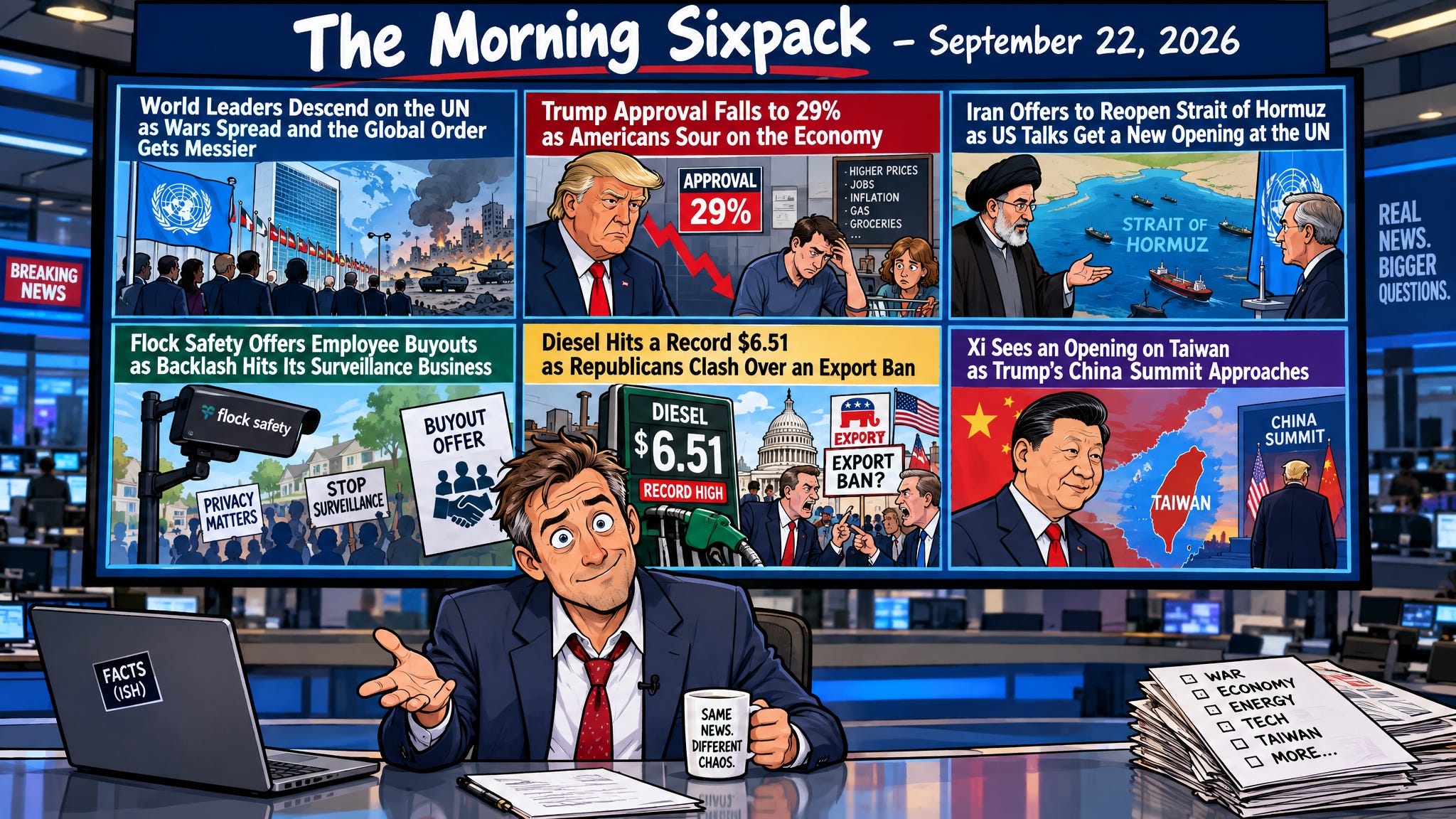
World diplomacy is having its messiest year in decades, and it’s all converging on New York this week. World leaders are gathering at the UN General Assembly as wars spread in Europe and the Middle East, alliances shift, and the international order grows more unpredictable. Secretary-General António Guterres called it an era of “deep uncertainty,” and diplomats interviewed by AP described the UN as sitting at an inflection point, where attacks on international law, stalled mediation, and disagreement over climate and security dominate the agenda. Much of the real work, officials say, will happen away from the microphones. Source: AP News
Back home, President Trump’s approval has slipped to 29%, and the economic picture behind that number is even bleaker. American Research Group’s September survey found just 26% approve of his handling of the economy, while 72% say conditions are getting worse and 67% believe the country is already in a recession. Even among Trump’s own approvers, 56% expect both the national economy and their household finances to worsen over the next year, a striking crack of pessimism inside his own base. Source: American Research Group
Iran, meanwhile, has floated an offer that could ripple through energy markets worldwide. Tehran says it could reopen the Strait of Hormuz within seven days if Washington eases military pressure and lifts its blockade on Iranian ports, a proposal that surfaced as Presidents Trump and Pezeshkian both attend the UN General Assembly. Oil fell more than 2% on the news, and Gulf states are pushing for a broader security framework, though officials caution this is an offer to negotiate, not a finished deal. Source: Reuters
Flock Safety, the license-plate surveillance company once valued above $8 billion, is now paying its own employees to leave. Facing lost government contracts, camera vandalism, and sustained criticism over privacy and alleged misuse of its technology, Flock has opened a voluntary buyout program ahead of an October 2 deadline. Ninety-three city and county governments cut ties with the company in August alone, and CEO Garrett Langley admitted the backlash has badly damaged internal morale even as Flock pushes to expand its AI-powered surveillance tools. Source: WIRED
At the pump, diesel just hit a record $6.51 a gallon, and Senate Republicans can’t agree on what to do about it. Farm-state senators like Chuck Grassley are pushing for export restrictions to keep more fuel at home, while oil-state senators like John Cornyn call that idea a “gimmick” that could create regional shortages instead of solving the problem. Diesel has climbed nearly $3 a gallon since the U.S.-Israel strikes on Iran began, and Senate Majority Leader John Thune says reopening the Strait of Hormuz would be the real fix. Source: The Hill
And in Taiwan, Xi Jinping appears to be betting that political pressure can succeed where military pressure has not. A senior Taiwanese official told The Wall Street Journal that Beijing views Trump’s unpredictability as a “rare window of opportunity” to shift Taiwanese public opinion, combining military pressure with outreach to the opposition KMT and an intensifying disinformation campaign that identified 45,000 suspected fake accounts in 2025 alone. Xi is expected to press Trump on Taiwan when the two meet in Washington this week, even though support for unification in Taiwan remains below 8%. Source: The Wall Street Journal
From a fraying UN to a record fuel bill to a surveillance company paying people to walk away, today’s news makes one thing clear: nobody, anywhere, is operating from a position of total certainty right now.
Prefer to read The Morning Sixpack? Do that here:


