


The Morning Sixpack stays free because the news that shapes your life should not be hidden behind a paywall. Paid subscribers are not paying for access. They are helping fund the research, writing, and independent voice that goes into every issue. Become a paid subscriber and help keep smart, honest news analysis free for everyone.
The U.S. says it wants to cut off every economic lifeline keeping Iran afloat, but Washington is still carefully avoiding the one marked “China.”
America Wants to Choke Iran’s Economy—But China Is Still Holding the Oxygen Tank
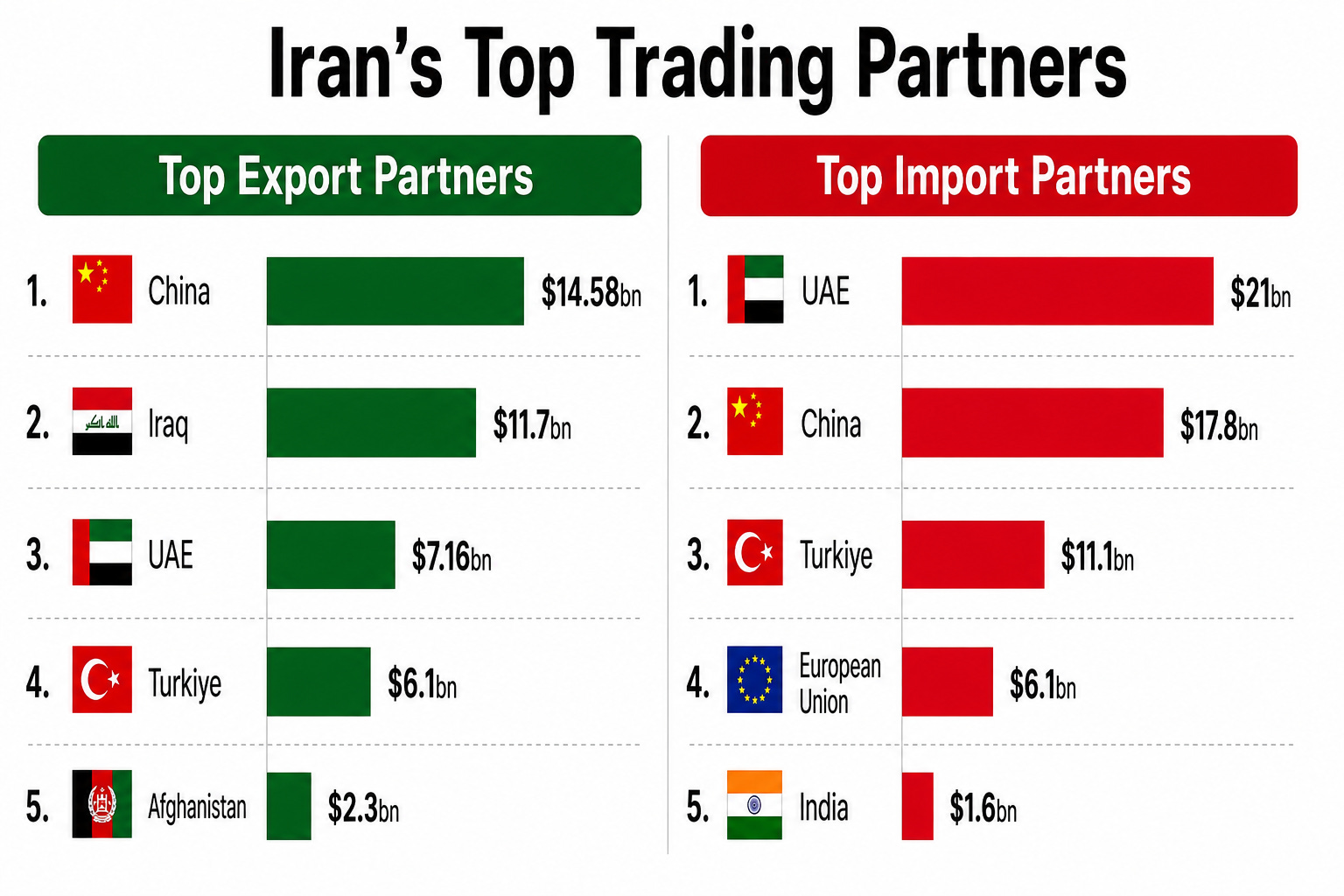
The Trump administration has launched an aggressive new campaign to cripple Iran’s economy, sanctioning more than 60 entities and threatening countries that continue doing business with Tehran—but it has stopped short of directly targeting the major Chinese banks and companies that make Iran’s sanctions-busting economy possible. China buys most of Iran’s oil and helps Tehran move the proceeds around the world, which makes this less a question of whether Washington knows where Iran’s lifeline is and more a question of whether it is willing to cut it.
You can declare “Economic D-Day” all you want, but D-Day generally works better when you actually storm the beach.
Treasury Secretary Scott Bessent’s “Operation Economic Outcast” adds to more than 1,000 sanctions imposed on Iran since President Trump returned to office. Washington is now threatening penalties against countries and entities doing Iranian business involving digital assets, technology, gold, aviation, and shipping. The pressure has helped hammer Iran’s currency and economy, but it hasn’t changed Tehran’s military posture or ended its nuclear ambitions.
Former U.S. diplomat Daniel Fried neatly captured the gap between the sales pitch and the policy: “The rhetoric was ferocious, but the punch less so.”
The China problem is enormous. U.S. officials say China buys more than 80% of Iranian oil exports, while Chinese banks, front companies, tankers, and trading networks help move money and goods through a sanctions-resistant maze. China was still importing more than 500,000 barrels of Iranian oil a day so far in August, according to Kpler figures cited by the Journal. Washington has gone after Chinese tankers, smaller firms, and Hong Kong intermediaries, but it has avoided prominent Chinese banks and corporations deeply connected to the U.S.-led financial system. That restraint comes as Trump pursues improved relations with Beijing following last year’s tariff fight and ahead of an expected Xi Jinping visit to Washington next month.
There is a strategy buried in the restraint: Threaten China loudly enough that Beijing quietly changes course without forcing a U.S.-China economic showdown. Former Treasury official Kerri Bitsoff said the sanctions were structured to give China room to adjust without immediately putting its banks in the crosshairs. Maybe that works. But if Beijing concludes Washington won’t risk Chinese retaliation, Operation Economic Outcast could become another sanctions version of whack-a-mole—shell companies disappear, new ones appear, and Iranian oil keeps finding buyers. As Bessent himself warned, “No one is above this.” China may be about to find out how literally Washington means that.
Source: The Wall Street Journal (free)
Additional Resource: Who are Iran’s top trading partners US would need to target to isolate it?
Editor: If China is buying most of Iran’s oil and helping keep the financial plumbing running, sanctioning everyone around China while sparing its biggest institutions is like locking every window while leaving the front door open.
The Trump administration is preparing to revoke business and tourist visas held by as many as 200,000 foreigners who sought asylum after entering the U.S.—potentially the largest mass visa revocation in American history.
Trump Administration Targets 200,000 Visas in Sweeping Asylum Crackdown
The State Department is preparing to cancel as many as 200,000 B1 and B2 business and tourism visas issued to foreigners who subsequently applied for asylum in the United States, according to an Associated Press report cited by Al Jazeera. If carried out, the move would reportedly become the largest single mass revocation of visas in U.S. history—and another major escalation of President Donald Trump’s second-term immigration crackdown.
Two hundred thousand visas at once isn’t tightening a rule—it’s taking a weed whacker to an entire immigration category.
The proposed action would cover B1 and B2 visas issued between 2016 and 2026 to people who later sought asylum or currently have asylum applications pending. The State Department is coordinating with the Department of Homeland Security to identify affected visa holders.
State Department spokesman Tommy Pigott explained the administration’s reasoning: “We are coordinating with DHS to identify and revoke the nonimmigrant visas of foreigners who have come to the United States claiming to be short-term visitors, but then file for asylum to stay here permanently.”
There’s an important distinction here: Losing the visa would not automatically mean deportation. According to officials cited by the AP, most people with pending asylum cases would instead move into a different immigration category while their cases continue. In other words, the administration is attacking the validity of their original visitor status, not necessarily terminating the underlying asylum proceedings. Deputy Secretary of State Christopher Landau was considerably less bureaucratic about the objective, writing on X: “Asylum isn’t supposed to be a loophole to circumvent immigration law.”
What will happen? They will be placed in an ICE detention gulag like Adelanto in the California desert.
The planned revocations fit a much broader second-term push by Trump to restrict entry and increase scrutiny of foreigners already holding U.S. visas. Applicants have faced expanded examination of social-media histories, visa bonds, and outright restrictions involving certain countries. Al Jazeera reports that the State Department has revoked roughly 175,000 visas during the past 18 months involving people convicted or accused of crimes as well as some people who publicly opposed U.S. policies. Add another potential 200,000 revocations and the message from Washington isn’t particularly subtle: Getting the visa is increasingly only the first immigration test.
Source: Al Jazeera
Editor: The administration’s argument is straightforward: A tourist visa is supposed to mean “tourist,” not “future asylum applicant.” The harder question is whether 200,000 individual cases can really be reduced to one giant assumption about why each person entered the country.
And whatabout… Melania and Elon? Look it up. (I know they don’t fit the years in the order.)
Reno’s Hawk Fire finally stopped growing after torching at least 32 homes and forcing more than 90,000 people into evacuation orders or warnings—apparently Mother Nature needed some help because officials say human activity started this one.
Reno’s Hawk Fire Burns 32 Homes, Forces Tens of Thousands to Flee
Firefighters are gaining ground on the Hawk Fire near Reno, Nevada, reaching 27% containment after the roughly 23-square-mile wildfire destroyed at least 32 homes, injured seven people, and sent tens of thousands of residents scrambling from its path. The fire showed no new growth Monday, but officials warned that heat, low humidity, dry vegetation, and another burst of wind could quickly turn progress into another emergency.
When one breeze and one ember can put entire neighborhoods back in the crosshairs, 27% containment doesn’t leave much room for celebrating.
The fire erupted Saturday near the California state line and exploded in size Sunday, prompting evacuation orders and warnings affecting more than 90,000 people at the peak. That number had dropped to roughly 63,000 by Monday as conditions improved. Nevada Gov. Joe Lombardo declared a state of emergency in Washoe County and mobilized the National Guard, while schools closed to keep roads available for emergency crews. At least three first responders and four civilians have been injured. Reno Mayor Hillary Schieve described watching the fire race across the landscape: “It lit up these areas like nothing I’ve seen before. It took your breath away, in the worst way.”
The Hawk Fire is the third major wildfire north of Reno in just two weeks. Fire officials say all three were caused by human activity. Authorities haven’t determined whether the Hawk Fire was deliberately set or accidental, but its speed demonstrated how little margin for error exists in the bone-dry West. Much of the burned landscape was sagebrush and grass, while officials warned flames could move into newer residential developments if the winds return. “It just takes that little breeze and one ember,” Washoe County Sheriff Darin Balaam said while explaining why some frustrated evacuees still weren’t being allowed home.
Then there are the people behind those acreage and containment numbers. Crystal Hallock lost her Reno-area home to fire for the second time in less than a decade after fleeing with her children, grandchildren, and pets. Her ex-husband escaped after initially trying to save the property and a vintage Cadillac with a garden hose. Meanwhile, western Nevada remains at elevated wildfire risk, and the National Interagency Fire Center says the U.S. has already recorded more than 50,000 wildfires this year—the highest total for this point in the year over the past decade. Firefighters may have stopped the Hawk Fire’s advance for now, but hot, dry, and breezy weather means Reno isn’t out of this fight yet.
Source: Associated Press
Editor: Three big fires in two weeks, all attributed to human activity. The West already supplies the heat, wind, and tinder for free—we really don’t need people volunteering to provide the ignition.
Ontario Premier Doug Ford says Canada could stop exporting electricity to the United States if Trump keeps escalating the trade war—and suddenly “We don’t need Canada” comes with a rather interesting extension cord problem.
Canada Threatens to Pull the Plug on U.S. Power as Trump Trade War Escalates
Ontario Premier Doug Ford is threatening to raise prices or shut off electricity exports to the United States as Canada considers increasingly painful retaliation against President Donald Trump’s tariffs, putting an energy relationship serving an estimated 1.5 million American homes and businesses directly into the trade-war crossfire. Ontario’s grid is interconnected with Michigan, New York, and Minnesota, making electricity one of the few retaliatory weapons Canada can deploy that Americans could potentially notice without checking the price tag on something at Walmart.
Trump says America doesn’t need Canada; Ford’s response is essentially: Great—then find your own electricity.
“We power 1.5 million homes and businesses,” Ford said. “Everything’s on the table. I’ll do whatever it takes.”
And he has played this card before. During an earlier round of the trade fight, Ontario imposed a 25% surcharge on electricity exported to Michigan, Minnesota, and New York. Trump responded by threatening to double tariffs on Canadian steel and aluminum before both governments backed away. Ontario historically has been a substantial U.S. electricity supplier, exporting more than 40 terawatt-hours to American states between 2021 and 2023, according to the Ontario government.
The threat matters particularly because electricity doesn’t behave like lumber or automobiles—you can’t simply leave it sitting at the border while somebody renegotiates the tariff. New York provides a good example of how important cross-border power can become during periods of heavy demand. On July 3, New York imported 52 gigawatt-hours from Canada, its highest daily interchange with Canada since January 2025, as a heat wave strained the state’s grid. Canadian electricity supplied about 9% of New York’s needs that day, according to federal energy data. Ontario isn’t responsible for all of those Canadian imports—Quebec is also a major supplier—but the episode demonstrates why cross-border electricity becomes especially valuable when demand spikes.
Ford isn’t limiting his threat to electricity. He says critical minerals, oil, and potash could also become Canadian leverage, specifically pointing to high-grade nickel and uranium. But electricity may be the politically sharpest weapon because higher wholesale costs will eventually find their way onto consumer bills. Ford’s warning was hard to misinterpret: If Trump continues trying to dismantle Canadian manufacturing, “he better have a pack of batteries.”
Whether Canada actually pulls the plug is another matter—the two countries’ energy systems are deeply interconnected and Ontario makes money selling that power. But trade wars have a funny habit of turning mutually beneficial relationships into ammunition, and Ford is making clear that Canada’s electrical socket is now on the table.
Source: The Independent
Additional Resource: U.S. Energy Information Administration—New York imports more electricity from Canada
Editor: Threatening tariffs on your neighbor’s products is one thing. Doing it while that neighbor helps keep the lights on is a more adventurous form of economic diplomacy. Maybe keep Ford’s “pack of batteries” line handy—it could end up being the slogan for this entire trade war.
Illinois built laws designed to keep local officials out of federal deportation enforcement, but prosecutors in roughly one of every six counties were sharing defendants’ personal information with immigration agents anyway—a sanctuary apparently comes with some fine print.
Illinois Called Itself a Sanctuary—Some Prosecutors Were Quietly Feeding Information to ICE
County prosecutors across Illinois shared addresses, photographs, court dates, release information, and other personal details about defendants with federal immigration agents, often without the defendants or their lawyers knowing, according to a WIRED and Injustice Watch investigation based on thousands of pages of government records. The investigation found state’s attorney offices in about one of every six Illinois counties communicated information useful to federal immigration enforcement during the first 15 months of President Donald Trump’s second term—even as Illinois promoted itself as one of America’s leading sanctuary states.
Turns out keeping local law enforcement separate from ICE gets complicated when somebody at the courthouse is quietly emailing ICE the address.
The investigation examined more than 5,000 pages obtained through Freedom of Information Act requests sent to all 102 Illinois state’s attorney offices. In Marion County, assistant state’s attorney John Christeson gave a Homeland Security Investigations agent information about Rolando Perez Samayoa, who was facing a DUI case, including his birth date, hometown, upcoming court date, and later his police report and tickets. Three weeks afterward, federal agents arrested Samayoa outside his home and also took his 17-year-old son into custody. Both eventually accepted voluntary departure and were removed to Mexico. Samayoa told reporters he had no idea the prosecutor handling his criminal case had supplied information to federal immigration authorities.
The legal issue sits inside a significant hole in Illinois’ sanctuary framework. The state’s 2017 TRUST Act restricts police and other agencies from assisting federal deportation efforts without a federal criminal warrant, but WIRED reports that the law doesn’t clearly settle whether county prosecutors and their employees face the same restrictions.
Prosecutors themselves don’t agree. Some say the law applies to their offices; others say it doesn’t. Meanwhile, unlike police departments and sheriff’s offices, state’s attorneys aren’t required to file annual reports documenting TRUST Act compliance. In DuPage County, prosecutors had more documented contacts with federal immigration agents than any other prosecutor’s office examined, sometimes answering federal requests and sometimes pointing agents toward specific cases.
What makes the story harder to dismiss as unavoidable federal pressure is what happened elsewhere: Many prosecutors simply didn’t participate. More than half of Illinois state’s attorney offices reported no records of ICE contact during the period examined, while Lake County State’s Attorney Eric Rinehart established policies specifically intended to keep immigration enforcement away from his office.
His explanation gets to the larger issue: “When people are afraid to come to court, for any reason, we cannot make our communities safe, we cannot find the truth, and we cannot achieve justice.”
That’s the real test of a sanctuary policy. It isn’t what the sign on the door says—it’s whether the person walking through that door can trust the government officials waiting inside.
Source: WIRED
Editor: Illinois spent years telling immigrants that local justice and federal immigration enforcement were separate operations. If the prosecutor handling your case is simultaneously sending your address and court schedule to Homeland Security, “separate” is doing Olympic-level linguistic gymnastics.
A new study estimates that at least one-quarter of former NFL players who died during a recent six-year period had CTE—and researchers say 25% is probably the floor, not the ceiling.
At Least 1 in 4 Former NFL Players Had CTE, Landmark Study Finds
A major new study published in The BMJ estimates that at least 25% of former NFL players who died between 2016 and 2021 had chronic traumatic encephalopathy (CTE), giving researchers one of their best estimates yet of how common the degenerative brain disease may be among professional football players. Scientists have known for years that repeated head impacts and football are associated with CTE. The maddeningly difficult question has been how many players actually develop it.
One in four as the minimum estimate should get the attention of everyone who plays, coaches, watches, or makes money from football.
Previous research produced eye-popping numbers but came with a major selection problem. More than 330 former NFL players who died between 2008 and 2021 had their brains donated to Boston University’s UNITE Brain Bank, and 93% were diagnosed with CTE. But families who suspected something was wrong were more likely to donate a player’s brain, making it difficult to extrapolate that percentage to the entire NFL population. Researchers at Mass General Brigham tackled the problem by identifying every player who had appeared in at least one NFL game since 1949 and building a comparison population from death records.
“We’ve known that this disease process can be caused by, in part, repeated traumatic brain injury. But we didn’t know how common it was,” lead author Dr. Daniel Daneshvar told NPR.
The resulting estimate puts CTE prevalence among the former players studied at no less than roughly 25%, and Daneshvar says that’s the “low end.” The true number cannot yet be pinned down because CTE can only be definitively diagnosed by examining the brain after death. Researchers identified additional suspected cases outside the donated-brain group, while death certificates for another 215 former players listed a neurodegenerative disease as a cause of death. At the wildly broad theoretical upper boundary, prevalence could approach 97%, although researchers aren’t suggesting that’s the actual rate. Their conclusion is considerably more careful: The real number lies somewhere between those extremes.
There are important caveats. The donated players died at an average age of about 66, meaning most played before the NFL began making major changes in response to growing concerns about concussions and repetitive head trauma. University of Washington neurological surgeon Dr. Randall Chesnut cautioned that the findings “may not represent the NFL in 2026.” And CTE isn’t the only possible explanation when former players experience memory, mood, or cognitive problems. Conditions including sleep apnea and high blood pressure can produce concerning symptoms and, unlike CTE today, can be treated. That’s an important distinction because this research shouldn’t tell living players that their future is predetermined. It should tell football that after decades of debate, denial, and safety reforms, the question isn’t whether CTE exists in former NFL players. It’s how much the modern game can reduce the risk.
Source: NPR
If you want to learn more about CTE in football, watch this: FRONTLINE | League of Denial: The NFL’s Concussion Crisis
Editor: Football has spent years improving helmets, changing kickoffs, and outlawing dangerous hits. Good. But when the best new research says 25% is the minimum estimate for CTE among these former players, “we’re making the game safer” can’t be the end of the conversation.
Extra
Make sure you read this SPECIAL REPORT about an ICE detention gulag in the bowels of SoCal.
Adelanto—The ICE Detention Center the Government Says It Doesn’t Control

The Morning Sixpack stays free because the news that shapes your life should not be hidden behind a paywall. Paid subscribers are not paying for access. They are helping fund the research, writing, and independent voice that goes into every issue. Become a paid subscriber and help keep smart, honest news analysis free for everyone.