


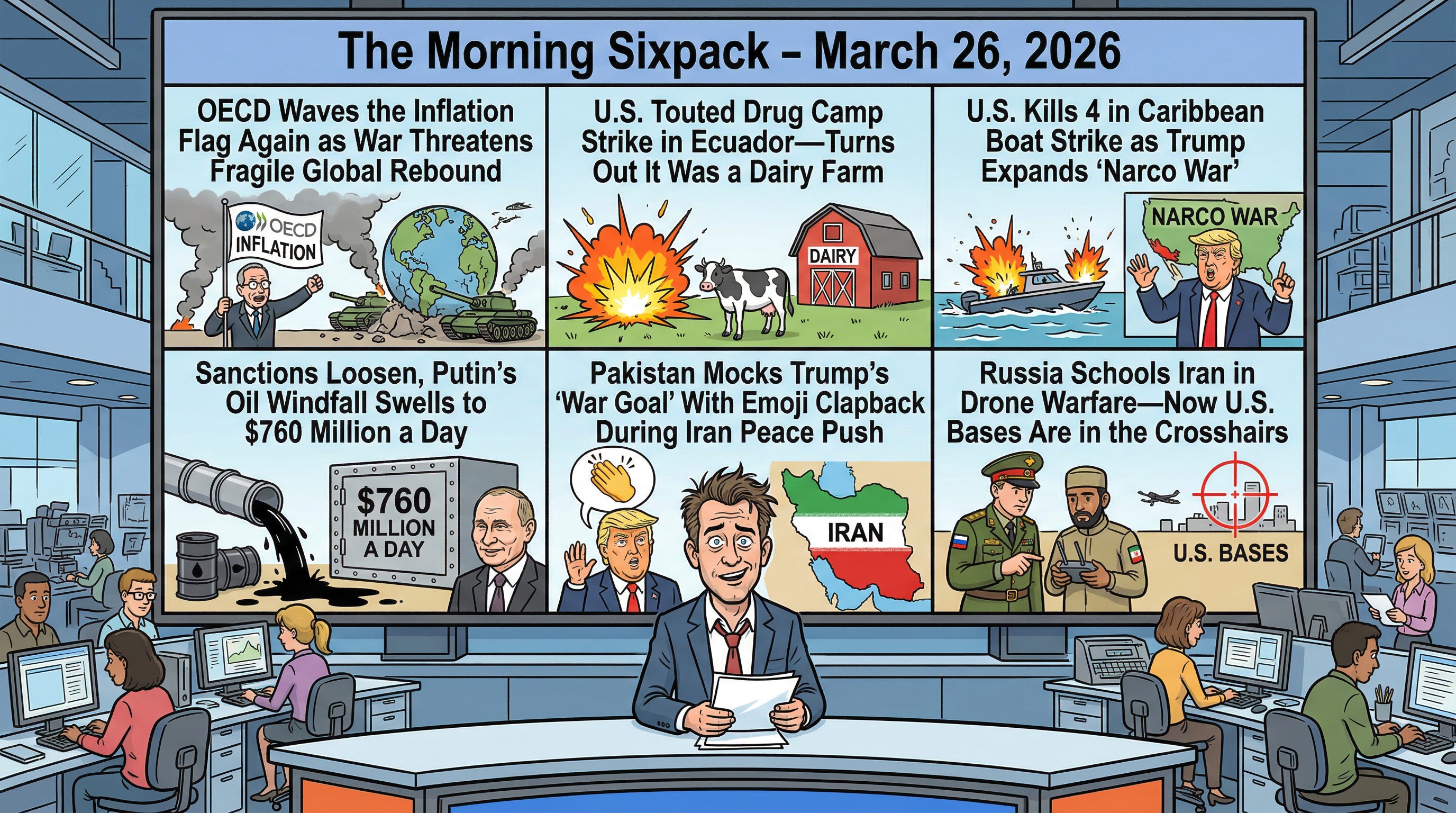
The global economy was finally catching its breath—and now it’s staring at another inflation gut punch.
OECD Waves the Inflation Flag Again as War Threatens Fragile Global Rebound
The OECD just jacked up its inflation forecast for the world’s biggest economies, warning that the Middle East conflict is pushing prices higher again just as growth was stabilizing.
The Paris-based organization now sees average inflation across the G-20 hitting 4% this year, up sharply from the 2.8% it predicted in December. In the U.S., inflation is projected to run even hotter at 4.2%. That’s not exactly the glide path back to central bank comfort zones policymakers were hoping for.
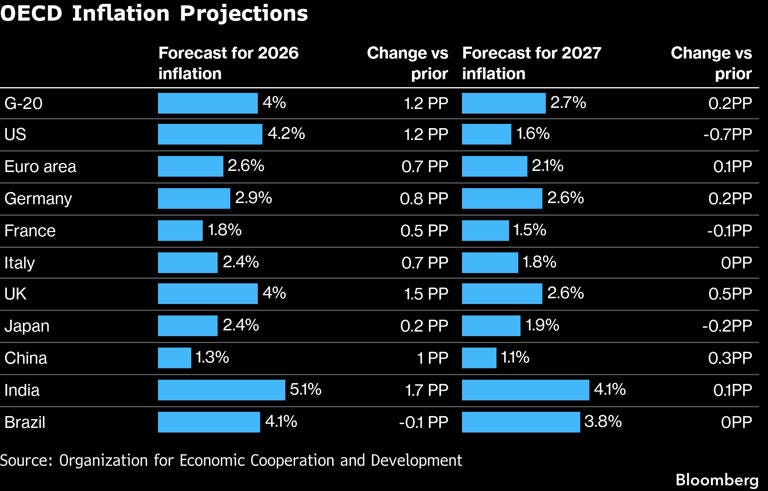
Growth downgrades were more muted—for now. The OECD said the hit from the Iran war is being partially offset by stronger-than-expected momentum at the start of the year. In other words, the global economy had enough early juice to cushion the blow, but don’t mistake that for immunity.
The bigger worry is what happens next. The organization warned there is a “significant downside risk” from further disruptions to Middle East exports. More supply shocks would mean higher inflation, slower growth and potentially fresh turmoil in financial markets. We’ve seen that movie before—and it didn’t end with rate cuts and champagne.
The OECD is the first major international institution to formally update its outlook since the conflict escalated. Business surveys are already flashing warning signs of weaker activity and rising prices across multiple economies, suggesting this could become a synchronized global squeeze rather than a localized flare-up.
Source: MSN
Editor: Just when central bankers were polishing their “mission accomplished” speeches, geopolitics barges in and lights the supply chain on fire.
If this was a victory lap, someone forgot to check what actually blew up.
U.S. Touted Drug Camp Strike in Ecuador—Turns Out It Was a Dairy Farm
The U.S. and Ecuador publicly celebrated the bombing of what they called a narco training camp—New York Times reporters found it was a working dairy farm.
As President Trump prepared for a summit with conservative Latin American leaders, U.S. officials released dramatic video of a massive explosion in rural Ecuador. Defense Secretary Pete Hegseth said the military was “now bombing Narco Terrorists on land.” The message was clear: tough, decisive, hemispheric muscle.
But a New York Times investigation tells a very different story. Reporters who traveled to San Martín, a remote village near the Colombia border, found the strike appears to have destroyed a 350-acre cattle and dairy operation owned by a 32-year-old carpenter named Miguel. Residents, workers and even a retired Ecuadorean intelligence chief told the paper the U.S. had no direct role in the bombing itself—despite public statements framing it as joint action.
“It’s an outrage,” Miguel said as he stood in the rubble of his farm. “It’s a lie that 50 people trained here. Where are they going to train? Out here in the open? There’s no logic.” Workers described being beaten, choked and shocked by Ecuadorean soldiers before helicopters returned days later to drop explosives on the already-burned structures. Chickens were killed. Cows survived. The “training camp” looked a lot like a cheese shed and livestock pens.
Ecuador says it relied on U.S. “intelligence and support” and insists the site was used by Comandos de la Frontera, a Colombian armed group. But no public evidence has been produced. Human rights lawyers have filed complaints, and villagers say the government may have used the strike to bolster support for its anti-gang crackdown. If the goal was to send a message, it certainly did—just not the one advertised.
Source: The New York Times
Editor: Nothing says “precision operation” like bombing the cheese room and calling it counterterrorism. And you know what? This isn’t the first time the U.S. has said it bombed a “narco” something-or-other and LIED.

This isn’t interdiction anymore—it’s open-water MURDER.
U.S. Kills 4 in Caribbean Boat Strike as Trump Expands ‘Narco War’
U.S. Southern Command says it killed four men in a strike on an alleged drug-trafficking boat in the Caribbean—part of a rapidly expanding military campaign the Trump administration calls an “armed conflict” with cartels.
According to SOUTHCOM, the vessel was operated by a designated terrorist organization and was moving “along known narco-trafficking routes in the Caribbean and was engaged in narco-trafficking operations.” A 15-second black-and-white aerial clip shows a boat engulfed in flames after being hit. No names. No cargo photos. No independent proof.
This was the third publicly reported strike since the U.S. began its war with Iran, and just the latest in a sweeping crackdown that has left at least 163 people dead and 47 vessels destroyed since early September, according to Pentagon statements and prior releases. That’s not a Coast Guard drug bust—that’s a body count.
Critics, including Democrats and human rights groups, argue the administration is stretching international law by using the military for what amounts to law enforcement, killing suspects who were never charged or convicted. The White House counters that the U.S. is in “armed conflict” with at least 10 cartels now designated as terrorist organizations. That legal framing is doing a lot of heavy lifting.
There was a brief lull after the January capture of Venezuela’s Nicolas Maduro, but the tempo has picked up again. Since Feb. 28, the U.S. has carried out two other strikes—killing six on March 8 and two more on March 19, with one survivor reportedly injured. The pattern is clear: identify, strike, release video, move on.
Source: UPI
Editor: We used to seize boats and make arrests. Now we drop explosives and post the clip. It’s MURDER PORN for the sickos in this world like Hegseth & Trump.
Russian crude was flowing anyway—now it’s flowing at a premium.
Sanctions Loosen, Putin’s Oil Windfall Swells to $760 Million a Day
U.S. sanctions waivers are letting Russia sell oil closer to full market price—handing Vladimir Putin a massive revenue boost as global tensions escalate.
The U.S. Treasury quietly issued a temporary general license allowing countries to purchase sanctioned Russian oil already loaded onto tankers—so-called “oil on water.” It followed a similar 30-day waiver granted to India. The practical effect? Moscow can now offload that crude at open market prices without buyers worrying about sanctions blowback.
While sanctions were technically in place, Russia still sold oil—but at steep discounts to compensate buyers for legal risk and logistical headaches. Those discounts are evaporating fast. Borys Dodonov of the KSE Institute says Russian oil has surged to 72% of benchmark levels, and in some cases is even trading at a premium at Indian ports.
Before the war, Russia sold oil to India at a $9 discount to Brent crude. “Sometimes it even sells with a premium on Brent at Indian ports. This market is very crazy right now,” Mr. Dodonov said. Discounts to China have also narrowed sharply—from $15 to $7.
Simon Johnson, the Nobel prize-winning former IMF chief economist, didn’t mince words: “This is a disaster. It won’t affect world prices because Russian oil was reaching the market anyway.” He added, “It just increases what Russia can receive per barrel, by a lot, putting cash in the pocket of our enemies.”
Officially, the waivers apply only to oil already at sea—about 150 million barrels before the conflict, according to Vortexa. But the signal matters. Markets hear “temporary waiver” and translate it into “lighter enforcement.” India has already ramped up imports of Russian oil by 72% month-over-month—an extra 750,000 barrels per day.
Put it all together and the math gets ugly: Russia keeps exporting, keeps funding its war machine, and now keeps more of the money.
Source: The Telegraph
Editor: Sanction the oil, waive the sanction, act surprised when the cash register rings louder in Moscow. We are—in effect—PAYING Russia/Putin to murder US soldiers.
When your diplomatic partner is replying with clapping emojis, the messaging may need work.
Pakistan Mocks Trump’s ‘War Goal’ With Emoji Clapback During Iran Peace Push
A key U.S.-Iran peace talks partner publicly mocked President Trump’s stated “war goal” of reopening the Strait of Hormuz—pointing out it was open before the war began.
Pakistan, which has positioned itself as a potential facilitator in winding down the U.S.-Israel military campaign against Iran, appeared to take a swipe at Trump’s shifting rationale for the conflict. Defense Minister Khawaja Asif posted on X: “The goal of the war seems to have shifted to opening the Strait of Hormuz, which was open before the war,” followed by three clapping emojis and a salute emoji—a not-so-subtle nod to Trump’s habit of signing off with “thank you for your attention to this matter.”
Trump, who launched the war on Feb. 28, had issued a 48-hour ultimatum demanding Iran reopen the Strait of Hormuz or face the destruction of its energy infrastructure. He later declared the war effectively won after lifting that ultimatum. The problem? Global shipping data showed traffic in the strait never fully stopped.
Behind the scenes, the administration has floated a 15-point proposal to end the conflict, reportedly including sanctions relief in exchange for Iran surrendering its enriched uranium stockpile and dismantling enrichment capabilities. The proposal also calls for limits on Iran’s ballistic missile program and an end to support for Hezbollah, the Houthis and Hamas.
The optics aren’t great. One minute it’s regime pressure, the next it’s oil chokepoints, and now it’s peace terms with sanctions relief on the table. Allies are watching. So are adversaries. And apparently, they’re reacting in emojis.
Source: Raw Story
Editor: If your war aim can be undercut by a shipping chart and three clap emojis, maybe it wasn’t much of a strategy to begin with.
The Ukraine battlefield just opened a franchise in the Strait of Hormuz.
Russia Schools Iran in Drone Warfare—Now U.S. Bases Are in the Crosshairs
Russia is sharing satellite imagery, targeting intelligence and upgraded drone tech with Iran—while Tehran applies hard-won lessons from Moscow’s war in Ukraine against U.S. forces in the Gulf.
According to The Wall Street Journal, Moscow has deepened intelligence sharing with Tehran, providing satellite data and modified components for Shahed drones to sharpen navigation, communication and targeting. Russian advisers have also reportedly passed along tactical guidance refined in Ukraine—how many drones to launch, at what altitude, and how to overwhelm air defenses before delivering a missile strike.
At the same time, Iran and its allied militias are deploying fiber-optic first-person-view drones—the kind that can’t be jammed with traditional electronic warfare. Recent attacks in Baghdad mirrored Russian tactics in Ukraine: drones swarm first to blind radar, then dive into helicopters and air-defense systems. Analysts say Iran’s strike packages now “strongly resemble what Russia does.”
The satellite imagery reportedly comes from Russia’s military fleet operated by its aerospace forces, giving Iran more granular views of U.S. aircraft, naval movements and radar sites. That kind of targeting data doesn’t just improve accuracy—it shortens the kill chain.
Meanwhile, U.S. forces heading toward a possible Hormuz operation could face a drone-saturated battlespace unlike Iraq or Afghanistan. Fiber-optic FPVs can spool out miles of cable, making jamming useless. In Ukraine, these drones account for the bulk of battlefield casualties. Some defense analysts warn the U.S. is only beginning to adapt to this new environment.
The White House insists Russian aid hasn’t changed operational outcomes. But strategically, the exchange is clear: Iran supplied Russia with Shaheds for Ukraine. Russia upgraded them in combat. Now some of those innovations are flowing back to Tehran—along with satellite intelligence.
Oil prices rise. U.S. interceptors get burned through. And the drone revolution that Western commanders once dismissed is now buzzing over American bases.
Source: The Wall Street Journal – Russia Is Sharing Satellite Imagery and Drone Technology With Iran (free)
The Wall Street Journal – Iran Is Applying the Lessons of Russia’s Drone Warfare Against America (free)
Editor: We arm Ukraine with intel. Russia arms Iran with intel. Welcome to the proxy ping-pong phase of geopolitics. And with Russia’s newfound wealth we gave them by lifting sanctions, they can build MORE DRONES.